

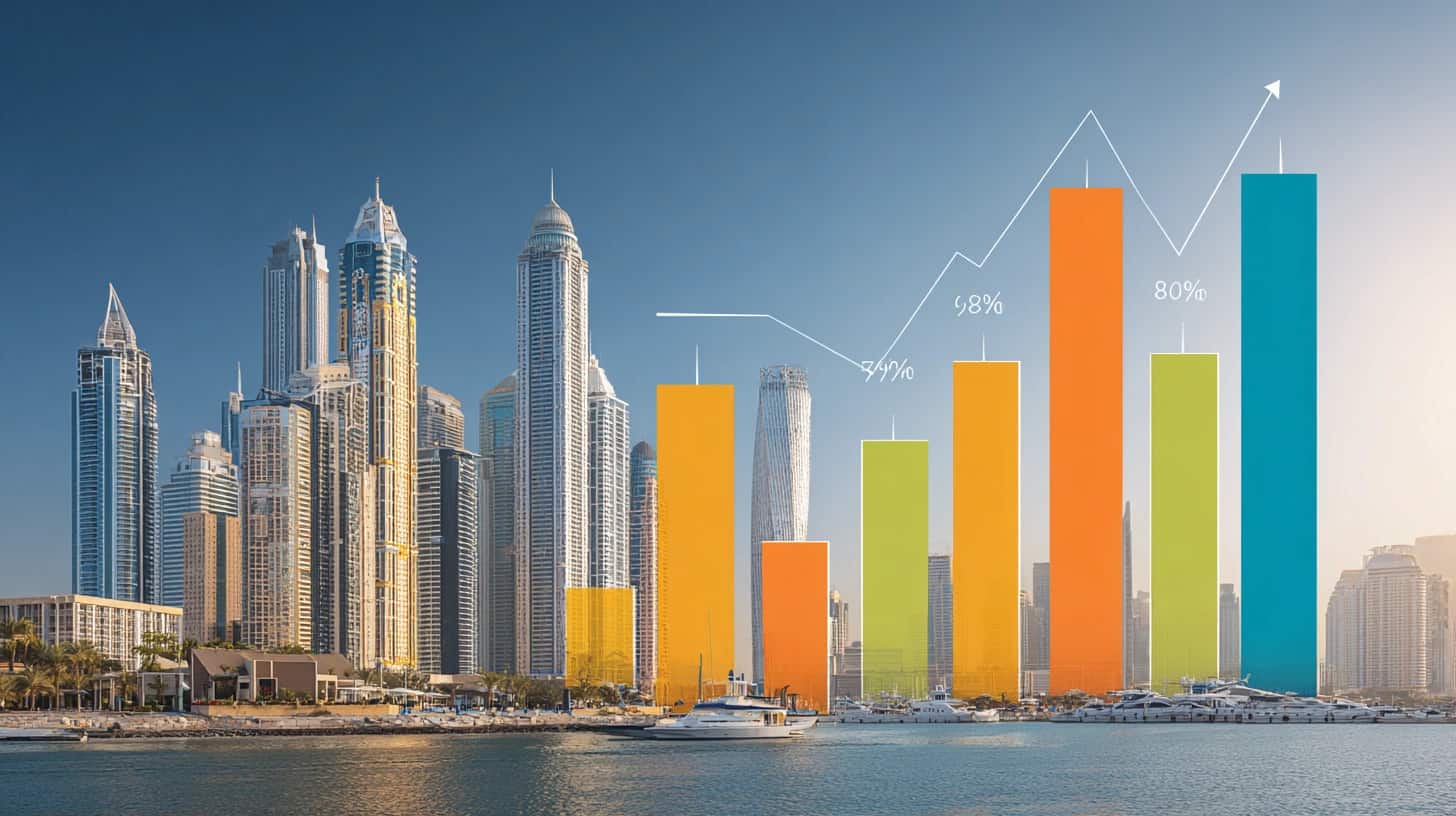
Ras Al Khaimah vs Dubai: Comparing Apartment Prices
Ras Al Khaimah is receiving more attention from property buyers and investors than ever before, at least for the last two years.
Ras Al Khaimah is receiving more attention from property buyers and investors than ever before, at least for the last two years. The Wynn resort, a slew of new launches on Al Marjan Island, and investors being priced out of Dubai's central business district all contribute to a conversation where RAK is now on the list, when historically, it wasn’t.
The price difference between Dubai and Ras Al Khaimah is considerable, and that's a fact. A AED 1.8 million apartment in Dubai Marina may well have a near-equivalent in Ras Al Khaimah for AED 600,000 to AED 800,000. That's a big difference, and one that should be considered when making a decision.
However, price is only one factor, and one should consider that there are reasons for this difference. The market is smaller, less developed, and quieter than Dubai, and there are many more factors to consider when making a decision, including understanding what you are giving up when you choose one over another.
The fact is, unless you understand what you are giving up when you make a decision, you are going to second-guess yourself in eighteen months, and that's a fact.
The prices of apartments in the two emirates will be compared in this guide in terms of real money. We'll also look at what each budget can buy in each market, what type of investor can afford each market, what areas offer the best value in each emirate, when RAK makes more sense compared to Dubai despite the prices, and when Dubai makes more sense compared to RAK despite the prices.
The UAE property market remains an attractive destination for property investors worldwide. According to the Dubai Land Department, Dubai's residential market recorded over AED 400 billion in transaction value in 2023. RAK's figures are a mere fraction of that; however, the growth rate of property prices in RAK has been among the highest in the UAE over the same period.
Apartment Prices in Dubai: What Different Budgets Actually Get You
Dubai's apartment market spans an enormous price range, and where you land within it depends on how much you're spending and which part of the city you're looking at. Let's go through the real numbers at different budget levels.
At the entry level, AED 400,000 to AED 700,000 buys a studio or small one-bedroom in outer areas like Jumeirah Village Circle, Dubai Silicon Oasis, International City, or parts of Dubailand. These are functional apartments in communities with basic amenities — supermarkets, gyms, access to the road network. They're not glamorous, but they're practical and they rent. Gross yields in these areas typically run 6% to 8%, which is competitive.
AED 700,000 to AED 1.2 million moves you into more established mid-market areas. One-bedrooms in JVC, two-bedrooms in Al Furjan, or entry-level stock in Business Bay. Buildings at this price point are generally well-maintained, have proper facilities — pool, gym, covered parking — and sit in communities with good transport links. Yields here are typically 5.5% to 7%.
AED 1.2 million to AED 2.5 million is the mid-to-upper market. One-bedrooms in Dubai Marina and JBR, two-bedrooms in Downtown Dubai and Business Bay, and entry into Dubai Hills. These are addresses with genuine lifestyle cachet, strong tenant demand, and a secondary market with liquidity. Yields compress slightly at 4.5% to 6% but capital value stability is stronger.
Above AED 2.5 million you're in premium and luxury territory — full-floor units in Downtown, Palm Jumeirah apartments, high-floor Marina units with full sea views. Yields compress further to 3.5% to 5% but the tenant and buyer profile changes entirely. These assets attract a global pool of buyers and high-earning tenants that provides a floor on values even when the broader market softens.
Dubai apartment price benchmarks by area:
- Studio in JVC or DSO: AED 400,000 to AED 600,000, yields 6.5% to 8%
- One-bedroom in JVC: AED 650,000 to AED 900,000, yields 6% to 7.5%
- One-bedroom in Business Bay: AED 900,000 to AED 1.4 million, yields 5.5% to 7%
- One-bedroom in Dubai Marina: AED 1.1 million to AED 1.8 million, yields 5% to 6.5%
- Two-bedroom in Downtown Dubai: AED 2 million to AED 3.5 million, yields 4.5% to 5.5%
- Two-bedroom in JBR: AED 2.2 million to AED 3.8 million, yields 4.5% to 5.5%
- Two-bedroom in Dubai Hills: AED 1.6 million to AED 2.8 million, yields 5% to 6%
- Three-bedroom in Marina or Downtown: AED 3 million to AED 6 million, yields 4% to 5%
- Studio in Dubai South: AED 350,000 to AED 550,000, yields 7% to 9%
- One-bedroom in Creek Harbour: AED 1 million to AED 1.6 million, yields 5.5% to 7%
Apartment Prices in Ras Al Khaimah: What the Market Looks Like Now
RAK's apartment market is smaller, younger, and structured quite differently from Dubai's. Most of the investor-grade residential stock is concentrated in a few key areas, with Al Marjan Island now commanding the most attension and the highest prices in the emirate.
At the entry level, AED 300,000 to AED 500,000 buys a studio or one-bedroom in established RAK areas like Al Nakheel, Al Hamra Village, or parts of Al Qurm. These are older buildings in some cases, but well-maintained communities with genuine residential infrastructure. Rents are lower than Dubai equivalents but yields often compensate — gross yields of 7% to 9% are achievable in these areas for well-chosen units.
AED 500,000 to AED 900,000 moves you into better-quality stock in Al Hamra Village — arguably RAK's most established residential community — or into newer off-plan developments in Al Marjan Island at early pricing. Al Hamra Village is a master-planned community with a golf course, marina, beach access, hotel, and retail. It's a genuine lifestyle product that punches above its price point compared to Dubai equivalents.
AED 900,000 to AED 1.8 million is where the current Al Marjan Island off-plan market sits for most one- and two-bedroom units from established developers. This is the price range that has attracted the most investor activity since the Wynn resort announcement, and it reflects a meaningful upward shift from where RAK prices were three years ago. The potential upside if the Wynn drives the kind of tourism and hospitality economy that's been projected is real. So is the risk if delivery timelines slip or the macro environment changes.
Above AED 1.8 million in RAK you're looking at larger units, premium positioning on Al Marjan Island, or some of the high-end beachfront products that have launched recently. This is a less liquid segment than the equivalent Dubai price point because the buyer pool is narrower.
RAK apartment price benchmarks by area:
- Studio in Al Nakheel: AED 250,000 to AED 400,000, yields 7% to 9%
- One-bedroom in Al Hamra Village: AED 450,000 to AED 700,000, yields 6.5% to 8.5%
- Two-bedroom in Al Hamra Village: AED 700,000 to AED 1.1 million, yields 6% to 8%
- One-bedroom on Al Marjan Island (off-plan): AED 700,000 to AED 1.2 million, yields projected 6% to 8%
- Two-bedroom on Al Marjan Island (off-plan): AED 1.1 million to AED 1.8 million, yields projected 5.5% to 7%
- Studio on Al Marjan Island (off-plan): AED 500,000 to AED 750,000, yields projected 7% to 9%
- One-bedroom in Mina Al Arab: AED 600,000 to AED 950,000, yields 6% to 8%
- Two-bedroom in Mina Al Arab: AED 900,000 to AED 1.4 million, yields 5.5% to 7%
- Premium beachfront unit on Al Marjan: AED 1.8 million to AED 3.5 million, yields 5% to 6.5%
- Studio in Al Qurm: AED 220,000 to AED 380,000, yields 7.5% to 9.5%
How Rental Yields Compare Between the Two Emirates
Yield is where RAK currently has a meaningful advantage over most Dubai areas, and it's worth looking at this carefully because the headline numbers can be misleading if you don't account for the full picture.
On paper, RAK yields are higher. A one-bedroom in Al Hamra Village at AED 550,000 renting for AED 45,000 per year is a gross yield of 8.2%. A comparable one-bedroom in Dubai Marina at AED 1.4 million renting for AED 90,000 per year is a gross yield of 6.4%. RAK wins on that comparison.
But gross yield isn't net yield, and net yield is what actually lands in your bank account. Service charges in RAK vary but can be higher as a percentage in some buildings than Dubai equivalents because the cost base is spread across a smaller number of units. Property management fees, if you're not managing the asset yourself, apply in both markets. Vacancy risk is higher in RAK because the tenant pool is smaller and less deep than Dubai's, meaning a vacant unit can stay empty longer.
The realistic net yield picture, accounting for those factors, is probably 5.5% to 7% for well-located RAK stock versus 4% to 6% for comparable Dubai mid-market stock. RAK still wins on yield, but the gap narrows meaningfully once you get below the gross number.
The more interesting comparison for investors is total return — yield plus capital appreciation. Dubai has a longer and deeper track record of capital appreciation, driven by consistent population growth, economic diversification, and a global buyer base. RAK's capital appreciation story is more speculative — it depends on the Wynn delivering, on the tourism economy developing as projected, and on the broader investor demand continuing to flow into the emirate. That upside is real but it's not guaranteed, and investors who are buying RAK purely on the capital growth story are taking on more risk than those who are buying on the yield story.
Yield comparison summary:
- RAK gross yields (established areas): 7% to 9.5% depending on area and unit type
- RAK gross yields (Al Marjan off-plan, projected): 6% to 8% once complete and rented
- Dubai gross yields (outer areas like JVC, DSO): 6.5% to 8%
- Dubai gross yields (mid-market like Marina, Business Bay): 5% to 7%
- Dubai gross yields (premium like Downtown, Palm): 3.5% to 5%
- RAK net yields (after service charges, management, vacancy): approximately 5.5% to 7%
- Dubai net yields (mid-market): approximately 4% to 6%
- Capital appreciation track record: Dubai significantly longer and deeper, RAK more speculative
- Liquidity on exit: Dubai secondary market far more liquid than RAK for resale
- Tenant pool depth: Dubai much deeper, lower vacancy risk across most areas
Who Is Buying in Each Market and Why
Understanding who else is buying in a market tells you something important about where demand is coming from, how sustainable it is, and what the secondary market looks like when you want to sell.
Dubai's buyer pool is genuinely global. European investors, South Asian diaspora, Russian and CIS buyers, African high-net-worth individuals, and increasingly American and East Asian buyers are all active in the market. That diversity of demand creates resilience — when one buyer cohort steps back, others fill the gap. It's one of the reasons Dubai's market has shown the recovery speed it has after previous corrections.
The buyer profile in RAK has historically been more concentrated — primarily UAE residents looking for a holiday home or second property, and investors attracted by the yield story. That's changing. The Wynn announcement has brought in a new wave of international investors who see RAK as an early-stage play on a tourism economy that doesn't fully exist yet. That creates upside potential but also concentration risk — if the international investor enthusiasm cools, the RAK market has less of a local residential buyer base to absorb the slack.
Lynnette Abad, a well-regarded Dubai property market analyst who has tracked UAE residential data for over a decade, has noted that markets with deep and diverse buyer pools tend to be significantly more resilient through cycles than those driven by a single investor thesis. Dubai currently has that diversity. RAK is working to build it.
Buyer profile comparison:
- Dubai primary buyers: end-users (UAE residents buying to live), investors, second home buyers from Europe and Asia
- Dubai buyer nationalities: Indian, British, Pakistani, Russian, Chinese, American, Egyptian among the most active
- RAK primary buyers: UAE-resident investors, second home buyers, international speculators on Al Marjan thesis
- RAK buyer nationality: predominantly Indian, British, and European with growing international interest
- End-user demand in Dubai: strong and diversifying as population grows and more residents choose to buy
- End-user demand in RAK: growing but still limited outside of Al Hamra and established communities
- Institutional buyer activity: Dubai attracting more institutional capital, RAK still primarily individual investor market
- Off-plan buyer profile: both markets dominated by investors using payment plans, RAK skews more heavily investor
- Resale market depth: Dubai significantly deeper with more active secondary market participants
- Price sensitivity to global macro: both affected, Dubai has more demand buffers to absorb shocks
When RAK Makes More Sense Than Dubai — and When It Doesn't
This is a practical conclusion that the majority of readers of this article need to understand.
With regard to budget, being between AED 500,000 and AED 1.2 million, RAK is more advantageous than Dubai for obtaining a truly high-quality residential product that provides a high level of yield and real lifestyle offerings, rather than a low-end product in Dubai’s outer suburbs that lacks these types of offerings. Al Hamra Village, at AED 600,000, is a more desirable product than a studio unit in International City for AED 450,000 in nearly all aspects related to a better quality of life and tenant appeal.
RAK is a logical investment strategy when considering investment thesis related to Al Marjan Island, including Wynn’s influence on a tourism-based economy, demand for hotel rooms, and pricing prior to completion of related infrastructure projects. This is a true investment thesis that indeed has potential, but requires a longer time horizon, tolerance for execution, and an honest assessment of potential outcomes should tourism projections not be realized as projected.
It is also reasonable for end-users who genuinely desire a quieter and more spacious living option but are also willing to commute to a workplace within Dubai for which they are employed. The travel time from central RAK to Dubai is approximately 45 to 60 minutes depending on the final destination within Dubai and travel time. For those who are able to work from home or within RAK itself, the issue of commuting is not as relevant.
If liquidity is a major factor for a buyer, then Dubai is a better option for them. Should they desire to sell within a reasonable period for a reasonable price, then the secondary market for sales is significantly deeper within Dubai than within RAK, providing a larger market for buyers when they decide to sell out.
For long-term capital retention, Dubai is a better option for buyers. Although RAK is showing signs of improved fundamentals, they still have not reached a level of certainty that is present within Dubai.Our team covers both markets and can give you a straight read on what's available, what the numbers actually look like at the current asking prices, and whether the investment case holds up when you stress-test it. If you want to look at current listings in Ras Al Khaimah or across Dubai, or if you want to run the numbers on a specific property you're considering, reach out and we'll take it from there.
Related stories
Dubai's Established Charm: The Case for Older Homes
In a city focused on the future, I believe the smartest move for many buyers is to look back. Dubai's seasoned communities offer space, character, and surprising value that new builds often can't match.

The True Cost of Owning a Dubai Property
Beyond the purchase price, your annual budget for a Dubai home must account for service charges, utilities, and maintenance. I'll break down every ongoing expense you need to plan for.
Calculating ROI on Dubai Rental Upgrades
As a landlord in Dubai, you can't just follow trends. I'll show you how to calculate the precise ROI of minor property upgrades to genuinely increase your rental yield.
Echoes, in your inbox
One thoughtful email a month. Market insight, new launches, no spam.