

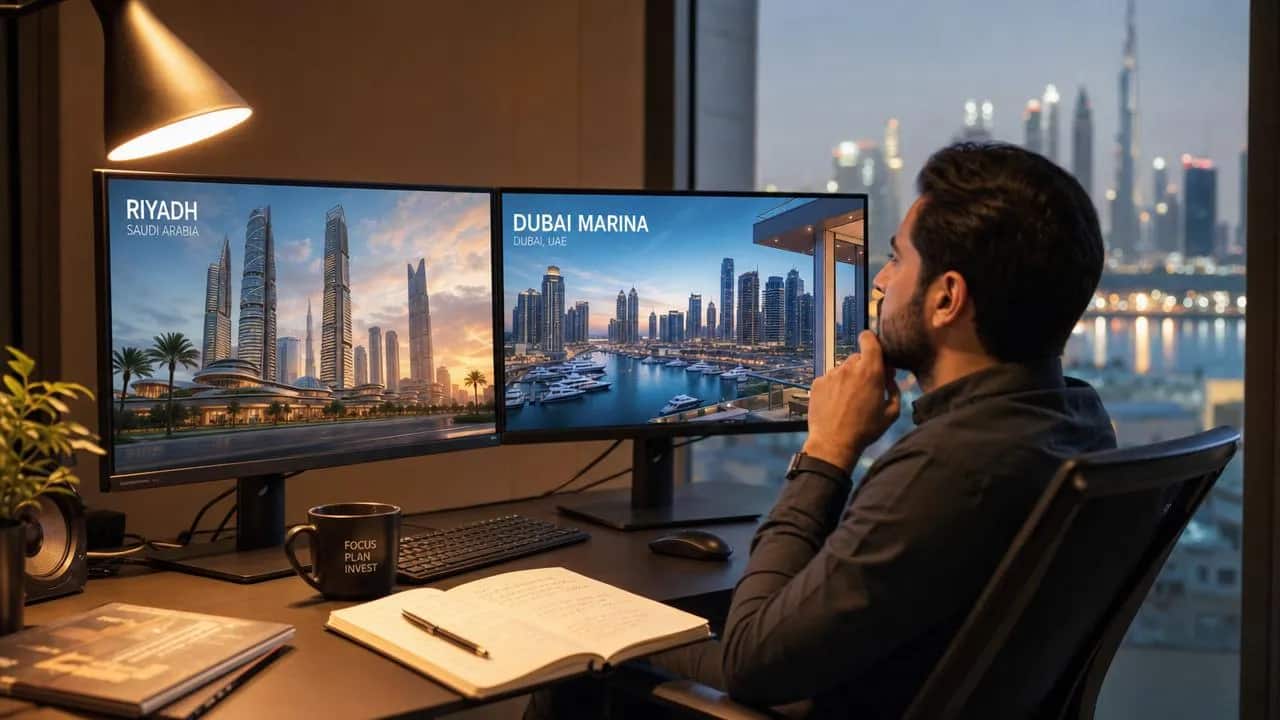
Buying Property in Saudi Arabia vs Dubai: Where Does Your Money Go Further
Buying property in Saudi Arabia vs Dubai? Here's how the two compare on price, ease of ownership, yields, visas, and where your money actually goes further.
For many years, a person desiring to invest in property within the Gulf had a simple decision to make: Dubai. The real estate market there is open, easy, and well utilized. Conversely, Saudi Arabia was barely ever even considered, seeing as foreigners were generally unable to freely purchase property there.
That is quickly changing. The real estate market of Saudi Arabia is being opened to foreign investors, and the regulations that govern this process appear to be in place to encourage outside interest and investment in Riyadh, Jeddah, and the upcoming developments in the nation. The question is then, for one who would like to invest, whether to buy real estate in Saudi Arabia or Dubai, where will their money be put best?
This question is legitimate, and the honest response to this question is that "it depends on your objectives," which leaves a lot to be desired. Therefore, let us examine precisely what it depends on. The difference between the two is clear. Dubai is a mature, liquid, and tested market – reliable and stable. Saudi Arabia is a nascent, ambitious market, recently opened to foreign capital, with greater risks and greater potential.
The following guide looks at both real estate markets against the criteria that indicate in which market capital operates better – how easy it is to make an acquisition, how much it costs, returns on the investment, capital recovery prospects, issues relating to visas and taxes, and finally, the lifestyle associated with each market.
The first thing to state is that while the rules governing the purchase of property by foreigners in Saudi Arabia are relatively recent and still being sorted out in 2026, the information provided below should serve as guidance but should always be checked prior to action. In contrast, Dubai has a well-established framework.
First, the Big Difference: Can You Even Buy?
Before price, before yield, before anything, there is a question that does not even come up in most country comparisons. Are you allowed to own property at all?
In Dubai, the answer has been a clear yes for over twenty years. Foreigners can buy freehold property in designated areas across the city, hold the title in their own name, and do it without residency or a local partner. The system is built for international buyers, the process is well-worn, and millions of foreign-owned homes later, nobody blinks. This is Dubai's single biggest advantage, and it is easy to take for granted until you compare it.
Saudi Arabia has been far more closed, and this is where the big change is happening. Historically, foreigners could not freely buy Saudi real estate. Ownership was largely limited to GCC nationals, holders of Saudi premium residency, or specific business cases. The country has now moved to open property ownership to foreigners under new rules, aimed at designated areas in cities like Riyadh and Jeddah, while keeping tight restrictions around the holy cities of Mecca and Medina.
Here is the state of play, in plain terms:
- Dubai: open to foreign freehold ownership in designated areas, settled and straightforward, for two decades.
- Saudi Arabia: newly opening to foreign owners under fresh rules, with designated zones rather than the whole country.
- Mecca and Medina: special status in Saudi, with ownership there restricted and not comparable to a normal purchase.
- Premium residency: in Saudi this has been a route to ownership, and it stays relevant alongside the new rules.
- The direction: Saudi is clearly opening up, but from a far more restricted starting point than Dubai.
This is the crux of the whole comparison. Dubai is a known, open market you can buy into this week with confidence. Saudi is a market that is opening its doors right now, which is exciting and full of potential, but newer and less tested for foreign buyers. Because these rules are so fresh, confirm the current Saudi position with an official or local legal source before you plan around any specific detail here. The rules are moving faster than any guide can keep up with.
Prices: Saudi Arabia vs Dubai
Now the part everyone actually wants. Where does a given budget stretch further? The honest answer is that it is closer than the headlines suggest, and it depends heavily on which city and which segment.
In Dubai, the range is enormous. You can buy a small apartment from a few hundred thousand dirhams in the more affordable communities, a comfortable family home for one to three million dirhams, and there is no ceiling at the top. The market is deep at every level, so whatever your budget, there is something in it, as our Dubai property listings show across every price point.
In Saudi Arabia, the picture is more uneven and changing fast. Riyadh prices have climbed sharply in recent years as the capital booms and demand outruns supply. Jeddah and other cities can offer more for the money. Across much of the Saudi market, residential property has historically been priced for a large domestic population rather than international investors, which in some segments means more space for your money, though the hottest parts of Riyadh have closed that gap.
We compared the two on the things that decide where a budget works hardest, each on one line:
- Foreign-ownership ease: Dubai wins clearly, open and proven, while Saudi is only now opening up.
- Entry price for an apartment: Dubai offers genuine entry points in affordable areas, Saudi varies a lot by city.
- Space for the money: parts of Saudi can offer more square footage, while prime Riyadh has caught up fast.
- Transaction cost: Dubai charges a 4% transfer fee, while Saudi applies a real estate transaction tax of around 5%.
- Market transparency: Dubai is highly transparent with published data, while Saudi's foreign market is still maturing.
- Choice and depth: Dubai has a deep, liquid market at every price point, Saudi's foreign-friendly stock is thinner for now.
The pattern is that Saudi can look cheaper per square metre in some places, but Dubai gives you a deeper, more transparent, easier market to actually transact in. You can sanity-check Dubai prices against published figures from the Dubai Land Department, which is itself part of the point. That kind of open, official data is harder to come by on the Saudi side, which matters when you are spending real money in an unfamiliar market.
So on raw price, Saudi sometimes edges it. On confidence that you are paying a fair, visible market rate, Dubai pulls ahead. Which matters more depends on how much certainty you need.
Yields, Liquidity, and Getting Your Money Back Out
Buying is only half the story. The other half is what the property earns while you hold it, and how easily you can sell when you want out. This is where Dubai's maturity really shows.
On rental yields, Dubai has a strong, well-documented record. Gross yields in many areas sit comfortably in the mid-to-high single digits, which beats most global cities and is a big reason investors pile in. The rental market is huge, driven by a transient, largely renting population, so finding tenants is rarely the problem, and our property management team handles the letting for owners who want it hands-off.
Saudi Arabia's rental market works differently. It has a large domestic population, more of whom traditionally owned or are being moved toward ownership through national housing programmes. The build-to-rent and institutional rental space is growing, but as a foreign investor chasing yield, you are stepping into a market that is still forming its rules and its norms. The potential is real, but it is less proven than Dubai's.
Here is how the two stack up on the money side:
- Rental yields: Dubai has strong, visible gross yields, while Saudi's foreign rental returns are less established and harder to benchmark.
- Tenant demand: Dubai's renting population is enormous and reliable, Saudi's rental market is growing but more domestic in character.
- Liquidity: Dubai has a deep resale market where you can sell relatively quickly, Saudi's foreign resale market is young and thinner.
- Exit certainty: Dubai gives you a clear, well-trodden path to sell, while exiting a Saudi investment as a foreigner is less tested.
- Currency: both the dirham and the riyal are pegged to the US dollar, so neither adds much currency risk for a dollar-based buyer.
- Data: Dubai's transparent transaction records make valuing and timing a sale easier, while Saudi's are still developing.
The theme repeats. Dubai is the more liquid, more proven money-maker today, with a clear way in and a clear way out. Saudi offers potential upside as it develops, but with more uncertainty about how easily you will be able to rent and resell as a foreign owner in the near term. If getting your money back out matters to you, and for most buyers it should, that is a real point in Dubai's favour right now.
Visas, Tax, and the Practical Stuff
Property is rarely just about the property. It is about what owning it unlocks, and what it costs you to hold. Both markets share one big draw, but they differ in the detail.
Start with the shared good news. Neither the UAE nor Saudi Arabia levies personal income tax, so your salary, pension, and investment income are not taxed in either place. That is a major reason both pull in international money. The differences sit in the residency you can earn and the smaller costs around a purchase.
On the practical side:
- Residency in Dubai: property can lead to residency, with the ten-year Golden Visa for a home worth AED 2 million or more, plus shorter investor routes at lower values.
- Residency in Saudi: the Premium Residency programme offers long-term residency, and the new ownership rules tie into Saudi's wider push to attract foreign residents and capital.
- Transfer cost in Dubai: a 4% Dubai Land Department transfer fee, plus agent and registration fees, is the main one-off cost.
- Transfer cost in Saudi: a real estate transaction tax of around 5% applies, so factor that into the total.
- Income tax: neither place taxes personal income, a shared advantage over most of the world.
- Process maturity: Dubai's buying process is fast, standardised, and friendly to remote international buyers, while Saudi's foreign process is newer and still bedding in.
The takeaway is that both offer the tax-friendly headline, but Dubai's residency-through-property route and buying process are more established and easier to plan around today. The UAE's residency and investment framework is set out on the UAE government portal.
Saudi's equivalents are real and improving, tied to the country's broader reform programme. You can read about that reform agenda, which drives much of the property opening, on the Saudi Vision 2030 site, then check the current property specifics with a local source before you commit.
Lifestyle and the Long Game
Numbers aside, you are buying into a place, and the two feel very different to live in and bet on.
Dubai is a known quantity. It is an international city built around expats, with beaches, restaurants, schools, nightlife, and a famously relaxed, convenient way of life. It is socially liberal by regional standards, set up for outsiders, and you know more or less what you are getting. For most foreign buyers, it is the comfortable, familiar choice.
Saudi Arabia is mid-transformation, and that is the whole story. Under its reform programme it has opened to tourism, loosened social rules, and launched a staggering pipeline of new projects, from new districts in Riyadh to vast developments along the Red Sea and beyond. It is changing faster than almost anywhere on earth. For a buyer, that is the appeal and the risk in one. You are betting on where the country is going, not just where it is now.
Here is how to think about the lifestyle and the long game:
- Dubai today: a mature, open, convenient international city, the lower-risk place to live and own right now.
- Saudi today: rapidly opening, with a fast-growing entertainment, tourism, and lifestyle scene, but earlier in the journey.
- Dubai's upside: steady, proven growth in a market that already works, rather than a dramatic re-rating.
- Saudi's upside: a genuine early-mover bet on a huge market opening up, with the higher potential and higher uncertainty that implies.
- The hedge: some investors buy in Dubai for certainty and watch Saudi to enter later, once the rules and the market settle.
That last option is one a lot of sensible money is taking. Buy where it is proven, keep an eye on where it is promising. If Dubai is your pick for now, our areas overview is a good way to see where the value and the lifestyle line up across the city.
The lifestyle question really comes down to temperament. If you want the sure thing and the established expat life, Dubai. If you want to plant a flag early in a market that could be transformed in a decade, Saudi has a real pull, as long as you go in clear-eyed about the risk.
So, Where Does Your Money Go Further?
And here comes our honest evaluation, which is anything but oblique. In the case of most foreigners who would invest their money, it is much more valuable to do so in Dubai, not because there is anything wrong with Saudi Arabia, but simply because Dubai has proven its stability, openness, liquidity, and usability, all of which have true value attached to them. You can buy with assurance, receive high rental income, and sell whenever you decide to. That assurance is quite valuable in its own right.
Saudi Arabia becomes much more appealing to a certain category of buyers, however. If you have a predisposition towards risks, if you see a longer time perspective, and you are convinced that things will develop positively for the country, it might become very profitable to be among those who invest in Saudi Arabia early on, as the country opens up to outside investors. It is definitely a gamble, but the legislative framework of the country is still being developed as you consider the opportunity.
Simply put: if you need something immediate, smooth, easy-to-exit, then Dubai will work perfectly well for your purposes. If, on the other hand, you feel ready for taking some risks, you have a long-term perspective in mind, and you think that things will change a lot in the next decade in Saudi Arabia, then investing in this country early on will definitely pay off. There are plenty of smart people who go for both options – keeping property in Dubai while observing developments in Saudi Arabia.
If Dubai is where you want to put your money to work, our property buying service covers the whole process from search to handover.
And if you want to talk it through honestly, including the case for waiting on Saudi, we are based here and happy to give you a straight read. Get in touch and we will take it from there.
Related stories
Dubai's Established Charm: The Case for Older Homes
In a city focused on the future, I believe the smartest move for many buyers is to look back. Dubai's seasoned communities offer space, character, and surprising value that new builds often can't match.
The True Cost of Owning a Dubai Property
Beyond the purchase price, your annual budget for a Dubai home must account for service charges, utilities, and maintenance. I'll break down every ongoing expense you need to plan for.
Calculating ROI on Dubai Rental Upgrades
As a landlord in Dubai, you can't just follow trends. I'll show you how to calculate the precise ROI of minor property upgrades to genuinely increase your rental yield.
Echoes, in your inbox
One thoughtful email a month. Market insight, new launches, no spam.