

Buying Property in Dubai in 2026: What the Record Sales Mean for You
Dubai property hit AED 252 billion in Q1 2026, a record. Here's what buying property in Dubai now involves, from off-plan to the fees you'll actually pay.
Dubai's property market just had its strongest quarter on record. In the first three months of 2026, total real estate transactions hit AED 252 billion. That is up 31% on the same period a year earlier. We read that number twice.
If you are thinking about buying property in Dubai in 2026, that headline cuts both ways. A market climbing this fast is a market people clearly trust. It is also a market where sitting on your hands for six months can cost you real money. So the question is not whether Dubai property is doing well. The data settles that one. The real question is what a record-breaking market means for you, the person actually trying to buy a home or park some money here.
Here is the short version. Deal volumes are up. Prices are holding steady. Off-plan is still where most of the action sits. And the buyer pool keeps getting wider, with more first-time and overseas buyers walking in every quarter. None of that tells you what to buy, or when to buy it. That is the part we care about.
This guide works through what the Dubai Land Department's record figures mean in practice. What is driving the growth. Where the risk sits. What buying off-plan looks like right now. The costs nobody warns you about until the money has already moved. And how to think about timing when every month seems to set another record.
We are not here to sell you on Dubai. The numbers do that on their own. We are here to help you buy well in a market that is moving fast. Because a hot market rewards the people who know what they are doing, and it quietly punishes the ones who rush in blind.
So. Let's get into it.
The Numbers Behind Dubai's Record 2026 Quarter
Start with the big one. AED 252 billion in deals in a single quarter. That is the highest the emirate has ever logged, and the Dubai Land Department data has the receipts. Volumes climbed too, past 60,000 transactions, which is about 6% more than the same stretch last year.
Then there is the part that does not make the headlines. More than 718,000 total property procedures ran through the system in the quarter. That covers sales, mortgages, and every other bit of paperwork a property market generates. It is a useful number because it shows the market is not just one type of deal. It is busy everywhere.
Investor money tells the same story. Investment value alone reached AED 173 billion, and the count of individual investors keeps rising. This is the record quarter talking, but it is also a sign of something steadier underneath. Money is not flooding in for one hot month and then leaving. It keeps showing up.
May 2026 backed that up. More than 14,000 deals worth over AED 38 billion in a single month. Month after month, the same direction.
We ran the year-on-year math ourselves to see how Q1 2026 actually stacks up against Q1 2025, line by line:
- Transaction value: around AED 252 billion this year against roughly AED 192 billion a year ago, a 31% jump.
- Deal volume: just over 60,000 transactions now versus about 56,600 last year, up 6%.
- Investor money: AED 173 billion in pure investment value flowing into the sector.
- Total procedures: more than 718,000 dealings logged across sales, mortgages and the rest.
- Single-month pace: May 2026 alone cleared 14,000 deals and AED 38 billion.
- Buyer mix: a visibly wider buyer base, with more first-time and international names than this time last year.
The momemtum is real, and it is broad. That word matters. A market that only grows in one neighbourhood or one price band is fragile. Dubai's growth is showing up across the board, which is a far more comfortable thing to buy into.
Why Off-Plan Still Owns the Dubai Market
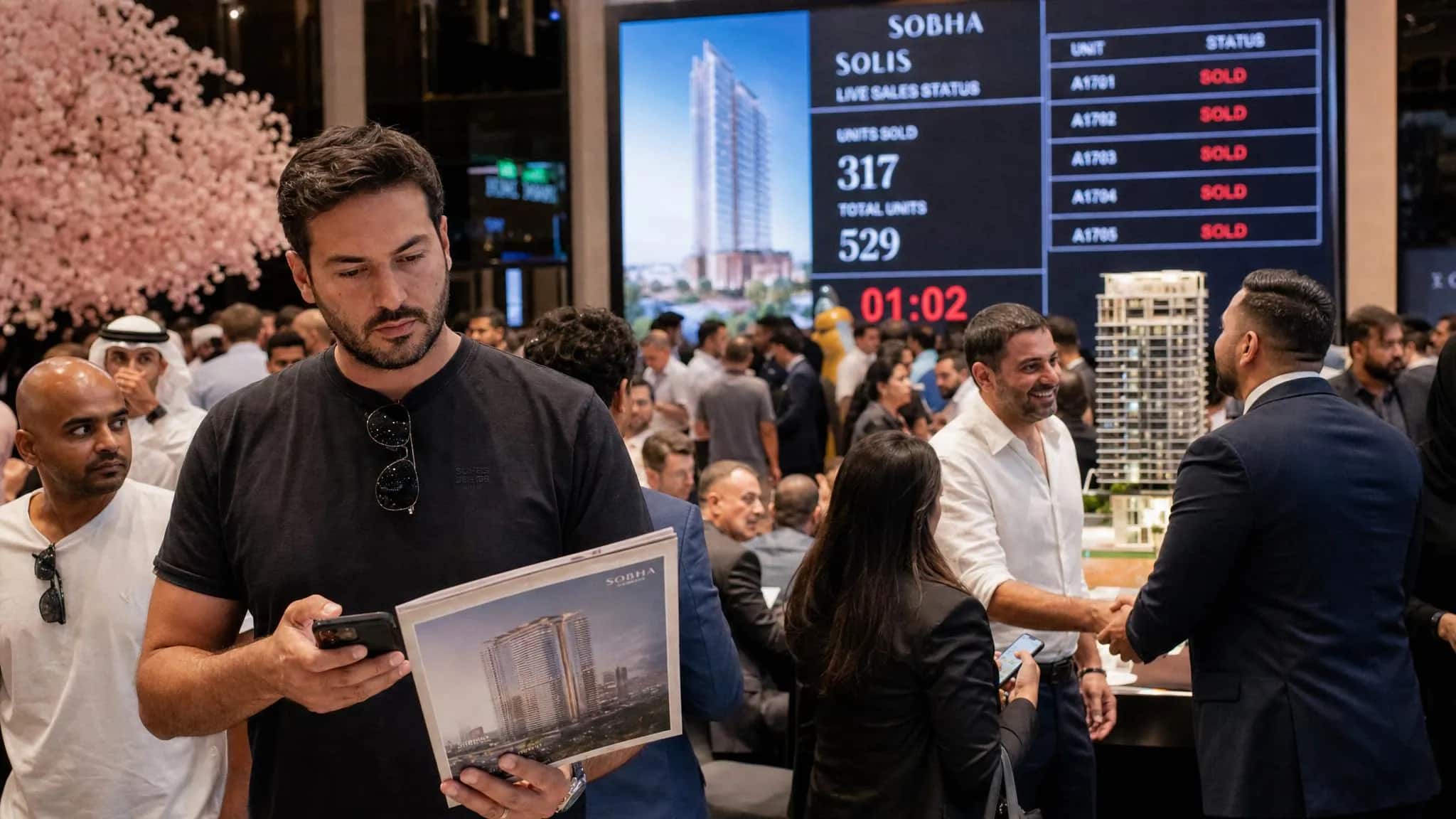
If you have spent any time looking at Dubai property in 2026, you have noticed it already. Off-plan is everywhere. Primary sales, the ones where you buy from a developer before or during construction, keep making up the bulk of transactions, with resale activity growing steadily alongside them according to DLD-linked data.
There is a reason buyers keep choosing it. Off-plan usually comes with a lower entry price, a payment plan stretched over the build, and the chance that the unit is worth more by the time you get the keys than it was the day you signed. In a market climbing 31% a year, that last part is doing a lot of work.
Two recent launches show what the demand looks like up close.
Casagrand Hermina is the debut UAE project from Casagrand, and it crossed the 50% sold mark not long after launch. That is a strong showing for a developer's first project in a new country. The buyers came from a genuinely mixed crowd, across the UAE, the wider GCC, India, Europe, Canada and the United States. Completion is on track for Q2 2028. Luthfullah K, Director Dubai at Casagrand, put it plainly: "Surpassing the 50% sales milestone at Casagrand Hermina is incredibly rewarding, and it is gratifying to see that legacy resonate in our first development in the UAE. It is a reflection of the trust that investors and homebuyers have placed in our vision."
Then there is MAREA Residences, a boutique waterfront launch from the century-old Sharafi Group Investments, sitting on Dubai Islands. It is a G+2+12 building with semi-furnished one and two-bedroom homes, priced from AED 2.74 million. The payment side is where it gets interesting for buyers watching cash flow. There is a 30/70 plan, and a 50/50 post-handover option that runs two years past completion. Handover is set for Q4 2027. Abdulla Sharafi, CEO of Sharafi Group Investments, described it as a project that "captures the true essence of resort island living while offering comfort, sophistication, and strong investment value for residents and investors alike."
Both projects say the same thing in different ways. Buyers want established names with a track record of actually delivering, and they want payment terms that do not demand the full amount up front.
If you are weighing up off-plan, here is what we tell people to check before signing anything:
- The developer's delivery record, not their brochure. Have they handed over projects on time before?
- The escrow account. Your payments should sit in a DLD-registered escrow tied to the project, not the developer's general account.
- The payment plan maths over its full term, including any post-handover portion.
- The realistic handover date, then add a buffer, because off-plan timelines slip.
- The resale and rental potential of the specific building, not just the area.
- The total cost including DLD fees, not just the sticker price.
- Whether the floor plan and finish you are sold actually match the unit you will receive.
You can see what is launching right now on the current property launches page, which is the fastest way to get a feel for who is building what and on what terms.
What Rising Build Costs Mean for the Price You Pay
Here is a part of the story that buyers tend to miss, because it sits on the construction side rather than the sales side. Building anything in the UAE got more expensive over the past year, and that feeds straight into off-plan pricing.
New research from AESG, built on tender return data, points to busy sites right across the GCC. MEED puts the value of GCC projects under active construction at around $951 billion. Concrete supply alone grew 13% between Q4 2025 and Q2 2026, which is the kind of jump you only get when a lot of cranes are turning at once.
The cost of the actual materials moved too. Here is how the key inputs shifted:
- Concrete works: up 13% over the period.
- Reinforcement steel: up 16%.
- The rebar index: up 6% since Q4 2025.
- Oil: up 20% across the same stretch.
- Aluminium: up 21%.
- The timing: both the oil and aluminium curves climbing sharply from January 2026 onwards.
None of that is abstract. When it costs more to pour concrete and bend steel, new launches get priced higher to protect the developer's margin. Which is exactly why a price you lock in today on an off-plan unit can look like a bargain by the time the building tops out.
Saeed Al Abbar, CEO of AESG, framed it as a moment for care rather than panic. "The data we are seeing reflects a market absorbing real and sustained cost pressure, but one that retains the capacity and ambition to deliver. These findings are a prompt for rigour, not retreat," he said. You can read more of the AESG research on where construction costs are heading.
The takeaway for a buyer is simple enough. Rising build costs are a quiet argument for buying off-plan sooner rather than later, as long as the developer is solid. The price on the table now is set against today's costs. Next year's launches will be set against next year's, which are pointing up.
How Buying Property in Dubai Actually Works
All the market data in the world does not help if the process trips you up. So here is how buying property in Dubai actually runs, start to finish, whether you are a resident or buying from overseas.
The good news is that foreigners can buy freehold property in designated areas across Dubai, and the system is built to handle international buyers. You do not need to be a resident, and you do not need to be physically present for every step. A lot of it can be done remotely with the right paperwork and a trusted agent on the ground.
Here is the process, step by step:
- Sort your budget and financing first. If you are paying cash, fine. If you need a mortgage, get a pre-approval before you start viewing, so you know your real ceiling.
- Pick your area and unit. This is where knowing the buildings, not just the listings, makes a difference.
- Agree terms and sign a Form F, the standard sale agreement, and pay a deposit, usually 10%.
- The seller gets a No Objection Certificate from the developer, confirming there are no outstanding charges on the unit.
- Transfer the property at a DLD trustee office, where the balance is paid and the title deed moves into your name.
- Pay the fees, which we get into in the next section, because they are bigger than most people expect.
For off-plan, the shape is a little different. You sign a sales and purchase agreement with the developer, pay according to the agreed plan, and the unit transfers to you at handover once the build is done and the final payments are made.
If you want the full picture of what we handle on the buying side, our property buying service walks through it in detail, from search to handover.
One thing we will say loudly. Get your financing nailed down early. People fall in love with a unit, then spend three weeks scrambling for a mortgage and watch it get sold to someone who was ready. If a home loan is part of your plan, our mortgage team can tell you what you can actually borrow before you start looking, not after.
The Costs People Forget to Budget For
The price on the listing is not the price you pay. This is the part that catches first-time buyers in Dubai every single time, so we are going to be blunt about it.
On top of the property price, here is what you should actually budget for:
- DLD transfer fee: 4% of the property value, the single biggest add-on.
- Agent commission: usually 2% of the price, plus VAT.
- Property registration fee: a few thousand dirhams, scaled to the property value.
- NOC fee: paid to the developer, often between AED 500 and AED 5,000.
- Mortgage registration: if you are financing, 0.25% of the loan amount goes to the DLD.
- Bank arrangement and valuation fees: another chunk if there is a home loan involved.
- Annual service charges: ongoing, charged per square foot, and they vary a lot by building.
Add it up and the one-off costs of buying land somewhere around 6% to 7% of the purchase price for a cash buyer, and more once a mortgage is in the mix. On an AED 2 million home, that is real money, not a rounding error.
The payment structure matters too, especially off-plan. A 50/50 post-handover plan like the one MAREA is offering spreads the load well past completion, which changes your cash flow picture completely compared with paying most of it before you get the keys.
Our advice is boring and it works. Build the full cost into your budget from day one. Do not treat the fees as a surprise at the transfer office. The buyers who get burned are almost always the ones who budgeted for the sticker price and nothing else.
Buying Now or Waiting It Out
This is the question we get more than any other, and there is no clean answer that fits everyone. But here is how we actually think about it.
A market up 31% a year is not a market that rewards waiting. Every quarter you sit out, the entry price tends to be higher than the one before. That is the honest read of the data. The flip side is that nobody should buy in a hurry just because the numbers are hot. A bad unit in a great market is still a bad unit.
So we split it like this:
- Buy sooner if you have your financing ready, you have found a building you actually rate, and you plan to hold for at least a few years.
- Buy sooner if you are buying to live in it, because then the daily value matters more than the exact entry price.
- Wait if you have not sorted your budget or your mortgage pre-approval yet.
- Wait if you are not confident about the area or the specific building.
- Think twice if your whole plan is to flip quickly for a fast profit. In a market this watched, that is a gamble, not a strategy.
If you want to see what is actually available right now rather than guessing from market reports, our property listings are updated regularly across Dubai and the wider UAE.
The market will keep doing its thing. Your job is not to time it perfectly, which is close to impossible anyway. Your job is to buy something good, on terms you understand, that you are happy to hold. Do that, and the record numbers are working for you instead of against you.
What We'd Tell a Friend
Boil it down and the picture is straightforward. Dubai's property market just posted its biggest quarter on record, and the growth is showing up across volumes, values, and a wider mix of buyers than ever. Off-plan is still leading, build costs are pushing new launch prices up, and the buyers doing well are the ones moving with a plan rather than a panic.
If a friend asked us what to do, we would say this. Sort your money first. Get the mortgage pre-approval before you fall for a unit. Pick a developer with a real delivery record, not just a slick launch event. Run the full cost, fees and all, before you sign anything. And buy something you would be happy to hold for a few years, because that is what turns a hot market into your gain instead of someone else's.
We would also say the obvious thing that gets lost in all the record-breaking headlines. A good purchase in 2026 is not about catching the exact bottom or top. There is no bottom in sight anyway. It is about buying the right thing, on terms you understand, in a building that will still be worth owning in 2030.
If you are buying to let, the numbers only work if the place is managed well, which is its own job. Our property management team handles that side for investors who would rather not chase tenants and maintenance themselves.
And if any of this has you thinking seriously about buying, our agents are based here, work these buildings every week, and know these numbers firsthand. Get in touch and we will take it from there.
Related stories
Dubai's Established Charm: The Case for Older Homes
In a city focused on the future, I believe the smartest move for many buyers is to look back. Dubai's seasoned communities offer space, character, and surprising value that new builds often can't match.
The True Cost of Owning a Dubai Property
Beyond the purchase price, your annual budget for a Dubai home must account for service charges, utilities, and maintenance. I'll break down every ongoing expense you need to plan for.
Calculating ROI on Dubai Rental Upgrades
As a landlord in Dubai, you can't just follow trends. I'll show you how to calculate the precise ROI of minor property upgrades to genuinely increase your rental yield.
Echoes, in your inbox
One thoughtful email a month. Market insight, new launches, no spam.