

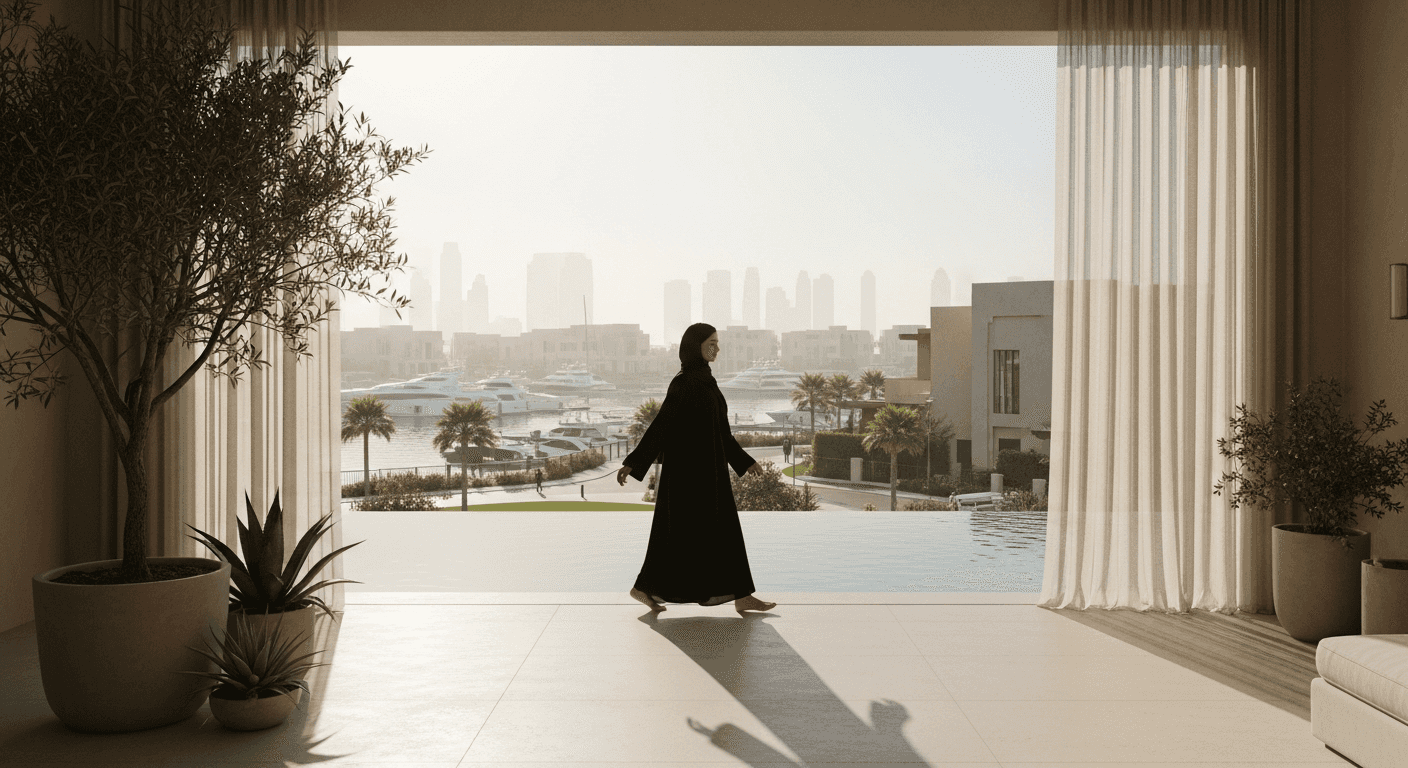
Beyond the Maid's Room: Designing for Dignity in Dubai Villas
For families in Dubai, live-in support is a cornerstone of daily life. This guide explores the villa communities that get staff accommodation right, balancing practicality, privacy, and human dignity.

For so many families I work with, the search for the perfect Dubai villa isn't just about the number of bedrooms or the size of the garden. It’s about finding a home that truly functions for the entire household, and in Dubai, that almost always includes live-in help. The quality of staff accommodation is a critical, yet often overlooked, part of that equation.
Here's what we'll explore in this guide:
- The evolution of staff accommodation in Dubai's villa design.
- What 'thoughtful design' for live-in help actually means.
- A spotlight on communities with superior maid and driver rooms.
- The hidden costs and legal duties of sponsoring household staff.
- My personal checklist for evaluating staff quarters during your property search.
- Future trends in integrated household support spaces.
The Unspoken Essential: Why Staff Quarters Define a Family Home
When clients give us their property brief, the 'maid's room' is usually listed as a non-negotiable, right alongside the number of bedrooms and desired location. It’s a standard feature on most property portals. But in my experience, simply ticking that box is a mistake. The term 'maid's room' itself is a catch-all that tells you nothing about the reality of the space. I have seen everything from a reasonably sized en-suite bedroom with a pleasant view to a windowless cupboard tucked behind a noisy kitchen. These two spaces are not equal, and the difference has a profound impact on daily life.
For families relying on a nanny for childcare, a housekeeper to manage the home, or a driver for school runs and commutes, these individuals are integral to the household's smooth operation. Their comfort, privacy, and well-being are not just an ethical consideration; they are a practical necessity. A happy, well-rested member of staff is better at their job. A living arrangement that creates friction, lacks privacy, or feels undignified can lead to high turnover and a constant sense of unease in the home. This is why I always urge clients to look beyond the label and scrutinise the staff accommodation with the same critical eye they apply to the master suite or kitchen.
Over the past few years, I've noticed a significant shift in my clients' attitudes. Both expatriate and Emirati families are becoming far more discerning about these spaces. They understand that a home's design needs to support the entire structure of their lives. A poorly planned staff room — one that requires a nanny to walk through the formal living room to get to her bedroom late at night, for example, is simply a failure of design. It creates awkwardness and compromises privacy for everyone. The best villa communities and developers in Dubai are responding to this, recognising that well-designed staff accommodation Dubai villas are not just a line item, but a key selling point for their target demographic.
From Afterthought to Feature: The Evolution of Staff Accommodation
 Featured project
The history of Dubai's rapid development can almost be charted through the evolution of the maid's room. In many of the older, yet still beloved, villa communities built in the early 2000s, staff quarters were often a clear afterthought. In some of the original villas in communities like The Springs or certain layouts in the first phase of Arabian Ranches, the maid's room can be quite small, sometimes located under a staircase or in a converted storage space with poor ventilation and no external window. They served a purpose, but with little consideration for the person living there.
This was a product of a time when the focus was on delivering a certain number of bedrooms for the primary family within a specific footprint and budget. The functionality of the support spaces was secondary. As the market matured and buyers became more sophisticated, expectations began to change. Families moving to Dubai from other global hubs brought with them different standards and perspectives on household management and living arrangements. They started asking more pointed questions about layout, privacy, and access.
We saw the first major shift with the rise of more premium master-planned communities. A developer like Emaar Properties, for example, has shown a clear design progression. If you compare an early Ranches villa to a modern one in Dubai Hills Estate, the difference is stark. In the newer properties, the maid's room is almost always en-suite, has a proper window, and is intelligently located near the utility and kitchen areas, creating a functional 'work zone' that is separate from the family's main living and relaxation areas. This is a direct response to market demand for more practical villa layouts Dubai.
This evolution is also driven by the sheer scale of modern luxury villas. In ultra-prime communities like Emirates Hills or Al Barari, developers are not just including a single maid's room; they are designing entire staff wings. These can include multiple bedrooms for a nanny, chef, and housekeeper, often with a separate small living area or kitchenette. This acknowledges that for a certain size of property and family, a team of support staff is required, and they need their own functional, private living quarters. This high-end trend has a trickle-down effect, raising the bar for what's considered acceptable in the mainstream premium villa market as well.
Anatomy of a Well-Designed Staff Room
So, what separates a thoughtful, functional staff room from a token gesture? When I walk clients through a villa, I encourage them to imagine the daily routines of the person who will live in that space. It’s an exercise that quickly reveals a layout’s strengths and weaknesses. A truly well-designed room considers several key factors, and I've developed a mental checklist over the years.
Here are the non-negotiables I look for in a property's staff quarters:
- Location and Access: This is paramount. The ideal location is on the ground floor, adjacent to the 'service' areas of the home like the kitchen, laundry room, and back entrance. This creates a natural flow for daily tasks. A separate external entrance is a massive bonus, as it affords the staff member a degree of independence and privacy, allowing them to enter and exit without disturbing the family — especially important if they work late or have a day off. Conversely, a room located upstairs next to the children's bedrooms or one that requires passage through a formal dining room is a poor design.
- Size and Layout: The room must be large enough to accommodate more than just a single bed. There should be space for a small wardrobe and perhaps a small desk or chair. While there are no legally mandated minimum dimensions in Dubai, I personally consider anything less than 7-8 square metres (around 75-85 square feet) to be too small. The shape of the room matters too; a long, narrow space is less usable than a more squarish layout.
- Natural Light and Ventilation: A window is not a luxury; it's a fundamental requirement for a humane living space. A room without natural light is psychologically draining and often suffers from poor air quality. I always check if the window is a decent size and if it actually opens. I also check for independent air conditioning controls. A staff room connected to the main house thermostat can lead to discomfort, as temperature preferences will inevitably vary.
- En-Suite Bathroom: A private, attached bathroom is a standard expectation in any modern villa. It’s a basic matter of privacy and dignity. Shared bathrooms are a relic of outdated design. I always inspect the quality of the fixtures and check for proper ventilation (an extractor fan or a small window) to prevent mould and dampness.
- Finishes and Practicality: While you can’t expect the same marble finishes as the master bathroom, the materials should be decent, durable, and easy to clean. Tiled floors, simple but robust cabinetry, and sufficient electrical sockets for charging a phone and other small electronics are all signs of a thoughtfully planned space.
“A poorly designed maid's room, tucked away without light or privacy, is a constant friction point in a home. The best developers in Dubai now understand that thoughtful staff accommodation isn't a cost — it's an investment in the daily function and harmony of a family villa.”
The Driver's Room: A Separate and Distinct Need
While the maid's room is now a common feature, the driver's room remains a more specialised requirement, typically found in larger, more premium villas. The needs for a driver are fundamentally different from those of a nanny or housekeeper who is more integrated into the internal workings of the home. A driver's schedule is often dictated by late-night airport runs, early morning school drop-offs, and waiting for long periods. This makes privacy and external access absolutely crucial.
This is why the most practical layouts for driver room villa communities position this accommodation externally. The gold standard is a self-contained en-suite room that is attached to the garage block or has its own completely separate entrance from the side of the villa. This configuration provides the ultimate privacy for both the family and the driver. It allows him to come and go at all hours without keys to the main house or the need to walk through any family spaces. It respects his independence and minimises any potential for disturbance.
Communities known for their grand plots and expansive villas, such as Emirates Hills, the larger properties in Jumeirah Golf Estates, and the magnificent homes in Al Barari, often include these external driver's rooms as standard. In my opinion, this is one of the hallmarks of a truly luxury-segment property. The developer has anticipated the full scope of household staffing needs for a home of that scale. In some custom-built villas, I've even seen layouts that include a small pantry or kitchenette attached to the driver's quarters, further enhancing their self-sufficiency.
Finding villas with good driver's rooms can be more challenging in the mid-range market. In many communities, even on larger five or six-bedroom villas, the second 'staff' room might simply be another small internal room, which isn't ideal for a driver. This is a common point of compromise for many of my clients. Sometimes, if the maid's room has an external door, they might allocate that to the driver and use a smaller internal room or even a converted study for a live-in nanny. It highlights the importance of thinking through your specific staffing needs before you begin your property search and communicating that clearly to your agent. At Gaia Living, it's one of the first questions we ask our villa-seeking clients: what does your household support team look like, now and in the future?
Community Spotlight: Where to Find the Best Staff Accommodation
Navigating the market for live-in help family villas requires knowing where to look. The quality and thoughtfulness of staff accommodation vary dramatically across Dubai's many communities. Based on hundreds of viewings and client feedback, here is my personal take on which areas get it right.
The Gold Standard: Emirates Hills & Al Barari For those with the budget, these communities are in a class of their own. The villas in Emirates Hills are often custom-built on vast plots, and as a result, staff accommodation is typically extensive and housed in a separate structure or a dedicated wing. It’s common to find multiple rooms, a staff kitchen, and a living area. Similarly, the developer at Al Barari is known for its focus on space and luxury. Their villas not only feature generous, well-appointed internal maid's rooms but the larger properties also include external driver's and watchman's quarters as a standard feature. These communities are designed for large-scale family life with a full complement of household staff.
The Modern Champion: Dubai Hills Estate In my view, Emaar has set a new benchmark for the premium-mainstream market with Dubai Hills Estate. Across the various sub-communities like Sidra, Maple, and the larger villas in Golf Place, the layouts are consistently practical. The maid's rooms are almost always located on the ground floor with good access to the kitchen and a back door. They are en-suite, feature a proper window, and are of a reasonable size. Emaar learned from its earlier projects and has perfected a formula that works for modern family living. For families seeking a balance of luxury, community amenities, and a truly functional home layout, Dubai Hills is often my top recommendation.
The Established Favourite, Upgraded: Arabian Ranches I, II & III Arabian Ranches is a fascinating case study in design evolution. The original Ranches 1, while still hugely popular for its charm, has the most inconsistent staff accommodation. Some layouts, like the smaller Palmera or Al Reem townhouses, have very compact rooms. However, the larger independent villas, such as the Mirador or Saheel types, offer much better spaces. When Ranches II and later Ranches III were launched, you can see the clear improvement. The layouts are more aligned with the Dubai Hills model: better-located, larger en-suite rooms as standard. When clients are looking in the Ranches, I always advise them to be specific about the villa type and to inspect the room in person, as there is significant variation.
The Spacious Contender: Jumeirah Golf Estates This community is defined by its large, open-plan homes and connection to the outdoors. This generosity of space often extends to the staff quarters. The villas in Jumeirah Golf Estates, particularly in enclaves like Olive Point, Orange Lake, or the Sanctuary Falls collection, tend to have some of the largest internal maid's rooms on the market. Beyond that, many of the five and six-bedroom villas come standard with an external driver's room, making it a strong contender for families with that specific need. The focus on spacious living makes JGE a reliable choice for those who want to ensure their staff have ample room.
The Practicalities: Sponsoring Live-in Staff in Dubai
Finding a villa with the right layout is only half the story. Employing live-in staff in Dubai means becoming a sponsor, and this comes with significant legal and financial responsibilities. It’s a formal process governed by the UAE's Domestic Labour Law (Federal Law No. 10 of 2017), which is designed to protect both the employer and the employee. Understanding these obligations is crucial before you commit. The UAE Government's official portal, u.ae, provides comprehensive guidance on this.
As a sponsor, you are legally required to provide a contract, pay a monthly salary on time, provide adequate accommodation, food and rest, grant a weekly day off, provide annual leave with a flight ticket home, and cover mandatory health insurance. These are not optional perks; they are legal rights. From a financial perspective, the upfront costs for sponsorship are not trivial. While salaries vary based on experience and nationality, the administrative costs are relatively fixed. Our team at Gaia Living always advises clients to budget for these expenses as part of their total cost of living.
To give you a clear idea, here is a typical line-by-line breakdown of the approximate first-year costs to sponsor one domestic worker, excluding their monthly salary:
- Refundable Security Deposit: Approximately AED 2,000 (per worker, refunded when the visa is cancelled).
- Visa & Entry Permit Fees: Around AED 5,000 - 6,000 (This is a one-time fee for a two-year visa, processed through government-approved centres like Tadbeer).
- Medical Fitness Test: Approximately AED 300 - 400.
- Emirates ID Application: Approximately AED 270 for a two-year card.
- Mandatory Health Insurance: This can range from AED 600 to over AED 1,000 per year, depending on the level of coverage.
- Domestic Worker's Insurance Package: This is a newer requirement that costs around AED 120-150 annually and provides protection for both parties.
Therefore, a family should budget roughly AED 8,500 - AED 10,000 in upfront government and administrative fees to sponsor one staff member for a two-year period. This is in addition to their monthly salary (which can range from AED 1,800 to AED 4,000+), the cost of an annual flight home, and end-of-service gratuity (calculated as 14 days' salary for each year of service). Factoring these costs into your household budget is an essential step in responsibly managing a home with live-in support.
Your Viewing Checklist: How to Assess Staff Quarters Like a Pro
To help you cut through the marketing and make an informed decision, I've compiled a simple checklist of questions to ask and things to inspect when you view a villa. Take this with you on your viewings. Don't be shy about opening doors, checking windows, and even bringing a small tape measure. A few minutes of thorough inspection can save you years of domestic friction.
My Essential Viewing Checklist:
- The Window Test: Does the room have an external window? Does it open? Does it look out onto something reasonable (like a side garden or walkway) or a blank wall/noisy machinery?
- Location, Location, Location: Where is the room situated? Trace the path from this room to the kitchen and the back door. Is it practical? Is it disruptive to the main family areas?
- Access Point: Is there a separate entrance or is the room only accessible through the main house? If internal, what areas must be crossed to reach it?
- The En-Suite: Confirm it has a private, attached bathroom. Is the bathroom ventilated with a fan or a window?
- Measure Up: Is the room genuinely big enough for a bed and a small personal area? If it looks tight, measure it. Anything under 7 square metres is a red flag for me.
- Climate Control: Does the room have its own A/C control unit? This is crucial for personal comfort.
- Power & Connectivity: Are there enough power sockets in logical places? Is there a TV/internet point? These small details make a big difference to livability.
- The Driver's Room Question: If you need one, ask specifically. Is it internal or external? Where is the access point relative to the garage and the street?
- Noise Audit: Stand in the room for a moment and listen. Is it located next to the A/C plant, a water pump, or the garage door mechanism? Constant noise can be a major issue.
The quality of staff accommodation is a critical, yet often overlooked, indicator of a villa's overall design quality and livability. Prioritising layouts that offer privacy, natural light, and practical access for your household help is essential for a harmonious family life in Dubai. Communities like Dubai Hills Estate are setting a new standard, but older areas like Arabian Ranches still offer value if you inspect the specific layout carefully.
The Future of Integrated Living
Looking ahead, I see the trend towards more thoughtful staff accommodation only accelerating. As Dubai's property market continues to attract discerning global citizens, developers of premium properties understand that functional, dignified support spaces are a powerful differentiator. We are moving away from the simple 'maid's room' and towards the concept of integrated 'staff zones' or flexible support quarters.
In some of the newest ultra-luxury off-plan launches, architects are designing entire ground-floor zones dedicated to household operations. This might include a large 'dirty' kitchen, a laundry room, storage, and one or two en-suite staff bedrooms, all discretely located with separate access. This is the ultimate expression of a practical villa layout, allowing the household to run like a well-oiled machine without interfering with the family's privacy and comfort.
Another trend is flexibility. Some developers are designing ground-floor en-suite rooms with good access that are marketed as a 'guest room, home office, or maid's room'. This acknowledges that modern family needs are fluid. A family with young children may need it for a nanny, but as the children grow, it could become a study or a room for an elderly parent. Designing the room to a high standard from the outset — with a proper window, good finishes, and a decent bathroom, gives the homeowner options. It future-proofs the home and increases its appeal to a wider range of buyers.
Ultimately, my advice is simple. When you are looking to buy or rent a family villa in Dubai, view the staff quarters as an integral part of the home's core infrastructure. A well-designed space that respects the dignity and privacy of your live-in help is not just an ethical choice; it is a smart investment in the happiness, harmony, and functionality of your home for years to come.
Sources
- UAE Government Portal (Domestic Helpers Law): u.ae
- Dubai Land Department: dubailand.gov.ae
Questions, answered
- Which Dubai communities are best for villas with good maid's rooms?
- Newer communities like Dubai Hills Estate generally have excellent, well-designed maid's rooms. Luxury areas such as Emirates Hills and Al Barari offer the most spacious options, while upgraded villas in established communities like Arabian Ranches are also a strong choice.
- What is the difference between a maid's room and a driver's room in a Dubai villa?
- A maid's room is typically internal, located near the kitchen or utility area. A driver's room is ideally external, often attached to the garage with a separate entrance, to allow for privacy and access at irregular hours without disturbing the household.
- Are there specific laws for staff accommodation in the UAE?
- Yes, the UAE's Domestic Labour Law mandates that employers provide 'suitable accommodation' for their live-in staff. While it doesn't specify room dimensions, it's part of a broader set of regulations ensuring fair treatment, privacy, and proper living conditions.
- Do all new villas in Dubai come with a maid's room?
- Most new family-sized villas (three bedrooms and up) in Dubai are built with a maid's room as a standard feature. However, the size, location, and quality can vary significantly between developers and communities, so it's crucial to inspect it carefully.
- How much does it cost to sponsor a maid in Dubai?
- The total first-year cost can range from AED 8,000 to AED 10,000, excluding salary. This includes visa fees, a refundable deposit, mandatory health insurance, and other administrative charges, in addition to their monthly salary and annual flight ticket.
- Can I find a villa with more than one staff room?
- Yes, larger villas in communities like Jumeirah Golf Estates, Emirates Hills, and Al Barari often feature multiple staff rooms to accommodate a nanny, cook, or housekeeper, sometimes in a dedicated 'staff wing' with its own kitchenette.

Sophia profiles Dubai's villa communities — schools, commute times, green space, and the intangible feel of a neighbourhood. She writes for families putting down roots.
Related stories
Dubai's Established Charm: The Case for Older Homes
In a city focused on the future, I believe the smartest move for many buyers is to look back. Dubai's seasoned communities offer space, character, and surprising value that new builds often can't match.
The True Cost of Owning a Dubai Property
Beyond the purchase price, your annual budget for a Dubai home must account for service charges, utilities, and maintenance. I'll break down every ongoing expense you need to plan for.
Calculating ROI on Dubai Rental Upgrades
As a landlord in Dubai, you can't just follow trends. I'll show you how to calculate the precise ROI of minor property upgrades to genuinely increase your rental yield.
Echoes, in your inbox
One thoughtful email a month. Market insight, new launches, no spam.