

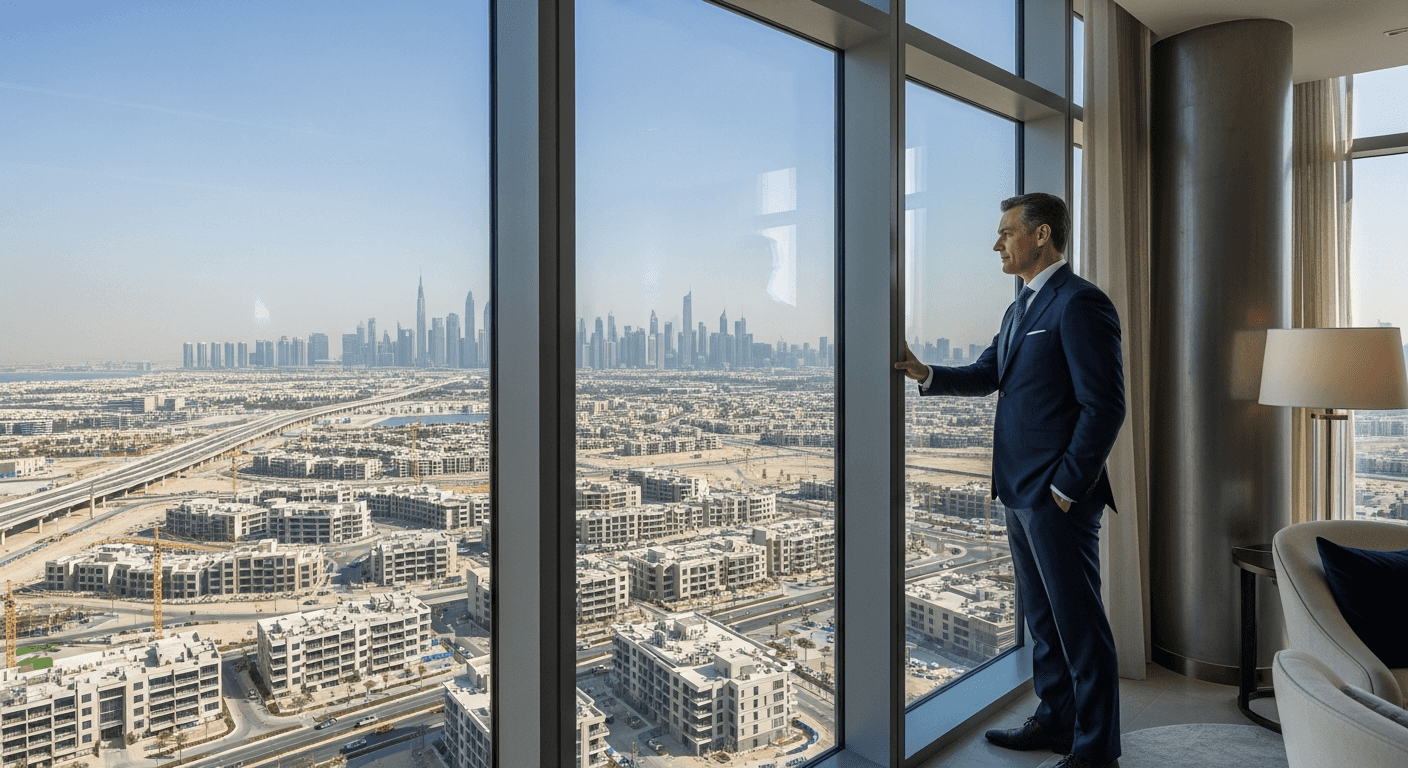
Beyond the Brochure: Off-Plan Location Due Diligence
A developer's reputation is just the start. True off-plan due diligence requires a deep analysis of a project's location, its place in Dubai's master plan, and the future infrastructure that will determine its long-term value.

In my years advising clients on off-plan investments, I’ve seen one pattern repeat itself: an obsessive focus on the developer, often at the expense of everything else. While choosing a reputable developer is a critical first step, it is only one part of a successful investment equation. The most meticulously built property from a world-class developer can still underperform if its location is flawed.
This article is about the other, equally important, side of the due diligence coin: location. We will move beyond the glossy brochure and the developer's track record to scrutinise the land a project is built on — and, crucially, the future being built around it. A thoughtful Dubai off-plan location analysis is what separates a speculative gamble from a strategic investment.
Here's what we'll explore:
- Why location fundamentals are as critical as developer selection.
- How to decode the Dubai 2040 Urban Master Plan for investment signals.
- The tangible signs of a high-growth infrastructure pipeline.
- How to assess a master community's core strengths: amenities, connectivity, and management.
- The 'micro-location' factors that create premiums within a single community.
- A practical framework for costing your investment and projecting returns.
- Case studies comparing an established prime location with an emerging opportunity.
The Developer Is Only Half the Story
When investors approach us at Gaia Living, the first names they mention are almost always the city's titans: Emaar Properties, Nakheel, Meraas, or a new-wave luxury player like Binghatti. This is a good instinct. A developer’s history of delivering on time, their quality of finish, and their ability to manage a community post-handover are non-negotiable pillars of a sound off-plan purchase. A weak developer introduces unacceptable levels of risk, from construction delays to outright project failure. But assuming you've filtered for only the best, the analysis has just begun.
Think of it this way: buying an off-plan unit is like buying a beautifully engineered car. The developer is the manufacturer — you want a brand known for reliability and performance. The location, however, is the road network, the destination, and the neighbourhood you'll be driving and parking in for years to come. A Porsche is still frustrating to own if you live at the end of a perpetually gridlocked dirt track with no amenities. Similarly, a stunning apartment in a poorly connected area with no schools, no retail, and no soul will always struggle to attract premium tenants and will see suppressed capital growth. The property itself might be perfect, but its context defines its value.
My primary role is to help investors balance developer risk with location opportunity. A Tier-1 developer launching in a saturated or poorly planned area might offer safety, but limited upside. Conversely, a credible Tier-2 developer with a strong track record, but who has secured a prime plot in a strategic future growth corridor, might present a far more compelling investment case. The real art is in identifying where these two forces — a reliable builder and a promising location, intersect. The off-plan investor’s profit is made not just by buying a good product, but by buying into a location *before* its full potential is reflected in the price.
Decoding the Dubai 2040 Urban Master Plan
 Featured project
For any serious investor looking at the long-term potential of an off-plan property, there is no more important document than the Dubai 2040 Urban Master Plan. This isn't just a government policy paper; it is the strategic blueprint for the city's growth over the next two decades. It tells you where the government intends to focus its investment, where the population is expected to grow, and what kind of city Dubai aims to become. Ignoring it is like trying to navigate the sea without a compass.
The plan's high-level goals are ambitious and directly impact real estate. It projects a population increase to 5.8 million residents by 2040 and aims to have 55% of that population living within 800 meters of a major public transport station. This immediately signals the long-term value of properties with metro proximity. The plan also emphasizes creating sustainable and people-centric "20-minute cities," where residents can access 80% of their daily needs and destinations within 20 minutes by foot or bicycle. This is a clear indicator that mixed-use, walkable master communities are the future. Projects that deliver on this vision, like City Walk or Dubai Hills, are not just trendy; they are aligned with the city's core long-term strategy.
The plan explicitly identifies five main urban centres that will be the focal points for development and density. Two are historical/commercial centres (Deira/Bur Dubai and Downtown/Business Bay), while three are seen as growth hubs: Dubai Marina/JBR, Expo CIty, and Dubai Silicon Oasis. For an off-plan investor, this is a roadmap. An investment in Dubai South is a direct bet on the government's vision for the Expo City corridor, anchored by the expansion of Al Maktoum International Airport. An investment in a community like Liwan, adjacent to Silicon Oasis, is a bet on the growth of that knowledge and technology hub. The master plan impact on off-plan value is not theoretical; it provides a government-backed thesis for your investment.
When we evaluate a new launch, we cross-reference its location against this master plan. Here is a simplified checklist of questions I ask:
- Proximity to a Key Centre: Is the project located within one of the five designated urban centres or on a direct transport corridor connecting to one?
- Green Space Allocation: The plan calls for a 105% increase in green and recreational spaces. Does the project or its master community contribute to this with significant parks and open areas?
- Transit-Oriented Development (TOD): How close is the project to an existing or planned Metro or Tram station? Is the area designed for walkability?
- Economic Focus: Does the location align with a specific economic objective? For example, being near Dubai Science Park or Dubai Media City can create a dedicated tenant pool from those industries.
The Infrastructure Pipeline: Reading the Signs of Growth
While the 2040 Master Plan provides the long-term vision, the tangible pipeline of new infrastructure is what creates value in the medium term. As an investor, your goal is to identify areas that are on the cusp of a major upgrade. Government spending on infrastructure is the single most powerful catalyst for property appreciation, acting as a direct injection of value into a location. Following the cranes of the Roads & Transport Authority (RTA) is often more predictive of future property hotspots than following the developer's marketing campaigns.
So, what are the signs? The most obvious are major transport projects. The announcement of the Metro's Blue Line, for example, will fundamentally transform accessibility for communities along its planned route. We saw this with the Route 2020 extension for Expo; areas like Al Furjan and Discovery Gardens, once considered secondary locations, saw a significant uplift in demand and value simply by being connected to the Metro. When evaluating an off-plan project in an area that feels a bit remote today, the critical question is: what transport infrastructure is coming in the next 3-5 years, timed for my property's handover? Road network upgrades, like the ongoing improvements to Hessa Street and Umm Suqeim Street, are also vital. They can shave 10-15 minutes off a commute, which directly translates into higher rental appeal and, consequently, higher property values.
Beyond transport, look for "soft" infrastructure. The development of new schools, particularly those with strong international reputations, is a huge magnet for the end-user family demographic. The concentration of top-tier schools around areas like Arabian Ranches and Dubai Hills is a primary reason for their sustained popularity and premium pricing. Similarly, the announcement of a new major hospital, a university campus, or a large-scale destination mall can act as an anchor that pulls up the value of all surrounding residential real estate. The arrival of these amenities signals that a developing area is maturing into a fully-fledged community, de-risking the investment for both tenants and future buyers.
This type of infrastructure development investment in Dubai is about connecting the dots. For instance, the government's massive investment in expanding Al Maktoum International Airport into a global mega-hub is not a standalone project. It necessitates the development of vast residential, commercial, and logistics support zones around it. Therefore, an off-plan purchase in Dubai South is not just a bet on a single building; it's a bet on an entire ecosystem of interconnected infrastructure projects materializing over the next decade. The key is to buy in when the plans are announced and concrete, but before the full impact of that infrastructure is priced into the market.
Anatomy of a Master Community: Beyond the Project Gates
Moving from the city-wide macro view, we arrive at the 'meso' level: the master community itself. A successful master community is far more than a collection of apartment buildings and villas. It is a carefully curated and managed environment, and its quality is a primary driver of long-term value retention and rental demand. A great building in a poorly conceived or managed master community will always be fighting an uphill battle. When I assess an off-plan project, I spend as much time scrutinizing the master plan as I do the floor plan.
First and foremost is connectivity. How does the community connect to the rest of Dubai? A location that looks close to the city centre on a map can be a logistical nightmare if its road access is limited to a single, congested entry/exit point. I look for multiple access points and direct proximity to at least one of Dubai’s main arterial highways: Sheikh Zayed Road, Al Khail Road, or Sheikh Mohammed Bin Zayed Road. The difference between a 5-minute drive to a major highway and a 15-minute crawl through local traffic to reach the same point is immense in the eyes of a potential tenant.
Second are the internal and external amenities. Every new project brochure will show swimming pools and a gym. These are standard. I look for the differentiating factors that create a genuine lifestyle. Does the community have a central park on the scale of the one in Dubai Hills? Does it have a destination beachfront like Emaar Beachfront? A championship golf course like Jumeirah Golf Estates? These are not just amenities; they are unique selling propositions that command a premium. Equally important are the day-to-day essentials. Are there supermarkets, clinics, and schools *within* the community or a short walk away? Are they operational now, or are they just coloured-in boxes on a future plan? The maturity of these amenities is a key indicator of the community's livability.
Finally, and this is often overlooked by first-time investors, is the quality of the master developer and the ongoing community management. A developer like Emaar or Meraas has a vested interest in maintaining the parks, roads, and security of their master communities to the highest standard, because it protects the value of their brand and their future projects. This commitment is reflected in the service charges, but it pays for itself in resident satisfaction and property value preservation. When you see service charges that seem too low to be true, it can be a red flag for future underinvestment in maintenance. I advise clients to budget for realistic service charges — typically between AED 16-25 per square foot for an apartment with good amenities, as the cost of protecting their asset in a well-run community.
The Power of Proximity: Analysing the 'Micro-Location'
Even within a world-class master community, not all properties are created equal. The final layer of our Dubai off-plan location analysis is the 'micro-location' — the specific position of the building and the unit itself. These subtle differences can have an outsized impact on both rental income and future resale value. A few hundred meters can be the difference between a standard unit and a premium one.
Views are the most obvious and potent factor. An unobstructed view of a prime landmark — the Burj Khalifa, the Ain Dubai, the sea, or a lush central park, can add a premium of 15-30%, sometimes more, compared to an identical unit on the other side of the building facing a less inspiring scene. The critical task for an off-plan investor is to assess the longevity of that view. That beautiful open plot of sand in front of your future balcony might offer a stunning vista today, but what is planned for it? This is where tools like the Dubai Land Department's Dubai REST application become invaluable. Its master plan feature allows you to check the zoning of adjacent plots. If the plot in front of you is zoned for a high-rise tower, your premium view is on a timer. If it’s zoned as a public park or is part of a protected coastline, that view is secure and its premium is durable.
Access and noise are two sides of the same coin. A building's proximity to a major road is great for commuting, but if the specific unit is directly overlooking six lanes of traffic, the constant noise will be a significant drawback for many tenants. I always analyze the building's exact placement relative to interchanges, main roads, and community infrastructure. Is it a quiet internal street or right on the main boulevard? Is it located next to a district cooling plant, a large electrical substation, or the service entrance for a mall? These factors may not appear in the marketing materials but become very apparent once you live there. My advice is simple: if possible, visit the actual plot of land at different times of the day to get a real sense of the ambient environment.
Finally, there's walkability. The ability to walk to a metro station, a beach, a retail strip, or a popular café is a powerful lifestyle enhancer that drives rental demand, particularly in dense urban areas like Downtown Dubai or Jumeirah Beach Residence. For a one-bedroom apartment targeting a young professional, being a 10-minute walk from the metro can be a more important factor than the size of the balcony. When assessing a project, I use a simple walking test: from the plot's entrance, what can I reach in 5, 10, and 15 minutes on foot? The more amenities and transport links within that walkable radius, the stronger the micro-location's investment case.
A Practical Framework for Financial Due Diligence
Qualitative analysis of location is essential, but it must be paired with rigorous quantitative analysis. Let's translate the concepts of a 'good location' into cold, hard numbers. Here is a practical, step-by-step framework for costing an off-plan investment and projecting its potential returns. We will use a hypothetical, but realistic, example of a one-bedroom apartment in a growing community like Arjan, known for its good connectivity and proximity to key amenities.
Example: 1-Bedroom Apartment in Arjan - Purchase Price (SPA Price): AED 1,200,000 - Payment Plan: 50/50 (50% during construction, 50% on handover)
Step 1: Upfront and Construction-Phase Costs Your initial cash outlay is more than just the first down payment. You must account for government fees, which are paid upfront.
- Down Payment (20% of SPA Price): AED 240,000
- Dubai Land Department (DLD) Fee (4% of SPA Price): AED 48,000
- Oqood (Off-plan Registration) Fee: AED 5,250 (approximate)
- Initial Outlay: AED 293,250
Over the construction period (let's assume 3 years), you will pay the remaining portion of the first 50%. This would be an additional 30% of the SPA price, or AED 360,000, typically paid in 5-10% installments at various construction milestones. It is critical to remember that during this entire period, your capital is tied up with no rental income being generated.
Step 2: Handover Costs & Financing Upon completion, the final 50% is due: AED 600,000. Many investors plan to finance this portion with a mortgage. This is a critical risk point. According to Central Bank of the UAE regulations, an expatriate investor can typically borrow up to 80% of the property's *appraised value at completion*. If you bought for AED 1.2M but the bank's valuation at handover is only AED 1.1M, they will only lend 80% of AED 1.1M (AED 880,000). Your loan-to-value is against the purchase price, but the bank's exposure is against the valuation. If the valuation is lower, you must cover the shortfall in cash. A strong location in a growing market makes a low valuation less likely.
Step 3: Projecting Net Yield Once you take possession, you can start earning rental income. Your calculation for net yield must be realistic and account for all annual expenses.
- Projected Annual Rent: Based on comparable ready properties in Arjan, a new 1-bed could realistically rent for AED 80,000 per year.
- Annual Service Charges: The apartment is 800 sq. Ft. and the estimated charge is AED 18/sq. Ft. Total: 800 * 18 = AED 14,400 per year.
- Net Rental Income: AED 80,000 - AED 14,400 = AED 65,600
- Gross Yield: (80,000 / 1,200,000) = 6.67%
- Net Yield: (65,600 / 1,200,000) = 5.47%
This 5.47% net yield is a healthy and sustainable return for a brand-new property in a solid location. This calculation, however, does not include potential capital appreciation, which is the primary goal for many off-plan investors. The quality of the location is the main factor that will drive that appreciation from your AED 1.2M purchase price.
“The price you pay for an off-plan unit is determined by today's market, but the value you receive at handover is dictated entirely by the location's future.”
Case Study 1: The Established Bet — Emaar Beachfront
To see these principles in action, let's look at a well-known success story: Emaar Beachfront. When it was launched in 2018, it represented a textbook example of a premium, location-driven investment. The analysis was straightforward but compelling.
The developer, Emaar, is the city's largest and most trusted master developer, which immediately minimized delivery and quality risk. But the location thesis was the true star. Emaar Beachfront is a private, gated island strategically positioned between two of Dubai's most iconic and desirable neighborhoods: Dubai Marina and Palm Jumeirah. This wasn't an emerging area; it was an insertion of new, prime real estate into the very heart of established 'prime Dubai'. The infrastructure was already there — excellent connectivity via Sheikh Zayed Road, Dubai Tram, and the nearby Metro, with new dedicated bridges built specifically for the project.
The micro-location and unique selling proposition were a masterstroke. It offered something that was surprisingly scarce in Dubai: brand new apartments with direct, private beach access for all residents. This wasn't just a 'sea view' — it was a tangible lifestyle proposition. The views themselves were protected and spectacular, looking out over the Palm, the Marina skyline, or the open sea. Investors buying off-plan here were not gambling on a future neighbourhood materializing. They were buying into a guaranteed prime location with a unique, unassailable feature.
The results speak for themselves. Early investors who bought at the initial launch prices have seen significant capital appreciation. A one-bedroom apartment purchased for around AED 1.3M-1.5M in 2018 would have been valued at well over AED 2.5M-3M post-handover, alongside strong rental yields. The risk was relatively low because the location's fundamentals were so powerful. The trade-off, of course, was the entry price. This was never going to be a 10x investment. It was a premium product in a premium location, and it was priced accordingly. It was a bet on solid, predictable growth, underpinned by one of the best residential locations in the city.
Case Study 2: The Emerging Opportunity — Al Marjan Island
Now let's contrast that with a higher-risk, potentially higher-reward scenario: Al Marjan Island in Ras Al Khaimah. While technically outside Dubai, its story is highly relevant for investors considering future growth areas Dubai and the surrounding Emirates. This is a classic catalyst-driven investment play.
For years, Al Marjan Island was a promising but slow-burning development. The game-changer was the 2022 announcement that Wynn Resorts would be building a multi-billion dollar integrated resort — the UAE's first with a gaming component, right on the island, slated to open in 2027. This single piece of infrastructure has completely redefined the investment thesis for the entire area. Suddenly, there is a concrete, date-stamped catalyst that is expected to draw millions of tourists annually and create thousands of jobs.
Investors buying off-plan properties on Al Marjan Island today from developers like Aldar or Address are making a very specific bet. They are betting that the 'Wynn effect' will cause a fundamental repricing of the entire island. The location's value proposition is almost entirely tied to this future infrastructure. The macro-location is a bet on Ras Al Khaimah's growth as a major tourism hub, just a 45-minute drive from Dubai International Airport. The micro-location depends on the specific project's proximity and views of the Wynn resort and the surrounding beachfront.
This is a different kind of due diligence. The risk is not about whether the developer of your apartment building will deliver; it's about the execution of the mega-project that underpins the whole investment case. Any significant delay or change to the Wynn resort could negatively impact sentiment and projected returns. The rental market is also less mature and proven than Dubai's. However, the potential upside is significantly higher than in an established area. Investors who bought in early, before the official Wynn announcement sent prices soaring, have already seen substantial paper gains. Those buying now are paying a higher price but with more certainty about the project. This is a textbook example of buying into a location based on a transformative infrastructural catalyst.
Location analysis is not a single action but a multi-layered process. It starts with the city's strategic vision in the Dubai 2040 Plan, drills down into the infrastructure pipeline and master community quality, and ends with scrutinising the views and walkability of a specific unit. Excelling at this analysis is what turns an off-plan purchase from a leap of faith into a calculated investment.
My Verdict: Integrating Location Analysis into Your Strategy
Throughout my career, I've seen investors make fortunes and I've seen them lose money. The difference often comes down to this: the successful ones buy a future, not just a floor plan. They understand that the developer's reputation gets you to the starting line, but a deep, evidence-based understanding of location is what gets you across the finish line with a profit. A spreadsheet comparing payment plans is not due diligence. It's just arithmetic.
True diligence is a blend of desktop research and on-the-ground validation. It means studying the 2040 Urban Master Plan to align your investment with the government's own vision. It means actively tracking RTA announcements for new transport links that will unlock value in an area. It means walking the streets of a master community to assess its soul, its amenities, and its management. It means standing on the sandy plot of your future home and using the Dubai REST app to understand what will be built next door. It means building a financial model with conservative rental projections and realistic costs, not just accepting the marketing numbers.
My advice to every investor is to create your own scorecard for every potential off-plan project. Weight the factors according to your own risk appetite. Give points for developer track record, but give equal, if not more, points for alignment with the 2040 plan, the tangible infrastructure pipeline, the quality of the master community, and the specific advantages of the micro-location. This structured approach forces you to look beyond the hype and make a decision based on a holistic view of the asset and its context. This level of granular analysis is precisely the value a seasoned advisor brings to the table. At Gaia Living, this is our standard process — to look beyond the brochure and help you invest in the future of a location, not just the present of a property.
## Sources - Dubai 2040 Urban Master Plan: UAE Government Portal - Real Estate Regulations and Data: Dubai Land Department - Transport Infrastructure Projects: Roads & Transport Authority (RTA) - Mortgage Regulations: Central Bank of the UAE
Questions, answered
- How can I check for future construction that might block my view?
- Use the Dubai REST app from the DLD, which has a master plan feature showing allocated plots and their intended use (e.g., residential, commercial, park). While not a guarantee, it's the best available tool to assess the risk of your view being obstructed by future developments.
- Are emerging areas like Dubai South a safe investment?
- They represent a calculated risk. The investment case for areas like Dubai South is tied to the long-term execution of major infrastructure like Al Maktoum Airport and the growth of Expo City. This offers higher potential for capital appreciation than established areas, but also carries more uncertainty until these projects are fully realized.
- What's a realistic service charge to budget for in a new Dubai apartment?
- For a new building with good facilities like a pool and gym, you should budget between AED 16 and AED 25 per square foot, per year. Ultra-luxury or branded residences can be higher, while older or more basic buildings may have lower fees. Always ask the developer for the official, RERA-approved estimate.
- Does the Dubai 2040 Urban Master Plan guarantee property prices will rise in those areas?
- The plan is a powerful statement of intent from the government, which heavily influences where infrastructure and development will be focused. It doesn't guarantee price rises, but it significantly de-risks investment in targeted growth zones by signalling long-term commitment and future demand drivers.
- Is it better to buy off-plan in a mature community or an emerging one?
- This depends entirely on your risk appetite and investment goals. Mature communities like Dubai Marina offer lower risk, stable rental yields, and predictable demand, but more modest capital growth potential. Emerging areas can offer higher capital growth as the district develops, but with higher risk and more variables affecting the final outcome.
- How important is proximity to a Metro station for an off-plan property?
- It is extremely important, particularly for one and two-bedroom apartments targeting the vast market of young professional renters. Properties within a 10 to 15-minute walk of a Metro station consistently command higher rental premiums and are in greater demand, which makes them easier to both rent out and eventually sell.

Isabelle covers off-plan and investment strategy — payment plans, handover risk, developer track records, and the maths of buying before completion.
Related stories

The Productive Address in Dubai
The line between home and work has blurred for good. Discover the Dubai properties and communities designed for the focus, flexibility, and balance that modern professionals demand.

The Mortgage Effect: Your Guide to Dubai Rental Yields
Financing is the engine of your property investment. As a yield analyst, I'll walk you through how different mortgage structures can either supercharge your net cash flow or quietly erode your returns in the Dubai market.

Dubai Off-Plan Delays: Your Legal Rights
When your Dubai off-plan property is delayed, understanding your legal rights is critical. This guide details RERA's framework, options for contract breaches, and practical steps to protect your investment.
Echoes, in your inbox
One thoughtful email a month. Market insight, new launches, no spam.