

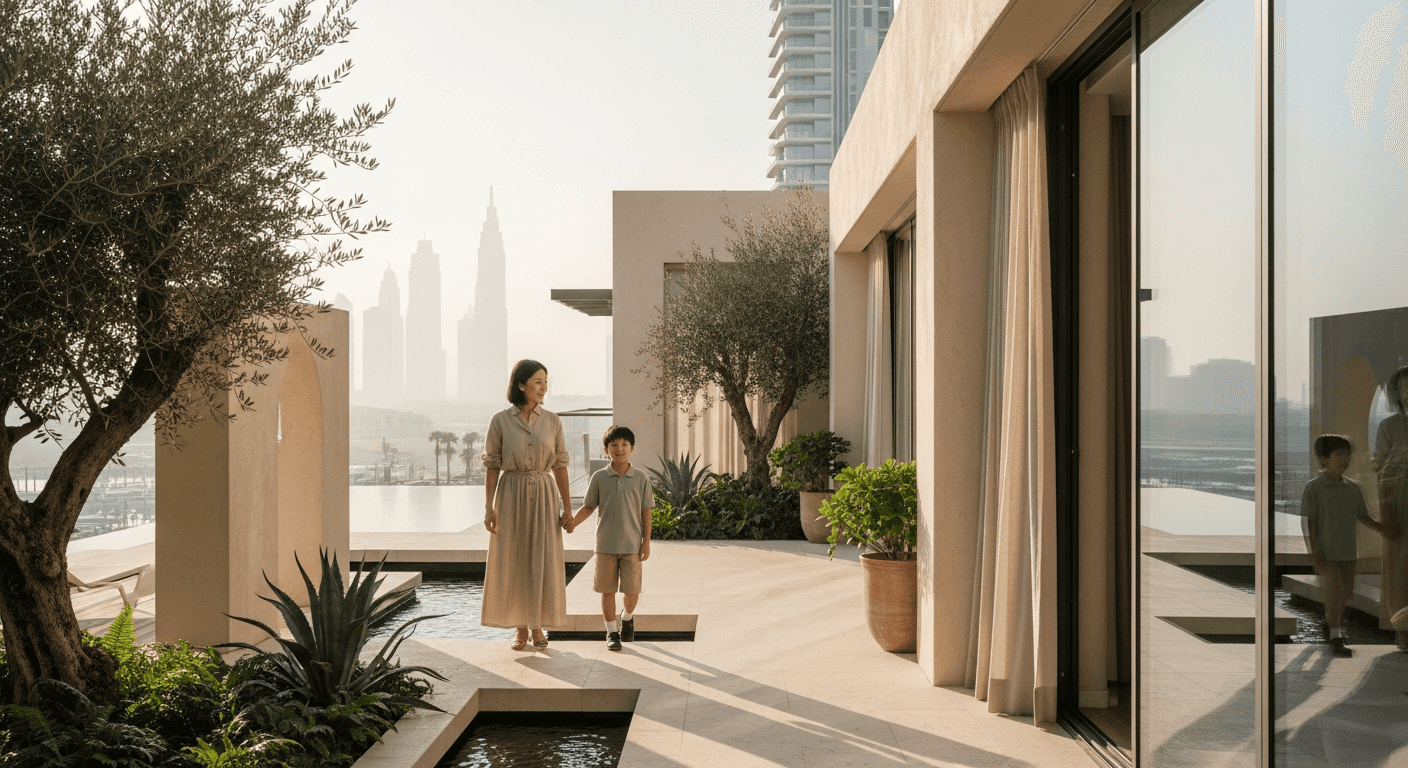
Beyond the Brochure: A Real-World Guide to Dubai's Amenities
A deep dive into the real-world quality of Dubai's luxury apartment amenities, from gym equipment and pool maintenance to the true value of residents' lounges and how they impact your service charges.

The marketing brochures all blur into one another after a while. Every new tower promises a 'resort-style' pool, a 'state-of-the-art' gym, and an 'exclusive' residents' lounge. As an apartment specialist at Gaia Living, my job is to look past the glossy renders and tell you what these spaces are actually like to live with. The difference between a brochure promise and the lived reality is where you find — or lose, real value.
Here's what we'll explore in this deep dive:
- The Amenity Arms Race: How facilities have evolved from a simple pool to a complete lifestyle offering.
- Fitness Centres: A detailed comparison of equipment, space, and what separates the best from the rest.
- Pools & Leisure Decks: Why factors like sunlight, size, and maintenance are more important than just having water.
- The Residents' Lounge: A litmus test for a building's quality and community spirit.
- The Rise of 'Lifestyle' Amenities: Investigating the real utility of cinemas, golf simulators, and more.
- The Service Charge Equation: A numerical breakdown of how much these amenities actually cost you.
- My Verdict: Naming the towers and developers that deliver genuine, lasting value.
The Amenity Arms Race: From Standard to Super-Premium
When I first started in Dubai real estate, 'luxury' amenities meant a key to a chain-link fence surrounding a pool and a small, air-conditioned room with a treadmill and a multi-gym. How times have changed. The baseline for a premium building today, especially in established hubs like Downtown Dubai or the Marina, has been raised dramatically. A temperature-controlled pool, a gym with a respectable selection of modern equipment, 24/7 security, and dedicated covered parking are no longer luxuries; they are the absolute minimum expectation for buyers and tenants in the AED 2M+ apartment segment.
This escalation is what I call the amenity arms race. It’s a direct result of a maturing market and fierce competition among developers. In the early days, location was everything. Now, with so many great locations available, developers must differentiate through lifestyle. They are no longer just selling square footage; they are selling a packaged, convenient, and curated living experience. This has led to the rise of the 'super-premium' or 'ultra-luxury' tier, where the amenity stack is the central pillar of the value proposition. Think of the branded residences that have become so popular, managed by hospitality giants and offering hotel-level services. Or consider standalone projects by developers like Emaar Properties, Meraas, and Select Group, who now compete on the quality and uniqueness of their common areas.
A clear line can be drawn. In one corner, you have a standard, solid-quality tower, perhaps built 5-10 years ago. It has a podium-level pool and a 1,500 sq ft gym. It's functional, clean, and does the job. In the other corner, you have a new launch like those in Emaar Beachfront. Here, the offering might include a private beach, multiple pools including a high-floor infinity pool, a sprawling fitness centre with yoga and HIIT studios, a residents' beach club, a licensed restaurant, and a full-time concierge. The apartment itself might be similar in size and finish to the older tower, but the lifestyle infrastructure it's connected to is in a different league entirely. This is the new battleground for premium real estate in Dubai.
Fitness Centres: A Detailed Equipment & Space Comparison
 Featured project
For many of my clients, the quality of the gym is a non-negotiable, make-or-break factor. A great in-house gym eliminates the cost (easily AED 4,000-8,000 per person annually) and inconvenience of a commercial gym membership. This is why a detailed luxury apartment amenities comparison must start here. Unfortunately, the term 'state-of-the-art gym' is one of the most abused phrases in real estate marketing. I've seen spaces that barely qualify as a hotel gym being described in such glowing terms.
In my experience, apartment gyms fall into three distinct categories. First, there's the 'disappointment gym'. You find these in older buildings or those by less-reputable developers. The tell-tale signs are a few mismatched, non-commercial grade treadmills, a single, wobbly multi-station machine where all the pins are missing, and a random assortment of dumbbells that max out at 10kg. The AC is usually weak, the lighting is fluorescent and grim, and it feels more like a storage room than a place for wellness. These gyms are a liability, not an asset.
Second is the 'Emaar Standard', which I use as a benchmark for good quality. In most Emaar buildings developed over the last decade, you'll find a well-appointed fitness centre. Typically, this means a full suite of Technogym or Life Fitness equipment — brands known for their durability and performance. You can expect a row of treadmills, ellipticals, and stationary bikes, a decent selection of selectorized resistance machines for a full-body workout, and a free-weights area with dumbbells going up to at least 30-40kg, along with several adjustable benches. There's often a separate area for stretching or floor work. These fitness centres apartment Dubai are well-maintained, clean, and genuinely useful for 90% of residents. They represent the modern standard for a premium building.
Finally, we have the 'elite' tier. These are gyms that are not just good for a residential building; they are better than most commercial facilities. Towers like The Volante in Business Bay, IL Primo in Downtown, or the new Six Senses Residences on Palm Jumeirah play in this league. Here, you'll find multiple squat racks and lifting platforms, extensive dumbbell racks (up to 50-60kg), specialist machines like dedicated leg presses and cable crossovers, and often separate studios for yoga, Pilates (with reformers), and high-energy spin classes. They might even have a boxing ring, a climbing wall, or outdoor workout zones. These facilities are designed for people who are serious about their training and are a powerful justification for the premium price tags and service charges these buildings command.
When you view an apartment, here's what I recommend you check in the gym:
- Brand Power: Look for Technogym, Life Fitness, Precor, or Matrix. It's a sign the developer didn't cut corners.
- The Dumbbell Test: Check the highest weight on the dumbbell rack. If it stops at 20kg, it's not a serious gym.
- Cardio Capacity: Are there enough treadmills and bikes for a building of this size? Imagine trying to get a machine at 7 PM. One treadmill for a 40-storey tower won't cut it.
- Space & Flow: Is there enough space between machines, or is it dangerously cramped? Is there a dedicated area for floor exercises and stretching?
- Ancillary Facilities: Are there clean changing rooms, showers, and lockers? Little things that make a big difference to usability.
Pools & Leisure Decks: More Than Just Water
After the gym, the swimming pool is usually the next item on a buyer's checklist. And just like the gym, the simple fact of its existence is not enough. The quality, design, and atmosphere of the pool area can define the entire living experience of a building. I’ve seen stunning infinity pools that are the heart and soul of their community, and I've seen sad, shaded pools that sit empty and unloved, a concrete monument to missed opportunity.
One of the most overlooked factors when assessing a pool is sunlight. Dubai's ever-growing skyline means 'canyoning' is a real problem. Many pools, especially those on lower podium levels in dense areas like the Marina or Business Bay, can be cast in the shadow of a neighbouring tower for most of the day. A pool that only gets direct sun from 1 PM to 3 PM is significantly less appealing. The best designs account for this. Look for buildings with pools on a south-facing aspect, on a higher floor, or in master-planned communities where building heights and orientations are designed to preserve light corridors. This is a level of detail that master developers like Emaar and Meraas excel at in their flagship projects.
Size and purpose are also critical. Is it a real lap pool for exercise, or is it a decorative, figure-eight-shaped 'leisure' pool? The best buildings often provide both. A 25-meter or even 50-meter lane pool is a massive draw for serious swimmers. Meanwhile, a separate, shallower lagoon-style pool with beach-entry or surrounded by cabanas creates a relaxed, family-friendly resort vibe. The Address Beach Resort in JBR is a prime example, famous for its record-breaking rooftop infinity pool for adults, but it also offers multiple family-friendly pools on its lower levels. It caters to every need.
Maintenance is the silent killer of pool-side luxury. Nothing deflates the 'premium' feel faster than missing tiles, cloudy water, or a deck littered with broken, faded sun loungers. This is where the quality of the Owners Association Management company becomes visible. A well-run building will have a pool that is impeccably clean, with crystal-clear water and a deck that is washed daily. The furniture will be high-quality, well-maintained, and plentiful. In contrast, a poorly managed building will let these things slide, and the pool area quickly becomes a depressing space. When inspecting a property, pay close attention to the state of the pool tiles, the clarity of the water, and the condition of the poolside furniture. It speaks volumes about how the building is managed and how your service charge is being spent.
The Residents' Lounge: A Litmus Test for Quality
If you want a quick and accurate measure of a building's true standing, go and see the residents' lounge. In my opinion, this single amenity is the most powerful litmus test for developer foresight and management competence. Why? Because a bad lounge is easy to build, but a good one is very hard to create. It requires a genuine understanding of how people live, work, and interact — something that can't be faked.
First, let's describe the failure case, which is depressingly common. The failed lounge is a large, soulless room, usually located in a forgotten corner of the building. It's filled with aesthetically pleasing but deeply uncomfortable furniture. There might be a 'pantry' which consists of an empty counter and a sink. The Wi-Fi is patchy, the lighting is harsh, and there's a profound silence that tells you nobody has willingly spent time here in months. This is the 'checkbox lounge' — the developer included it to tick a box on the features list, but invested zero thought into its actual function. It's a wasted space and a drain on the service charge.
Now, contrast this with a successful residents' lounge. It's a vibrant, multi-functional hub that acts as an extension of each resident's apartment. It's the building's living room. A great lounge is zoned for different activities. There might be a quiet, library-like area with comfortable armchairs for reading. Another section might have large tables and high-speed internet, effectively serving as a high-end co-working space — a huge value of building amenities for the growing number of remote workers. There will be a high-quality, bean-to-cup coffee machine that is constantly maintained and restocked. The space is used for community events, informal neighbourly chats, or simply as a place to work for a few hours without being cooped up in your apartment. Some of the best examples can be found in projects in DIFC and City Walk, which cater to a demographic of professionals who value these 'third spaces'.
“The most expensive amenities are the ones you pay for but never use. Judge a building on the quality and usability of its facilities, not just the length of the list in the brochure.”
The residents' lounge quality is therefore a direct reflection of the developer's philosophy. Did they think about power outlet placement for laptops? Did they specify commercial-grade Wi-Fi? Is there a simple system for booking a connected meeting room? Did they partner with a local roastery for the coffee beans? These small details are what separate the premium developers from the pack. A well-executed lounge fosters a sense of community, makes the building stickier for tenants, and adds tangible value to every apartment. When you view a building, don't just peek into the lounge; spend ten minutes there. If you feel comfortable and can imagine yourself using the space, it's a very positive sign.
The Rise of 'Lifestyle' Amenities: Cinemas, Golf Simulators, and More
Beyond the holy trinity of gym, pool, and lounge, we're now seeing a surge in specialized 'lifestyle' amenities designed to cater to specific hobbies and interests. This is the next frontier in the amenity arms race, where developers are creating niche facilities to attract a particular buyer profile. The offerings are getting more creative every year, but it's important to analyze their true utility versus their novelty factor.
Private cinema rooms are one of the most common examples. When done well, they are a fantastic perk. I've seen some with plush, tiered velvet seating, professional-grade 4K projectors, and Dolby Atmos sound systems that rival a commercial cinema. For a family movie night or watching a big sports match with neighbours, they can be a brilliant addition to the community. However, their success hinges entirely on management. Is there a simple, fair online booking system? Is it kept clean? Is there a library of content or an easy way to stream your own? If these aren't managed properly, the cinema room often becomes the most expensive, least-used room in the building.
Golf simulators have also exploded in popularity. In a city as golf-mad as Dubai, this is a huge value-add. For an avid golfer, the ability to practice their swing for an hour every evening without driving to a course is a game-changer. It's a smart amenity that provides real, tangible value to a passionate and affluent demographic. You'll often find these in buildings located in or near golf communities like Dubai Hills or Jumeirah Golf Estates, where the developer knows their target audience. Similarly, Padel tennis courts are the hot amenity of the moment. They take up less space than a full tennis court and are incredibly popular, fostering a social and active community.
Then you have the more niche offerings. We're seeing buildings with kids' splash pads and elaborate indoor playrooms, pet spas with grooming stations, music rooms with soundproof walls and a piano, and even private dining rooms with adjoining professional-grade kitchens that residents can book for dinner parties. Developers like Damac are known for pushing the boat out with themed and extravagant amenities, while others focus on wellness, incorporating yoga lawns, meditation gardens, and spa facilities with saunas, steam rooms, and treatment rooms. Each of these adds a layer of lifestyle, but also a layer of cost to the service charge. The crucial question a buyer must ask is not 'is this a cool feature?' but 'will I personally use this feature enough to justify its share of the cost?'. A building with a pet spa is fantastic if you have a dog; it's a completely wasted expense if you don't.
The Service Charge Equation: Calculating the Real Cost of Amenities
This brings us to the most important, and least glamorous, part of the discussion: the cost. Every sparkling pool, every high-tech treadmill, every plush cinema seat is paid for by the owners through their annual service charges. Understanding this equation is fundamental to making a smart property investment in Dubai. These premium residential facilities Dubai are not free. The fees are regulated, transparent, and must be understood before you sign any contract.
Service charges in Dubai are calculated on a per-square-foot basis for your unit's total area. These fees are proposed by the Owners Association management company and must be approved by the Real Estate Regulatory Agency (RERA). You can check the approved rates for any building on the Dubai Land Department (DLD) website or the Dubai REST app, which is a fantastic tool for transparency. The charges cover all common area maintenance, utilities, management fees, and, of course, the running and upkeep of the amenities.
Let's break down what this means in real numbers. Here are some realistic annual service charge ranges you can expect: - Standard/Older Building: AED 12 - 16 per sq. Ft. (e.g., an older tower in JLT or Discovery Gardens with a basic pool and gym). - Premium Building: AED 18 - 25 per sq. Ft. (e.g., a good quality Emaar or Meraas tower in Downtown, the Marina, or City Walk with a great gym, pool, and other facilities). - Ultra-Luxury/Branded Residence: AED 25 - 45+ per sq. Ft. (e.g., The Address residences, One at Palm Jumeirah, The Royal Atlantis. This includes hotel services, multiple pools, spas, etc.).
To put that in perspective, let's run the numbers for a typical 1,200 sq. Ft. two-bedroom apartment:
- Building A (Standard @ AED 15/sq. Ft.):
- 1,200 sq. Ft. x AED 15 = AED 18,000 per year (or AED 1,500 per month)
- Building B (Premium @ AED 25/sq. Ft.):
- 1,200 sq. Ft. x AED 25 = AED 30,000 per year (or AED 2,500 per month)
- Building C (Ultra-Luxury @ AED 40/sq. Ft.):
- 1,200 sq. Ft. x AED 40 = AED 48,000 per year (or AED 4,000 per month)
The jump from Building A to Building C is AED 30,000 per year. The critical task for any buyer is to conduct a personal cost-benefit analysis. That AED 1,000 monthly difference between Building A and Building B needs to be justified. Does Building B's elite gym save you and your partner two commercial gym memberships worth AED 1,200 a month? Does its co-working lounge save you a AED 1,000 monthly hot-desk fee? Does its amazing pool and community events genuinely improve your quality of life in a way you're willing to pay for? If the answer is yes, then the higher service charge represents fantastic value. If you'll never use those facilities, you're better off in Building A.
My Verdict: Which Towers Deliver True Value?
After years of walking through hundreds of buildings, I've come to believe that 'value' in the context of amenities is not about having the longest list of features. It's about the intersection of quality, usability, and cost. A building that gets this trifecta right is a building that will hold its value and provide a superior quality of life for its residents.
For the value-conscious end-user or a first-time buyer, my advice is often to look at the foundational projects by top-tier developers. The original six Emaar towers in Dubai Marina are a perfect case study. Their amenities — by today's super-premium standards, are basic: good-sized pools, functional gyms, squash courts, and well-kept common areas. They don't have cinemas or pet spas. But what they have is robust, built to last, and has been impeccably maintained for two decades. The service charges are reasonable (often in the AED 17-20/sqft range), and the lifestyle is fantastic thanks to the prime location. You get 80% of the luxury lifestyle experience for a fraction of the running cost of a newer, more ostentatious tower. This is smart, sustainable luxury.
For the lifestyle maximiser, for whom the amenity package is the primary draw, I would point towards master-planned communities built around a specific theme. Projects in Emaar Beachfront, for example, are all about sun and sea. The private beach access and resort-style pools are the central selling point. Yes, the service charges are higher, but they directly fund the very lifestyle that attracted you in the first place. Similarly, the residences in Bluewaters by Meraas offer a unique island lifestyle with a stunning pool and beach club at its heart, all within a walkable, low-rise community. In these instances, you are paying a premium for a unique and cohesive living experience that is impossible to replicate elsewhere.
Finally, for the ultra-high-net-worth individual seeking ultimate convenience and exclusivity, the branded residences remain in a class of their own. Towers like The Address Sky View, The Royal Atlantis Residences, or One at Palm Jumeirah offer a smooth, five-star hotel living experience. The amenities are world-class, but the real luxury is the service — valet parking, 24/7 concierge, in-residence dining, and à la carte housekeeping. The service charges can easily exceed AED 35-45/sqft, but for the target audience, the time and hassle saved is well worth the price. It's the pinnacle of effortless living.
The best value in Dubai's apartment market isn't found in the buildings with the longest list of amenities, but in those where the facilities are high-quality, well-maintained, genuinely useful, and appropriately priced through service charges. A great gym you use daily is worth paying for; a private cinema that sits empty is just a shared cost you should avoid.
Sources
- Dubai Land Department (DLD): dubailand.gov.ae
- Real Estate Regulatory Agency (RERA): Service Charge Index information available via the DLD portal.
- Dubai REST App: dubairest.gov.ae
Questions, answered
- What are typical service charges for a premium apartment in Dubai?
- For a premium building with good amenities in areas like Dubai Marina or Downtown, expect service charges between AED 18 and AED 25 per square foot, per year. Ultra-luxury or branded residences can be significantly higher, from AED 25 to over AED 45 per square foot.
- Are building amenities in Dubai really worth the higher cost?
- It depends on your lifestyle. If you replace a monthly gym membership (AED 400-800) and co-working space fee (AED 1000+) with high-quality building facilities you use daily, the higher service charge can represent excellent value. However, paying for amenities you never use is a poor investment.
- How can I check the quality of a building's gym before buying?
- During a viewing, check the brand and condition of the equipment (Technogym/Life Fitness are good signs), the range of free weights, and whether there are enough cardio machines for the building's size. Also, note the cleanliness, ventilation, and opening hours to see if it fits your routine.
- What's more important: the number of amenities or their quality?
- Quality is far more important. A building with a long list of poorly maintained, unusable facilities offers worse value than one with just a high-quality, well-managed gym and pool. Focus on the usability and condition of the amenities that matter most to you.
- Where can I find the official service charge for a Dubai building?
- You can find approved service charge indexes on the Dubai Land Department's (DLD) official website and through the Dubai REST mobile application. This provides transparency and allows you to check the fees for any specific building.
- Do amenities affect an apartment's rental yield?
- Yes, significantly. A superior amenity package makes a building more attractive to tenants, allowing for higher rental rates and reducing vacancy periods. For tenants, a building with a great gym, pool, and lounge can justify a higher rent as it saves them money on external memberships.

Ravi lives and breathes apartment living — from studio yields in JVC to branded residences on the Palm. Floor plans, service charges, and view lines are his love language.
Related stories
Right-Sizing Your Dubai Villa for a New Chapter
As an empty nester or active retiree, your idea of the perfect Dubai home shifts. I explore the best villa communities that prioritise lifestyle and low-maintenance living over sheer size.
Dubai's AC Dilemma: The Real Cost of Cooling
Your apartment's air conditioning is more than just a utility—it's a major factor in your monthly budget and comfort. I'll break down the real costs and benefits of Dubai's two main cooling systems, helping you choose your next home wisely.
Managing Multiple Offers: A Dubai Seller's Playbook
Receiving multiple offers on your Dubai property is an excellent problem to have, but handling it incorrectly can cost you time and money. Here’s my strategic playbook for managing competitive bids to secure the best possible outcome.
Echoes, in your inbox
One thoughtful email a month. Market insight, new launches, no spam.