

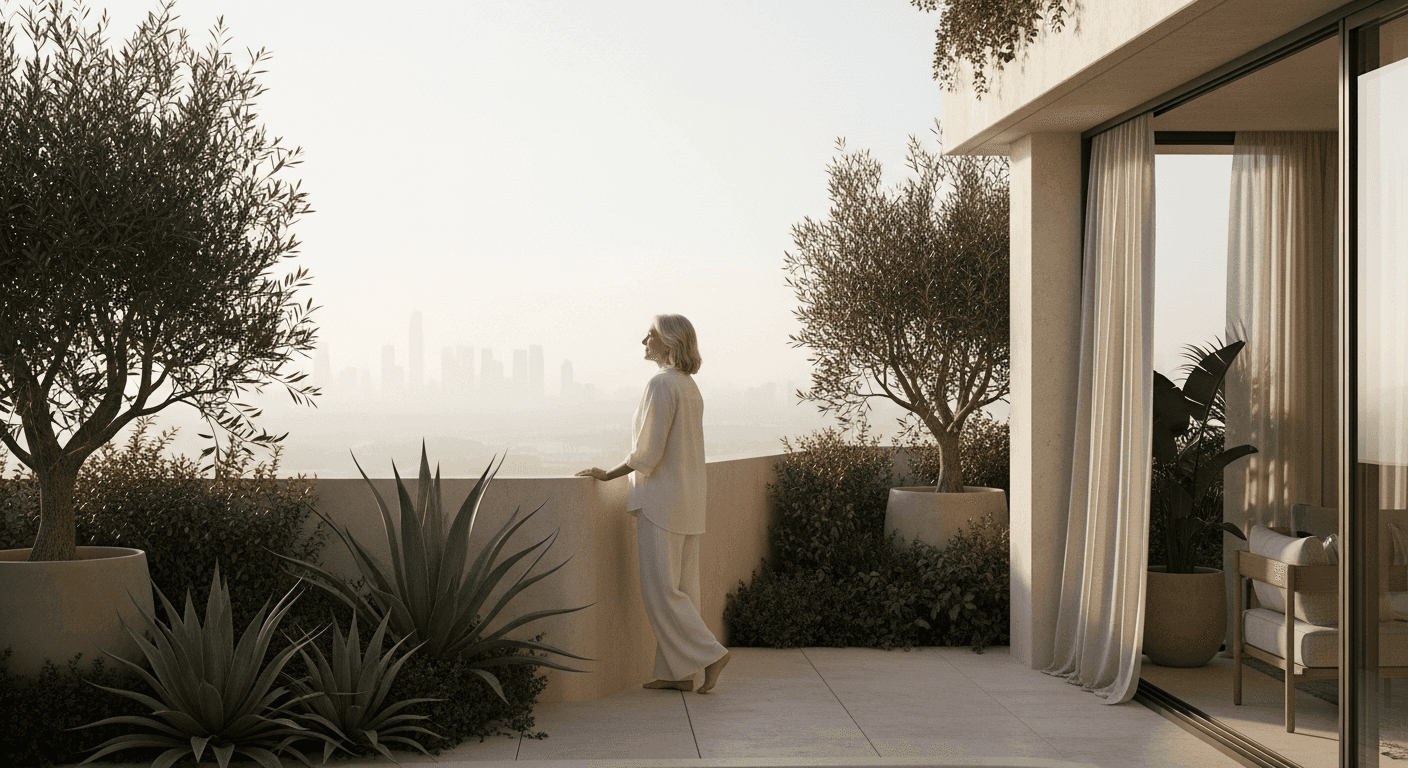
Beyond the Balcony: Dubai's Best Terraces
A large terrace is more than a feature; it's a lifestyle with a quantifiable premium. As an apartment specialist, I'll guide you through the true value, hidden costs, and best examples of terrace apartments in Dubai.

In my years specialising in Dubai apartments, I’ve seen client wishlists evolve dramatically. What was once a simple request for a balcony big enough for a chair has blossomed into a full-blown demand for genuine outdoor living. The pandemic crystalised this shift, but the desire for private, usable green space was already growing. Today, the ultimate expression of this is the apartment terrace.
Here's what we'll explore in this detailed guide:
- The real definition of apartment luxury and the `indoor-outdoor living premium`.
- How to properly quantify the value of a terrace — beyond simple price-per-square-foot math.
- The significant hidden costs, especially service charges, that every buyer must understand.
- A tour of the best beachfront terrace apartments in Palm Jumeirah and JBR.
- A look at the ultimate urban-view terraces in Downtown Dubai and City Walk.
- The greenest, most serene options in communities like Al Barari and Dubai Hills.
- A breakdown of different terrace types, from wrap-arounds to podiums.
- My personal, essential checklist for assessing any terrace apartment before you commit.
The New Definition of Apartment Luxury
For decades, luxury in a Dubai apartment was defined by two things: the view and the internal finishing. A high floor, marble floors, and brand-name kitchen appliances were the hallmarks of a premium property. The balcony was often an afterthought — a narrow ledge, sometimes awkwardly shaped, offering just enough space to step outside and feel the humidity. It was a feature to be listed, not a space to be lived in. That era is definitively over. The new benchmark for luxury, the one my clients are increasingly willing to pay a significant premium for, is space. Specifically, `private outdoor space value`.
This is about more than just square footage. A true terrace, in the context of today's market, is an extension of the home. It’s an outdoor room. It’s a space for dining with a dozen friends, for children to play safely, for a morning yoga session with a skyline view, or for creating a private garden in the sky. When we at Gaia Living talk about `apartments with large terraces Dubai` has to offer, we're not talking about a 150-square-foot balcony. We are talking about spaces ranging from 500 square feet to, in some extraordinary cases, several thousand square feet. These are spaces that fundamentally change the experience of apartment living, blurring the lines between a high-rise residence and a villa.
The demand is driven by a profound shift in how we want to live. The `indoor-outdoor living premium` isn't just a marketing term; it's a reflection of a desire for a healthier, more balanced lifestyle. Residents want natural light, fresh air, and a connection to the environment, even in a dense urban setting. A well-designed terrace offers this in a way no other amenity can. It provides the convenience and security of an apartment with the soul and private retreat of a traditional house. My client conversations have changed; the first question is often no longer "which floor?" but "how big is the terrace and what can I do with it?"
Developers have responded, albeit with varying degrees of success. Newer projects are increasingly designed around this concept, with architects carving out significant portions of the building's mass to create these outdoor voids. Older buildings are being reassessed, with their often-overlooked podium-level units or oversized penthouse terraces suddenly becoming the most sought-after properties in the tower. Understanding this shift is the first step to appreciating the true value proposition of a terrace apartment. It is a home, a garden, and a status symbol, all in one.
Quantifying the Terrace Premium
 Featured project
So, how much is a terrace actually worth? This is one of the most common questions I get, and the answer is more complex than a simple calculation. The common mistake is to apply the apartment's internal price per square foot directly to the terrace. A 2,000 sq ft apartment selling for AED 4 million (AED 2,000/sq ft) with a 1,000 sq ft terrace is not simply worth AED 4 million + (1,000 sq ft * AED 2,000/sq ft) = AED 6 million. If it were that simple, my job would be a lot easier. The market applies a more nuanced valuation.
The industry's rule of thumb is to value external space at a fraction of the internal space, typically between 25% and 50% of the price per square foot. Using our example, a more realistic valuation might be: AED 4 million (internal) + (1,000 sq ft * [AED 2,000 * 50%]) = AED 5 million. This 50% figure is reserved for prime, highly usable terraces with excellent views. A less private, oddly shaped, or view-obstructed terrace might only command a 25% valuation, bringing the total value down to AED 4.5 million. This is the basic, quantitative starting point.
However, this calculation misses the most important factor: the emotional and lifestyle premium. For certain `best apartment terraces Dubai`, the whole is far greater than the sum of its parts. A wrap-around terrace on the 70th floor of a Dubai Marina tower overlooking the sea and the Palm, or a ground-floor terrace in Al Barari that melts into the community's botanical gardens, carries a value that defies simple formulas. In these cases, the terrace isn't just an add-on; it's the defining feature of the property. This is where the premium can escalate to 20%, 30%, or even more over an equivalent unit without that specific outdoor space. It creates a scarcity value. There may be 100 two-bedroom apartments in a building, but only two with that game-changing terrace. That scarcity is what drives the price beyond the math.
From a rental investment perspective, the logic holds. A spectacular terrace can absolutely justify a higher rental price and attract a better quality of tenant who is likely to stay longer. It makes the property stand out in a crowded rental market. Tenants will pay more for a home that offers a unique lifestyle. However, there's a ceiling. The rent premium must still make sense within the context of the area. While a great terrace might add 20% to the rental value, it's unlikely to add 50%. As a buyer, you need to weigh the purchase premium against the achievable rental premium and the undeniable lifestyle benefits if you plan to live there yourself.
The Hidden Costs of a Large Terrace
This is the part of the conversation where I bring my clients back down to earth. The romance of a sprawling terrace is powerful, but the financial reality needs to be understood from day one. The purchase price is just the beginning. The single most significant and frequently overlooked ongoing cost is the service charge.
In Dubai, service charges are levied by the Owners Association to cover the maintenance of all common areas, and they are regulated and monitored by the Real Estate Regulatory Agency (RERA). The crucial point is that these charges are calculated based on the total area registered on your Title Deed. This includes the internal built-up area *and* your terrace. A terrace is not free land; you pay for it at purchase, and you rent it forever from the Owner's Association through service charges.
Let’s run a real-world cost breakdown. Imagine two similar-quality apartments in Business Bay where the RERA-approved service charge is AED 20 per square foot per year.
- Apartment A (Standard Balcony):
- Internal Area: 1,800 sq ft
- Balcony Area: 200 sq ft
- Total Chargeable Area: 2,000 sq ft
- Annual Service Charge: 2,000 sq ft x AED 20/sq ft = AED 40,000
- Apartment B (Large Terrace):
- Internal Area: 1,800 sq ft
- Terrace Area: 1,500 sq ft
- Total Chargeable Area: 3,300 sq ft
- Annual Service Charge: 3,300 sq ft x AED 20/sq ft = AED 66,000
That is an extra AED 26,000 every single year — or over AED 2,100 per month, just for the privilege of having that terrace. This is a perpetual cost you cannot avoid. When you're considering two properties, you must do this calculation. A seemingly better deal on a terrace apartment might be a financial trap if the service charges are crippling.
Beyond service charges, there are other significant costs. The developer will hand over a tiled, waterproofed concrete slab. Turning it into the oasis you envision costs money. A high-quality pergola can cost AED 50,000 or more. An outdoor kitchen with a built-in grill and fridge can easily exceed AED 100,000. Designer outdoor furniture, extensive planting with irrigation systems, feature lighting, and regular maintenance (jet washing, plant care, waterproofing checks) all add up. I advise my clients to budget at least 5-10% of the property's value for a proper initial terrace fit-out if they want to do it justice. Ignoring these hidden costs can lead to a beautiful, large terrace that sits empty and unused because the owner never budgeted to make it habitable.
“A terrace is not free land; you pay for it at purchase and you rent it forever from the Owner's Association through service charges.”
The Best of the Beachfront: Palm Jumeirah and JBR
When clients ask for the ultimate beachfront apartment experience, the conversation invariably starts with two iconic addresses: Palm Jumeirah and Jumeirah Beach Residence. Both offer spectacular sea views, but they deliver the terrace lifestyle in distinctly different ways.
Palm Jumeirah is the global benchmark for luxury coastal living. The terraces here are about grandeur and showcasing breathtaking views of the Arabian Gulf, the Dubai skyline, or the Atlantis. In super-prime new developments like the Atlantis The Royal Residences or One Palm by Omniyat, the terraces are architectural marvels. They feature private pools, double-height ceilings, and enough space for large-scale entertaining. These are not just balconies; they are private sky-courtyards. The developer Nakheel set the stage for this, but subsequent ultra-luxury projects have taken the concept to another level. The premium is immense, but for a certain type of buyer, this is the pinnacle of Dubai living.
For those seeking value on the Palm without the multi-million-dirham price tag of the newest launches, I often point towards older, established buildings. The Shoreline Apartments, for example, have some fantastic large terraces in their penthouse units. Marina Residences, located at the base of the trunk, offers apartments with generous, usable outdoor spaces overlooking the marina. While they may not have the brand-new finishes, they provide the same world-class location and lifestyle at a more accessible price point. A terrace here isn't just about the view; it's about a lifestyle that includes private beach access, seaside restaurants, and a permanent holiday atmosphere.
Just across the water, Jumeirah Beach Residence (JBR) offers a more vibrant, energetic, and urban take on beachfront living. While the high-floor penthouses in its 40 towers offer stunning wrap-around terraces with views of the Ain Dubai and the Palm, the most unique terrace properties in my opinion are at the podium level. These are apartments situated on the roof of the shared parking and retail structure, often with direct access to the communal swimming pools. These terraces can be enormous — sometimes larger than the apartment itself. They feel more like a private villa garden than a balcony, offering incredible space for families and entertainers. The trade-off is privacy and view; you are overlooked by the towers above and you don't get the same panoramic sea view as the penthouses. But for sheer space and value, they are hard to beat. I've seen clients create incredible gardens, play areas, and even install full-size gazebos on these podium terraces in clusters like Sadaf, Murjan, and Bahar.
Urban Oases: Downtown Dubai and City Walk
Moving away from the coast, the urban core of Dubai offers a different but equally compelling proposition for terrace living. Here, the terrace is a front-row seat to the city's dynamism, with the view itself becoming the primary asset.
Downtown Dubai, master-planned by Emaar Properties, is the epicentre of this trend. The ultimate prize here is a terrace with a direct, unobstructed view of the Burj Khalifa and the Dubai Fountain. The premium for this specific view is one of a handful of the most pronounced in the entire Dubai property market. I have seen identical apartments on opposite sides of the same building trade with a price differential of over 30%, purely based on the view from the terrace. It's a trophy asset. Buildings like The Address Fountain Views, Opera Grand, or the penthouses in the Burj Khalifa itself, offer some of the most spectacular (and expensive) terraces in the world. During New Year's Eve, these spaces become priceless private viewing decks.
But Downtown is not just about the super-prime. Some of the older communities, like the South Ridge or Old Town complexes, offer apartments with surprisingly generous and charming terraces. Old Town, in particular, with its low-rise, traditional Arabic architecture, has beautiful courtyard-facing terraces that provide a sense of calm and community in the heart of the bustling city. They don't have the knockout Burj view, but they offer a different kind of `private outdoor space value` — one based on tranquility and architectural charm. These often represent a more affordable entry point into the Downtown terrace market.
A few kilometres away, City Walk by Meraas presents a different model for urban terrace living. It’s low-rise, design-focused, and has a distinctly European feel. The terraces here are smoothly integrated into the architecture. They are less about a single, dramatic view and more about creating a private, sophisticated outdoor living room that overlooks the curated, pedestrian-friendly boulevards. The build quality is exceptional, and the focus is on a complete lifestyle package with high-end retail and dining right at your doorstep. A terrace apartment in City Walk is for someone who appreciates design, walkability, and a sense of being in a cosmopolitan, vibrant neighbourhood without the verticality of a traditional skyscraper district.
The Green Sanctuaries: Al Barari and Dubai Hills Estate
For a growing number of residents, the ultimate luxury isn't a sea view or a skyline view; it's a green view. This desire for nature, tranquility, and wellness has given rise to some of Dubai's most exciting residential communities, where the terrace is transformed into a private garden.
The undisputed champion in this category is Al Barari. The name itself means "wilderness," and the entire community is built around this ethos. It's a botanical haven, with 60% of the masterplan dedicated to landscaped gardens, lakes, and waterways. The apartments here, in buildings like Seventh Heaven and The Neighbourhood, were designed from the ground up to maximize this connection to nature. They are famous for their enormous, cascading terraces that are deep enough to plant mature trees. The `indoor-outdoor living premium` reaches its zenith here. The lines between the living room and the terrace are blurred by floor-to-ceiling glass that slides away completely. It feels less like an apartment and more like a treehouse villa.
Living in Al Barari is a conscious choice. You are trading proximity to the main business hubs for an unparalleled sense of peace and a connection to nature. The buyers I work with who choose Al Barari are not just looking for a home; they are buying into a wellness-focused lifestyle. The terrace is not an amenity; it is the centrepiece of the home, a space for reflection, family time, and immersion in the lush surroundings. The service charges reflect the immense upkeep of the community's greenery, but for its residents, it's a price worth paying for a unique living experience.
A more mainstream but equally compelling option is Dubai Hills Estate. This vast master community by Emaar is anchored by a championship golf course and a huge central park. While it also offers villas, the apartment buildings positioned along the park and golf course have become incredibly popular. Buildings like Golf Suites, Collective, and Park Point offer apartments with generous terraces that look out over rolling fairways and manicured green spaces. The views are serene and calming, providing a welcome respite from the city's hustle.
The appeal of Dubai Hills is its balanced proposition. It offers the green sanctuary feel but combines it with the amenities of a fully-fledged town: a world-class mall, international schools, a hospital, and excellent connectivity to the rest of Dubai. The terraces here provide a country-club lifestyle at a more accessible price point than Al Barari. It’s particularly popular with families who want safe outdoor space for their children and direct access to parks and playgrounds. The `best apartment terraces Dubai` has for golf lovers are undoubtedly found here.
The Wrap-Around Wonders and Podium Giants
Beyond location, the specific type and position of a terrace within a building has a massive impact on its usability and value. As an apartment specialist, I encourage my clients to think about the architectural form as much as the address. Two types that deserve special attention are the wrap-around terrace and the podium terrace.
A wrap-around terrace, typically found on a corner unit or as part of a full-floor penthouse, is a truly special feature. Because it spans at least two sides of the building, it offers multiple views and exposures to the sun and wind. This allows you to create distinct zones. You can have a dining area that catches the morning sun for breakfast, a lounge area that is shaded in the afternoon, and a spot that is perfect for watching the sunset. In Dubai's climate, this is a huge advantage, as it means some part of your terrace is likely to be usable at any given time of day. You might have a stunning sea view on one side and a dynamic skyline or marina view on the other. This multi-aspect living is a rare luxury, and these units command a significant premium and are highly sought-after in towers across Dubai Marina and JBR.
Then there are the podium giants. As I mentioned with JBR, these are apartments located on the lower floors of a tower, built on the roof of the podium structure that usually houses parking and retail. Their defining characteristic is space — often vast, sprawling, and on a single level. It’s the closest you can get to a traditional villa's backyard in a high-rise development. The trade-offs, however, are significant. The number one issue is privacy. You are almost always directly overlooked by hundreds of apartments in the tower above. The views are also limited; you're typically looking at the building opposite or the communal pool area. There can also be more noise from podium-level amenities. That said, for the right buyer, these can be hidden gems. I have clients who value sheer space above all else, for large pets, for kids' play equipment, or for hosting large gatherings. For them, a 3,000 sq ft podium terrace is far more valuable than a 500 sq ft penthouse balcony, even with its superior view. Communities like City Walk and some buildings in Downtown Dubai have excellent examples of well-designed podium units.
A Buyer's Checklist for Terrace Apartments
Finding an apartment with a large terrace listed online is easy. Finding one that truly works is much harder. Over the years, I've developed a mental checklist that I run through whenever I inspect a terrace property. I urge every prospective buyer to do the same. Don't be swayed by the view alone; the practical details are what determine if you'll actually use and enjoy the space.
Here is my essential checklist for assessing `luxury apartment balconies` and terraces:
- Layout and Usability: Is the terrace a functional shape, like a square or a deep rectangle, or is it a long, narrow 'bowling alley' that's difficult to furnish? Walk the space. Can you realistically fit a dining table and a separate lounge area? Are there awkward angles or structural columns that eat into the usable space?
- View and Privacy: Stand in every corner and at the glass door. What exactly do you see? Now, who can see you? Look up at the apartments above. Look across to the neighbouring buildings. Is the sense of privacy acceptable to you? A beautiful sea view can be ruined if you feel like you're on stage for the entire neighbourhood.
- Sun, Shade, and Wind: Visit at different times of the day if possible. Which way does the terrace face? A south-facing terrace will be a furnace in the summer months unless it has a deep overhang or pergola. A high-floor, exposed terrace can become an unusable wind tunnel. Understand the microclimate of that specific terrace.
- Structural Provisions: This is a big one. Look for existing water taps and drainage points. Are there enough for the plants you envision? Where are the external power sockets, and are they weatherproofed? If you're dreaming of a plunge pool or hot tub, has the slab been structurally reinforced to take the weight? Don't assume; ask to see the building's technical specifications.
- Building and Community Rules: Before you fall in love, find out what you're allowed to do. You must obtain a No Objection Certificate (NOC) from the Owners Association for almost any modification. Can you install a permanent pergola? Can you build an outdoor kitchen? Are there rules about the type of furniture or plants you can have? Some high-end communities have strict aesthetic guidelines. Get the community rules in writing *before* you sign the contract.
- Waterproofing and Condition: Look for signs of past leaks, especially where the terrace meets the building facade and around drainage points. Check for cracked tiles or failing grout. Ask about the maintenance history. A leaking terrace can cause catastrophic damage to the apartment below and within your own unit, and repairs are complex and expensive.
A great terrace transforms an apartment into a home with the soul of a villa, but a poorly chosen one is just an expensive, dusty liability that adds to your service charges. Due diligence is everything.
At Gaia Living, we pride ourselves on looking beyond the glossy photos to help our clients understand these critical details. A terrace apartment is a significant investment in both money and lifestyle. My goal is to ensure it's a decision that brings you joy for years to come, not a recurring maintenance bill for a space you never use. If you are starting your search for an apartment with exceptional outdoor space, I and my colleagues are here to guide you through every step of this checklist and beyond.
## Sources - Dubai Land Department (DLD) - dubailand.gov.ae - Real Estate Regulatory Agency (RERA) - dubailand.gov.ae - UAE Government Portal - u.ae
Questions, answered
- How much value does a large terrace add to a Dubai apartment?
- There's no fixed rule, but a common industry benchmark values outdoor space at 25-50% of the internal area's price per square foot. However, for exceptional terraces with prime views (e.g., Burj Khalifa or sea), the lifestyle premium can push the apartment's total value up by 20% or more.
- Are service charges for terraces the same as for internal areas in Dubai?
- Yes. In Dubai, service charges are almost always calculated on the total area on the title deed, which includes terraces, balconies, and even parking spaces. This is a critical and often overlooked cost when considering an apartment with a large terrace.
- Can I build a pergola or install a hot tub on my apartment terrace in Dubai?
- It depends entirely on the building's rules, which are set by the developer and the Owners Association. You must obtain a No Objection Certificate (NOC) for any structural additions. Always verify these rules before purchasing, as they vary significantly between communities.
- Which Dubai communities are best for apartments with large terraces?
- For beachfront living, look at Palm Jumeirah and podium units in JBR. For iconic city views, Downtown Dubai is unmatched. If you want lush, green surroundings, Al Barari and Dubai Hills Estate offer apartments with exceptionally large and green terraces.
- What's the difference between a podium terrace and a penthouse terrace?
- A podium terrace is on a lower floor, typically the roof of the building's parking or amenity level. They are often very large but may lack views and privacy. A penthouse terrace is on the top floor, offering the best views, privacy, and prestige, usually at a much higher price point.
- Is a large terrace a good investment?
- A well-chosen terrace apartment in a prime location can be an excellent investment, commanding both higher resale values and rental yields. However, you must factor in the higher initial cost and ongoing service charges. A poorly designed or located terrace may not provide a proportional return.

Ravi lives and breathes apartment living — from studio yields in JVC to branded residences on the Palm. Floor plans, service charges, and view lines are his love language.
Related stories
Dubai's Established Charm: The Case for Older Homes
In a city focused on the future, I believe the smartest move for many buyers is to look back. Dubai's seasoned communities offer space, character, and surprising value that new builds often can't match.
The True Cost of Owning a Dubai Property
Beyond the purchase price, your annual budget for a Dubai home must account for service charges, utilities, and maintenance. I'll break down every ongoing expense you need to plan for.
Calculating ROI on Dubai Rental Upgrades
As a landlord in Dubai, you can't just follow trends. I'll show you how to calculate the precise ROI of minor property upgrades to genuinely increase your rental yield.
Echoes, in your inbox
One thoughtful email a month. Market insight, new launches, no spam.