

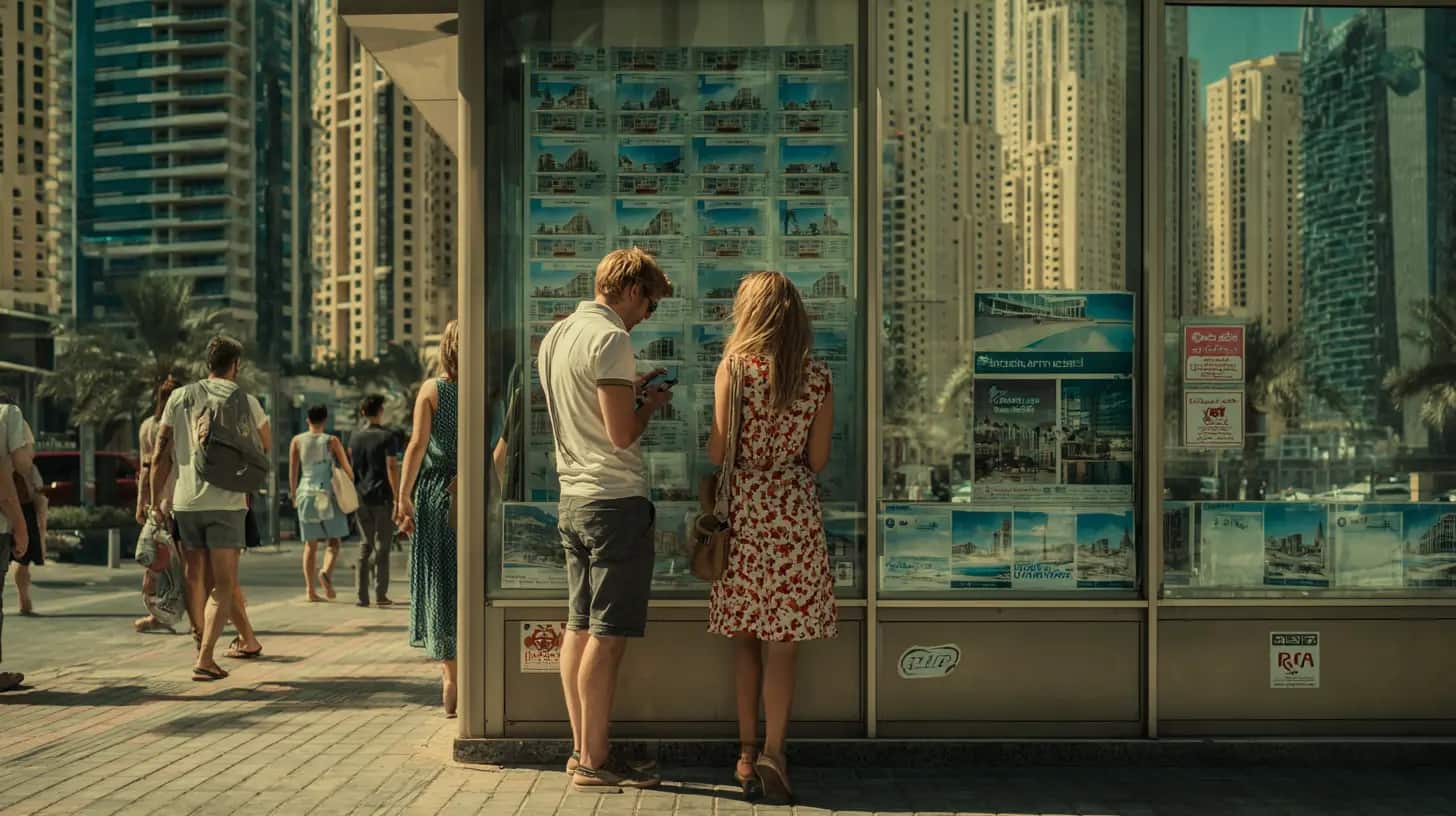
What Is the Average Rent in Dubai
"Average Rent in Dubai" Is Almost a Meaningless Number Without the Context That Makes It Useful. If you were to ask about the average rent of one-bedroom apartments in Dubai, you would be…
"Average Rent in Dubai" Is Almost a Meaningless Number Without the Context That Makes It Useful.
If you were to ask about the average rent of one-bedroom apartments in Dubai, you would be told something between AED 80,000 and AED 120,000 per year. This information is technically correct, but it does not provide any practical value. It does not matter whether you are talking about a one-bedroom in JVC and a one-bedroom in Downtown Dubai with a view of the Burj Khalifa; they are still both one-bedroom apartments in Dubai, yet neither can be considered an equivalent product and certainly not in the same market.
The only thing that would be helpful for anyone looking for accommodation in Dubai—for planning a move, comparing your current rent against market trends, or assessing your rental property investments—would be knowing the rents of specific communities and specific unit types.
The rental market in Dubai has reached its peak levels in the majority of communities in 2026. The cycle of appreciation that started in 2020 has lasted for five years already. While some communities have witnessed a growth in rents by 50%-70% from the starting level of the cycle, others have seen smaller increases. Meanwhile, the RERA rent index—which regulates the amount by which the landlord is allowed to increase the rent during the renewal period—has been steadily growing along with the market. This means that those who signed contracts in 2021 and 2022 now find themselves negotiating their renewals under the conditions of an appreciating market.
This article describes the actual rental rates of one-bedroom apartments in Dubai's main residential communities in 2026.
How Dubai Rents Are Structured
Before the numbers, a brief orientation on how the Dubai rental market works mechanically — because it affects how rents are presented and compared.
Dubai rents are quoted annually in AED as a total annual figure, not as a monthly amount. A landlord advertising at AED 120,000 is quoting the full annual rent — the monthly equivalent is AED 10,000. Listings on Property Finder and Bayut sometimes show both the annual and monthly equivalent, but the annual figure is the contractual reference.
Payment is made by post-dated cheques, typically split into one, two, four, or twelve instalments per year. A one-cheque arrangement — the full year's rent in a single cheque deposited at the start of the tenancy — is the most landlord-preferred structure. Tenants who offer fewer cheques (one or two) sometimes negotiate a slight discount relative to the same property offered at four or twelve cheques, because the landlord prefers the certainty.
The RERA rental index is the regulatory reference that governs allowable rent increases at renewal. RERA publishes quarterly data on average market rents by community and unit type. At renewal, a landlord can only increase rent by the RERA-specified amount based on how the current rent compares to the index — and in some cases, if the current rent already meets or exceeds the index, no increase is permitted at all. For tenants currently paying below-market rents who are coming up to renewal, understanding the RERA framework is important. Current index data is available at RERA's official rental index portal.
Studio Apartments: What to Expect
Studios in Dubai are predominantly occupied by young professionals, single expats, and investors targeting maximum yield. They represent the lowest entry point to the rental market in most communities.
Current annual rents for studios across Dubai's main communities:
- JVC and Al Furjan: AED 45,000 to AED 65,000 — the most accessible tier, good road connectivity, functional community infrastructure
- Deira and Bur Dubai: AED 35,000 to AED 55,000 — older buildings, more urban character, central location
- Business Bay: AED 65,000 to AED 90,000 — urban professional community, canal-facing units at the top of the range
- Dubai Marina: AED 75,000 to AED 110,000 — waterfront address, wide range of building quality within the range
- Downtown Dubai: AED 75,000 to AED 110,000 — limited studio supply, strong demand from young professionals
- DIFC: AED 85,000 to AED 120,000 — financial district address premium
- Palm Jumeirah: AED 90,000 to AED 130,000 — island premium, beach access
Studios are typically the highest-yielding unit type in each community — strong demand from the large professional single-occupant population and lower capital cost relative to the rent they generate. Yields run 7% to 10% in the accessible communities.
One-Bedroom Apartments: The Market's Core Product
One-bedroom apartments are the most actively rented unit type in Dubai — the product that serves the largest segment of the city's professional population and the unit type with the most inventory, the most competition among landlords, and the most transparent pricing data.
Annual rents for one-bedrooms across the main communities:
- Mirdif: AED 70,000 to AED 100,000 — accessible family community, airport proximity, good schools nearby
- JVC: AED 80,000 to AED 120,000 — consistent mid-market yield community, Circle Mall anchor, good road access
- Al Furjan: AED 80,000 to AED 125,000 — metro connectivity distinguishes it from comparable communities
- Jumeirah Lake Towers (JLT): AED 85,000 to AED 130,000 — DMCC free zone address, metro access, lake views
- Business Bay: AED 95,000 to AED 155,000 — canal-facing units at the top end, strong corporate tenant base
- Dubai Marina: AED 110,000 to AED 185,000 — waterfront lifestyle premium, high short-term rental activity
- JBR: AED 120,000 to AED 180,000 — beach access drives premium over non-waterfront peers
- Downtown Dubai: AED 115,000 to AED 220,000 — widest range in any community, Burj view units at the top
- DIFC: AED 130,000 to AED 200,000 — financial district professional tenant base
- Emaar Beachfront: AED 140,000 to AED 210,000 — private beach, gated community, newer stock
- Palm Jumeirah: AED 150,000 to AED 250,000 — island address, beach access, resort lifestyle
The range within each community is significant and reflects the variables covered earlier — building age and quality, floor level, view, and the specific micro-location within the community. A one-bedroom in an older JVC building on a lower floor without views sits at the lower end of the JVC range. A one-bedroom in an Ellington or Binghatti building with Circle Mall proximity and good natural light sits at the upper end.
Two-Bedroom Apartments: Family and Professional Households
Two-bedrooms are the unit type most affected by the post-2020 appreciation cycle. Rents have risen sharply as Dubai's resident population has grown and as families — particularly those who previously rented two-bedrooms in secondary communities — have competed for inventory across a range of communities.
Annual rents for two-bedrooms:
- Mirdif: AED 100,000 to AED 145,000 — best value for genuine family living in Dubai
- JVC: AED 115,000 to AED 165,000 — good school access, parks, improving community infrastructure
- Al Furjan: AED 110,000 to AED 160,000 — metro access adds commuter value for Business Bay and Marina workers
- JLT: AED 120,000 to AED 175,000 — lake views and DMCC free zone access
- Dubai Hills Estate: AED 160,000 to AED 240,000 — school catchment premium, golf course views at the top
- Business Bay: AED 155,000 to AED 240,000 — central urban address, canal views commanding the premium
- Dubai Marina: AED 175,000 to AED 300,000 — high range reflecting quality variance within the community
- Downtown Dubai: AED 185,000 to AED 380,000 — widest range, fountain and Burj view units at the top
- Arabian Ranches: AED 180,000 to AED 260,000 (townhouses and apartments) — established family community
- Emaar Beachfront: AED 200,000 to AED 320,000 — private beach access justifies the premium over non-beach peers
- Palm Jumeirah Shoreline: AED 210,000 to AED 350,000 — beach-facing units approaching villa territory on price
Two-bedroom rents in Dubai's most sought-after communities have crossed thresholds that are requiring some families to make difficult choices about community versus budget. A two-bedroom in Dubai Hills Estate at AED 200,000 annually is a AED 16,700 per month commitment — a real test of budget for households earning AED 40,000 to AED 50,000 monthly.
Three-Bedroom and Larger: Family Space at Significant Cost
Three-bedroom apartment rents cover the widest absolute range of any unit type — from accessible family apartments in mid-market communities to large high-floor units in premium towers that approach villa pricing.
Annual rents for three-bedrooms:
- Mirdif: AED 130,000 to AED 175,000 — genuine family value, most affordable three-bedroom market in Dubai
- JVC: AED 145,000 to AED 200,000 — improving school access, parks, functional community
- Dubai Hills Estate: AED 220,000 to AED 330,000 — school catchment, golf environment, well-managed community
- Business Bay: AED 200,000 to AED 320,000 — urban professional community, corporate tenant base
- Dubai Marina: AED 230,000 to AED 420,000 — high-floor marina view units at the premium end
- Downtown Dubai: AED 260,000 to AED 600,000 — ultra-premium units with panoramic Burj and fountain views at the ceiling
- Palm Jumeirah: AED 280,000 to AED 550,000 — Shoreline three-bedrooms, crescent apartments, approaching frond villa territory
For families specifically, the three-bedroom market in Mirdif and JVC represents the best value for space relative to cost. The trade-off compared to Dubai Hills or Arabian Ranches is primarily school quality and community prestige.
Gaia Realty Original Research: Dubai Rental Market Snapshot, Q1 2026
Based on RERA rental registration data, DLD transaction records, and active listing analysis across Dubai's residential communities as of Q1 2026.
Median annual rents by community and unit type:
Studios:
- JVC: AED 54,000 — Business Bay: AED 76,000 — Marina: AED 90,000 — Downtown: AED 93,000
1-bed apartments:
- JVC: AED 96,000 — JLT: AED 107,000 — Business Bay: AED 121,000 — Marina: AED 145,000 — Downtown: AED 158,000 — Palm Jumeirah: AED 195,000
2-bed apartments:
- Mirdif: AED 120,000 — JVC: AED 138,000 — Dubai Hills: AED 198,000 — Marina: AED 234,000 — Downtown: AED 268,000
3-bed apartments:
- Mirdif: AED 152,000 — JVC: AED 171,000 — Dubai Hills: AED 271,000 — Downtown: AED 388,000
Rent growth since 2020 by community:
- Downtown Dubai: up 68% on median rents
- Dubai Marina: up 62%
- Business Bay: up 58%
- Dubai Hills Estate: up 71% — highest growth community in the survey
- JVC: up 45% — below average growth, higher starting base
- Mirdif: up 38% — most moderate growth, reflecting accessible market positioning
Average tenancy length by community:
- Dubai Hills Estate: 3.8 years — highest retention
- Arabian Ranches: 4.2 years — school anchor effect
- Marina: 2.4 years
- Downtown: 2.1 years
- JVC: 2.7 years
Vacancy rates (percentage of units vacant at any given time):
- Prime waterfront communities: 4% to 6%
- Mid-market established communities: 5% to 8%
- Peripheral and newer communities: 8% to 14%
The RERA Rent Index and What It Means for Tenants in 2026
For tenants who are coming up to renewal — particularly those who signed leases in 2021 or 2022 when the market was beginning its appreciation cycle — the RERA rent increase framework is the most practically important piece of regulatory knowledge available.
The mechanism works on a sliding scale based on how far below the current RERA market rate the existing rent sits. If the current rent is within 10% of the RERA reference rate, no increase is permitted. If it is 11% to 20% below market, the landlord can increase by up to 5%. The maximum permitted increase for any single renewal is 20%, which applies when the current rent is more than 40% below the market reference rate.
The problem for many tenants in 2026 is that the market has risen so substantially since 2020 that rents signed at that time can be 30% to 50% below the current RERA reference rate — putting some tenants in a position where their landlord can legitimately request a 15% to 20% increase at renewal. This is legal, it is within the RERA framework, and it is happening regularly.
Tenants who want to understand their specific renewal exposure should check the RERA index before their renewal notice arrives — not after. The DLD's Dubai REST app provides community-level rent index data, and the RERA calculator allows tenants to calculate the precise permitted increase for their specific property. Arriving at the renewal negotiation knowing the permitted increase gives tenants a clear reference for what they can accept and what they can push back on.
According to the DLD's 2024 Real Estate Market Report, average rent growth across Dubai's residential market was 16% year on year — the fifth consecutive year of above-average rental growth. The full market data is available at the Dubai Land Department's official market statistics portal.
For renters looking at new leases or renewals across any Dubai community, our rent property service covers current market rates and the RERA compliance framework.
Questions People Ask About Average Rent in Dubai
What is the average monthly rent for a one-bedroom in Dubai?
At the community median, a one-bedroom in mid-market communities like JVC runs approximately AED 8,000 per month (AED 96,000 annually). In the Marina, the median sits around AED 12,000 per month. Downtown median is approximately AED 13,200 per month. These are medians — the actual range within each community is significantly wider than these figures suggest.
Has rent in Dubai gone up recently?
Significantly. Across the main communities, median rents are 38% to 71% above their 2020 levels. Dubai Hills has seen the most growth, Downtown and Marina the most absolute increase in AED terms. The pace of growth has moderated somewhat since 2023 but rents remain at or near historical highs across most communities.
Is it cheaper to rent in Sharjah and commute to Dubai?
For renters who commute two to three days per week, yes — the saving is substantial. A two-bedroom in Al Nahda Sharjah rents for AED 70,000 to AED 95,000 versus AED 135,000 to AED 165,000 in JVC. The saving of AED 65,000 to AED 70,000 annually is real. The cost is commute time — roughly 45 minutes each way in normal traffic, significantly longer during rush hours.
Can a landlord increase my rent by more than 10% at renewal?
Yes, under the RERA framework. If your current rent is more than 10% below the RERA market reference rate for your property type and community, the landlord can increase by 5% to 20% depending on how far below the index the current rent sits. Check the RERA rent calculator before renewal — knowing the permitted amount in advance is the most effective negotiating position.
What is included in Dubai rent?
Rent covers the apartment only. DEWA (electricity and water) is paid separately by the tenant directly to DEWA — typically AED 500 to AED 1,500 per month depending on apartment size and season. Building service charges are the landlord's obligation, not the tenant's. Internet is arranged separately by the tenant. Some landlords in furnished apartments include DEWA in the rent — always confirm what is and isn't included before signing.
How much should I budget for an apartment in Dubai Marina?
For a one-bedroom in a mid-tier Marina building, AED 120,000 to AED 160,000 annually is a realistic budget. Add AED 6,000 to AED 8,000 for DEWA over the year, AED 6,000 to AED 9,000 for agent commission (5% of annual rent), and AED 5,000 to AED 6,000 for security deposit (5% of annual rent for unfurnished). First-year total outlay runs AED 137,000 to AED 183,000.
Are rents in Dubai negotiable?
Yes, particularly in softer demand periods and for properties that have been on the market for several weeks without a tenant. Offering fewer cheques (one or two instead of four) can sometimes secure a discount. Offering to pay for a longer lease period upfront can also create negotiating room. In the peak October to April season for popular communities, landlords have less flexibility.
What is the cheapest area to rent in Dubai?
Deira, International City, and parts of Bur Dubai offer the lowest rents in the city — studios from AED 25,000 to AED 40,000 annually, one-bedrooms from AED 35,000 to AED 55,000. These are older buildings with more modest infrastructure but functional daily lives and central locations that work well for residents who prioritise cost over community amenity.
How does Dubai rent compare to Abu Dhabi?
Broadly comparable at the mid-market level, with Abu Dhabi's premium communities slightly cheaper than Dubai equivalents. A one-bedroom on Al Reem Island in Abu Dhabi runs AED 80,000 to AED 130,000 annually — comparable to JVC and slightly below the Marina. Abu Dhabi's transaction fee on renting (2% transfer fee versus Dubai's 5% agency commission structure) makes the upfront cost marginally lower.
What notice is required to end a tenancy in Dubai?
Ninety days before the contract expiry date for non-renewal — the tenant or landlord must give written notice ninety days before the lease end if they do not wish to renew. For a landlord to require the tenant to vacate for personal use or sale, twelve months' written notice is required regardless of the lease period remaining.
Do rents in Dubai include furniture?
Only if the listing specifically states "furnished." Most long-term Dubai rentals are unfurnished — an empty apartment with kitchen appliances but no furniture. Furnished rentals exist but command a 15% to 30% premium over unfurnished equivalents and are more common in short-term and hotel apartment formats. For families making a permanent move, unfurnished is the standard.
What is the best community in Dubai for rent under AED 100,000 annually for a one-bedroom?
JVC offers the strongest combination of value, community infrastructure, and access for the budget. Good Binghatti or Ellington buildings in the AED 85,000 to AED 100,000 range deliver above-average building quality and management for the price point. Al Furjan is worth considering if metro access is a priority. Both communities have functional daily life infrastructure within the community boundary.
Dubai Rents Are High by Historical Standards. They Are Also, for Many Residents, Worth What They Cost.
The rental sector in the city has seen an upward trend over the past five years. Rents are still relatively high. Although RERA aims to help moderate any further rise in the rentals paid by existing tenants, there is nothing that can be done to undo any price appreciation that may have already taken place. New entrants in the market in 2026 will face rentals that were extraordinary in 2019.
But what these numbers do not tell us is the worth of what we pay. An AED 145,000 Marina one-bedroom property has a swimming pool, fitness facilities, a marina promenade, good F&B services, and just a twelve-minute commute to Business Bay. A Dubai Hills two-bedroom costs AED 200,000 and comes with a nearby school within walking distance, a golf course, a hospital, and a shopping mall. None of these amenities are offered with what would cost the same AED elsewhere. The value per rent AED is truly impressive by international standards.
The best value is not necessarily found in cheap rents, but in communities whose daily life infrastructure makes its costs justified. JVC provides average returns and improved community facilities. Dubai Hills is a suitable choice for a family needing the school catchment area. Mirdif is ideal for families with priorities on space and budget over status. The Marina is the best for professional people with an interest in utilizing their time in the available lifestyle facilities around the waterfront areas.
Knowing what one's value perspective means to the choice and understanding how to weigh things helps make the renting decision reasonable and not necessarily expensive.
If you want to find a rental property that fits your specific budget and lifestyle priorities across Dubai's main communities, our agents work these markets daily. Reach out and we'll take it from there.
Related stories
Dubai's Established Charm: The Case for Older Homes
In a city focused on the future, I believe the smartest move for many buyers is to look back. Dubai's seasoned communities offer space, character, and surprising value that new builds often can't match.
The True Cost of Owning a Dubai Property
Beyond the purchase price, your annual budget for a Dubai home must account for service charges, utilities, and maintenance. I'll break down every ongoing expense you need to plan for.
Calculating ROI on Dubai Rental Upgrades
As a landlord in Dubai, you can't just follow trends. I'll show you how to calculate the precise ROI of minor property upgrades to genuinely increase your rental yield.
Echoes, in your inbox
One thoughtful email a month. Market insight, new launches, no spam.