

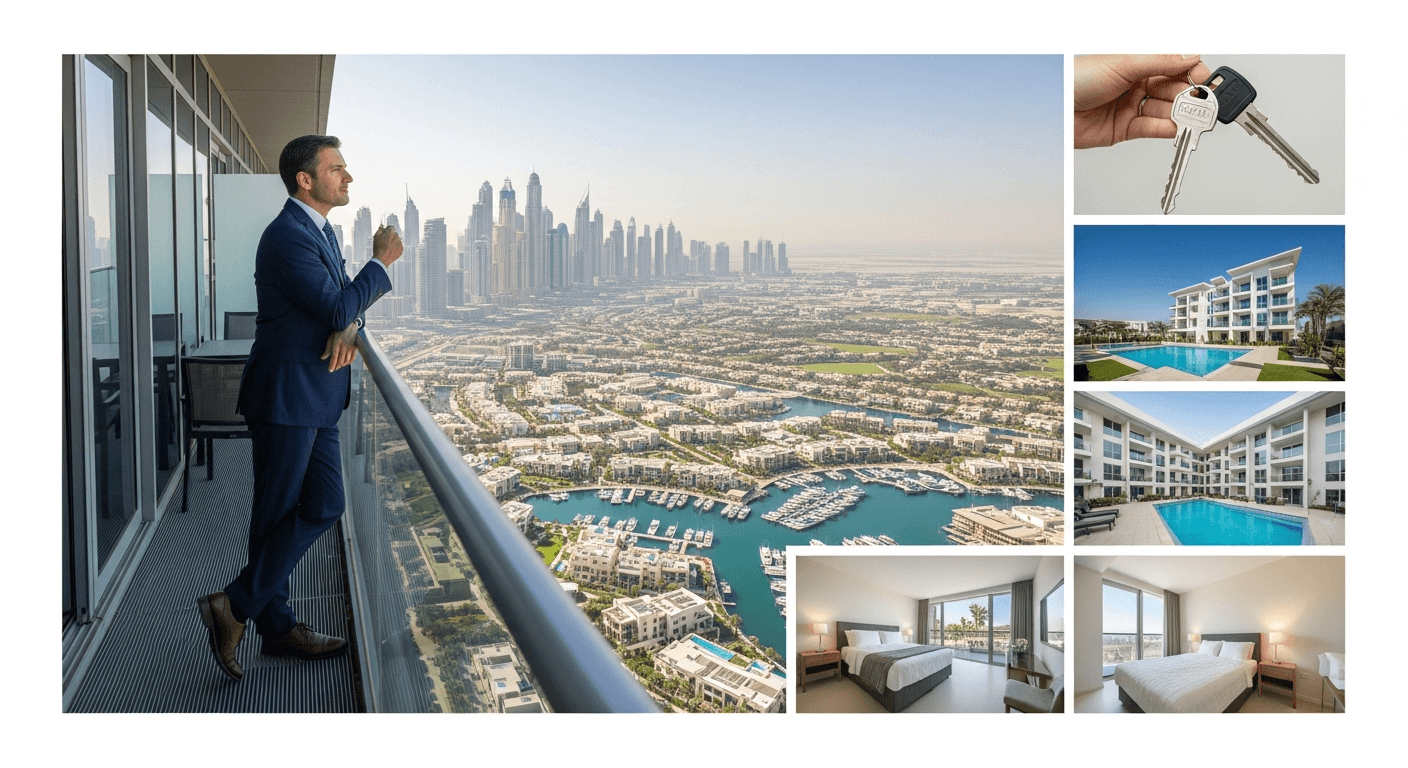
Apartment vs. Villa: A Dubai Rental Yield Analysis
A deep, numbers-driven analysis of whether apartments or villas deliver superior rental yields in Dubai. We break down the real net returns after all costs in key communities.

As an analyst focused on rental returns, the most common question I get is deceptively simple: for the best rental yield, should I buy an apartment or a villa? The answer is anything but simple. Gross yields, often quoted enthusiastically, are a vanity metric; it's the net yield, after every single cost is deducted, that truly matters to an investor's bank account. This property type rental yield analysis requires a forensic look at the numbers, community by community.
Here's what we'll explore in detail:
- The crucial difference between Gross and Net Yield.
- A deep dive into apartment hotspots like Dubai Marina and JVC.
- The numbers behind villa and townhouse communities like Dubai Hills Estate.
- How service charges and maintenance costs impact your bottom line.
- The financial effect of tenant profiles and vacancy risk.
- Balancing capital appreciation against immediate cash flow.
- How the short-term rental market changes the investment case.
- My final, community-specific verdict for different investor types.
Gross vs. Net Yield: The Most Important Distinction
Before we compare a single property, we need to agree on the math. In my experience, the single biggest mistake new investors make is conflating gross and net rental yield. Agents and marketing materials almost exclusively highlight gross yield because it produces a bigger, more attractive number. As a serious investor, you must ignore it. Gross yield is a starting point for a conversation, not a basis for a decision.
The formula is simple: Gross Yield % = (Annual Rental Income / Property Purchase Price) x 100. It tells you what the property earns in a perfect world with zero costs. This world does not exist, especially not for landlords. Net yield is the metric that reflects reality. The formula is more involved: Net Yield % = (Annual Rental Income - All Annual Costs) / (Total Investment Cost) x 100. The difference is stark, and understanding every component of 'All Annual Costs' and 'Total Investment Cost' is the key to a successful buy-to-let strategy.
Let’s break down the real costs you will face. Your 'Total Investment Cost' is not just the sticker price of the property. It includes a mandatory set of upfront acquisition costs that many first-time buyers underestimate. Here’s a typical breakdown for a ready property purchase:
- Property Price: The agreed-upon sale price.
- DLD Transfer Fee: 4% of the property price, payable to the Dubai Land Department (DLD).
- Agency Fee: Typically 2% of the property price + 5% VAT.
- Trustee Office Fee: Around AED 4,000 + VAT for apartments and villas.
- NOC Fee: A No-Objection Certificate fee paid to the developer, ranging from AED 500 to AED 5,000.
- Title Deed Issuance Fee: Approximately AED 580.
So, for a property with a list price of AED 2,000,000, your actual upfront investment is closer to AED 2,130,000. This denominator inflation immediately suppresses your real yield calculation. Then come the 'All Annual Costs', the recurring expenses that eat into your rental income. These include annual service charges, property management fees (if you don't self-manage), routine maintenance, and an allowance for void periods between tenants. Forgetting even one of these can turn a profitable investment into a loss-making headache. This framework of forensic accounting is what separates professional investors from speculators.
Apartment Deep Dive: The Cash Flow Kings?
 Featured project
Apartments are the classic entry point for buy-to-let investors in Dubai, and for good reason. They offer a lower capital outlay, a larger tenant pool, and, on paper, a higher apartment rental yield Dubai investors seek. Let's examine three distinct sub-markets to understand the nuances: the premium, the mid-market, and the high-yield frontier.
In premium areas like Dubai Marina or Downtown Dubai, you buy into a world-class location and lifestyle. A typical one-bedroom apartment might cost between AED 1.5 million and AED 2.5 million. Let's take a mid-range example: a one-bed in the Marina purchased for AED 1.8 million, renting for AED 120,000 per year. The gross yield is (120,000 / 1,800,000) * 100 = 6.67%. It looks healthy. But now let's apply the net yield calculation. Your total investment is around AED 1.9 million after fees. Service charges in a premium tower can be high, say AED 22 per square foot. For an 800 sq ft apartment, that's AED 17,600 per year. Add a 5% property management fee (AED 6,000) and assume a modest 2-week void/turnover allowance (effectively losing AED 5,000 in rent). Your net rental income is now AED 120,000 - 17,600 - 6,000 - 5,000 = AED 91,400. Your net yield is (91,400 / 1,900,000) * 100 = 4.81%. It's a solid return, but a far cry from the nearly 7% gross figure.
Now, let's look at the high-yield frontier, communities like Jumeirah Village Circle (JVC) or Arjan. These areas are popular with investors because the entry prices are much lower. You might find a good quality one-bedroom apartment for AED 850,000 that can rent for AED 75,000 per year. The gross yield calculation is compelling: (75,000 / 850,000) * 100 = 8.82%. This is the kind of figure that gets widely publicised. But again, let's be rigorous. Total investment cost is circa AED 905,000. Service charges are lower, perhaps AED 16 per sq ft for a 700 sq ft unit, which is AED 11,200 annually. A 5% management fee is AED 3,750. Due to the higher volume of rental units and potentially higher tenant turnover, let's budget for a 3-week vacancy, costing about AED 4,300. The net rent is AED 75,000 - 11,200 - 3,750 - 4,300 = AED 55,750. Your net yield is (55,750 / 905,000) * 100 = 6.16%. This is an excellent return, and it demonstrates why these areas are investor favourites. The key takeaway is that the lower purchase price magnifies the impact of rental income, even after significant costs are factored in.
The tenant profile in these apartment-heavy areas is typically young professionals, couples, and new arrivals to Dubai. This creates a deep and liquid rental market, making it relatively easy to find tenants. However, it can also mean higher turnover rates compared to family-oriented villa communities. More frequent tenant changes mean more work for the landlord, higher letting fees, and more frequent 'refresh' costs for painting and deep cleaning between tenancies. This is a crucial, often overlooked factor in the long-term profitability of an apartment investment.
Villa & Townhouse Analysis: The Stability Play
Shifting our focus to villas and townhouses, we enter a different world of property investment. Here, the strategy is less about maximising monthly cash flow and more about securing a stable, long-term asset with significant potential for capital appreciation. The initial capital outlay is substantially higher, and the gross yields are almost always lower than what you'd find in the apartment market. This often deters pure yield-focused investors, but in my view, it misses the bigger picture.
Let's analyze two prime examples: the established luxury of Arabian Ranches and the modern, family-centric appeal of Dubai Hills Estate. In Dubai Hills, a popular three-bedroom townhouse might cost around AED 4 million. It could reasonably rent for AED 240,000 per year to a family. The gross yield is immediately less spectacular: (240,000 / 4,000,000) * 100 = 6.0%. An investor comparing this to the 8.8% gross yield in JVC might walk away. But that would be a premature conclusion. Let's do the math properly. The total investment cost, after DLD and other fees, would be approximately AED 4,250,000. This is the first major difference: the 4% DLD fee on a larger base price is a significant sum.
Now for the annual costs. Service charges for villas and townhouses are calculated differently. They are much lower on a per-square-foot basis, typically ranging from AED 3 to AED 6. For a 3,000 sq ft BUA property, at AED 4.50 psf, the annual community service charge is AED 13,500. This is lower than the service charge on our much smaller Dubai Marina apartment. However, this fee only covers communal areas. The landlord is fully responsible for all external maintenance, including gardening, pool servicing (if applicable), and pest control. This can easily add another AED 15,000-25,000 per year. Let's budget AED 20,000. Add a 5% management fee (AED 12,000). The total annual cost is AED 13,500 + 20,000 + 12,000 = AED 45,500. The net rent is AED 240,000 - 45,500 = AED 194,500. The net yield is (194,500 / 4,250,000) * 100 = 4.58%. This is a textbook example of a villa rental income comparison. The net yield is respectable but clearly lower than the 6.16% we calculated for the JVC apartment. So why would anyone choose the villa? The answer lies in stability and capital growth. The tenant for a three-bedroom townhouse is a family, likely with children in a nearby school. They sign multi-year contracts. Tenant turnover is exceptionally low. This drastically reduces vacancy risk, re-letting fees, and wear-and-tear. You might have the same tenant for five years or more, providing a predictable, hassle-free income stream. This stability has a real, quantifiable financial value.
The Deciding Factor: Service Charges and Maintenance
Let's dig deeper into the costs that erode gross yield, as this is where the apartment vs. Villa debate gets truly interesting. Service charges are the most significant recurring expense after financing, and they are mandated and regulated by the Real Estate Regulatory Agency (RERA). Every owner must pay them, and they cover everything from security and concierge services to the upkeep of common areas like lobbies, gyms, pools, and landscaping. The budget for these charges is approved by RERA annually, ensuring a degree of transparency.
For apartments, especially in premium, amenity-rich towers, these charges can be substantial. A high-end building in Business Bay or Downtown might have charges of AED 25-35 per square foot. For a 1,500 sq ft two-bedroom apartment, this translates to AED 37,500 to AED 52,500 per year. That's potentially two full months of rent wiped out before you even consider other costs. In more affordable communities like Dubai Silicon Oasis or Liwan, charges might be a more manageable AED 12-18 per square foot. The critical lesson for apartment investors is that the headline rent and purchase price are only two parts of the equation; the service charge is the third, equally important variable. When we at Gaia Living advise clients, we always present the service charge history of a building as a primary due diligence item.
“In the final calculation, the lower tenant turnover and superior capital growth potential of a villa often deliver a higher total return than an apartment, even if the annual net yield is lower.”
For villas and townhouses, the service charge figure on paper looks far more appealing. A rate of AED 3-6 per square foot of Built-Up Area (BUA) is common in master communities from developers like Emaar Properties or Nakheel. For a 4,000 sq ft villa at AED 5 psf, that’s AED 20,000 a year. However, this is where a naive townhouse investment returns Dubai analysis can be misleading. This fee covers the community's roads, parks, and security gates — it does not cover anything specific to your property's plot. The landlord is responsible for a separate set of costs that don't exist for apartment owners. A detailed breakdown of villa-specific annual maintenance costs could look like this:
- Landscaping/Gardening Contract: AED 500 - 1,000 per month (AED 6,000 - 12,000 per year)
- Private Pool Maintenance: AED 600 - 1,200 per month (AED 7,200 - 14,400 per year)
- External Pest Control: AED 1,000 - 2,000 per year
- Façade Cleaning/Painting Fund: Prudent to set aside AED 3,000 - 5,000 per year
- Water Tank Cleaning: AED 500 - 800 per year
Suddenly, you've added another AED 17,700 to AED 34,200 in annual costs. When you add this to the community service charge, the total running cost of a villa can easily approach or even exceed that of a premium apartment. The key difference is that villa maintenance costs are more variable and require more direct management from the landlord, whereas apartment service charges are a fixed, consolidated bill.
Tenant Profiles and Vacancy Rates: A Risk Assessment
The profile of your target tenant has a profound impact on the financial performance of your investment property. This is a qualitative factor that has very real quantitative consequences. The difference in tenant profile is one of the starkest distinctions in the buy-to-let apartment vs villa debate.
Apartments, particularly studios and one-bedroom units, attract a more transient demographic. The tenant pool is vast, consisting of young professionals on two-year contracts, new expatriates finding their feet in the city, and couples saving for a larger home. This liquidity is a double-edged sword. On the one hand, finding a replacement tenant is usually quick, especially in popular areas. On the other hand, the average tenancy length is shorter. A one- or two-year lease is standard. When a tenant leaves, the landlord faces a series of costs: the property is vacant for a period (a minimum of one to two weeks even in a hot market), you may need to pay an agent a fee to find a new tenant, and there are invariably costs for repainting and deep cleaning. A one-month vacancy on an apartment renting for AED 100,000 per year represents an 8.3% loss of your total potential gross income for that year. If this happens every two years, it significantly drags down your long-term average yield.
In stark contrast, villas and larger townhouses attract families. The decision to rent a villa is a much larger commitment, often revolving around proximity to schools, community amenities, and a desire for more space and privacy. These tenants are inherently more stable. They are not looking to move every year. It’s common for us to see family tenants in communities like Dubai Hills or Jumeirah Golf Estates remain in the same property for three, five, or even more years. They put down roots. Their children are enrolled in local schools, they become part of the community fabric, and the hassle of moving a full family home is a powerful disincentive to leave. For a landlord, this stability is golden. It means a predictable, uninterrupted income stream with minimal void periods. It means fewer marketing costs, fewer agent fees, and less wear and tear from move-ins and move-outs. This lower churn rate is a hidden financial benefit that compensates for the lower gross yield.
Beyond that, family tenants in villas often treat the property more like their own home. They invest in the garden, they are diligent with upkeep, and they report maintenance issues promptly. The relationship is often more of a partnership than the purely transactional nature of a one-bed apartment lease. This reduction in risk and management headache is a significant, if unquantifiable, part of the total return equation for a villa investment. It’s a factor that spreadsheet analysis alone often fails to capture fully.
Capital Appreciation vs. Immediate Cash Flow
An investor's time horizon and financial goals are paramount when deciding between property types. The choice between an apartment and a villa is often a choice between prioritizing immediate, high-percentage cash flow versus long-term capital appreciation. Neither is inherently better; they simply serve different strategies.
Apartments, especially smaller units in dense, well-connected urban areas, are primarily cash flow instruments. Their value is driven by rental demand, the quality of the building's management, and overall market sentiment. While they do appreciate in value, the appreciation is on a depreciating asset (the building structure) and a fractional share of the land. This limits the ceiling for growth compared to a property with a significant, exclusive land plot. The investment thesis for an apartment is to generate a strong and steady income stream from day one that significantly beats holding cash in a bank. The 6%+ net yields achievable in areas like JVC are a perfect example of this strategy in action. The goal is to have the tenant pay off your mortgage (if any) while providing you with positive monthly cash flow.
Villas and townhouses are fundamentally different. They are hybrid assets that offer a blend of moderate cash flow and significant long-term wealth creation through capital appreciation. The core reason for this is land. When you buy a villa, you are buying a sizeable, exclusive-use plot of land in a growing city with a finite supply of it. The building on top will depreciate over time, but the land underneath is what drives long-term value. History has shown that during Dubai's major growth cycles, the demand for space and privacy pushes the value of well-located villas and townhouses up at a faster rate than apartments. The post-2020 market was a clear proof of this, as families sought more space, driving a huge premium for villas with gardens and private pools.
Therefore, the lower net rental yield of a villa (e.g., 4.5%) is only half the story. An investor choosing this asset is often underwriting their decision with an expectation of 5-10% annual capital growth over the long term. The total return (Net Yield + Capital Appreciation) is what they focus on. A 4.5% net yield plus 7% capital growth in a year gives a total return of 11.5%, which is a very compelling figure. This makes villas a powerful tool for wealth preservation and accumulation for investors with a 7-10 year or longer time horizon. It's about building equity and net worth, with the rental income serving to cover costs and provide a modest bonus, rather than being the primary objective itself.
The Short-Term Let Wildcard: A Game Changer?
No modern discussion of rental yields in Dubai is complete without addressing the short-term rental (STR) or holiday home market. This model, governed by the Dubai Department of Economy and Tourism (DET), can completely rewrite the profitability equation, but it comes with its own set of significant costs and complexities. It is not a passive investment; it is an active hospitality business.
This strategy overwhelmingly favours apartments in prime tourist locations. A one-bedroom apartment on the Palm Jumeirah, in JBR, or with a Burj Khalifa view in Downtown Dubai is the ideal candidate. On the long-term market, such a property might rent for AED 180,000 per year (AED 15,000/month). On the short-term market, the same apartment could achieve an average daily rate (ADR) of AED 1,000. Assuming a realistic 80% annual occupancy, the gross annual revenue would be AED 1,000 * 365 * 0.80 = AED 292,000. This is a massive 62% uplift in gross revenue compared to the long-term rental model.
However, the costs are proportionally higher and far more complex. A standard property manager for a long-term let charges 5-8% of the annual rent. A short-term rental operator will charge 15-25% of the gross *revenue*, a much larger number. You, the owner, are now also responsible for all the bills the tenant would normally pay. A typical monthly cost breakdown for an STR apartment might include:
- DEWA (Utilities): AED 1,000 - 1,500
- High-Speed Internet & TV: AED 400
- Cleaning & Laundry (between guests): AED 1,500 - 2,500
- Consumables (toiletries, coffee, etc.): AED 300
These operating costs can easily total AED 4,000 per month or AED 48,000 per year, before the manager's fee. Let's not forget the substantial one-time upfront cost of fully furnishing the apartment to a high standard, which can be AED 50,000-100,000. Applying these costs to our example: from AED 292,000 revenue, we subtract a 20% management fee (AED 58,400) and annual operating costs (AED 48,000), and the building service charge (let's say AED 20,000). The net income is AED 165,600. While this is still higher than the net income from a long-term let, the operational intensity is an order of magnitude greater. You are exposed to seasonality, bad guest reviews, and the constant logistical demands of a hotel-like operation. For this reason, I advise clients that STR is only suitable for those who want to run a business, not for those seeking a passive buy-to-let investment.
The optimal rental investment in Dubai is not a single property type, but a specific property type in a specific community that aligns with your financial goals — whether that's high cash flow from a JVC apartment, balanced growth from a Dubai Hills townhouse, or long-term wealth preservation in a Palm Jumeirah villa.
Final Verdict: Matching Property Type to Investor Strategy
After analyzing the numbers, costs, and qualitative factors, it’s clear that there is no single winner in the apartment vs. Villa debate. The 'better' investment is entirely dependent on the investor's capital, risk tolerance, and ultimate financial objective. My verdict is not to recommend one property type over the other, but to provide a clear framework for which type suits which strategy.
1. For Maximum Passive Cash Flow (Target Net Yield: 5.5% - 7%) Your focus should be on studios, one-bedroom, and smaller two-bedroom apartments in high-density, mid-market communities with established infrastructure. My top picks are [JVC](/areas/jvc), [Arjan](/areas/arjan), and [Dubai Science Park](/areas/dubai-science-park). These areas offer the most potent combination of affordable purchase prices, strong rental demand from a large tenant pool, and manageable service charges. The key is to buy a quality building to minimise maintenance issues. This is a volume game, where the objective is to acquire an asset that generates predictable monthly income with minimal fuss. Capital appreciation is a secondary bonus, not the primary goal.
2. For Balanced Growth & Stable Income (Target Net Yield: 4% - 5% + Capital Appreciation) Here, the ideal assets are three- and four-bedroom townhouses and smaller villas in family-oriented master communities. Look towards [Dubai Hills Estate](/areas/dubai-hills), [Town Square](/areas/town-square), and the newer phases of [Arabian Ranches](/areas/arabian-ranches). The initial yield is lower, but you are buying stability. Family tenants mean longer leases, fewer vacancies, and a property that is well cared for. More importantly, you are buying a significant plot of land, which is the primary driver of long-term capital growth in Dubai. This is the strategy for the patient investor building a multi-generational asset portfolio.
3. For High-Risk, High-Reward Active Investment (Target Net Yield: 7%+ with active management) This is the domain of short-term rentals. The best assets are well-furnished, stylish apartments (studios to two-beds) in absolute prime tourist and business hubs. Think [Dubai Marina](/areas/dubai-marina), [JBR](/areas/jumeirah-beach-residence), [Bluewaters Island](/areas/bluewaters-island), and [Downtown Dubai](/areas/downtown-dubai). This path offers the highest potential returns but requires you to either partner with an excellent (and expensive) holiday home operator or manage the high-touch hospitality business yourself. It is not passive. Success depends on marketing, guest service, and managing variable occupancy and rates.
4. For Pure Wealth Preservation & Legacy (Yield is secondary) For high-net-worth individuals where the primary goal is not income but safeguarding and growing wealth, the answer is prime, large-format real estate. This means signature villas on large plots in Dubai's most exclusive enclaves: [Palm Jumeirah](/areas/palm-jumeirah), [Emirates Hills](/areas/emirates-hills), and certain sectors of Jumeirah Golf Estates or [Al Barari](/areas/al-barari). The rental yield on these multi-million-dirham properties is often low (2-3.5% net), but that's not the point. These are trophy assets in finite supply, acting as a hedge against inflation and a vehicle for substantial long-term capital appreciation. The rental income simply serves to cover the significant running costs.
Ultimately, the data shows a clear divergence in purpose. To choose correctly, you must first be honest with yourself about your goals. Are you an income investor, a growth investor, or a business operator? Once you know the answer, the right property type and community will become clear.
Sources
- Dubai Land Department (DLD): https://dubailand.gov.ae/
- Real Estate Regulatory Agency (RERA): Part of the DLD website, for service charge information and regulations.
- UAE Government Portal: For information on fees and regulations https://u.ae/
Questions, answered
- Which property type generally has a higher net rental yield in Dubai?
- Apartments, particularly studios and one-bedrooms in mid-market areas like JVC or Arjan, typically offer higher net rental yields, often exceeding 5.5%. Villas tend to have lower net yields (4-5%) but often see stronger capital appreciation over the long term.
- Are service charges higher for apartments or villas in Dubai?
- Apartment service charges are higher on a per-square-foot basis (e.g., AED 15-30 psf) due to amenities like pools, gyms, and security in a single building. Villa charges are lower per square foot (e.g., AED 3-6 psf) but apply to a larger area and don't include private maintenance like garden or pool upkeep, which is an additional cost for the landlord.
- Is a villa a better long-term investment than an apartment in Dubai?
- It depends on your goals. For long-term wealth creation and capital growth, villas are often superior due to their significant land component and appeal to stable, family tenants. For generating consistent monthly cash flow, apartments are typically more effective.
- What are the main hidden costs of a buy-to-let property in Dubai?
- Beyond the purchase price, you must budget for a 4% DLD transfer fee, ~2% agency fee, trustee fees, annual service charges, property management fees (5-8% of rent), maintenance costs, and potential vacancy periods between tenants, all of which reduce your net yield.
- Does short-term letting in Dubai really produce higher returns?
- Short-term lets can generate significantly higher gross revenue, especially for prime apartments. However, after accounting for higher management fees (15-25%), furnishing costs, utility bills, and potential seasonality, the net yield can be volatile and requires treating the property as an active business, not a passive investment.
- What is a good net rental yield in Dubai for 2026?
- A 'good' net rental yield depends on the asset class and your goals. In my view, a solid target for a passive buy-to-let apartment is 5.5-6.5%. For a villa, a net yield of 4-5% is considered strong, as a larger portion of the total return is expected from capital appreciation.

Marcus is all about cash flow — gross vs net yields, short-term vs long-term lets, and the RERA rental index. He writes for landlords and income investors.
Related stories

The Productive Address in Dubai
The line between home and work has blurred for good. Discover the Dubai properties and communities designed for the focus, flexibility, and balance that modern professionals demand.
The Mortgage Effect: Your Guide to Dubai Rental Yields
Financing is the engine of your property investment. As a yield analyst, I'll walk you through how different mortgage structures can either supercharge your net cash flow or quietly erode your returns in the Dubai market.
Dubai Off-Plan Delays: Your Legal Rights
When your Dubai off-plan property is delayed, understanding your legal rights is critical. This guide details RERA's framework, options for contract breaches, and practical steps to protect your investment.
Echoes, in your inbox
One thoughtful email a month. Market insight, new launches, no spam.