

Jumeirah Apartments: Quiet Living Minutes From the Beach
Jumeirah is one of those Dubai areas where people who live there don’t really want you to know about it. Not because they’re secretive about a great find.
Jumeirah is one of those Dubai areas where people who live there don’t really want you to know about it. Not because they’re secretive about a great find. Because they like what they have, and they know any influx of attention raises the prices and breaks the quiet that drew them in the first place. We’ve sold and rented across Jumeirah for years, and the same conversation keeps coming up. Buyers who finally figure out Jumeirah usually wish they’d looked there first instead of last.
The thing about Jumeirah is that it isn’t really an apartment district. It’s a villa district. Old Jumeirah (1, 2, 3) was Dubai’s original residential suburb, built out in the 1970s and 1980s, mostly with single-storey and two-storey villas on plots that would now cost a small fortune to assemble. The apartment buildings that exist in Jumeirah are the exception, not the rule. They are scattered along Beach Road (now officially Jumeirah Road), tucked into side streets, and concentrated in a few pockets where mid-rise development was permitted.
That scarcity matters. Jumeirah doesn’t have the apartment density of Marina, JBR, or even Downtown. There’s no master-planned cluster of towers. There are maybe 40 or 50 residential buildings of any meaningful size scattered across the three Jumeirah sub-areas. Total apartment stock is a tiny fraction of what Marina alone delivers. The buildings that exist tend to be low-rise, often less than ten storeys, and the units are usually larger than their Marina equivalents because they were designed when land was cheaper and developers built more generously.
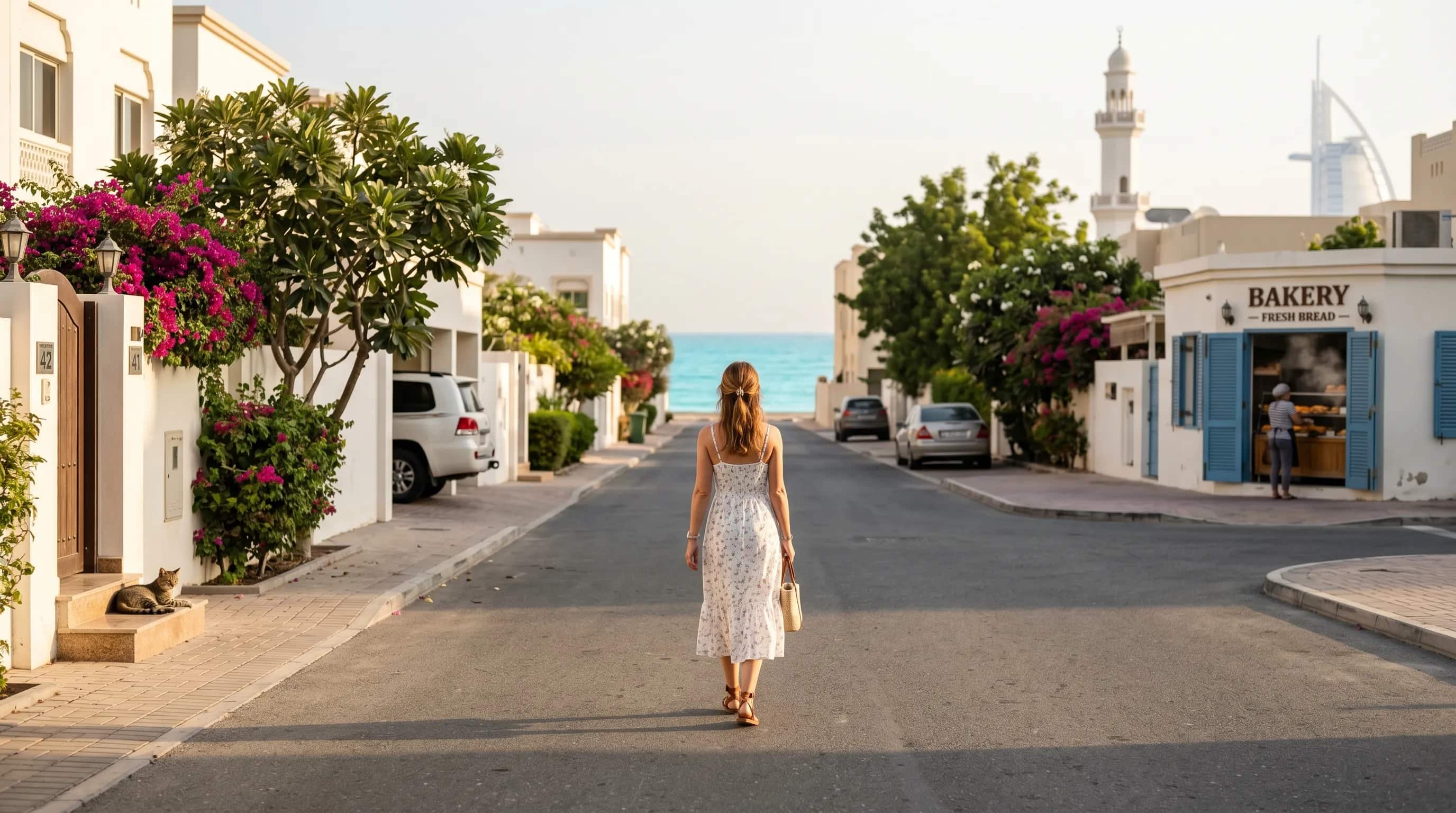
What Jumeirah buyers get is something almost none of Dubai’s other apartment districts can offer. A residential neighbourhood feel. Beach within minutes by walk or short drive. Mature trees. A quieter, older-Dubai daily rhythm. Schools, clinics, and grocery stores within the immediate area rather than across town. And a buyer profile that is meaningfully different from the rest of the city.
This article walks through what Jumeirah actually is in 2026, the apartment options that exist and where they sit, the lifestyle on a typical week, what you pay to live there, our research on Jumeirah apartment yields and resale dynamics, and the honest read on whether the area fits the kind of buyer reading this piece.
A note up front. If you’re looking for high-rise, glass-and-steel, branded amenity-stacked Dubai, Jumeirah is not the area. The buildings here are mostly mid-rise. The amenity packages are modest. The shared facilities are limited compared to Marina or City Walk. What you get instead is location, neighbourhood feel, and beach access. For the right buyer, that trade-off is the most appealing in Dubai. For the wrong buyer, Jumeirah feels underwhelming on a viewing tour.
What Jumeirah Actually Is in 2026
Jumeirah stretches along the Gulf coast from Port Rashid in the north to Umm Suqeim in the south. The area is divided into Jumeirah 1 (the northernmost section, closest to Downtown), Jumeirah 2 (the middle stretch), and Jumeirah 3 (further south, bordering Umm Suqeim). Each has slightly different character.
Jumeirah 1 is the most central. Closest to Sheikh Zayed Road, Downtown, and the older commercial spine of Dubai. Apartment buildings here are mostly along Al Wasl Road and side streets running parallel to Beach Road. Mercato Mall sits within Jumeirah 1, as does City Walk’s northern edge.
Jumeirah 2 is residential to the core. Quieter streets, mostly villas, with a handful of apartment buildings tucked behind the main road. Schools (Jumeirah Primary, Raffles International, Dubai International Academy) are concentrated here.
Jumeirah 3 is the longest stretch and includes some of Dubai’s most established residential clusters. Sunset Mall and the surrounding food and retail scene have grown over the past five years.
A few things that matter for apartment buyers in 2026:
1. The Beach Road frontage is largely beachfront villas and a small number of low-rise residential buildings. Direct beach views from apartments here carry a significant premium
2. Al Wasl Road is the main inland artery and has higher apartment density, with mid-rise buildings 5 to 12 storeys tall
3. Pearl Jumeirah sits just offshore and is technically separate but functions as part of the broader Jumeirah residential picture
4. La Mer beach development on Pearl Jumeirah border has reshaped the food and weekend leisure scene
5. The Box Park retail strip extends from City Walk into Jumeirah 1
6. Public beach access at multiple points along the Jumeirah coast remains free and is one of the area’s signature features
Jumeirah is not getting denser. The Dubai master plan has effectively capped further high-rise development in the residential core. Some renovation and replacement of older buildings is happening, but the area’s character is largely settled. That settling-in is a feature, not a bug, for the buyers who want a Dubai address that won’t reshape every two years.
Jumeirah Apartment Options That Actually Exist
The apartment stock in Jumeirah falls into four broad categories.
Older mid-rise buildings on Al Wasl Road and side streets. These are the bulk of Jumeirah’s apartment supply. Five to ten storeys. Built between the late 1990s and the mid-2010s. Larger floor plates and unit sizes than newer Dubai builds. Some have been refurbished, others show their age. Examples include buildings around Al Hudaiba and the residential streets behind Mercato Mall.
Newer mid-rise developments, mostly built post-2015. These include smaller boutique projects from developers like Meraas, ALEC, and various smaller developers. Examples include Bluewaters Residences (technically off Jumeirah but in the orbit), Nikki Beach Residences, and several smaller buildings around Pearl Jumeirah.
Pearl Jumeirah developments. This is the cluster of higher-end newer buildings on the man-made island just off Jumeirah 2. Different price point and lifestyle to the rest of Jumeirah. Examples include the developments around the Nikki Beach Resort and the Drydocks-connected residential cluster.
Branded residences like the Address Jumeirah Resort and Spa apartments. Limited supply, full hotel-style services, premium pricing.
Across all four categories, total Jumeirah apartment supply is well under 5,000 units. That’s a fraction of Dubai Marina’s tower population. The supply constraint is what underpins Jumeirah’s relative price stability and rental performance over time.
A useful guide for apartment buyers looking at Jumeirah:
1. The closer to Beach Road, the higher the price per square foot
2. Buildings with direct beach access (very few) command another 30% premium on top
3. Older buildings need careful inspection for maintenance and reserve fund status
4. Pearl Jumeirah is a separate price band from mainland Jumeirah, generally higher
5. Service charges in older mainland Jumeirah buildings can be unexpectedly low (often AED 8 to 12 per square foot) because the amenity packages are modest
6. Newer boutique buildings carry higher service charges (AED 18 to 28 per square foot) reflecting more services
7. Parking is generally well-supplied in Jumeirah apartments, often two spaces per unit
8. Many buildings allow short-term rental licensing, though policies vary
Knight Frank’s Dubai prime residential research has consistently highlighted Jumeirah and Pearl Jumeirah as among the most resilient sub-segments of the Dubai apartment market. The combination of supply constraint and stable owner-occupier demand keeps the market from the kind of price volatility seen in higher-supply districts.
The Jumeirah Lifestyle on a Regular Week
A typical week in Jumeirah looks very different from a typical week in Marina or Downtown. Monday morning starts quieter. School runs to one of the nearby private schools dominate the residential streets between 7am and 8:15. Coffee is at a small independent place, not a chain. The walking is genuine but local rather than destination-driven. People walk to Sunset Mall, to the beach, to Spinneys at Mercato, to the kids’ school. The car is for trips outside Jumeirah, not for trips within it.
What works about Jumeirah life:
1. The beach is within five minutes of almost any Jumeirah apartment, often within walking distance
2. The schools (Jumeirah College, Jumeirah English Speaking School, Raffles International, Latifa School) are among the city’s best and are within the area
3. The food and retail at Sunset Mall, Mercato, City Walk (on the border), and La Mer cover daily needs without crossing town
4. The community feel is real. Residents know their neighbours, the cafes know their customers, the school runs see the same families year after year
5. Healthcare access is strong, with Mediclinic, Latifa Hospital, Iranian Hospital, and various clinics all within the area
6. Air quality is genuinely better than central Dubai because of the proximity to the sea and the lower-density build-out
7. Daily noise levels are noticeably lower than Marina or Downtown
8. Parking on residential streets is generally available, which is rare elsewhere in Dubai
What doesn’t work:
1. The metro doesn’t serve Jumeirah directly. Nearest stations are at Burj Khalifa/Dubai Mall or further afield
2. Sheikh Zayed Road access is via Al Wasl or the back roads, which can be slow in peak hours
3. Restaurant variety, while improving, doesn’t match Marina, City Walk, or Downtown
4. Some older buildings have maintenance deferral that you only spot on careful inspection
5. The bus network is workable but not a substitute for metro access
6. Beach access at the public beaches is excellent but can get crowded on weekends
Jumeirah works for residents who value daily life quality over urban density and entertainment density. It is genuinely a place where children can grow up with mature trees on the street, neighbours who know them, and a beach as the default weekend backdrop. That combination is rare in Dubai at any price point.
What Jumeirah Apartments Cost in 2026
Sale prices in Jumeirah vary widely by building age, location, and view. The general picture:
Studios are rare in Jumeirah and when they appear, they list between AED 950,000 and AED 1.6 million depending on building and location.
One-bedroom apartments in mainland Jumeirah typically range from AED 1.4 million in older inland buildings to AED 3.5 million in newer Beach Road buildings with sea views.
Two-bedroom apartments run AED 2.2 million to AED 5.5 million, with the wide range reflecting the difference between older Al Wasl Road stock and beach-fronting premium buildings.
Three-bedroom apartments start around AED 3.8 million and reach AED 9 million plus for premium Pearl Jumeirah and beachfront units.
Pearl Jumeirah carries its own price band. Premium two-bedroom units there start around AED 5 million and climb. Branded residences like the Address Jumeirah Resort and Spa run higher still.
Rentals follow the sale price pattern. Studios where they exist rent for AED 90,000 to AED 130,000 a year. One-bedrooms run AED 120,000 to AED 220,000. Two-bedrooms range AED 180,000 to AED 350,000. Three-bedrooms in premium buildings can exceed AED 400,000.
Rental yields in Jumeirah run between 4.5% and 6.0% on a gross basis, lower than most of Dubai because the area is owner-occupier dominated rather than investor-driven. That yield compression is a feature of the buyer profile, not a problem to be solved. People buy in Jumeirah to live there, not to maximise rental return.
Service charges, as noted, vary widely by building age and amenity level. Verify before any purchase.
Original Research: Jumeirah Apartment Resale and Rental Patterns
We pulled data on 60-plus Jumeirah apartment transactions and 100-plus rental contracts from 2023 and 2024, drawing from Property Monitor and our own records. The headline findings:
Beach Road and direct-sea-view buildings, average gross yield: 4.6%. Average resale time on market: 45 days.
Al Wasl Road mid-rise older buildings, average gross yield: 5.3%. Average resale time on market: 70 days.
Side street and inland Jumeirah buildings, average gross yield: 5.8%. Average resale time on market: 85 days.
Pearl Jumeirah newer buildings, average gross yield: 4.8%. Average resale time on market: 60 days.
Branded residences (Address and similar), average gross yield: 4.2%. Average resale time on market: 90 days.
Three-year capital appreciation across Jumeirah (2022-2025): 28% to 42% depending on building, with Beach Road and Pearl Jumeirah at the top of that range.
A few things stand out. Resale velocity in Jumeirah is faster than the Dubai average, particularly for sea-view buildings. That tells us demand is sticky. Yields are lower than the city average, which tells us the buyer pool is owner-occupier dominated. Capital growth has been modest but consistent, with very low downside volatility through several cycles.
For yield-focused investors, Jumeirah is not the area. For buyers prioritising owner-occupier appeal, sea-view exposure, and long-term value stability, the area performs better than its yield numbers suggest.
Cross-referenced against the Dubai Land Department transaction database, the pattern holds. Jumeirah transactions are a small share of total Dubai apartment activity but a meaningful share of premium-segment transactions in the AED 2 million plus band.
Is a Jumeirah Apartment Right for You
Looking at all of this together, the verdict on Jumeirah comes down to whether you’re buying to live or buying to invest.
If you want a Dubai apartment to live in, you have children at school in the area or you intend to put them there, you value a residential neighbourhood over urban density, and you genuinely want the beach as part of your weekly life, Jumeirah is one of the strongest options in the city. The premium over Marina or JLT is real but defensible. The lifestyle on offer is meaningfully different from anything in the high-density districts.
If you want a Dubai apartment to invest in, you’re chasing yield, or you want capital growth as the primary driver, Jumeirah is not the right area. The yields are too low and the capital growth, while solid, isn’t fast enough to make the math compelling against alternatives.
If you want a hybrid (live in it for years, then rent it out), Jumeirah works, but you’re paying for the years of lifestyle you’ll enjoy, not building a yield portfolio.
The most common Jumeirah buyer we work with is the long-term Dubai resident who has accumulated enough capital to upgrade from a Marina or Downtown apartment into something that feels like a permanent Dubai home. That buyer has rarely regretted the move. The buyers we’ve seen regret it are the ones who bought in Jumeirah expecting it to perform like the rest of Dubai. It doesn’t. It performs like a settled residential suburb, because that’s what it is.
For anyone weighing Jumeirah against alternatives, the team can pull live yield data and resale comparables for the specific buildings you’re considering. The variance within Jumeirah and adjacent Dubai apartment areas is significant enough that the building selection genuinely matters. Our agents handle Jumeirah transactions regularly, and if you want help with the buying process, the service overview covers the steps. Ready to look at specific buildings? Reach out and we’ll take it from there.
Related stories

The Commuter's Edge: Dubai's Secretly Connected Hubs
Forget the car-city myth. I'm revealing the Dubai neighbourhoods with surprisingly brilliant public transport links that offer a smarter, more cost-effective lifestyle.

Furnishing Your New Dubai Home: A Buyer's Guide
Setting up your new home in Dubai involves more than just buying property. I'll walk you through creating a realistic furnishing budget, exploring your options from luxury to budget-friendly, and managing the process like a seasoned resident.
Beyond the Price Tag: The Real Value of Off-Plan Incentives
In Dubai's competitive off-plan market, developer incentives can be compelling. I'll break down which offers add real financial value and which are merely marketing noise.
Echoes, in your inbox
One thoughtful email a month. Market insight, new launches, no spam.