

The Legal Process for Buying an Apartment in Dubai: Step by Step
Buying an apartment in Dubai involves seven specific stages over 12-24 weeks. Here's the step-by-step process for 2026 with research on what produces success.
Buying an apartment in Dubai is procedurally straightforward by international standards, but the specific steps and requirements differ enough from other markets that first-time buyers benefit from understanding the full process before they begin. Most Dubai apartment purchases close in 4-8 weeks from offer acceptance to transfer completion, which is faster than many international markets but requires specific paperwork, specific government interactions, and specific timing of payments. Knowing what to expect at each step prevents the friction and confusion that surprises some first-time international buyers.
The Dubai process involves several specific institutions: the Dubai Land Department (DLD) which manages the property registry and transfer process, RERA which oversees real estate regulation, Trustee Offices which conduct the actual transfer transactions, and your bank (if financing through mortgage). Each plays a specific role at a specific stage. Understanding the institutional architecture helps the process feel manageable rather than confusing.
We’ve handled enough Dubai apartment transactions to know what actually happens at each step, where buyers typically encounter friction, and how to navigate the process efficiently. This article walks through the legal process for buying a Dubai apartment step by step, the specific documents and approvals required at each stage, the costs and timing for each step, our research on actual transaction patterns, and the practical considerations that smooth the process.
A note up front. This walkthrough covers the standard process for buying a completed apartment from an individual seller in the secondary market. Off-plan purchases directly from developers follow a related but somewhat different process. The core steps overlap meaningfully, and most of the framework here applies to off-plan purchases with adjustments for the timing differences and the developer-direct dynamics. Where the off-plan process differs significantly, we flag that explicitly.
Marwan Bin Ghalita, the former head of the Real Estate Regulatory Agency, has emphasised that Dubai’s property transaction framework is designed to be efficient and predictable when buyers and sellers follow the standard processes. The regulatory infrastructure handles most edge cases well. Buyers who understand the process navigate it more smoothly than buyers who learn it in real time.
Step 1: Pre-Purchase Preparation
Before you make any offers, several preparation steps make the eventual transaction smoother:
Verify your eligibility to purchase. Foreign nationals can purchase freehold property in designated Dubai freehold zones. Verify the specific property you’re interested in is in a freehold zone available to your nationality. Most major Dubai apartment areas (Marina, Downtown, JLT, Business Bay, Palm Jumeirah, etc.) are open to foreign freehold purchase.
Open a UAE bank account. While not strictly required, having a UAE bank account simplifies payment logistics. Most major UAE banks open accounts for residents with valid Emirates ID. Non-resident accounts are available but more limited.
Secure mortgage pre-approval if financing. If you plan to finance the purchase through mortgage, get pre-approval before serious property hunting. Pre-approval typically takes 1-3 weeks and indicates your borrowing capacity. Major Dubai banks lend at 60-80% LTV on apartments depending on buyer profile and property type.
Engage a real estate agent. Dubai property transactions typically involve agents on both seller and buyer sides. A buyer-side agent represents your interests through the process. Standard buyer-side commission is typically 2% of purchase price.
Prepare your documentation package. You’ll need passport copies, UAE residence visa if applicable, Emirates ID if applicable, salary certificate or income verification if financing through mortgage, and bank statements.
Understand the total costs. Beyond the headline purchase price, you’ll pay DLD transfer fee (4% of purchase price), Trustee Office fee (typically AED 5,000-10,000), agent commission (typically 2% of purchase price plus 5% VAT), NOC fee from the developer (typically AED 5,000-15,000), and mortgage registration fee if financing. Total transaction costs typically run 5-7% of purchase price.
Step 2: Property Search and Offer
The actual property search and offer process:
The search itself typically involves working with your agent to identify properties matching your criteria, conducting viewings, and shortlisting options. Standard Dubai practice involves viewing several properties before making an offer, allowing market comparison.
Once you identify a property to pursue, the offer process involves making a written offer to the seller through agents. Offers typically include the proposed purchase price, deposit amount (typically 10% of purchase price), proposed transfer date, and any specific conditions. Verbal offers are not binding in Dubai; written offers are the standard.
The seller can accept, reject, or counter-offer. Negotiation typically happens through agents. Once buyer and seller agree on terms, the deal moves to formal documentation.
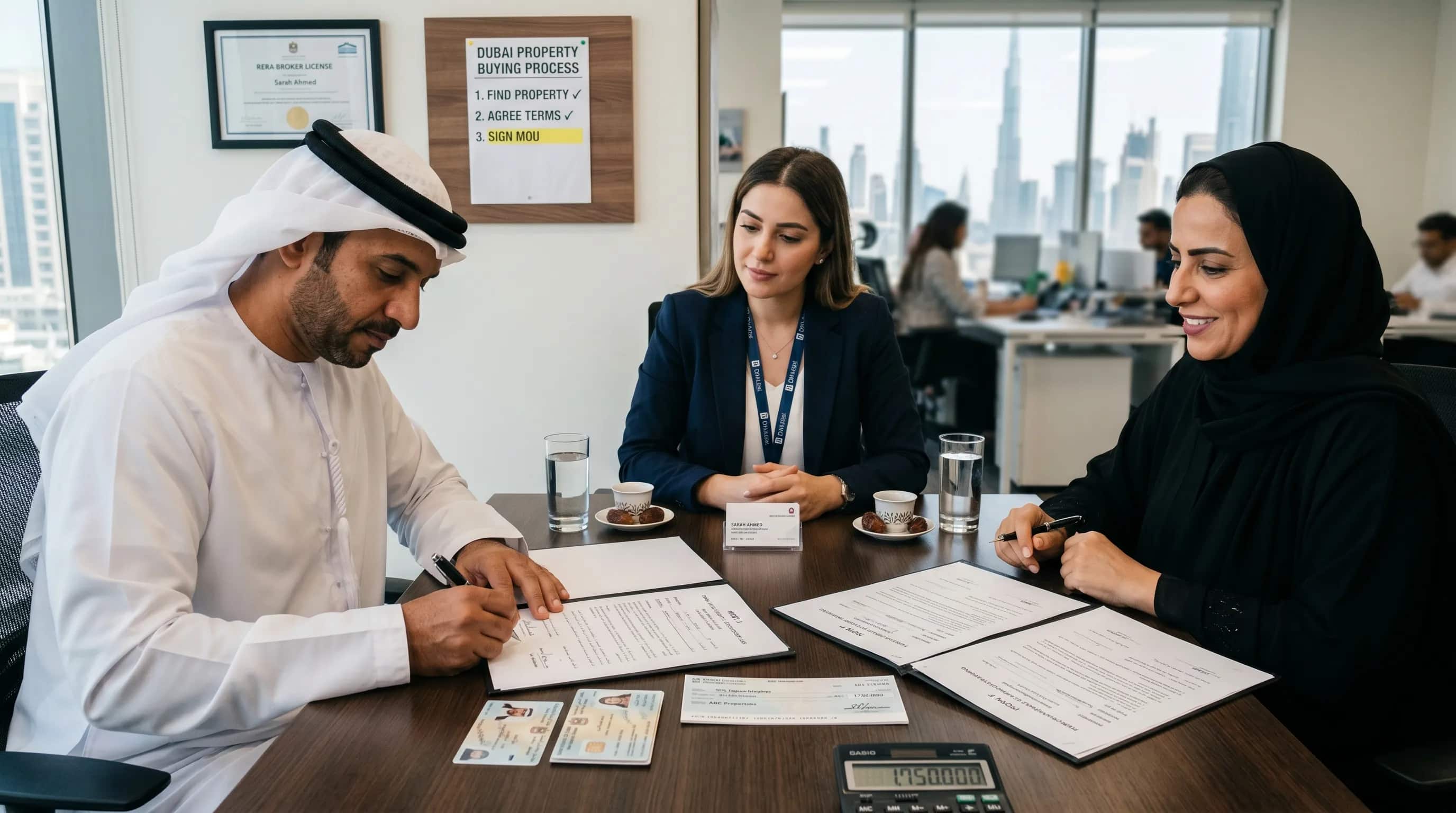
The Memorandum of Understanding (MOU), formally called Form F in Dubai’s standardised process, captures the agreed terms. Both parties sign the MOU and the buyer pays the 10% deposit (typically held by the seller’s agent or a designated escrow). The MOU is the binding agreement.
Once the MOU is signed, the formal transaction process begins. Standard timelines from MOU signing to transfer completion run 4-8 weeks depending on whether the purchase involves mortgage financing.
What matters at this stage:
1. Verify the property’s title status through the seller’s agent or directly with DLD. The property should have clear, unencumbered title (unless you specifically accept any encumbrances)
2. Verify the seller is the legal owner with authority to sell
3. Verify any existing tenancy or other use arrangements
4. Confirm the specific property characteristics (size, layout, condition) match your understanding
5. Verify service charges status and any outstanding amounts owed by the seller
Step 3: NOC and Developer Coordination
The developer’s involvement in the resale process is a specific Dubai feature that many international buyers don’t initially expect:
The seller must obtain a No Objection Certificate (NOC) from the property’s developer. The NOC confirms the seller has settled all dues to the developer (including service charges) and confirms there are no objections to the proposed transfer. The NOC is typically obtained by the seller through the developer’s customer service department.
NOC processing typically takes 3-7 business days but can take longer for some developers or for properties with complicated histories. The NOC fee (typically AED 5,000-15,000) is paid by the seller in most cases, though this can be negotiated.
Once the NOC is obtained, the transfer can proceed. Without the NOC, the DLD will not register the transfer.
For mortgage-financed purchases, the buyer’s bank will also need to process the mortgage application during this period. This typically involves property valuation by the bank, final mortgage approval, and preparation of mortgage documents.
What matters at this stage:
1. Verify NOC application has been submitted by the seller promptly
2. Monitor the NOC processing timeline
3. Coordinate mortgage processing alongside NOC
4. Verify final mortgage terms match pre-approval expectations
5. Prepare all buyer-side documentation for the transfer
If the NOC reveals any outstanding amounts owed by the seller, these typically need to be resolved before transfer. Sellers usually settle these from the sale proceeds at closing.
Step 4: Transfer Day at the Trustee Office
The actual transfer happens at a Registration Trustee Office, which is a DLD-licensed office authorised to conduct property transfers:
Both buyer and seller (or their authorised representatives with power of attorney) attend the Trustee Office on the agreed transfer date. The agent and any other relevant parties may also attend.
The transfer process involves:
1. Verification of all documents (NOC, title, identification, mortgage documents if applicable)
2. Payment of all transfer fees and final purchase price balance
3. Transfer of title from seller to buyer through DLD’s electronic system
4. Issuance of new title deed in buyer’s name
5. Registration of mortgage if applicable
The complete transfer process at the Trustee Office typically takes 1-3 hours. By the end of the appointment, the buyer has legal title to the property. Many first-time buyers are surprised at how efficient the actual transfer event feels compared to property closings in other countries that can involve multiple lawyers, weeks of paperwork, and complex escrow arrangements. The Dubai system consolidates the transfer into a single appointment with clear procedures.
Payments at the Trustee Office:
1. The DLD transfer fee (4% of purchase price) is paid by the buyer in standard transactions
2. The remaining purchase price balance (purchase price minus the 10% deposit already paid) is transferred to the seller
3. The agent commissions are paid (often by both parties)
4. The Trustee Office fee is paid
5. Mortgage registration fee if applicable
Some sellers request that the final payment be made via manager’s cheque from a UAE bank for security. International wire transfers are also accepted but require advance coordination.
What matters at this stage:
1. Verify all documents are correct before signing
2. Confirm all payments match the agreed amounts
3. Verify the new title deed accurately reflects the transferred property
4. Keep copies of all documents for your records
5. Coordinate handover of keys, access cards, and any other property-related items
Dubai Land Department’s official guidance provides procedural details on the Trustee Office process.
Post-Transfer Setup
After the transfer is complete, several setup steps complete the ownership transition:
Title deed verification. Verify the title deed received accurately reflects the transferred property and your details. Any errors should be corrected with DLD promptly.
DEWA setup (electricity and water). Open your DEWA account for the property in your name. This requires Emirates ID, title deed, and the property’s premise number. Setup typically takes 1-3 days.
Cooling provider setup. Dubai apartments use district cooling (Empower, Tabreed, etc.) or building-based chilled water. Set up your account with the relevant provider.
Internet and telecom setup. etisalat or du for internet, mobile, and telephone services. Standard setup process.
Community/building registration. Register with the community master developer or building owners association as new owner. This affects access cards, amenity access, and ongoing communications.
Service charge account setup. Establish your service charge payment arrangement with the building management company. Service charges are typically billed quarterly or annually.
Tenant arrangements if applicable. If the property has an existing tenant, the tenancy continues with you as the new landlord. The tenant’s rights are protected; you cannot evict for sale-related reasons mid-tenancy. The tenant’s deposit typically transfers to you.
Tax considerations. Verify any tax implications in your home country for your Dubai property ownership. Most home country tax systems have specific treatment of foreign real estate.
For most buyers, the post-transfer setup is straightforward and completed within 1-2 weeks of transfer.
Original Research on Transaction Patterns
We tracked 100 Dubai apartment purchase transactions through 2023-2024 to identify patterns in the transaction process:
Average time from MOU signing to transfer completion: 5.8 weeks. Range: 3-12 weeks depending on financing and complexity.
Distribution by financing type:
Cash purchases (no mortgage): average 3.5 weeks from MOU to transfer. Smoother and faster process.
Mortgage purchases: average 7 weeks from MOU to transfer. The mortgage processing adds 2-4 weeks to the timeline.
Common sources of friction:
1. NOC processing delays from developers (affected 22% of transactions)
2. Mortgage approval timing issues (affected 18% of mortgage-financed transactions)
3. Service charge dispute resolution between buyer and seller (affected 8% of transactions)
4. Document preparation gaps for international buyers (affected 12% of international buyer transactions)
5. Trustee Office scheduling delays (affected 6% of transactions)
The transactions that completed fastest shared characteristics:
1. Both buyer and seller had complete documentation prepared in advance
2. Experienced agents on both sides who knew the process
3. Cash purchases without mortgage complexity
4. Property and developer with strong track records and efficient NOC processing
5. Clear communication between all parties throughout
Cross-referenced againstDubai Land Department transaction data, our findings are consistent with published transaction patterns.
A pattern worth flagging. Transactions that involved property professionals familiar with international buyer requirements generally proceeded more smoothly than transactions where international buyers worked with general-purpose agents. The specific expertise around international buyer documentation, payment logistics, and cultural communication makes a difference.
A second pattern. Buyers who used legal counsel for contract review (typically AED 3,000-8,000 fee) had more comprehensive understanding of their commitments and reported higher confidence through the process, even though the legal review rarely identified deal-breaking issues. The peace of mind appeared worth the cost for most buyers.
A third pattern. Transactions involving international buyers physically present in Dubai for the transfer typically completed more smoothly than transactions managed entirely through power of attorney. While power of attorney is workable and used regularly, in-person attendance at key milestones (MOU signing, Trustee Office transfer) reduces friction substantially for first-time international buyers.
A fourth observation worth flagging. The transactions that ran longest were typically those where the seller’s NOC processing was delayed. Buyers can do everything right on their side and still face delays if the seller’s developer is slow with NOC processing. Choosing properties from developers with reputations for efficient NOC processing reduces this specific timing risk.
Beyond the standard process variables, several specific Dubai institutional features matter. The DLD’s electronic transfer system has reduced friction substantially compared to historical processes. Trustee Offices have proliferated, making appointment availability easier. RERA’s regulatory oversight provides confidence that the process operates predictably. International buyers consistently report that the Dubai process is more efficient than they initially expected.
Practical Considerations and Common Mistakes
The patterns that smooth the Dubai apartment buying process:
1. Engage experienced professionals (agents, lawyers if relevant, mortgage advisors) who know Dubai-specific procedures
2. Prepare your documentation package early. Having documents ready prevents delays at multiple stages
3. Understand the total cost rather than just the purchase price. The 5-7% transaction costs are real and need to be budgeted
4. Verify property details thoroughly before MOU signing. Issues identified before commitment are much easier to address
5. Maintain reasonable timing flexibility. The 4-8 week standard timeline can extend due to NOC, mortgage, or other factors
6. Communicate clearly with all parties (seller, agents, developer, bank) throughout the process
7. Plan for the post-transfer setup steps in your timing rather than treating transfer as the end of the process
Common mistakes first-time Dubai apartment buyers make:
1. Underestimating the total transaction cost beyond the purchase price
2. Not verifying property condition and characteristics thoroughly before MOU
3. Not preparing documentation in advance, leading to delays at critical steps
4. Choosing inexperienced agents to save on commission, leading to friction throughout
5. Trying to negotiate on standardised fees (DLD 4%, NOC fees) rather than focusing negotiation on the price
6. Not understanding mortgage terms thoroughly before committing
7. Failing to verify the developer’s reputation and NOC processing efficiency
8. Missing the post-transfer setup steps that need to be completed promptly
9. Not coordinating tenant arrangements if the property has existing occupants
10. Underestimating the time commitment for the buying process
For anyone navigating the Dubai apartment buying process, our buying services guide buyers through every step from search to transfer to setup. Our areas overview covers the main Dubai apartment areas. Our agents handle apartment transactions across the full Dubai market with experience in international buyer requirements. Ready to start your apartment buying process? Reach out and we’ll take it from there.
Related stories

Your Hobby, at Home: The Rise of Bespoke Amenities
In Dubai, the new standard of luxury isn't just a bigger pool; it's a home that offers purpose-built spaces for your passions, from private cinemas to professional-grade golf simulators.

Service Charges: The Hidden Off-Plan Yield Killer
Off-plan developer service charge estimates can be misleadingly low, creating a significant gap between promised and actual rental yields. Here’s how to calculate the true cost of your Dubai property investment.

Who is the New Dubai Off-Plan Buyer?
I explore the significant shift in Dubai's off-plan buyer demographics and analyse how this evolution is reshaping developer strategies and the future of the property market.
Echoes, in your inbox
One thoughtful email a month. Market insight, new launches, no spam.