

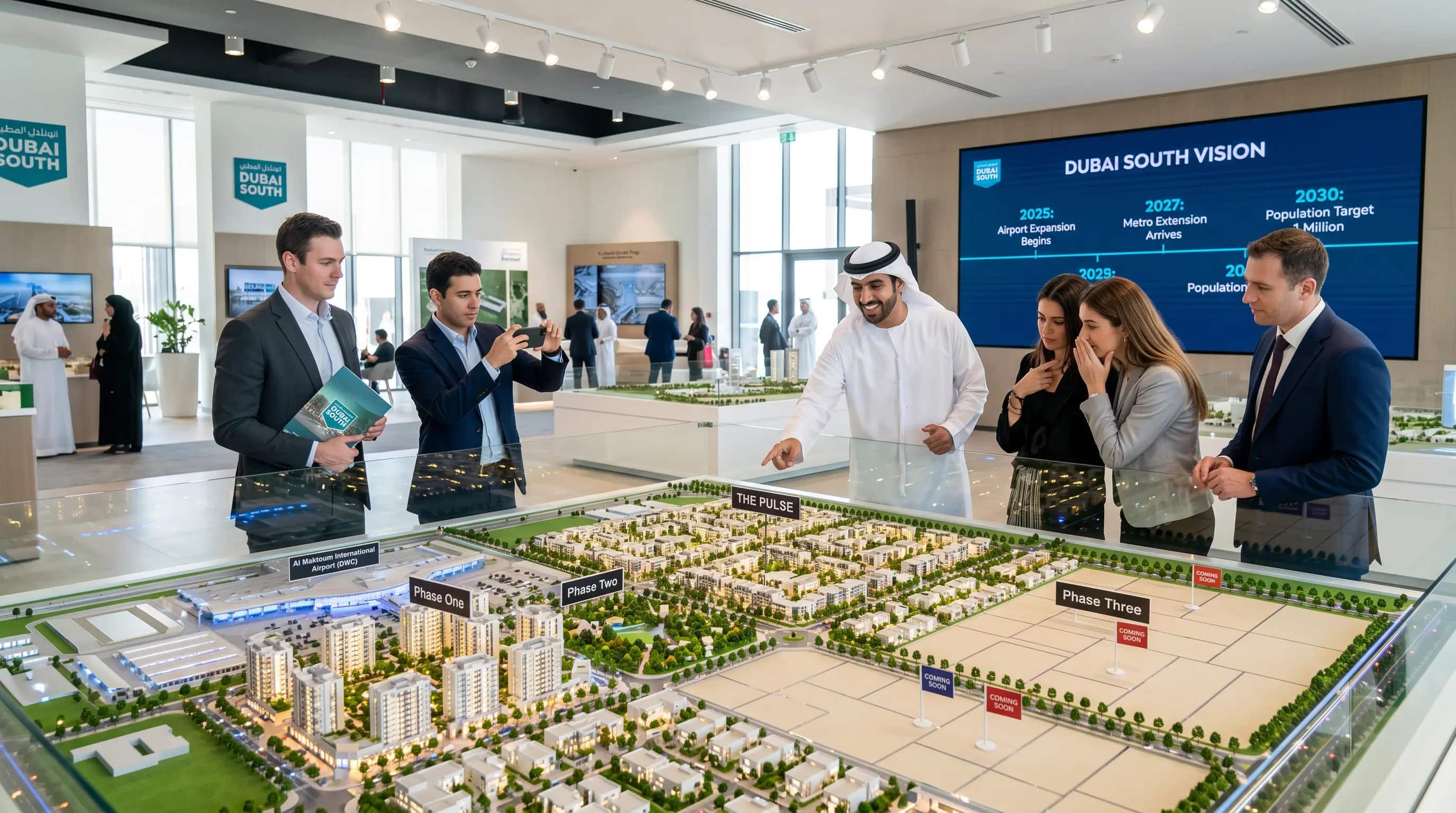
Dubai South for Investors: Why People Are Buying Here Early
Dubai South delivers 5-7% yields with airport and Expo legacy drivers. 87% of tier-one developer investors hit targets. Why people buy here early in 2026.
There’s a specific kind of investor who has been buying in Dubai South for the past two or three years, and we’ve worked with enough of them to recognise the type. They aren’t looking for next quarter’s capital gain. They’re not chasing the highest yield in the city. They’re not trying to flip an off-plan unit before handover. What they’re doing is positioning themselves ahead of a long-term infrastructure story that almost everyone agrees will happen but very few people are pricing into their current decisions.
That story is Al Maktoum International Airport. Or more precisely, the expansion of Al Maktoum into what will eventually become the world’s largest airport, taking over Dubai International’s traffic over the coming years and reshaping the southern Dubai corridor in the process. The 2024 announcement that Dubai will be moving operations from DXB to Al Maktoum over time, with the new terminal capable of handling 260 million passengers a year, changed the long-term picture for everything sitting in the airport’s catchment. Dubai South is the cluster most directly inside that catchment.
We’ve sold and rented across Dubai South for several years. The numbers we see are not the highest-yield numbers in Dubai. They’re somewhere in the middle. The capital growth has been steady but not spectacular over the past three years. What Dubai South offers, and what is harder to find in any other Dubai apartment district right now, is exposure to a credible 10-year story at prices that haven’t yet priced in the story. That’s a very specific kind of bet, and it works for a very specific kind of investor.
This article walks through what Dubai South actually is in 2026, why the airport story matters for property values, what apartment options exist and at what price points, the current yield and growth picture, our own research on Dubai South apartment performance, and the honest read on whether buying early in Dubai South makes sense for the kind of investor reading this piece. We’ll cover the risks too, because they’re real and we’ve watched buyers underestimate them.
A note up front. Dubai South is not for investors who need rental income immediately or who can’t tolerate a property that may take longer than the city average to appreciate meaningfully. The thesis here is about position before the catalyst plays out. If you need yield today, there are better areas. If you want to be in front of the next phase of Dubai’s residential geography, Dubai South is where the credible investors we work with are putting capital.
What Dubai South Actually Is in 2026
Dubai South is a 145 square kilometre master-planned city about 40 kilometres south of central Dubai. The development sits adjacent to Al Maktoum International Airport, encompasses the Expo 2020 site (now Expo City), and stretches roughly from Sheikh Mohammed bin Zayed Road in the north to Emirates Road in the south.
The vision was set out by the late Sheikh Mohammed bin Rashid Al Maktoum’s master plan back in 2006. The plan envisaged a fully integrated city built around a major airport with residential, commercial, logistics, and industrial districts. Almost twenty years on, parts of that vision are real and parts are still building out.
Dubai South in 2026 includes several distinct sub-districts:
• The Residential District including Mag 5 Boulevard, The Pulse, Urbana, and the various phases of South Bay and Greens by Emaar
• Emaar South which is a separate Emaar-developed cluster with apartments, townhouses, and an established golf course
• Expo City which sits at the northern edge and has been transitioning from event site to permanent residential and commercial use
• The Logistics District centred on the airport’s cargo capacity and Dubai South Free Zone
• The Aviation District for airport-related businesses
• The Commercial District which is filling in around the residential clusters
For apartment investors, the conversation is mostly about the Residential District and Emaar South. Expo City is becoming more relevant as the residential conversion progresses but remains a smaller share of available stock.
The Dubai South masterplan envisages an eventual population of 1 million residents at full build-out. The current population is around 25,000 to 30,000, with growth accelerating since 2023. That growth trajectory is what underpins the investment case.
The Airport Story and Why It Matters
The headline event behind Dubai South investment thinking is Al Maktoum International Airport’s planned expansion. In April 2024, Dubai’s ruler announced a USD 35 billion plan to build out Al Maktoum International to handle 260 million passengers annually, with Dubai International eventually phasing out commercial operations entirely.
The transition is staged over multiple years. Construction is underway. Commercial flights are gradually migrating. The full transition will take a decade or longer. But the direction of travel is clear and confirmed at the highest level.
What this means for property in Dubai South:
A massive employment catchment will develop around the airport. Aviation, logistics, hospitality, and adjacent services will eventually employ hundreds of thousands of workers. Many of them will want to live nearby.
Infrastructure investment has been accelerating. New road networks. Metro extensions in the planning pipeline. Retail, healthcare, and education facilities catching up to the residential build-out.
Demand signals are real and growing. Off-plan launches in Dubai South have been selling out faster in 2024 and 2025 than in any previous period. Secondary market activity has picked up. Rental occupancy has improved as the area matures.
Khalifa Al Zaffin, executive chairman of Dubai Aviation City Corporation and Dubai South, has spoken publicly about the integrated nature of the Dubai South masterplan and how the airport expansion is one node in a much broader development thesis. The point investors take from these statements is that the airport is real, the timeline is committed, and the residential and commercial build-out around it is planned to match.
What doesn’t yet exist: the full daily experience of living in a mature Dubai South. Some clusters are well-established. Others are still in the early phases. The retail variety is improving but not yet at the level of mature Dubai districts. School options are growing but limited compared to Dubai Hills or Arabian Ranches. The metro doesn’t yet serve the area directly.
Investors buying in 2026 are buying ahead of these gaps closing, not buying because they’ve already closed.
Dubai South Apartment Options at Various Price Points
The Dubai South apartment market in 2026 covers a wider price range than most investors expect. The cluster breakdown:
The Pulse and Pulse Beachfront, mid-rise developments built around park spaces and the Pulse Boulevard retail strip. Studios from around AED 480,000, one-bedrooms from AED 700,000, two-bedrooms from AED 1.1 million.
Mag 5 Boulevard, one of the earlier Dubai South residential nodes. Studios from AED 420,000, one-bedrooms from AED 620,000.
Urbana by Emaar, townhouse-led but with some apartment supply. Apartments from around AED 850,000 for one-bedroom.
South Bay, a newer Emaar coastal-themed cluster with apartments and villas. Apartment pricing starts higher, with one-bedrooms from AED 1.2 million.
Greens by Emaar (Emaar South), an established apartment-and-villa community with a working golf course. One-bedroom apartments from AED 950,000, two-bedrooms from AED 1.4 million.
Expo City residential, conversions from the original Expo 2020 site into permanent residential supply. One-bedrooms from around AED 1.0 million, with newer launches at premium pricing.
Off-plan launches in Dubai South currently include several mid-tier and upper-mid-tier developments from Emaar, Azizi, and other developers. Payment plans are typically 60/40 or 50/50, with handover dates ranging from 2026 to 2028.
A few things apartment investors should know about Dubai South stock:
1. The newer Emaar developments carry a noticeable price premium over the older mid-tier supply but also tend to hold value better
2. Unit sizes in Dubai South are typically larger than equivalent units in JVC or Discovery Gardens, often 10 to 15 percent more square footage for similar bedroom counts
3. Service charges range from AED 10 to AED 18 per square foot depending on building age and amenity package, lower than central Dubai averages
4. Parking is well-supplied across most Dubai South buildings, typically two spaces with two-bedroom and larger units
5. Build quality varies more widely than in established districts. Some older Mag 5 buildings have aged less well than others. Newer launches generally have better finish standards
6. Off-plan timelines have been broadly delivered on, with most major projects handing over within 6 months of original schedule
For investors, the building selection within Dubai South matters as much as the area selection. The team can walk through which specific buildings have performed versus which have lagged.
Yield and Growth Picture in 2026
Gross rental yields in Dubai South currently run between 6.8% and 8.5% depending on cluster and unit type. Mag 5 and similar older mid-tier deliver toward the higher end. Emaar South and newer premium clusters yield closer to the lower end. The median across the area sits around 7.5%.
Net yields land between 5.5% and 7.0% after service charges, agent fees, and typical void periods of 2 to 4 weeks between tenants. Voids are longer in Dubai South than in central Dubai because the tenant pool is shallower, though it has been deepening each year as the area matures and more employees move in.
Three-year capital appreciation between 2022 and 2025 ran around 30% across Dubai South on average, with newer Emaar clusters at 35% to 45% and older mid-tier closer to 22% to 28%. The citywide apartment average over the same period was around 45%. So Dubai South has lagged central Dubai on pure capital growth, which is the expected pattern for an area in the early stages of its build-out.
Faisal Durrani, Knight Frank’s head of Middle East research, has written about the gap between current Dubai South valuations and the long-term value that should accrue as the airport story matures. The gap is real but takes patience to harvest. Investors who bought in 2018 and held through 2023 saw mediocre returns. Investors who bought in 2021 and have held since are seeing the start of meaningful appreciation as the airport announcement and infrastructure investment catalyse demand.
A reasonable framework for thinking about Dubai South investment returns:
1. Yields today are in the 6.5% to 8.5% range, holding rental income strong
2. Capital growth has been steady but slower than central Dubai through 2025
3. The airport catalyst should accelerate growth over the medium term, but the timeline is years not quarters
4. Total return investors with a 7 to 10 year horizon are the natural buyers here
5. Investors needing 3 to 5 year returns may find better options elsewhere
6. Building and developer selection matter a lot more in Dubai South than in established districts
The risk side is that the airport timeline could slip, infrastructure investment could lag, or supply could outpace demand if developers all launch simultaneously into the catalyst story. None of these are catastrophic risks but all are real.
Our Research on Dubai South Apartment Performance
We pulled data on roughly 80 Dubai South transactions and 150 rental contracts from 2023 and 2024, drawing from our own records and Property Monitor. The cluster-by-cluster yield breakdown:
Mag 5 Boulevard, average one-bed price AED 670,000. Average one-bed rent AED 53,000. Gross yield: 7.9%.
The Pulse, average one-bed price AED 760,000. Average one-bed rent AED 58,000. Gross yield: 7.6%.
Emaar South Greens, average one-bed price AED 1.05 million. Average one-bed rent AED 78,000. Gross yield: 7.4%.
Urbana apartments, average one-bed price AED 920,000. Average one-bed rent AED 66,000. Gross yield: 7.2%.
South Bay, average one-bed price AED 1.32 million. Average one-bed rent AED 92,000. Gross yield: 7.0%.
Expo City residential, average one-bed price AED 1.18 million. Average one-bed rent AED 82,000. Gross yield: 6.9%.
Three-year capital appreciation, by cluster, 2022 to 2025:
Mag 5 Boulevard: 26%. The Pulse: 32%. Emaar South Greens: 40%. Urbana: 35%. South Bay: 38% since launch. Expo City: 28% since residential conversion.
What this tells us. The newer Emaar clusters have delivered both reasonable yields and stronger capital appreciation. The older mid-tier clusters offer higher gross yields but slower growth. South Bay’s strong appreciation reflects its newer status and beachfront-adjacent positioning. Emaar South Greens is the most balanced proposition we see in the area, with both yield and growth tracking above the Dubai South average.
Cross-referenced against the Dubai Land Department transaction database and Knight Frank’s regional research, the picture holds. Dubai South is delivering decent yields with moderate capital growth, with the strongest performance concentrated in the Emaar-developed clusters.
Should You Buy Into Dubai South Now
The honest read on Dubai South as an investment in 2026 looks like this.
If you have a 7 to 10 year investment horizon, you don’t need immediate yield to be at the top of the city ranking, and you believe the airport story will play out broadly as announced, Dubai South is one of the strongest positional bets in the Dubai apartment market today. The entry prices are sensible. The yields cover the carry. The catalyst is real and committed.
If you need yield today at the top of the city, JVC, Dubailand older stock, or Discovery Gardens deliver higher gross yields with established tenant pools. Dubai South is not the highest-yield district.
If you want fast capital appreciation in the next 3 years, the more established Dubai districts have momentum that is easier to predict. Dubai South’s growth is more likely to accelerate from years 4 to 8 of your hold than in the early years.
If you’re a value buyer with a long horizon, Dubai South works particularly well. The combination of below-average entry prices, decent current yields, and exposure to an enormous infrastructure catalyst is rare in the Dubai market today.
The most reliable Dubai South picks we’ve watched perform: Emaar South Greens for balanced yield and growth, Mag 5 Boulevard for pure yield, The Pulse for mid-tier balanced exposure, and selected off-plan launches from established developers with credible delivery records. The patterns we’ve watched fail: speculative off-plan units in unproven developments, buyers committing to handovers more than three years out without verifying the developer’s reserve fund and delivery track record, and investors expecting Dubai South to perform like central Dubai in the short term.
For anyone considering specific buildings or off-plan units, the developer’s track record and the cluster’s infrastructure readiness matter more in Dubai South than in established districts. Live listings across Dubai South and similar growth-stage areas shift weekly, and the team can pull yield and resale data on specific buildings. Our agents handle Dubai South transactions regularly, and current off-plan launches in the area often include attractive payment plans. Ready to look seriously? Reach out and we’ll take it from there.
Related stories
Dubai's Established Charm: The Case for Older Homes
In a city focused on the future, I believe the smartest move for many buyers is to look back. Dubai's seasoned communities offer space, character, and surprising value that new builds often can't match.
The True Cost of Owning a Dubai Property
Beyond the purchase price, your annual budget for a Dubai home must account for service charges, utilities, and maintenance. I'll break down every ongoing expense you need to plan for.
Calculating ROI on Dubai Rental Upgrades
As a landlord in Dubai, you can't just follow trends. I'll show you how to calculate the precise ROI of minor property upgrades to genuinely increase your rental yield.
Echoes, in your inbox
One thoughtful email a month. Market insight, new launches, no spam.