

2-Bed Apartment vs Small Townhouse in Dubai: The Lifestyle Tradeoff
You have a budget. Let’s assume that it amounts to about two million dirhams. It's always a tough call between two quite opposite houses which, essentially, cost you the same: two-bedroom…
You have a budget. Let’s assume that it amounts to about two million dirhams. It's always a tough call between two quite opposite houses which, essentially, cost you the same: two-bedroom apartment in downtown, with a balcony, and the house in the community, equipped with all facilities, or small townhouse in the community, having a garden and a private entrance. The price is equal, but the way of life is totally different.
That's one of the most widespread dilemmas of Dubai buyers. It's not about what option is better than another, because both of them are pretty good. It's really about trading off the way of life. One option gives you the location, and another one offers more comfort and space. The right answer can be found only depending on your real-life needs, not on what option you like more.
This guide tells you the truth about the tradeoff, explaining the advantages of the two-bedroom apartment and the small townhouse, their disadvantages, expenses besides the initial price, and how to make sure which option is best for you, if you are going to buy or to rent.
Just one word about the numbers. Prices, service charges and operating costs differ dramatically depending on the region and the building; so, these numbers are rather an illustration of the tradeoff than quotations. But you still should calculate real numbers before making a decision. With that in mind, let's discuss the two ways of life.
Same Budget, Two Different Lives
The reason this choice is so common is a quirk of how Dubai prices work. At a similar budget, say somewhere around AED 2 million, a two-bed apartment in a central or popular area often costs about the same as a small townhouse in an outer master community, so the same money genuinely buys you either, and the trade is real rather than imagined. You are not comparing a cheaper option against a pricier one. You are comparing two roughly equal-cost homes that deliver opposite things.
What you are really trading is space against location, with a few other things riding along. The apartment tends to put you closer to the action, work, dining, the metro, the buzz, in a smaller footprint with no outdoor space of your own but a building full of shared facilities. The townhouse tends to give you more room, a private garden, and a community feel, further from the centre, with more to maintain and a car you will rely on. How those pricings and trade-offs sit in the current market is something research from firms like Knight Frank tracks, and it shifts over time, which is one more reason to check the live numbers for your areas.
Here is the trade in a nutshell:
- Space. The townhouse gives you more of it, the apartment less.
- Location. The apartment tends to be more central, the townhouse further out.
- Outdoor space. The townhouse usually has a garden, the apartment a balcony at most.
- Convenience. The apartment is lock-up-and-go, the townhouse is a home to run.
- Amenities. The apartment has them in the building, the townhouse across the community.
- Daily feel. The apartment is urban living, the townhouse is house living.
None of those is a winner on its own. A garden is wonderful if you have kids or a dog and useless if you travel constantly. A central location is gold if you work downtown and irrelevant if you work from home. The same feature is a plus for one person and a non-event for another, which is exactly why this is a lifestyle question and not a ranking.
So the useful way through is not to ask which home is better, but which life is yours. The next two sections lay out each life in full, the apartment and the townhouse, so you can feel which one sounds like your actual week rather than your daydream. Then we get into the costs and the decision.
The 2-Bed Apartment Life
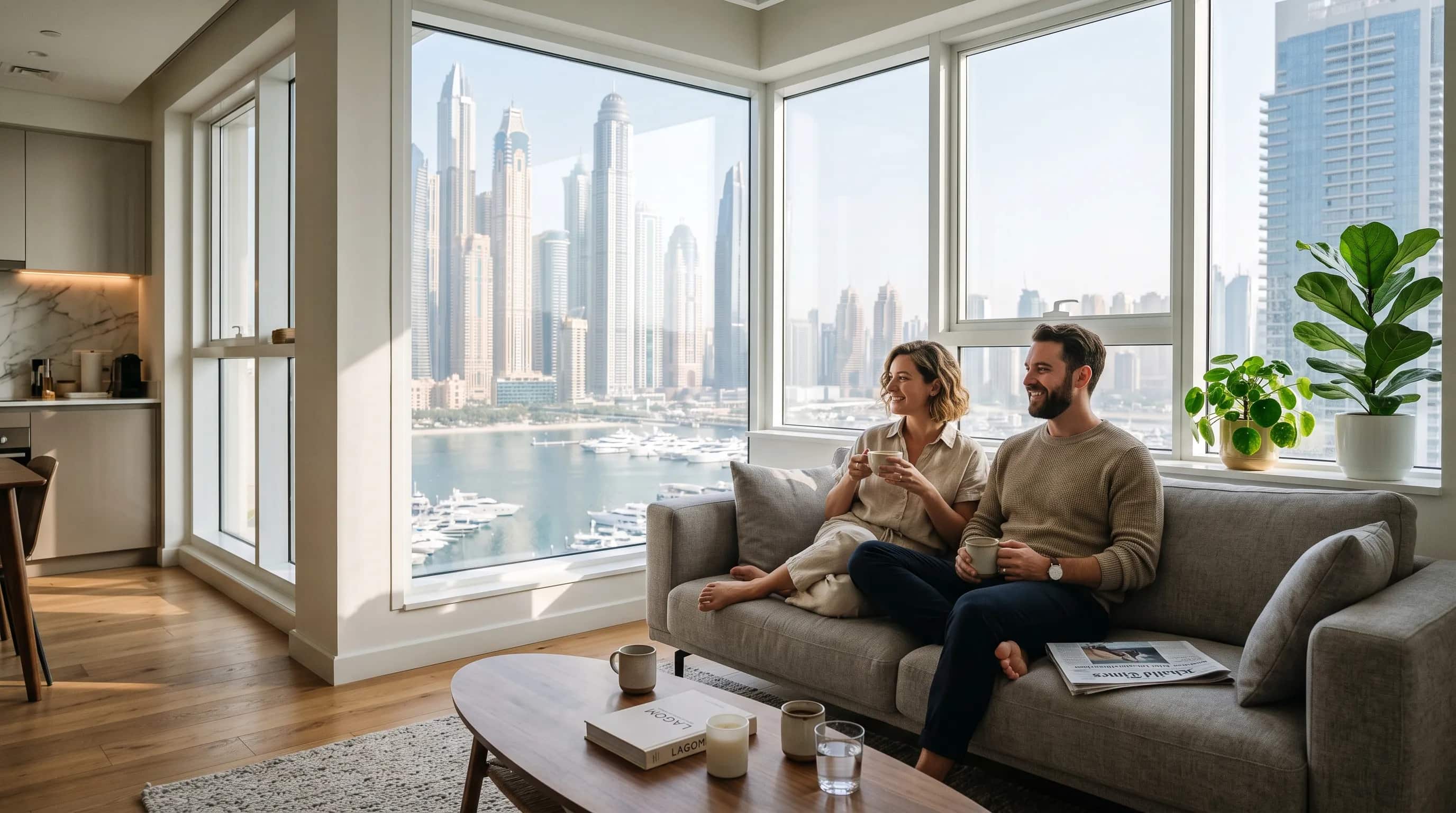
Picture the apartment version of your life. You are somewhere central or well-connected, maybe a tower in a popular district, with a balcony, a building gym and pool downstairs, a concierge or security at the door, and the city a short walk or drive away. It is compact, efficient, and easy, and for the right person it is close to ideal.
The headline strengths are location and ease. A central two-bed puts you near work, restaurants, the metro, and the social scene, often within walking distance of things a townhouse owner has to drive to. It is also lock-up-and-go, which is a bigger deal than people realise, since you can travel for weeks, lock the door, and not worry about a garden or a house, with the building handling the upkeep of everything shared. The amenities come built in, a pool and gym you never have to maintain yourself, and for couples, professionals, and frequent travellers, that low-effort, well-located life is genuinely hard to beat. The apartment route is the one most first-time and investor buyers take, and you can get a feel for what is out there on our apartments page.
Here is what the apartment life gives you:
- Central location. Closer to work, dining, transport, and the social scene.
- Lock-up-and-go. Travel freely without a house or garden to worry about.
- Built-in amenities. A pool and gym you use but never maintain.
- Low personal upkeep. The building handles the shared maintenance.
- Walkability. More likely to have things within walking distance.
- Easier letting. A central two-bed is simple to rent out and tends to stay in demand.
The trade-offs are space and the bill for all those facilities. You get less room, no private outdoor space beyond a balcony, and you may feel the squeeze if your life or family grows. And the amenities are not free, an amenity-rich building carries service charges that can be meaningful, which we will come to. There is also less of the privacy and quiet of a house, since you share walls, lifts, and facilities with a lot of neighbours. General guidance on living and renting in the country sits within the UAE government portal, which is a useful background read whichever way you lean.
The honest summary is that the two-bed apartment suits people who value location, convenience, and a low-effort home over space and a garden. Couples without kids, busy professionals, frequent travellers, and investors tend to love it. If your week is built around work, the city, and the freedom to lock up and leave, the apartment is very likely your home.
The Small Townhouse Life
Now the townhouse version. You are in a community further from the centre, with a small garden, your own front door, two or three floors of space, and parks, pools, and maybe schools within the neighbourhood rather than your building. It is more home and more space, and for the right person it is exactly what a place to live should feel like.
The headline strengths are space and a sense of home. A townhouse gives you room to spread out, a private outdoor space for kids, pets, or a morning coffee, and the simple pleasure of a house that is yours from the front door in, with no shared lifts or corridors. Communities built around townhouses tend to be quieter and family-focused, with green space, play areas, and a neighbourly feel that suits putting down roots. For families, for anyone with children or animals, and for people who simply want more room and a garden, that life is hard to replicate in a flat. If this is the direction you are leaning, our townhouse page is a good place to see how they are laid out and where they sit.
Here is what the townhouse life gives you:
- More space. Multiple floors and more room than an apartment at the price.
- A private garden. Outdoor space of your own for kids, pets, or relaxing.
- Your own front door. A house feel with no shared lifts or corridors.
- Community living. Parks, pools, and a family-focused, neighbourly setting.
- Room to grow. Space that suits a family that may expand.
- Privacy. Fewer shared walls and more of your own space.
The trade-offs are location and effort. Townhouses usually sit further out, so you are more car-dependent and further from the central buzz, and the daily commute and errands lean on driving. You also maintain more, the garden, the home itself, the small repairs that a building would handle in an apartment, and a bigger home costs more to run, especially to cool through the Dubai summer. It is more home, but it is also more to look after, which is a feature for some and a chore for others.
The honest summary is that the small townhouse suits people who value space, a garden, and a settled family life over a central location and a low-effort home. Families, pet owners, and long-term settlers tend to love it. If your week is built around home, kids, and space to breathe, and you do not mind the drive and the upkeep, the townhouse is very likely your home.
The Real Costs Beyond the Price Tag
The purchase price is only half the money story. What it costs to run each home month to month differs in ways that can quietly tip the decision, so it is worth getting clear-eyed about before you buy.
Start with service charges. Apartments, especially in amenity-rich buildings, carry service charges based on the size of your home, and in a tower packed with pools, gyms, and concierge service, those charges can be meaningful, paying for all the facilities you enjoy. Townhouse communities usually have lower charges per square foot, since there is less shared infrastructure, but the catch is that you take on the upkeep the building used to handle, the garden, the home maintenance, the repairs. Then there is the running cost of space itself, because a bigger townhouse simply costs more to cool, and cooling is the big Dubai utility bill, so a larger home through the summer can mean a noticeably higher electricity cost than a compact flat. You can get a feel for utility costs and tariffs through DEWA, which is worth a look when you are sizing up the running cost of a bigger home.
Here is how the running costs compare:
- Apartment service charges. Can be high in amenity-rich buildings, paying for the facilities.
- Townhouse community charges. Usually lower per square foot, with less shared infrastructure.
- Townhouse upkeep. You maintain the garden, the home, and the repairs yourself.
- Cooling costs. A bigger townhouse costs more to cool through the summer.
- Maintenance effort. The apartment outsources it, the townhouse puts it on you.
- The evening-out. Lower townhouse charges can be offset by higher upkeep and cooling.
The point that surprises people is that the two often even out more than the headline service charge suggests. An apartment owner pays higher charges but outsources almost all the effort and runs a smaller, cheaper-to-cool home. A townhouse owner pays lower charges but takes on the garden, the upkeep, and a bigger cooling bill. So do not pick purely on the service charge number, since it tells only part of the story, and a low community charge on a big house you cool and maintain yourself is not the bargain it first looks.
The honest summary is that both homes cost more to run than the price tag implies, just in different shapes. The apartment bundles the cost into a charge you pay and forget. The townhouse spreads it across charges, upkeep, and cooling that you manage yourself. Add up the real monthly cost of each, not just the service charge, and you will compare them fairly.
Which One Actually Fits You
With both lives and both cost pictures on the table, the decision comes down to matching the home to how you actually live, and to your stage of life as much as your budget.
We lined up common priorities against the home that tends to fit, each on one line:
- You want a central location near work and nightlife: the 2-bed apartment, closer to the action.
- You want space and a private garden: the townhouse, with room the apartment cannot match.
- You travel a lot and want lock-up-and-go: the apartment, easy to leave and forget.
- You have kids or pets who need room: the townhouse, with outdoor space and a community feel.
- You want the highest rental yield: the apartment, which typically earns more as a percentage.
- You are settling for the long term: the townhouse often suits putting down roots better.
The pattern usually tracks life stage. Couples, single professionals, and frequent travellers tend to lean apartment, drawn by location and ease, while families, pet owners, and long-term settlers tend to lean townhouse, drawn by space and a garden. Plenty of people switch from one to the other as life changes, the central two-bed that was perfect at thirty making way for the townhouse that suits a growing family at thirty-five. Where you are in that arc matters as much as what you can afford.
There is an investment angle too, worth a quick, non-advisory word. Apartments, especially central two-beds, tend to offer higher rental yields and easier letting, since the tenant pool is large and the home simple to rent, while townhouses tend to appeal to families and can do well on longer-term capital growth in good communities, with lower percentage yields but a bigger asset. Neither is automatically the better investment, it depends on your goals and timeframe, so run your own numbers rather than taking a rule of thumb. Location drives a lot of this, and our areas guide helps you see where the central apartment districts and the townhouse communities actually sit, which shapes both lifestyle and returns.
The honest read is that this is a question of fit, not quality. The right home is the one that matches your daily life, your stage, and your priorities, the apartment for location and ease, the townhouse for space and roots. Be honest about which describes you now, not the version of you in a brochure, and the choice tends to make itself.
What We Would Actually Do
To put it succinctly, the decision between a two-bedroom apartment and a small townhouse is a matter of lifestyle rather than a competition. The apartment comes with location, convenience, and easy-going style, with space and a garden sacrificed. The townhouse provides you with space, outdoors, and family atmosphere, but it lacks central location and requires maintenance. With the same budget, you get two different lifestyles; hence, all you need to do is choose the one that suits you the most.
In case a friend were to come to us for advice, we would not waste time on brochures but ask him/her about his/her week. Do you work downtown or at home? Are you often traveling or staying at one place? Children or pets, plans for either? Garden or gym? These questions would provide us with an insight into a person's lifestyle: someone who is constantly traveling and working downtown is more likely to prefer an apartment, while those who have two kids and a pet and dream of a barbecue on Friday would be attracted by a townhouse. In general, most people can tell their preference when they see what a typical day in it looks like.
We would also warn them about buying dreams instead of realities. A townhouse garden can be very attractive; however, it should be considered whether the buyer uses it. In the same way, location of an apartment becomes valuable depending on how often the buyer is going to use it. Buying a house that matches your lifestyle instead of your imagination is the way to happiness in many years ahead.
The number one mistake that buyers make is concentrating on location or space, but forgetting everything else – commuting, maintenance, costs of living, and the current stage of your life. Think of everything, imagine your typical Tuesday in both cases and choose. There is no right or wrong here, only a mismatch.
If you want some help in choosing real apartments and townhouses according to your budget and deciding which one suits you the best, that is precisely the job of our service. Our property buying service can put both side by side and be honest about the trade-offs.
And if you want a straight conversation about your situation, your budget, your week, and which home fits, we are glad to help. Get in touch and we will take it from there.
Related stories
Buying in Dubai By Selling Assets Abroad
A detailed guide on how to strategically sell your international property or investments to fund your home purchase in Dubai. I'll walk you through the entire process, from legal and tax considerations to transferring funds and proving their origin.

Exit Strategy: The Key to Total Return in Dubai Property
Many investors focus only on annual rental yield. I'll explain why your exit strategy and understanding total return are far more critical for a successful Dubai property investment.

The Professional's Retreat: Dubai Villas for Work & Family
For professionals balancing careers and family, finding the right Dubai villa is crucial. I explore the communities that masterfully blend dedicated home offices with exceptional family living.
Echoes, in your inbox
One thoughtful email a month. Market insight, new launches, no spam.