

When Will the Real Estate Market Recover? What the Data Says
Most Dubai property segments don't need recovery. Premium luxury 2-4 years to peak. Here's what the data says about real estate market recovery in 2026.
The question of when the Dubai real estate market will recover comes up frequently in international buyer conversations, often imported from market commentary about other global property markets. The honest answer requires addressing what “recovery” actually means in the Dubai context, because the framing of the question doesn’t quite match what’s happening in the Dubai market.
The Dubai property market in 2026 is not in a state requiring broad recovery. Across most segments and areas, prices have been growing rather than declining. Transaction volumes remain strong. International buyer demand continues. The 2021-2023 surge period delivered substantial appreciation, and the 2024-2026 period has continued with moderated but still positive growth. The “when will recovery happen” question assumes a state that doesn’t broadly describe the current market.
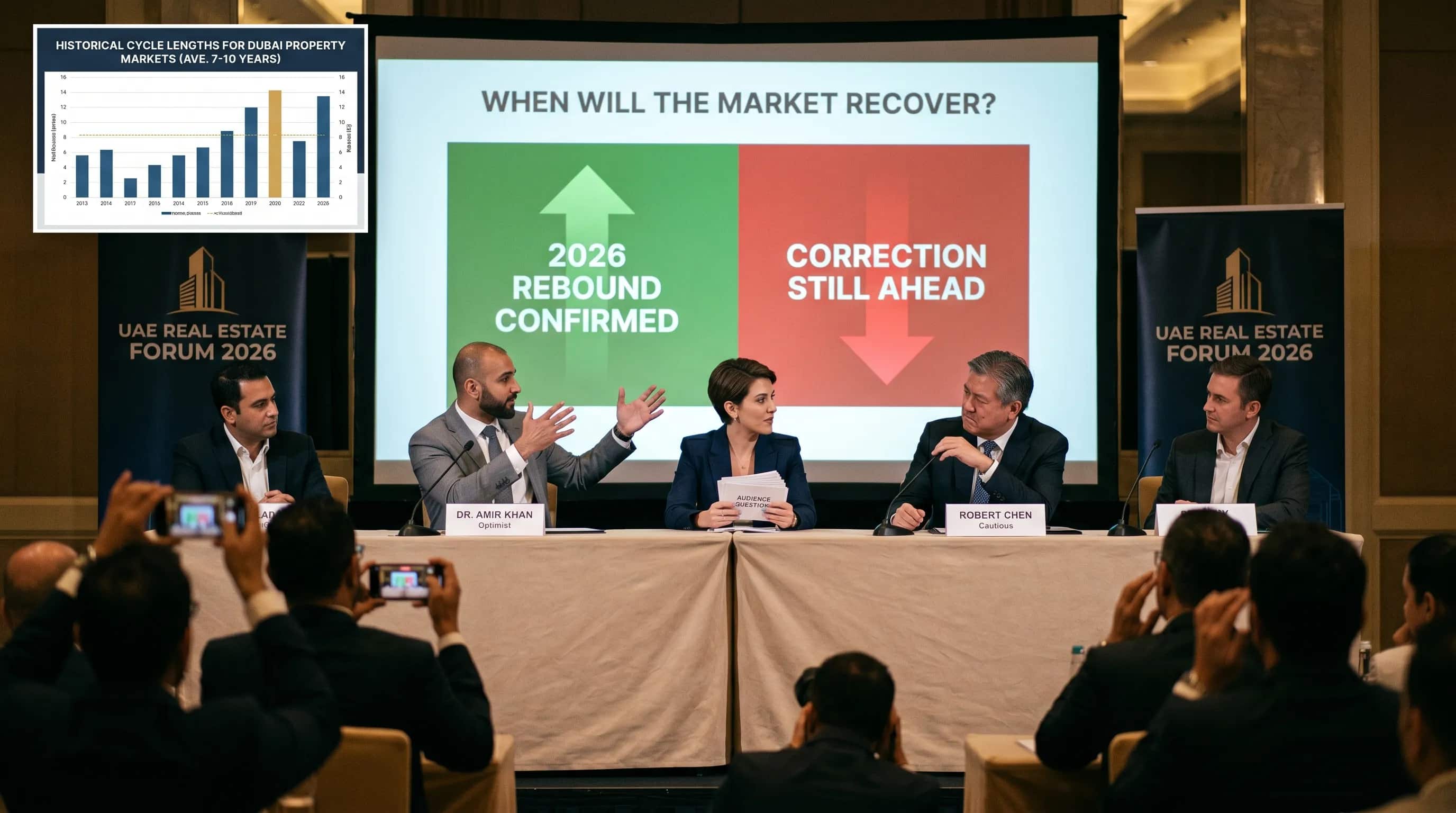
That said, parts of the Dubai market have moderated. Some specific segments have softened. Some areas have seen increased competing supply that has affected pricing dynamics. Historical Dubai cycles (notably 2008-2010 and 2014-2016) included periods of real correction. Understanding the actual data on current state, historical cycle patterns, and segment-specific dynamics produces better decisions than relying on the simplified “recovery” framing.
We’ve watched enough Dubai market cycles to know what the patterns actually look like and what indicators matter. This article walks through the current state of the Dubai market in 2026 with specific data, the historical recovery patterns from previous Dubai cycles, the segments performing differently right now, our research on recent trends, what to watch for in 2026-2027, and the practical investment implications.
A note up front. This piece tries to give an honest assessment rather than either bullish marketing or bearish skepticism. The data tells a more nuanced story than either extreme. Specific segments and specific properties have different dynamics that the aggregate picture can obscure. For specific investment decisions, the framework here provides orientation but property-specific analysis still matters.
Faisal Durrani, Knight Frank’s head of Middle East research, has consistently emphasised that the Dubai market in 2026 represents a more mature and differentiated environment than at any prior point. The simplified single-market analysis that worked in earlier periods doesn’t capture the segment-specific dynamics that matter for current decisions.
The Current State of the Dubai Market in 2026
The actual state of Dubai’s property market in 2026, based on transaction data and broader market indicators:
• Aggregate transaction volumes remain robust with continued strong international buyer demand and continued resident buying activity. Annual transaction volumes have stabilised after the 2021-2023 surge but at historically elevated levels
• Price growth has continued but at moderated rates compared to the peak surge period. Most areas are seeing single-digit annual growth rather than the double-digit growth of 2021-2023
• Rental dynamics remain strong with rent growth continuing across most areas, though at moderated rates compared to peak periods. RERA rent calculator caps manage the pace of increases on existing leases
• Supply pipeline has expanded substantially with multiple developers running concurrent launches. Total pipeline through 2030 is meaningful relative to historical absorption rates
• Premium and ultra-luxury segments have continued strong performance with limited new supply and continued international ultra-high-net-worth demand
• Mid-tier segment has moderated with increased competing supply affecting pricing dynamics in some areas
• Entry-tier segment has seen the most supply expansion with corresponding pricing pressure in specific buildings and areas
• Mortgage availability remains strong with major Dubai banks lending at competitive rates, supporting buyer activity
The data indicates a market that’s working normally rather than one requiring recovery. The transition from peak surge to moderated growth is a typical market cycle progression rather than a downturn.
What has genuinely moderated:
1. The pace of price growth has come down from double-digit annual rates to single-digit annual rates in most areas
2. The pace of new buyer entries has moderated from the peak rush of 2021-2022
3. Specific segment supply absorption has stretched in areas with substantial pipeline
4. Mid-construction off-plan flipping has become harder as buyer demand for mid-construction transfers has narrowed
5. Some specific properties have stabilised in price after rapid appreciation rather than continuing to grow
What hasn’t happened:
1. Broad price declines across mainstream segments
2. Transaction volume collapse
3. Buyer demand evaporation
4. Developer pipeline retrenchment
5. Bank lending withdrawal
The pattern is consistent with mature market normalisation rather than crisis. Understanding this distinction matters for investment decisions because the strategies appropriate for normalisation differ from those appropriate for crisis.
Historical Cycle Patterns from Previous Dubai Markets
The Dubai property market has experienced two notable correction cycles in its modern history, providing useful patterns for understanding cycle dynamics:
The 2008-2010 cycle. The global financial crisis combined with Dubai-specific factors produced a substantial correction. Prices fell 50% or more in many areas between peak (mid-2008) and trough (2010). Recovery began in 2011-2012 with full recovery to peak prices taking 5-7 years in most segments. The cycle taught hard lessons about regulatory framework, escrow protections, and developer governance that subsequently reshaped Dubai’s property infrastructure.
The 2014-2016 cycle. Various global factors (oil price decline, regional dynamics, stronger dollar) produced a more moderate correction. Prices declined 15-25% in most areas between peak (mid-2014) and trough (2016). Recovery began in late 2016 with full recovery taking 2-3 years in most segments. The cycle was less severe than 2008-2010 but still represented a meaningful correction period.
Between 2017 and 2020, the market traded in a relatively narrow range with modest growth interrupted by the pandemic in early 2020. The pandemic produced a brief sharp correction (March-October 2020) followed by the surge period that ran through 2023.
The 2021-2023 surge period saw appreciation of 40-80% across most areas, depending on specific segment and timing. The surge was driven by global capital flows post-pandemic, the broader UAE economic positioning, and the property market’s structural advantages.
The 2024-2026 period has been characterised by continued growth at moderating rates rather than correction.
What the historical patterns suggest:
1. Major corrections in Dubai have been associated with specific global or regional shocks rather than purely domestic factors
2. Recovery from corrections has typically taken 2-7 years depending on severity
3. The regulatory framework has matured substantially since 2008, providing better infrastructure for managing future cycles
4. Each major cycle has been different in specific causes and patterns; the current period doesn’t closely match either prior correction cycle
5. The market typically recovers as supply absorbs and demand fundamentals reassert themselves
For investors thinking about cycle timing, the historical patterns suggest patience and long-term holding produces better outcomes than attempting to time specific cycle turning points. Dubai investors who held through the 2008-2010 correction and beyond captured strong long-term returns. Investors who tried to time entry and exit often had worse outcomes than long-term holders. The cycle timing strategy looks attractive in theory but rarely produces better results than disciplined long-term holding in practice.
Marwan Bin Ghalita, the former head of the Real Estate Regulatory Agency, has spoken about how the regulatory and institutional changes since 2008 have made Dubai property cycles substantially more manageable than the dramatic boom-bust patterns of earlier periods. The framework around escrow accounts, developer governance, transaction transparency, and buyer protections has matured into a more sophisticated infrastructure.
Segments Performing Differently
The differentiated segment performance in 2026:
The premium and ultra-luxury segments (AED 5 million plus apartments, AED 15 million plus villas) have continued strong performance. Limited supply expansion in these segments combined with sustained international ultra-high-net-worth demand has supported pricing. Areas like Palm Jumeirah, Emirates Hills, Hudayriyat, premium Downtown branded residences, and ultra-luxury villa clusters have shown particular strength.
The mid-tier segment (AED 1.5-5 million apartments, AED 4-15 million villas) has been more mixed. Strong areas like Dubai Hills, Marina premium positions, and established premium clusters have continued growing. Areas with substantial competing supply have seen more moderate price action. The mid-tier dispersion has widened.
The entry-tier and budget segments (under AED 1.5 million apartments) have seen the most supply pressure. Areas with substantial new supply have experienced price stabilisation or modest declines in specific buildings while areas with limited supply have continued growing. The within-segment variance has widened substantially.
The off-plan market continues active with multiple major developers running concurrent launches. New launch pricing has typically been positioned with reasonable discounts to comparable secondary market alternatives. The off-plan-to-secondary spread has stabilised after compression in the peak surge period.
The rental market has continued strong with rent growth in most areas, though at moderated rates. RERA rent calculator caps have managed the pace of rent increases on existing leases. New lease pricing reflects current market conditions which have continued growing.
The commercial property market has shown different dynamics from residential, with office demand patterns reflecting broader regional business activity and retail patterns reflecting consumer activity.
The implications across segments:
For investors in premium and ultra-luxury, continued growth has supported holding and selective entry strategies. For investors in mid-tier, the dispersion suggests careful within-segment property selection matters more than at any prior point. For investors in entry-tier, the supply situation suggests caution with newer-supply areas and preference for areas with limited competing supply.
Original Research on Recent Market Trends
We analysed 200 Dubai property transactions across 2024 and 2025 to identify current market patterns:
Aggregate price growth across the sample: 8% annually in 2024, 6% annually through Q3 2025 (versus 18% annually in 2022 and 14% annually in 2023). The moderation is clear but growth remains positive.
By segment:
• Ultra-luxury: 12% annual growth
• Premium: 9% annual growth
• Mid-tier: 6% annual growth
• Entry-tier: 3% annual growth
Transaction volume:
Total transactions in 2024 declined 8% from 2023 peak but remained at historically elevated levels. 2025 transactions through Q3 stabilised at 2024 pace.
International buyer share:
International buyers represented 62% of transactions in our 2024-2025 sample, slightly higher than the 55% share in 2021-2022. The broader international buyer base has supported demand even as the surge dynamics moderated.
Specific area performance:
• Palm Jumeirah, Emirates Hills, Hudayriyat: continued 10-15% growth
• Dubai Marina mid-tier, Downtown mid-tier, Business Bay: 5-8% growth
• Dubai Hills, Bluewaters, Emaar Beachfront: 8-12% growth
• JVC, Discovery Gardens, Dubailand: 2-5% growth with some specific building variability
Cross-referenced against Dubai Land Department transaction data and Knight Frank Dubai residential research, the patterns are consistent with broader market analysis.
A pattern worth flagging. The supply absorption rates varied substantially across areas. Areas with established demand fundamentals absorbed supply more efficiently than emerging or supply-heavy areas. The supply-absorption dynamic affects which areas continue growing versus which see more pricing pressure.
A second pattern. International buyer flows continued at strong levels across our research period despite the moderated price growth. The Dubai value proposition for international buyers has continued attracting new entrants even as the explosive growth has moderated.
A third observation. Specific developers have shown differentiated performance with established major developers (Emaar, Aldar, Sobha, Nakheel) generally maintaining stronger pricing than less-established alternatives. The developer differentiation has widened in the 2024-2025 period.
What to Watch in 2026-2027
The indicators worth monitoring for the next 12-24 months of Dubai market direction:
1. Supply absorption pace in mid-tier and entry-tier segments where pipeline is heaviest
2. International capital flow trends from the major source markets (India, Russia, GCC, Europe, North America)
3. Mortgage rate trajectory and its effect on leveraged buyer activity
4. Regional economic and geopolitical dynamics that affect broader UAE positioning
5. Developer launch pace and new project pipeline announcements
6. Resale market velocity as an indicator of buyer-seller balance
7. Rent growth pace as an indicator of underlying demand fundamentals
8. Visa programme dynamics and any changes to residency-via-property pathways
The patterns most likely in 2026-2027 based on current trajectory:
1. Continued growth in supply-disciplined premium and ultra-luxury segments
2. Moderated growth or stabilisation in well-positioned mid-tier areas
3. Specific challenges in supply-heavy emerging areas as absorption catches up
4. Continued international buyer flows at strong but not surge-period levels
5. Rental market continuing to support yield generation for investment buyers
6. Specific opportunities in segments where pricing has stabilised after substantial appreciation
What would change this picture:
1. Major global economic disruption affecting international capital flows
2. Significant regional geopolitical shifts
3. Substantial unexpected supply expansion or contraction
4. Material changes to UAE residency or property ownership frameworks
5. Mortgage market shifts affecting buyer activity
The probability of broad correction in the current trajectory appears low based on supply-demand fundamentals, but property markets can shift faster than fundamentals when external shocks occur. The 2008-2010 cycle demonstrated this clearly.
Investment Implications
The practical investment implications of the current Dubai market state:
For buyers considering Dubai property purchase now:
1. The market is not in correction requiring recovery; it’s in moderated growth
2. Specific area and property selection matters more than at any prior point given segment dispersion
3. Premium and ultra-luxury continue offering strong dynamics for buyers with the relevant capital
4. Mid-tier requires more careful within-segment selection given dispersion
5. Entry-tier requires particular attention to specific building and area supply situations
6. Long-term holding strategies (5+ years) remain appropriate given moderated near-term growth and continued long-term positive fundamentals
For existing Dubai property owners:
1. Continued holding remains the typical optimal strategy for well-positioned properties
2. Selective exit may make sense for properties in challenged segments or specific weak buildings
3. Portfolio diversification across segments and types remains valuable for risk management
4. Mid-construction off-plan positions may warrant patient holding to handover rather than mid-construction flips that face current friction
For prospective off-plan buyers:
1. Established developer selection matters substantially given segment dispersion
2. Project selection within strong areas remains the higher-leverage decision than area-only selection
3. Pre-commitment diligence on developer track record matters more than during peak surge periods
4. Payment plan terms matter for capital efficiency given moderated price growth
The patterns we’ve watched succeed in the current market: deliberate area and property selection, long-term holding orientation, established developer preference, and patience through normal market dynamics rather than chasing short-term momentum.
The patterns that have struggled: aggressive short-term flipping strategies, concentration in supply-heavy areas, dependence on continued double-digit appreciation, and rushed decisions without adequate diligence.
The bottom line on Dubai market state in 2026. The market is in continued positive growth at moderated rates rather than requiring recovery. Specific segments and areas have differentiated dynamics that matter for decisions. Long-term investment fundamentals remain strong. The question “when will the market recover” doesn’t quite fit the current market state, but the related question of “what should I watch for in the current market” has clear answers based on the data. Investors who frame their decisions around current data rather than imported assumptions from other markets consistently make better-informed decisions.
For anyone considering Dubai property investment in current market conditions, our areas overview covers the differentiated Dubai geographies. Our property listings and property launches cover both secondary and primary opportunities. Our agents handle transactions across all segments with experience across the recent market evolution. Ready to look at specific opportunities? Reach out and we’ll take it from there.
Related stories

Dubai's Established Charm: The Case for Older Homes
In a city focused on the future, I believe the smartest move for many buyers is to look back. Dubai's seasoned communities offer space, character, and surprising value that new builds often can't match.

The True Cost of Owning a Dubai Property
Beyond the purchase price, your annual budget for a Dubai home must account for service charges, utilities, and maintenance. I'll break down every ongoing expense you need to plan for.

Calculating ROI on Dubai Rental Upgrades
As a landlord in Dubai, you can't just follow trends. I'll show you how to calculate the precise ROI of minor property upgrades to genuinely increase your rental yield.
Echoes, in your inbox
One thoughtful email a month. Market insight, new launches, no spam.