

Sobha in Dubai: Communities, Quality, and Whether the Premium Is Justified
In any event, the discourse around Sobha is considerable within the context of Dubai's property market. This is the kind of builder that is usually referenced in conversations surrounding…
In any event, the discourse around Sobha is considerable within the context of Dubai's property market. This is the kind of builder that is usually referenced in conversations surrounding quality. While Sobha remains a key point of reference regarding the standard of excellence among Dubai builders, criticism is inevitable, primarily because of price, layout issues, and what buyers refer to as the "Sobha premium"—the premium charged above similar units built by other developers. Opinions range widely, signaling that there is indeed something worth examining here.
We have known Sobha for many years now. We have marketed their inventory, reviewed their model units during handover, and interviewed Sobha buyers who are happy with their new home and those who would never buy anything else from Sobha ever again. The verdict appears mixed. On the one hand, Sobha enjoys one of the best delivery track records within Dubai's developer community, while, on the other hand, they price their units at such a rate as to make buyers pay a 20% to 35% premium over others.
Sometimes, the premium is justified, and sometimes, it really isn't. In this article, we seek to take an objective look at Sobha. What does they offer that makes it stand out? Are the communities worthy of their extra price or are they simply relying on reputation? How are resale and rental figures compared to mid-tier developers? Is their story of superior quality valid?
We shall begin with a look at Sobha's founder PNC Menon, whose modus operandi is different from most Dubai builders. Our discussion shall revolve around primary communities: Hartland, Hartland II, SeaHaven, and recent launches. We will analyze pricing using actual numbers and discuss feedback from Sobha owners after 6 and 12 months of handing over their unit. There is a narrative to be shared.
We do not think the Sobha premium applies across the board. It is valid in some cases but not in others. We will explicitly highlight where this is the case.
For those considering a purchase from Sobha, we hope this will give an insight into whether the premium they charge is justified.
Sobha Realty in Dubai: The Reputation, Decoded
PNC Menon started Sobha in Oman in the 1970s. The Dubai operation came later, with Sobha Hartland breaking ground in the early 2010s as the company's flagship master-planned community. The full name of the Dubai entity is Sobha Realty. The Indian arm, Sobha Limited, is a separate listed entity.
The reputation comes from a specific founding story. Menon was obsessive about build quality from day one. He set up backward integration early, meaning Sobha owns most of its supply chain. Glass facades, marble, woodwork, joinery, even some of the construction equipment. The argument is that controlling the supply chain means controlling the quality. Other developers in Dubai outsource most of this to subcontractors. Sobha does it in-house.
Whether this actually produces better units is the question every Sobha buyer asks. We'll get to that. But the structural difference is real, not marketing.
The current chairman is Ravi Menon, PNC's son, who's been running the business for years. The direction hasn't changed much since the founder stepped back from day-to-day operations. Premium positioning. Quality-first marketing. A deliberate decision to stay smaller than Emaar or DAMAC and protect the brand.
Knight Frank's Faisal Durrani has been a consistent voice arguing that the named brands like Sobha, Emaar, Omniyat, and Ellington benefit from a buyer preference that's only strengthened in recent years. That preference translates into resale liquidity and rental absorption, both of which we'll get into with actual numbers further down.
What Sobha is not is a volume developer. They launch fewer projects than Emaar in a year. They sell at higher per-square-foot prices. They're not chasing the middle market. The model is intentionally premium, intentionally smaller, and intentionally builder-led rather than marketing-led.
Sobha Dubai Communities Worth Knowing About
Sobha's Dubai footprint is concentrated. They're not everywhere. The communities that matter are clustered in a few specific areas, mostly anchored around Mohammed Bin Rashid City and now Dubai Harbour.
Sobha Hartland and Hartland II as Dubai's Flagship Sobha Community
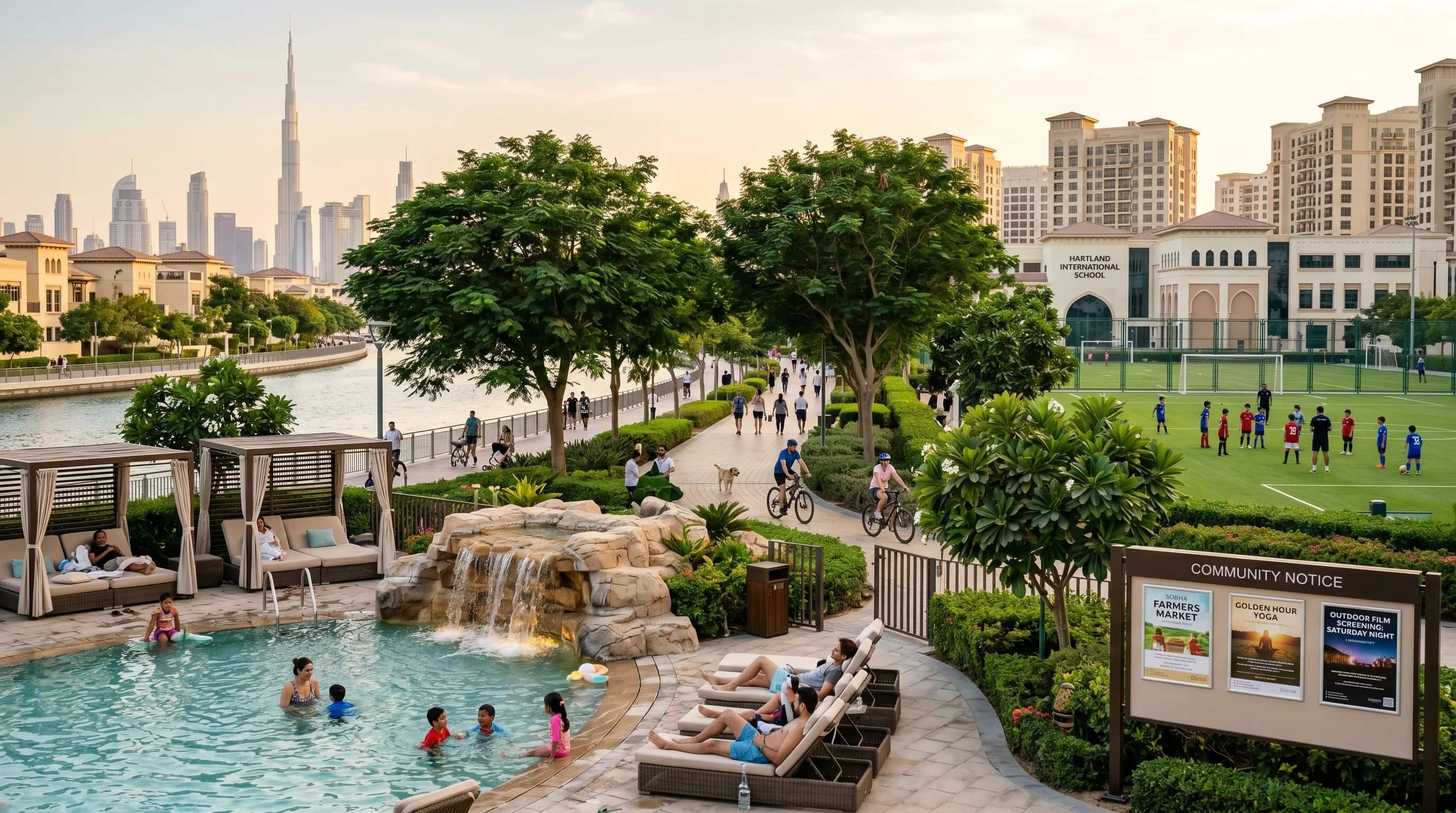
Sobha Hartland is the flagship. The community sits in Mohammed Bin Rashid City, a few minutes from Downtown, with the Ras Al Khor wildlife sanctuary on one side and Meydan on the other. It's a master-planned community with apartments, townhouses, and villas spread across roughly 8 million square feet.
Hartland is where Sobha proved itself in Dubai. The infrastructure is genuinely complete now. International schools (Hartland International School, North London Collegiate), parks, a community centre, retail. It's not a future-facing project. It's already built out and functioning.
Hartland II is the newer extension. Same master plan philosophy, more apartments, more recent launches. Some buyers prefer Hartland II for the newer stock and the slightly better infrastructure planning, others prefer the original Hartland for the maturity. The pricing reflects this. Hartland II sells at a small premium to comparable Hartland units.
Things to check before buying in Sobha Hartland:
- Service charge per square foot, which varies a lot between buildings, with a range from AED 12 to AED 22 per sqft
- Community fee on top of service charge, often overlooked in cost calculations
- View premium for canal-facing or park-facing units, which can run 15% to 25%
- Distance from the main entrance and central amenities for daily convenience
- Building age and which Sobha sub-project the unit sits within (Hartland Greens, Creek Vistas, and so on)
- Rental restrictions if you plan to short-term let (DTCM permits aren't always granted)
- School catchment if you have school-age children
- Parking allocation, which is more constrained in some buildings than others
If you want to see what's currently available, the Sobha Hartland area page is updated regularly.
Sobha SeaHaven and the Dubai Harbour Bet
This is the bigger story. Sobha SeaHaven is their move into Dubai Harbour, the new master-planned waterfront area at the entrance to the Marina. SeaHaven is a multi-tower beachfront residential project that put Sobha into prime waterfront for the first time at this scale.
The pricing was aggressive at launch. Premium per square foot, premium location, premium finishes. The marketing was unmistakable. This is meant to be Sobha's most desirable Dubai address, sitting betwen the Marina and the Palm with sea views on both sides.
Resale data so far suggests early SeaHaven buyers are sitting on healthy paper gains. Whether that holds through handover and the first wave of resales is the real test. Dubai Harbour as an area is still maturing, with multiple competing projects launching in parallel from other developers. Supply is going to land at roughly the same time, which usually puts downward pressure on rents in the first year of full operation.
Sobha Reserve, Sobha One, and the Newer Sobha Launches
Sobha Reserve in Wadi Al Safa is the villa play. Larger plots, established suburban setting, designed for end-user buyers and family relocators rather than investors. The pricing here makes more sense as an end-user product. As pure investment, the yield math doesn't work as well.
Sobha One in Ras Al Khor sits closer to the airport. Five towers, central location, smaller unit sizes targeted at investor buyers. The yield positioning here is much stronger than Reserve.
Other recent Sobha launches in Dubai include Sobha Verde, Sobha Skyscape, and several Hartland II towers. The pattern across all of them is consistent. Higher quality finishes, higher per-square-foot pricing, and shorter sell-out timelines than middle-market developers experience. Sobha doesn't typically launch and then sit on inventory.
For the current Sobha launches available now, the property launches page lists the active inventory.
The Quality Argument: What Sobha Does That Other Dubai Developers Don't
OK so the quality story.
Sobha's pitch is that they build better than anyone else in Dubai. Every developer says some version of this, so the question is whether there's anything behind it. After years of watching their projects from launch through handover, our honest answer is yes, mostly, but not for the reasons people assume.
The backward integration matters less than the marketing suggests. Yes, Sobha owns most of its supply chain. But that doesn't automatically produce better units. What it does is give them tighter control over finishing quality and faster ability to fix issues at handover. The actual marble or joinery isn't necessarily better than what a top-tier subcontractor would provide. The consistency is.
The bigger differentiator is the obsession at the site level. Sobha's handover quality is better than most Dubai developers becuase they spend more time on snagging and rework before issuing keys. Buyers we've talked to report fewer issues at handover and faster resolution of the issues that do come up. That's a real benefit and it's where the premium starts to make sense.
PNC Menon has talked publicly for decades about the same idea. That Sobha sees itself as a quality manufacturer that happens to produce homes, rather than a homebuilder that has to manage quality. Marketing language, sure, but the operational behavior backs it up. Sobha's quality control function reports directly to senior leadership, not through the project management chain. That's structurally different from how most Dubai developers operate.
Where the quality story is overplayed is on design. Sobha layouts are competent but not exceptional. Floor plans tend to be on the smaller side per bedroom count. Storage is often limited. Kitchen sizing can be tight in the apartments. If you're comparing a Sobha 2-bedroom against an Emaar 2-bedroom of similar age, the Emaar unit is often more efficiently laid out. The Sobha unit has better finishes but uses the space less well.
Net assessment. Sobha quality is real on finishing, handover, and after-sales. Sobha quality is overrated on layouts and space efficiency. The premium is mostly justified for buyers who care about move-in condition and long-term resale appearance. The premium is less justified for buyers who prioritize livability and per-square-foot value.
Sobha Dubai Pricing: What the Premium Actually Looks Like
Sobha pricing sits at the top of the Dubai mid-to-upper market. Not as high as Omniyat or super-prime developers, but consistently 20% to 35% above mid-tier developers like Danube or Azizi for comparable unit types and locations.
A rough current benchmark, based on transactions we've seen and Property Finder data:
- 1-bedroom apartment in Sobha Hartland: AED 1.6M to AED 2.2M, depending on building and view
- 2-bedroom apartment in Sobha Hartland: AED 2.4M to AED 3.4M
- 3-bedroom apartment in Sobha Hartland: AED 4.0M to AED 5.5M
- Villa in Sobha Reserve: AED 6M to AED 12M and up
- 1-bedroom in Sobha SeaHaven: AED 2.5M to AED 3.5M at launch, now trading higher on secondary
- 2-bedroom in Sobha SeaHaven: AED 4.5M to AED 6M and up
- 1-bedroom in Sobha One: AED 1.7M to AED 2.3M
- Penthouse units across communities: AED 8M to AED 30M and up
These numbers move. The point isn't the exact figure, it's the spread. A comparable 2-bedroom in JVC from a mid-tier developer can be had for AED 1.2M to AED 1.6M. The Sobha equivalent in Hartland is AED 2.4M to AED 3.4M. That's the premium.
What you're actually paying for, in our reading:
- Better finishes that hold up over 5 to 10 years
- Lower issue rate at handover and faster post-handover service
- Stronger resale liquidity, with more buyers actively looking for Sobha units
- Brand premium on rental listings of roughly 8% to 15% over comparable mid-tier
- Faster rental absorption, often within 30 to 60 days vs 90 days or more for mid-tier
- Service charge consistency across the buildings within a community
- Maintenance quality on the common areas, which holds the value of the unit over time
What you're not necessarily paying for. More floor area per dirham. Better unit layouts. Better lifestyle amenities at the building level (some Sobha buildings are surprisingly light on amenity). Higher rental yields, because yields are often lower when the price is higher.
Our Research: How Sobha Properties Performed in 2024 and 2025
We pulled secondary market transaction data and rental absorption data for Sobha communities against comparable Dubai stock to see what the numbers actually say about the Sobha premium.
Sobha communities, 2024 to 2025 performance summary:
- Sobha Hartland apartments: +4.2% price growth, 5.8% gross yield, 6 to 8 week average rental absorption
- Sobha Hartland II: +5.6% price growth, 6.1% gross yield, 4 to 6 week rental absorption
- Sobha Creek Vistas (within Hartland): +3.8% price growth, 5.5% gross yield, 5 to 7 week absorption
- Sobha One: +6.4% price growth (off-plan to secondary), 7.2% projected gross yield, not yet at handover
- Sobha SeaHaven: +12% price growth off-plan to secondary, still pre-handover so yield TBD
- Sobha Reserve villas: +5.8% price growth, 4.1% gross yield, 8 to 12 week absorption (end-user market)
For comparison, the Dubai apartment market overall posted around 4% price growth in 2025 with average gross yields of 5.5% to 6.5% depending on area. Sobha apartments tracked at or above the market average on price growth, slightly below on yield, and noticeably above on rental absorption speed.
Two specific observations. First, Sobha SeaHaven's off-plan-to-secondary appreciation is the strongest in the data. That's a function of the location combined with the brand, and it's the closest the Sobha premium gets to a clear capital-gains case. Second, the rental absorption advantage is real. Sobha apartments rent faster than comparable non-Sobha apartments in similar areas, which matters more than people realize for actual investor returns.
Property Monitor data confirms the absorption advantage extends to secondary sales as well. Sobha resale listings clear faster on average than non-Sobha listings of similar specification in the same area. We don't knwo of a Dubai mid-tier developer where this is also true.
The Honest Read on Whether the Sobha Premium Is Worth It
Here’s our analysis in formal language.
The Sobha premium is justifiable in certain contexts. End-users planning to reside in the property for at least five years clearly see benefits from the premium in terms of finishes, handover, and post-sales service. The premium is paid off over time by the occupant. If you are looking at long term investment in your property, you should go for Sobha.
The Sobha premium has value to investors looking at liquidity over yield. Resales and rentals absorption rates by Sobha properties are better than the average of the market. If you want to sell your unit after three to five years, then the added liquidity value is a big positive factor. Investors, who value minimal vacancy rates and quick renting out of their properties, benefit from Sobha name attracting tenants quicker.
If you are focusing on yields alone, Sobha premium might be unjustified. The math is simple. Buying Sobha property 20% to 35% more expensive but earning rent 8% to 15% more than another comparable unit makes net yield smaller. Hence, in case yield is what you need, Sobha premium doesn’t look like the best choice available.
The premium is less attractive for first-time investors looking to accumulate real estate portfolio. Investing into one Sobha unit instead of two regular ones might not help you maximize your profits. Thus, it is wiser for second or even third unit in Dubai, but not the first.
What we definitely won’t do, is ignore Sobha premium completely. Quality is really high, and brand value is worth something tangible. It all boils down to whether your situation needs extra money or not.
If you want to talk through whether a Sobha purchase fits your situation, or you're looking at a specific Sobha launch and want a sanity check, the Gaia Realty team has sold dozens of Sobha units over the years, and we know which buildings and unit types deliver on the premium and which don't. Drop us a line at the contact page and we'll take it from there.
Related stories
Dubai's Established Charm: The Case for Older Homes
In a city focused on the future, I believe the smartest move for many buyers is to look back. Dubai's seasoned communities offer space, character, and surprising value that new builds often can't match.

The True Cost of Owning a Dubai Property
Beyond the purchase price, your annual budget for a Dubai home must account for service charges, utilities, and maintenance. I'll break down every ongoing expense you need to plan for.
Calculating ROI on Dubai Rental Upgrades
As a landlord in Dubai, you can't just follow trends. I'll show you how to calculate the precise ROI of minor property upgrades to genuinely increase your rental yield.
Echoes, in your inbox
One thoughtful email a month. Market insight, new launches, no spam.