

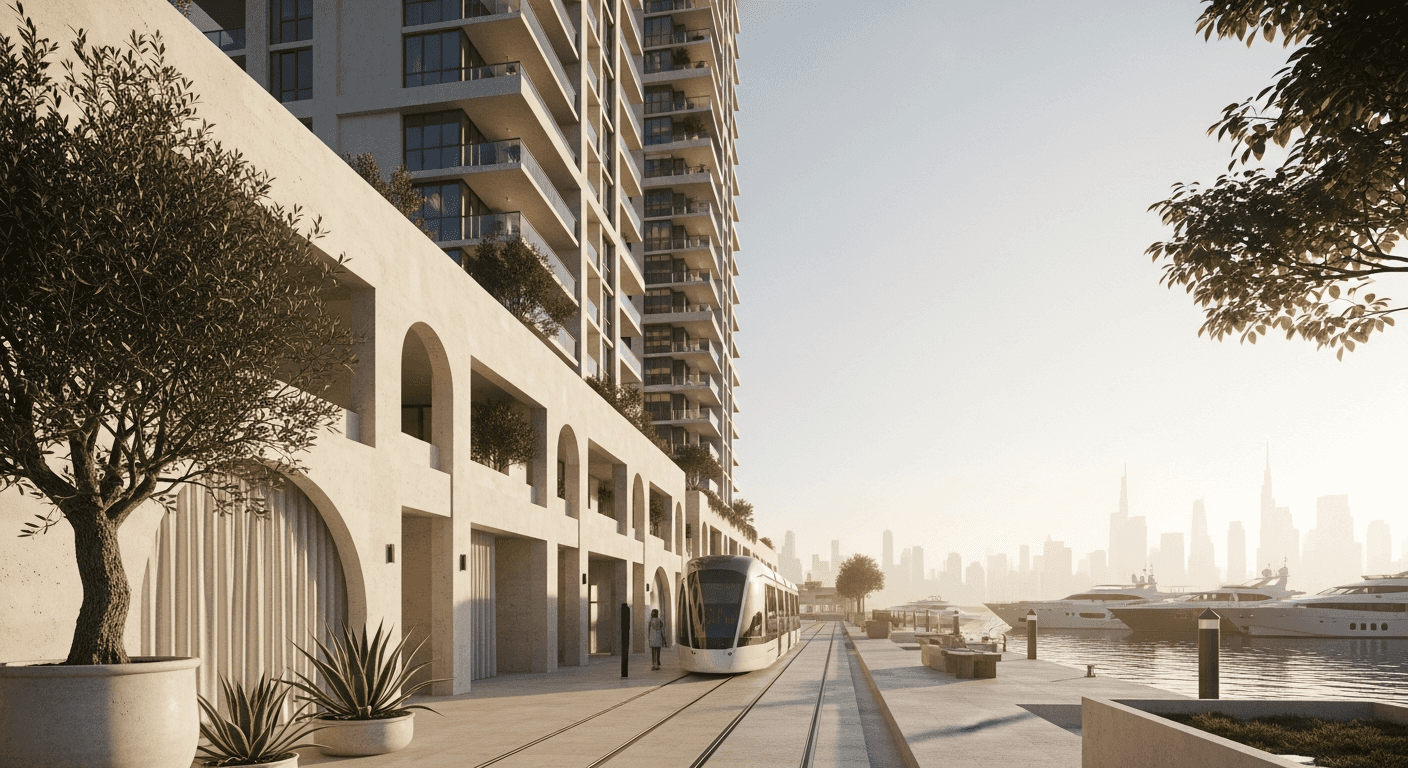
The Transit Premium: Valuing Dubai's Transport Links
I analyse the direct, quantifiable link between Dubai’s public transport expansion and property values, arguing that the uplift is far from uniform and requires a nuanced, street-by-street approach from investors.

The link between transport infrastructure and real estate value is one of the most established principles in urban economics. Yet in a city as dynamic as Dubai, simply stating that a new metro line adds value is a gross oversimplification. As Head of Market Research at Gaia Living, I argue that the real story is far more granular. The Dubai Metro property value impact is not a blanket premium but a highly conditional uplift, dictated by the specific mode of transport, the character of the neighbourhood, the type of property, and the quality of the last-mile connection. Understanding these nuances is what separates a successful transit-oriented investment from a missed opportunity.
Here's what we'll explore:
- The fundamental economics of the connectivity premium.
- Lessons from the original Metro Red and Green Lines on mature communities.
- The Dubai Tram's role as a lifestyle multiplier in high-density zones.
- A case study on Route 2020 and its effect on emerging hubs.
- A practical, numbers-based analysis to quantify the premium.
- The underrated influence of the RTA's bus network.
- A forward look at the upcoming Blue Line and its potential beneficiaries.
- A strategic framework for investors to assess transit-linked opportunities.
The Connectivity Premium: A Fundamental Driver of Value
At its core, the value proposition of public transport is simple: it reduces friction. Every minute and every dirham a resident saves on their commute is a tangible benefit that can be monetised. This benefit translates directly into rental demand. A tenant pool willing to pay more for the convenience of a shorter, cheaper, or less stressful journey to work, school, or leisure destinations underpins the entire investment case. This increased rental yield, in turn, gets capitalised into a higher sales price, creating what we call the 'connectivity premium'. This principle is the cornerstone of transit-oriented development Dubai has so effectively embraced over the past two decades.
However, it's crucial to recognise that Dubai's residential market serves two distinct, though sometimes overlapping, user groups. The first is the car-centric household, for whom proximity to a major highway like Sheikh Zayed Road or Al Khail Road is the primary accessibility metric. For these residents, typically families in villa communities like Arabian Ranches or Emirates Hills, public transport is a secondary concern. The second group is the transport-reliant resident. This demographic often includes young professionals, students, and service-sector workers who may not own a car or prefer not to use one for daily commutes. For them, walkability to a Metro or bus station is a primary decision-making factor.
My analysis shows that the most significant RTA infrastructure property gains are found where these two worlds meet, or where a development successfully caters to the latter group. The Roads and Transport Authority's (RTA) strategic plans, particularly the '20-minute city' concept — where residents can access 80% of their daily needs and destinations within 20 minutes by foot or bike, are not just urban planning ideals. They are a direct roadmap for future real estate value creation. As the city densifies and road congestion becomes a greater factor, the demand for properties that align with this vision will only intensify. The premium for connectivity is, in my view, a premium for time, convenience, and a more sustainable urban lifestyle.
The Original Metro Effect: Lessons from the Red and Green Lines
 Featured project
To understand the future, we must look to the past. The opening of the Dubai Metro's Red Line in 2009 was a watershed moment for the city's real estate market. It sliced through the city's densest commercial and residential corridor, connecting key employment hubs like the World Trade Centre, DIFC, and Dubai Media City with populous residential areas. The impact was immediate and profound, but it was not evenly distributed. The properties that saw the most significant and sustained value uplift shared a key characteristic: true walkability.
It wasn't enough to be 'near' a station. The premium crystallised for buildings located within a comfortable 5 to 10-minute walk — roughly 400 to 800 metres, via a safe, and preferably shaded, pedestrian path. An apartment tower directly connected to a station via an air-conditioned walkway, like several along Sheikh Zayed Road, commands a demonstrably higher premium than one 500 metres away across a six-lane service road with no designated crossing. This distinction between simple proximity and genuine accessibility is critical. It’s the difference between a line on a map and a lived reality for a resident carrying groceries in the July heat.
In mature, high-density areas like Downtown and Dubai Marina, the Metro integrated into an already popular landscape and amplified its appeal. Market studies conducted in the years following the Red Line's launch often cited capital value premiums ranging from 5% to 15% for properties within that golden 800-metre radius. The effect was even more pronounced in the rental market, where apartments near stations demonstrated lower vacancy rates and higher yields. The target demographic of one and two-bedroom apartments in these towers aligns perfectly with the typical Metro user: the young professional working in DIFC or the executive travelling frequently from DXB airport. The infrastructure didn't just provide a service; it reinforced the very lifestyle proposition these communities were built on.
The Tram Multiplier: Density, Lifestyle, and Last-Mile Connectivity
If the Metro is Dubai's central nervous system, the Dubai Tram is a sophisticated set of nerve endings, and its impact on property values operates on a different logic. Launched in 2014, the tram serves the ultra-dense communities of Jumeirah Beach Residence (JBR) and Dubai Marina. Unlike the Metro, which is primarily a commuter tool connecting disparate parts of the city, the tram is a local circulator. Its genius lies in solving the 'last-mile' problem within an already walkable, high-amenity environment.
Before the tram, moving between one end of JBR's 'The Walk' and the other, or from a Marina apartment to the beach, could be a frustrating exercise in finding parking or navigating heavy traffic. The tram transformed this by linking residential towers, retail promenades, the beach, and, crucially, two Metro stations (Sobha Realty and DMCC) and the Palm Jumeirah Monorail gateway. This created a powerful network effect, making the entire district a smoothly connected ecosystem. It's a prime example of infrastructure enhancing an existing lifestyle proposition rather than creating a new one from scratch.
From a property value perspective, the impact is highly targeted. The biggest beneficiaries are properties whose target market values this hyper-local connectivity most: studios, one-bedroom, and two-bedroom apartments. These are the units most likely to be occupied by tourists on short-term leases or young residents who prioritise lifestyle and beach access over large living spaces. For these tenants, the ability to hop on the tram to get to the Metro for work, or to the beach for the weekend, is a major selling point that supports higher rental rates. In my opinion, the tram's contribution to value in JBR and Marina is less about a direct capital uplift and more about creating a higher rental floor and boosting occupancy, particularly in the lucrative holiday home market.
“The real premium isn't just about proximity to a station; it's about the quality of the time saved and the lifestyle it enables.”
Case Study: Route 2020 and the Emergence of New Hubs
The Route 2020 Metro extension, built for the Expo 2020 event and now serving a permanent residential corridor, provides the most recent large-scale case study of the Dubai Metro property value impact. This line extended the Red Line from Jebel Ali to the Expo City site, cutting through several developing communities that were previously almost entirely car-dependent. The results offer a clear 'before and after' picture of infrastructure-led value creation.
The community of Al Furjan, developed primarily by Nakheel, is perhaps the clearest beneficiary. Prior to 2021, Al Furjan was a relatively affordable community of villas, townhouses, and low-to-mid-rise apartment buildings popular with families. Its main drawback was its reliance on road access. The opening of the Al Furjan and Discovery Gardens stations on Route 2020 fundamentally altered its investment thesis. Suddenly, thousands of apartments were within walking distance of the Metro network, opening up the area to a vast new pool of tenants working along the entire Red Line corridor.
Observing the market data from 2021 onwards, we see a clear divergence in performance. Apartment buildings in Al Furjan located within that critical 800-metre radius of the station began to command higher rental and sales prices compared to identical properties further inside the community. While the whole of Dubai has seen a market upswing, the growth in these specific transit-adjacent properties has been measurably sharper. This is a classic example of infrastructure unlocking latent value. The buildings were already there, but the Metro connection made them accessible and therefore more desirable to a different, and larger, market segment. For investors, the lesson from Route 2020 is that the arrival of transport infrastructure can completely re-write the demand equation for a neighbourhood.
Quantifying the Premium: A Practical Cost-Benefit Analysis
Theoretical discussions of value uplift are useful, but for an investor, the numbers must add up. To illustrate the Dubai connectivity property prices in real terms, let's conduct a comparative analysis of two hypothetical but realistic one-bedroom apartments. One is in a well-regarded tower in Jumeirah Lakes Towers (JLT), a 5-minute walk from the DMCC Metro station. The other is in an equally modern building in Arjan, a community known for its quality new builds but, until the announcement of future transport links, lacking rail connectivity.
Our JLT apartment, benefiting from its prime Metro access, might command a purchase price of approximately AED 1.2 million. The strong rental demand from professionals working in the Marina, Jebel Ali, or DIFC could support an annual rent of around AED 95,000. This gives us a gross rental yield of 7.9%. In contrast, the similar-sized apartment in Arjan might be priced lower, at around AED 950,000. Its rental income, appealing to a more car-dependent tenant base, might be closer to AED 70,000 per year, resulting in a gross yield of 7.3%. The AED 250,000 difference in purchase price is, in essence, the market's capitalisation of the Metro's convenience. The investor in JLT pays more upfront but is rewarded with higher rental income and, arguably, a more resilient asset with a wider tenant pool.
To make this even more concrete, here is a line-by-line breakdown of the upfront costs an investor would face when purchasing the AED 1.2 million JLT apartment. Understanding these costs is crucial for any accurate return on investment calculation.
Worked Example: Upfront Costs for a AED 1,200,000 Property - Purchase Price: AED 1,200,000 - Dubai Land Department (DLD) Transfer Fee (4%): AED 48,000 - DLD Administration Fee: ~AED 4,200 - Real Estate Agency Fee (2% + 5% VAT): AED 25,200 - Property Registration Fee (Trustee Office): ~AED 4,200 - Mortgage Registration Fee (0.25% of loan, on an 80% LTV of AED 960k): AED 2,400 - Developer No Objection Certificate (NOC) Fee: AED 1,000 - 5,000 (we'll use an average of AED 2,500) - Estimated Total Upfront Cost: AED 86,500 - Total Cash Outlay (20% Down Payment + Fees): AED 326,500
This breakdown, which excludes bank processing and valuation fees, shows that the real cost of acquisition is significantly higher than the sticker price. An investor must weigh this total outlay against the projected rental income, service charges (which can range from AED 15-25 per sqft in such areas), and potential for capital appreciation, which is directly influenced by the property's superb connectivity.
Beyond the Rails: The Underrated Impact of the Bus Network
While the glamour and media attention are invariably focused on the Metro and Tram, my analysis suggests that overlooking the RTA's extensive bus network is a mistake for any serious public transport real estate analysis. For many emerging and affordable communities across Dubai, the humble bus is the most critical piece of public infrastructure, providing a vital link to the wider city and the rail network.
Consider a community like Jumeirah Village Circle. It's one of Dubai's most popular areas for both renting and buying due to its relative affordability and abundance of modern apartments. However, it has no Metro station. The introduction and expansion of bus routes, such as the J01 which connects JVC directly to the Mall of the Emirates Metro station, have been a game-changer for residents. These routes act as 'feeder' services, transforming a previously isolated area into a connected one. For a tenant on a budget, the ability to take a direct bus to the Metro can eliminate the need for a car, saving thousands of dirhams per year in transport costs.
This improved connectivity has a direct, if less dramatic, impact on property values. It widens the potential tenant pool for landlords, reduces vacancy periods, and puts upward pressure on rents in buildings located close to bus stops. While you won't see the same 10-15% capital value jump as with a new Metro station, a reliable, high-frequency bus service adds a crucial layer of resilience and appeal to an investment property. It makes the area viable for a whole demographic that would otherwise be excluded. At Gaia Living, when we assess the investment potential of properties in areas like JVC, Liwan, or Dubai Production City, the quality and frequency of the local bus service is a key data point in our analysis.
The Next Frontier: Anticipating Gains from the Blue Line
Looking ahead, the most significant piece of upcoming transport infrastructure is the recently announced Dubai Metro Blue Line. This 30-kilometre line is poised to be another transformative project, plugging major gaps in the existing network and creating a new corridor of transit-oriented opportunities. My professional opinion is that investors who understand the route and its implications early stand to benefit significantly.
The Blue Line is projected to connect the current Creek station on the Green Line with Academic City, passing through areas like Festival City, Ras Al Khor, International City, Dubai Silicon Oasis, and Liwan. It will also have a spur connecting to the airport. This route is strategically brilliant. It will bring rail connectivity to over a million residents in established and developing communities that are currently heavily car-dependent. It directly addresses one of the city's most congested corridors and will link residential hubs with major educational and commercial zones.
The communities I see benefiting most are those that already have a significant resident population and a stock of quality housing but lack the final connectivity piece. A place like Dubai Silicon Oasis or the residential clusters around Academic City will be fundamentally changed. They will transition from being suburban-style commuter dormitories to fully-fledged urban nodes on the Metro map. We can anticipate a similar effect to what was seen in Al Furjan with Route 2020, but potentially on a larger scale given the population density of areas like International City. For investors looking at off-plan launches from developers like Emaar Properties in Creek Harbour or other projects along this future corridor, the game has changed. The key will be to scrutinise development plans and identify projects with prime, walkable access to the proposed station locations.
An Investor's Framework: How to Assess Transit Value
To distil this analysis into a practical tool, I have developed a framework we use at Gaia Living to evaluate the true value of a property's transport links. A blanket assumption that 'near a station is good' is insufficient. A granular approach is required. I encourage every investor to use this checklist when assessing a potential purchase.
Here is my framework for assessing transit-oriented value:
- Mode of Transport & Network Integration: What type of transport is it? The value hierarchy is clear: Metro offers the highest premium due to its city-wide reach, followed by the Tram for its lifestyle and last-mile benefits, and then the Bus for its essential feeder function. Is the station an interchange, connecting multiple lines? Network theory shows that nodes with more connections are exponentially more valuable.
- Proximity & Quality of Access: Measure the *actual* walking distance, not the 'as the crow flies' distance. The sweet spot is under 800 metres, or a 10-minute walk. Critically, assess the quality of that walk. Is it a shaded, dedicated, and safe pedestrian walkway, or does it involve crossing a busy road? An air-conditioned link, where available, represents the gold standard.
- Community Maturity & Property Type: Is the infrastructure being added to a mature, dense area, or is it creating a new hub? The value dynamics are different. Also, match the property type to the likely user. The transit premium is highest for studios and one-bedroom apartments targeting young professionals and lowest for large villas targeting car-dependent families.
- Surrounding Amenities: A station is more than just a transit point; it's a potential community hub. Are there supermarkets, cafes, clinics, and other daily necessities clustered around the station? A property near a station that is also an amenity hub will always outperform one near an isolated stop in a purely residential area.
Investing in property based on public transport expansion is one of the most reliable strategies in a growing city like Dubai, but the highest returns are reserved for those who look past the headlines. Success requires a deep understanding of the local context: the mode of transport, the quality of the pedestrian experience, and the specific needs of the target demographic. The value is not in the line on the map, but in the life it enables for the person living there.
## Sources - Dubai Roads and Transport Authority (RTA) - rta.ae - Dubai Land Department (DLD) - dubailand.gov.ae - UAE Government Official Portal - u.ae
Questions, answered
- How much value does a new Metro station add to a property in Dubai?
- There is no single figure, but market analysis consistently shows a price and rental premium of 5-15% for properties within a 10-minute walk of a Metro station compared to similar properties further away. The actual uplift depends on the property type, the community's maturity, and the quality of pedestrian access to the station.
- Which areas will benefit most from the upcoming Dubai Metro Blue Line?
- The Blue Line is expected to significantly benefit communities that are currently established but lack rail connectivity. Areas like Liwan, Dubai Silicon Oasis, and the residential districts around Academic City are prime candidates for value appreciation. Key hubs like Creek Harbour will also see their connectivity greatly enhanced.
- Is it better to invest in a property near a Metro or a Tram station?
- It depends on the investment goal. The Metro offers a broader commuter-focused value uplift, connecting large swathes of the city. The Tram provides a more localised 'lifestyle' premium within high-density, walkable communities like Dubai Marina, enhancing last-mile connectivity and leisure access, which strongly boosts short-term rental potential.
- Does the RTA bus network affect property values in Dubai?
- Yes, although the effect is more subtle than the Metro. A high-frequency bus route provides crucial 'feeder' connectivity to the rail network, significantly improving the rentability and appeal of properties in affordable, car-dependent communities like JVC or parts of International City.
- What is 'transit-oriented development' in the context of Dubai?
- Transit-oriented development (TOD) in Dubai is a planning strategy focused on creating compact, walkable, mixed-use communities centered around high-quality transport hubs like Metro stations. The goal is to reduce dependency on private cars and create more vibrant, sustainable urban environments, a strategy clearly visible in areas like Downtown Dubai and Dubai Marina.
- What fees are involved when buying a property near a transport hub?
- The fees are standard for any property purchase in Dubai. You should budget for the Dubai Land Department (DLD) transfer fee of 4% of the property price, agency fees of around 2% plus VAT, and various administrative fees for registration and the No Objection Certificate (NOC) from the developer, which can total an additional AED 10,000-15,000.

Amara translates DLD transaction data, supply pipelines, and macro signals into clear calls on where Dubai's market is heading. She writes the numbers most brokers only feel.
Related stories

Beyond the Gates: Dubai's Boutique Villa Sanctuaries
I'm exploring the small, exclusive villa communities that offer a real sense of place, moving beyond the well-trodden path of Dubai's famous megaprojects to find homes with genuine character.

Off-Plan vs Ready: The Dubai Investor's Guide
A detailed comparison for apartment investors in Dubai, weighing the capital appreciation potential of off-plan against the immediate returns of ready properties.

Clearing Disputes for a Smooth Dubai Sale
Unseen property disputes or financial encumbrances can derail your Dubai property sale. I'll share my strategic playbook for identifying and resolving these issues before they cost you time and money.
Echoes, in your inbox
One thoughtful email a month. Market insight, new launches, no spam.