

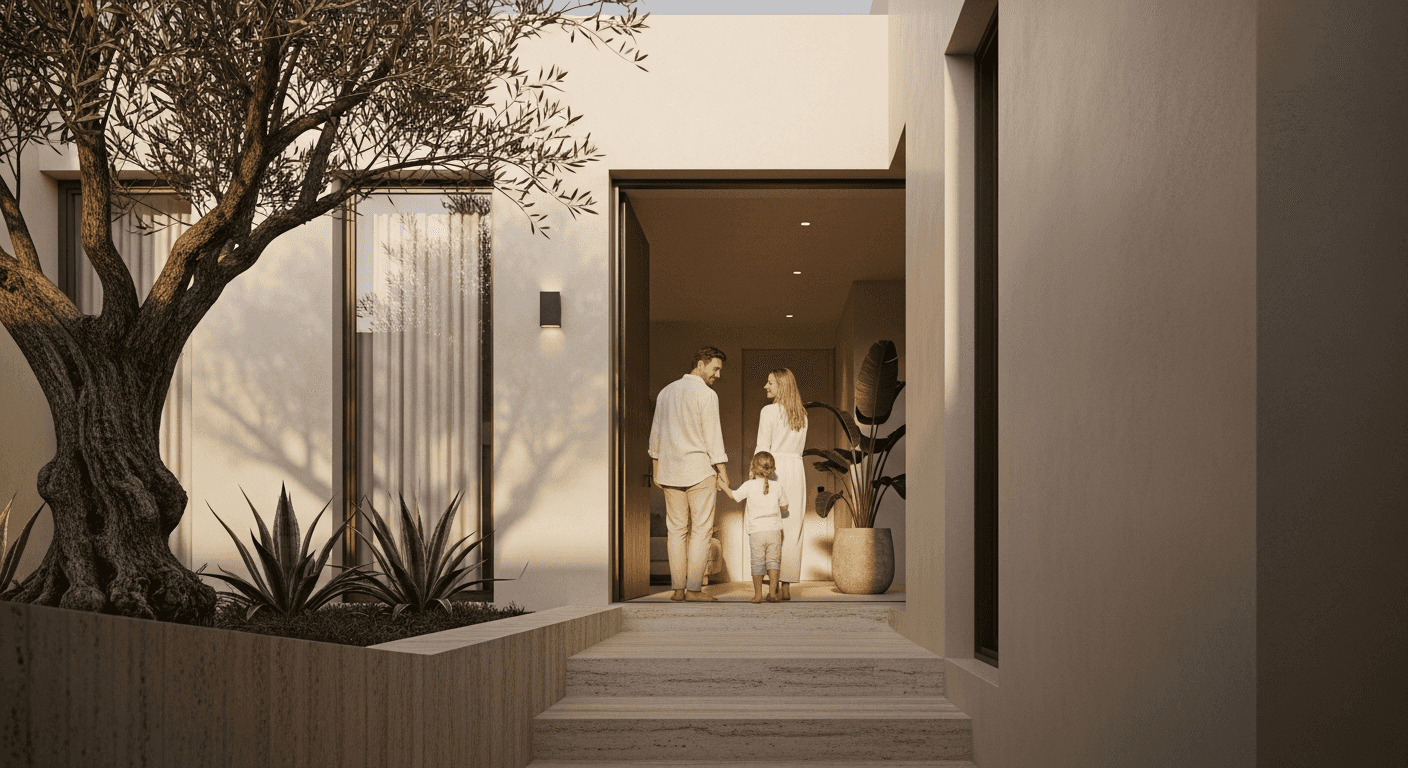
The Smart Living Edge: Dubai's Top Tech Neighbourhoods
Beyond gimmicks, true smart homes offer efficiency, security, and a smooth lifestyle. I explore which Dubai communities get it right and what future-proof living really costs.

For years, the term 'smart home' has been thrown around so casually in property brochures that it's lost much of its meaning. Often, it refers to little more than a voice-activated speaker and a few colour-changing lightbulbs. As someone who walks clients through Dubai's most advanced properties every day, I can tell you that true smart living is something else entirely. It's about a residence that works in the background to make your life more efficient, secure, and comfortable, creating a truly intelligent lifestyle. This is the new benchmark for premium real estate in the city.
Here's what we'll explore:
- What 'smart living' truly means in the context of Dubai's property market today.
- A spotlight on pioneering communities that set the standard, like The Sustainable City and Dubai Hills Estate.
- The cutting-edge technology found in the new wave of ultra-luxury branded residences.
- How major developers like Emaar, Meraas, and Damac are shaping the future of connected homes.
- The critical choice for buyers: Retrofitting an older home versus buying a property with native smart integration.
- A transparent look at the hidden costs and tangible benefits of owning a connected home.
- A complete, line-by-line cost breakdown for purchasing a modern smart apartment.
- My final verdict on whether the 'smart' premium represents a sound investment for the future.
Beyond the Hype: Defining True Smart Living in Dubai
I recently had a client, a tech executive from Europe, who was looking to browse properties for sale in Dubai. His checklist included "a fully integrated smart home." When we visited a few resale properties advertised as such, his disappointment was palpable. One had a Nest thermostat and a Ring doorbell. Another had an iPad clumsily mounted to the wall to control the lights. "This isn't a smart home," he said, "it's a home with gadgets." He was absolutely right. There’s a fundamental difference between a home filled with disparate smart devices and a property with a central, integrated nervous system. True `integrated technology property Dubai` is about the smooth dialogue between systems. It’s when your blinds, lights, and air conditioning work in concert based on the time of day and the sun's position to conserve energy. It's when your building's security system recognizes your car and grants access without you touching a button, while simultaneously calling the elevator to your floor.
In my view, a genuine smart home rests on four pillars: efficiency, security, convenience, and wellness. Efficiency comes from intelligent climate control and lighting that drastically reduce your DEWA bill, and smart irrigation in a villa that uses precisely the right amount of water. Security is about more than just a camera; it's biometric access, remote monitoring, and instant alerts integrated with building security. Convenience means controlling your entire environment — from music to guest access, via a single, intuitive interface, whether you're on the sofa or in another country. And wellness, a growing focus, involves features like air and water purification systems that monitor quality in real time and automated circadian lighting that supports natural sleep cycles. This holistic approach is what defines the next generation of `connected homes Dubai`.
This shift isn't happening in a vacuum. It's directly supported by Dubai's top-down vision. Initiatives like the Dubai 2040 Urban Master Plan and DEWA's own smart grid infrastructure provide the backbone for these `intelligent lifestyle neighbourhoods Dubai`. When your home's smart meter can communicate with the city's grid to optimize energy consumption, you're moving beyond in-home automation into a city-wide ecosystem of efficiency. This is the level of integration that excites discerning buyers and what we at Gaia Living are increasingly seeing as a non-negotiable feature in the premium and ultra-luxury segments. It's about building homes that are not just modern for today, but prepared for the technological advancements of tomorrow.
The Pioneers: Where Smart Living Became the Standard
 Featured project
Long before 'smart home' became a marketing buzzword, a few visionary projects in Dubai were already laying the groundwork for what it means to live in a technologically advanced and sustainable environment. These communities went beyond in-home gadgets and re-imagined the entire infrastructure of a neighbourhood. Two stand out in my mind as crucial case studies: The Sustainable City and Dubai Hills Estate. The Sustainable City, located in Dubailand, was a game-changer from its inception. Its philosophy was less about luxury tech and more about functional, environmental intelligence built into the very fabric of the community. Every villa was designed to be net-zero energy, equipped with rooftop solar panels as standard. The community features extensive waste and water recycling systems, a shared electric buggy and EV transport network, and urban farms that residents actively participate in. This is smart living at a community scale.
What I find compelling about The Sustainable City is that the technology serves a clear purpose: to achieve a quantifiable reduction in environmental impact and living costs. Residents genuinely see lower utility bills and enjoy a lifestyle that feels both modern and responsible. The technology isn't a gimmick; it’s the engine of the community's core identity. For buyers, this translates into a unique value proposition. A four-bedroom villa here might trade in the range of AED 4 million to AED 6 million, a price point that reflects not just the space but the embedded energy infrastructure and the promise of lower running costs. It has consistently attracted a community of like-minded individuals who prioritize sustainability, proving there is a strong market for this kind of purpose-driven development.
On the other end of the spectrum is Dubai Hills Estate, a master-planned community by Emaar Properties. Where The Sustainable City focused on ecological tech, Dubai Hills represents the blueprint for large-scale, premium smart community integration. Emaar’s approach was to create a robust, reliable, and scalable digital backbone for the entire neighbourhood. This manifests in practical ways that enhance daily life: a community app for booking a paddle tennis court or a BBQ pit, smart access control systems for residents and guests, and fibre-optic infrastructure ready for the most demanding home automation setups. While the individual villas and apartments are often sold as 'smart-ready' rather than 'fully-automated', this framework is arguably more valuable. It gives homeowners a high-quality foundation upon which they can build their own customised smart home ecosystem, without being locked into a single proprietary system. This approach caters to a broader market, from young families in the apartments of Dubai Hills Park to UHNWIs in the mansions of Hills Grove Villas, all benefiting from the same smooth community experience.
The New Wave: Ultra-Luxury and Branded Residences
If the pioneers established the blueprint, the current wave of ultra-luxury developments is taking home technology into the realm of bespoke service and artistry. In this tier of the market, which includes many of the new branded residences in Business Bay, along the Dubai Canal, or on Palm Jumeirah, technology is no longer just about efficiency. It's about creating an experience of effortless living, where the home anticipates and serves its owner's needs with invisible precision. We're talking about a level of integration that feels less like technology and more like a personal butler service. These are the properties that are truly defining what `future-proof living Dubai` looks like at the highest end.
In projects by developers such as AHS Properties or in branded towers from world-renowned hospitality and fashion labels, the feature list is astounding. Biometric readers grant access not just to the building, but to your private elevator lobby. Home automation is no longer controlled by a generic app, but by a custom-designed interface that matches the building's aesthetic, allowing you to manage lighting, climate, security, and entertainment from anywhere. Drapery and blinds are programmed to open with the rising sun and close as the desert heat intensifies, a concept known as daylight harvesting. Climate control systems use artificial intelligence to learn your preferences over time, adjusting temperatures in different rooms based on occupancy and time of day, creating a perfect ambient environment without you ever touching a dial. This is where a home transitions from being a passive structure to an active partner in your lifestyle.
“True smart living isn't about voice-controlled coffee machines. It's about a home that anticipates your needs, conserves resources without you noticing, and offers genuine peace of mind — that's the premium you're really paying for.”
This level of sophistication comes at a price, and it's a key component of the premium commanded by these properties. A two-bedroom apartment in a new, high-tech branded residence in Downtown or Business Bay can easily start from AED 5-7 million, with penthouses reaching astronomical figures. What buyers at this level are paying for is the complete ecosystem. It includes the technology itself, but also its integration with the building's five-star services. Through the residence app, an owner can summon the valet, book a session with a personal trainer, order in-room dining, or request housekeeping. The technology is the conduit for a life of ultimate convenience. For the global elite who own these properties, the ability to manage their asset and lifestyle remotely with such a high degree of control and security is not a luxury; it's a fundamental requirement.
The Developer's Blueprint: Who's Building the Future?
The approach to integrating smart home technology varies significantly among Dubai's major developers, and understanding these differences is crucial for any potential buyer. Each developer has a distinct philosophy that shapes the type of `smart homes Dubai communities` they build. At Gaia Living, we guide our clients through these nuances, as the developer's strategy directly impacts the long-term ownership experience, including upgradeability, maintenance, and user-friendliness. The biggest players have established clear and consistent blueprints for how they incorporate technology into their projects, from mass-market apartments to ultra-luxury villas.
Emaar Properties, as the city's largest developer, has adopted a strategy of standardization and scale. In their newer master communities like Creek Harbour and Emaar Beachfront, they typically provide a foundational smart home package. This often includes a digital touchscreen panel, smart lighting in the main living areas, and intelligent thermostats. Crucially, as seen in Dubai Hills Estate, their properties are 'smart-ready,' built with the necessary high-speed fiber and structured cabling to allow owners to easily add more advanced features later. This is a pragmatic approach; it provides a modern baseline for all residents while giving tech-savvy buyers the freedom to customize and expand using their preferred systems, avoiding the trap of proprietary technology that may become obsolete.
In contrast, developers like Meraas often focus on technology as an element of lifestyle design. In their highly curated destinations such as City Walk and Bluewaters Island, the tech is woven into the fabric of the urban experience itself. It's less about the number of in-home gadgets and more about the smooth flow from your apartment to the retail, dining, and entertainment options at your doorstep. This can include smart parking systems that guide you to an empty spot, a community-wide Wi-Fi network, and integrated resident apps that offer exclusive deals and event information. Then you have developers like Damac, particularly in their luxury segment, who often use technology as a statement of opulence. By partnering with high-fashion and luxury brands like de Grisogono or Cavalli, they embed technology that reflects the brand's ethos. This might mean bespoke control panels, high-end integrated sound systems, and unique features that serve as much as a design element as a functional tool. Understanding whether a developer's approach is based on scalability (Emaar), lifestyle (Meraas), or luxury statement (Damac) is key to finding a property that aligns with your own priorities.
Native vs. Retrofit: A Critical Choice for Buyers
When considering a smart home, buyers in Dubai face a fundamental choice: purchase a property with native integration built by the developer, or buy a more traditional property and retrofit it with smart technology yourself. This decision has significant implications for cost, functionality, and long-term satisfaction. Neither path is inherently better; the right choice depends entirely on your budget, technical comfort level, and desire for customization. As a brokerage, we see clients succeed with both approaches, but it’s vital to go in with your eyes open to the trade-offs.
A natively integrated smart home is one where the technology was part of the original design and construction. The wiring is hidden in the walls, the control panels are flush-mounted, and all the core systems — HVAC, lighting, security, are designed to work together from day one. The primary advantage here is seamlessness. There are no compatibility headaches or aesthetic compromises. The system is usually covered under the developer's initial warranty, and the user experience is often polished and intuitive, managed through a single, professionally designed app. However, the downside can be a lack of flexibility. These systems are often proprietary 'walled gardens'. You are locked into the developer’s chosen technology partner, which might limit your ability to integrate new devices in the future. Upgrades or repairs can also be more expensive and may require a specialist from the original installer.
Retrofitting, on the other hand, offers ultimate freedom. You can take any apartment in an older but well-located building in Dubai Marina or Downtown Dubai and transform it into a cutting-edge smart home. You choose the ecosystem — whether it's Apple HomeKit, Google Home, or a more advanced control system like Control4 or Crestron. You can start small, perhaps with smart lighting and thermostats, and expand as your budget allows. The main drawback is the potential for a less polished result. You may have to deal with visible hubs or wires, and ensuring all your chosen devices from different brands work together harmoniously can be a challenge. For complex retrofits involving electrical work, hiring a professional integrator is essential, which adds to the cost. Here is a simple breakdown of the trade-offs:
Native Smart Home - Pros: Smooth integration, clean aesthetics, single point of contact for support (initially), often included in the property purchase and mortgage. - Cons: Can be proprietary and restrictive, potentially expensive to upgrade, less choice in technology.
Retrofit Smart Home - Pros: Complete customization and choice of brands, can be implemented in phases to manage cost, ability to use the latest technology on the market. - Cons: Can be less smooth, potential for compatibility issues, may require professional installation adding to the cost, aesthetics can be compromised.
My advice to clients is this: if your priority is a turn-key, hassle-free experience and you are buying a new property, a native system from a reputable developer is an excellent choice. If you are a tech enthusiast who loves to tinker and customize, or if you've found the perfect home in an older building, retrofitting offers a rewarding path to creating a home that is uniquely yours.
The True Cost of a Connected Home
While the lifestyle benefits of a connected home are clear, it's my job to ensure clients understand the full financial picture. The 'smart' label on a property invariably comes with cost implications, both upfront and ongoing. Ignoring these can lead to surprises down the line. A transparent assessment of these costs, weighed against the potential savings, is essential for making an informed purchase decision. The first and most obvious cost is the upfront premium. A new property with extensive, native smart home integration will typically be priced higher than a comparable non-smart property in the same area. In my experience, this premium can range from 5% to as high as 15% in the ultra-luxury segment. The key question a buyer must ask is whether this premium is justified by the quality of the technology and its potential to enhance the property's long-term value and rentability.
Beyond the purchase price, you must scrutinize the service charges. In Dubai, service charges are paid annually by homeowners to cover the maintenance and operation of common areas and shared facilities. Buildings with sophisticated technology — such as biometric security, automated parking systems, complex building management systems (BMS), and app-based concierge services, will naturally have higher maintenance costs. These costs are passed on to the homeowners. For example, a standard high-rise apartment tower might have service charges of AED 16-20 per square foot per year. A high-tech, luxury tower in the same area could have charges of AED 22-28 per square foot. On a 1,500 sq.ft. Apartment, that's a difference of up to AED 12,000 per year. You can and should verify the approved service charges for any property on the Dubai Land Department's Dubai REST app before you commit to a purchase.
However, it's not all about expenses. A truly smart home offers tangible savings that can offset these higher costs over time. The most significant savings come from energy efficiency. An intelligent climate control system that optimizes AC usage can reduce your DEWA bill by 15-25% — a substantial amount given Dubai's climate. Smart LED lighting and automated blinds that reduce solar heat gain contribute further savings. In villas, smart irrigation systems prevent water waste, another key saving. There are also less direct financial benefits. Advanced security systems can sometimes lead to lower home insurance premiums. More importantly, these features make a property more attractive to high-quality tenants, potentially reducing vacancy periods and supporting a stronger rental yield. It's a calculation of higher initial outlay and running costs versus long-term savings and enhanced asset value.
A Buyer's Budget: The Line-by-Line Cost
To make this tangible, let's walk through a realistic cost breakdown for purchasing a modern, `integrated technology property Dubai`. Theory is helpful, but seeing the actual numbers is what truly prepares a buyer for the process. This financial planning is a core part of the service we provide at Gaia Living, ensuring there are no surprises on the path to ownership.
Let's create a scenario: An expatriate resident is buying their first home, a new two-bedroom apartment in a tech-forward building in Business Bay. The property is listed by the developer as having a fully integrated smart home system controlling climate, lighting, and security.
The initial, and most significant, costs are the upfront payments required to secure the property and legally transfer ownership. Here’s what the buyer can expect to pay, on top of their ongoing mortgage payments:
- Purchase Price: AED 2,500,000
- Down Payment (20% for residents on a property under AED 5M): AED 500,000
- Dubai Land Department (DLD) Transfer Fee (4% of purchase price): AED 100,000
- DLD Registration Trustee Fee: AED 4,200 (this is a fixed fee including VAT)
- Real Estate Agency Fee (2% of purchase price + 5% VAT): AED 52,500
- Mortgage Registration Fee (0.25% of the loan amount of AED 2,000,000): AED 5,000
- Bank Arrangement & Valuation Fees (approximate): AED 8,000
- ---
- Total Estimated Upfront Cost: AED 669,700
This total — nearly 27% of the purchase price, is a critical number for buyers to have ready in cash. It is separate from the mortgage loan itself. For off-plan properties, the payment structure is different, often involving a smaller initial down payment followed by installments linked to construction milestones, but the DLD fees are still applicable. It's crucial to get these figures confirmed by your agent and mortgage provider. The 4% DLD fee, for instance, is a legal requirement stipulated by the Dubai Land Department and is non-negotiable.
After the purchase, the owner's financial commitments shift to ongoing costs. The first is the monthly mortgage payment. For our scenario, a loan of AED 2,000,000 over 25 years at an interest rate of, say, 4.5% would result in monthly payments of approximately AED 11,100. The second major ongoing cost is the service charge. For a high-tech building in Business Bay, let's estimate this at AED 22 per sq.ft. If the apartment is 1,400 sq.ft., the annual service charge would be AED 30,800, or AED 2,567 per month. Finally, there are utility bills (DEWA) and home insurance. While the smart technology should help reduce the DEWA bill, it's still a significant monthly expense. Understanding this complete financial picture is the foundation of a successful and sustainable property investment.
My Verdict: Is the 'Smart' Premium Worth It?
After walking through hundreds of properties, from simple studios to sprawling smart palaces, my conclusion is clear: for new builds, integrated home technology is rapidly moving from a 'nice-to-have' to an essential feature. The market is evolving, and buyer expectations have shifted. In my opinion, purchasing a brand-new property today that lacks even a basic smart-ready framework is a risk to its future resale value. In five to ten years, a 'dumb' home will likely be viewed the same way we now view a home without central air conditioning or high-speed internet connectivity. It will be seen as dated, and will likely trade at a discount. Therefore, paying a modest premium for `future-proof living Dubai` is not just an investment in convenience; it's a defensive move to protect your asset's value over the long term.
For end-users — the people who will actually live in these homes, the value proposition is even stronger. The quality-of-life improvements are tangible. A home that manages energy consumption efficiently, enhances your family's security, and simplifies daily routines through automation offers a genuine return in comfort and peace of mind. The concept of `intelligent lifestyle neighbourhoods Dubai` is coming to fruition in communities where technology enhances the living experience both inside the home and across the wider area. The convenience of booking amenities from an app, granting smooth guest access, or having community security bolstered by smart surveillance creates a superior living environment that residents value highly.
For pure investors, the calculation is more nuanced. Will a smart home achieve a significantly higher rental yield than a non-smart one in the same building? The answer is, probably not dramatically. The primary drivers of rent remain location, size, view, and building quality. However, a technologically advanced property is almost certain to attract a higher caliber of tenant and experience shorter vacancy periods. In a competitive rental market, having a smart, efficient, and modern apartment is a powerful differentiator that can tip the scales in your favor. It's a feature that makes your listing stand out and can justify a slightly higher rental price, which over time, contributes positively to your overall return on investment.
Investing in a property with integrated smart technology is no longer a futuristic indulgence; it's a pragmatic decision. For new properties, it's becoming the standard and is essential for future-proofing your asset. While it commands a price premium and may involve higher service charges, the benefits in lifestyle, energy savings, security, and long-term market relevance make it, in my professional opinion, a premium worth paying.
Sources
- Dubai Land Department (DLD): https://dubailand.gov.ae
- Dubai REST App: https://dubairest.gov.ae
- UAE Government Portal (u.ae): https://u.ae/en/information-and-services/business/dubai-land-department
Questions, answered
- Which are the best smart home communities in Dubai?
- Pioneering communities like The Sustainable City and Dubai Hills Estate offer deeply integrated smart living. Newer developments in Business Bay, Emaar Beachfront, and Creek Harbour by developers like Emaar and Meraas also feature advanced, built-in home technology as a standard.
- Is buying a smart home in Dubai more expensive?
- Yes, properties with native smart home integration typically carry a price premium of 5-15% over comparable non-smart homes. You may also see slightly higher service charges, but these can be offset by long-term energy savings and improved security.
- What are the main benefits of an integrated technology property in Dubai?
- The primary benefits are enhanced convenience, improved energy efficiency leading to lower utility bills, advanced security systems, and a more smooth lifestyle. These features also contribute to making the property more attractive for resale in the future.
- What fees are involved when buying a smart home in Dubai?
- The main upfront costs include the property down payment (typically 20-25%), a 4% DLD Transfer Fee, agency fees of around 2%, and various registration and mortgage fees. Always budget for these additional costs on top of the property's ticket price.
- Can I retrofit my older Dubai apartment to be a smart home?
- Yes, you can absolutely retrofit an older property with smart technology. While this offers greater customisation, it can be less smooth than a natively-built smart home and may require expert installation for systems controlling lighting, security, and climate.
- How does smart home technology affect service charges in Dubai?
- Buildings with advanced smart features like automated security, smart waste management, or app-based concierge services may have higher service charges. You can verify the exact service charge for any building through the Dubai Land Department's public index before purchasing.

Yusuf writes about how Dubai actually lives — waterfront mornings, community dining, walkability, and the lifestyle premium built into an address.
Related stories
Calculating ROI on Dubai Rental Upgrades
As a landlord in Dubai, you can't just follow trends. I'll show you how to calculate the precise ROI of minor property upgrades to genuinely increase your rental yield.

Off-Plan vs Ready: The Real Cost of Capital
I analyse the fundamental trade-off every Dubai investor faces: the lure of off-plan capital growth versus the security of immediate rental income from a ready property.

Beyond the Gates: Dubai's Boutique Villa Sanctuaries
I'm exploring the small, exclusive villa communities that offer a real sense of place, moving beyond the well-trodden path of Dubai's famous megaprojects to find homes with genuine character.
Echoes, in your inbox
One thoughtful email a month. Market insight, new launches, no spam.