

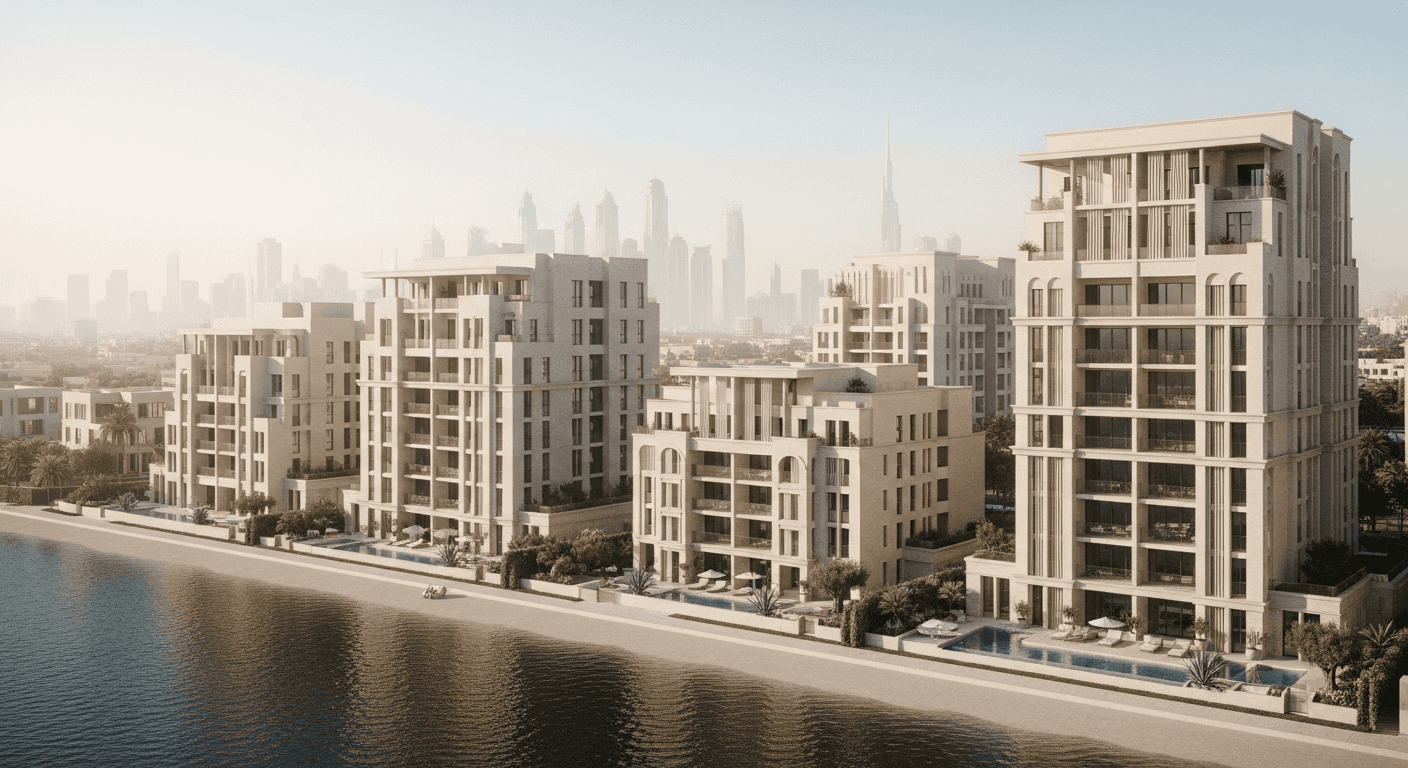
The Rising Cost of Building Dubai
A deep dive into how escalating construction costs and supply chain pressures are fundamentally reshaping the price, quality, and investment calculus for new properties in Dubai.

The final price tag on a new Dubai apartment or villa is the end result of a thousand complex calculations. But recently, one part of that equation has begun to swell, placing unprecedented pressure on the entire development model. The persistent rise in global and local construction costs is no longer a temporary blip; it’s a structural shift that is actively reshaping `new project pricing Dubai analysis` and forcing a market-wide re-evaluation of value, quality, and risk.
Here's what we'll explore in this analysis:
- The global and local drivers behind the surge in `real estate development costs Dubai`.
- A breakdown of the specific materials and services seeing the steepest inflation.
- How developers are adjusting their project plans, pricing, and even their designs in response.
- The direct impact on `developer margins Dubai real estate` and the viability of new projects.
- A transparent look at how these costs translate into the final price per square foot a buyer pays.
- The long-term implications for investors considering off-plan launches.
- My verdict on where the new risks and opportunities lie in this evolving market.
The New Cost Calculus: Why Building in Dubai is More Expensive
For years, the story of Dubai development was one of scale and speed, fuelled by efficient global supply chains and a competitive labour market. That paradigm has fundamentally changed. The current pressure on `Dubai construction costs impact property` pricing is not the result of a single factor but a confluence of powerful global and local forces. The post-pandemic economic rebound created a worldwide surge in demand for raw materials, from structural steel to semiconductors. This demand spike collided head-on with a supply chain still recovering from lockdowns, port congestion, and logistical chaos. The result was a classic economic squeeze: more buyers than sellers, leading to sharp and sustained price hikes for foundational building components.
Compounding this global issue are significant increases in logistics and energy costs. The cost of shipping a container from Asia or Europe to Jebel Ali Port has become both more expensive and less predictable. Recent geopolitical tensions impacting key shipping lanes, such as the Red Sea, have only added another layer of expense and uncertainty, forcing freight carriers to take longer, costlier routes. Since a vast proportion of finishing materials, specialized equipment, and MEP (Mechanical, Electrical, and Plumbing) systems for Dubai's high-end projects are imported, these freight costs are baked directly into the final development budget. Higher energy prices also play a crucial role, increasing the production cost of energy-intensive materials like cement, steel, and glass, both locally and internationally.
On the local front, Dubai's own spectacular success has created its own cost pressures. The sheer volume of new projects underway, from master communities by giants like Emaar Properties and Nakheel to a vibrant ecosystem of private developers, has created intense competition for a finite pool of resources. This is most acute in the labour market. While Dubai has access to a large workforce, there is a clear shortage of highly skilled professionals: experienced project managers, facade specialists, high-end finishing carpenters, and certified MEP technicians. This scarcity of top-tier talent has driven up wages and the fees charged by reputable contractors and subcontractors, who can now be far more selective about the projects they take on. The market for reliable, grade-A contractors is tight, and their pricing reflects that reality.
Deconstructing the Bill: A Look at Key Material & Labor Inflation
 Featured project
To truly understand the impact on project pricing, we need to move beyond generalities and examine the specific line items in a developer's budget. The `supply chain effect Dubai property` is not uniform; certain components have experienced far more volatility than others, directly influencing both a project's cost and its construction timeline. Structural materials form the skeleton of any building, and their cost is a primary determinant of viability. Steel, used for reinforcement bars (rebar) in concrete and for structural frames in high-rises, has been subject to dramatic price swings based on global commodity markets. Similarly, aluminum, essential for window frames and modern facade cladding, has seen significant price inflation.
Concrete itself, the most used man-made material on earth, has not been immune. While the UAE has significant local production capacity, the process of producing cement is highly energy-intensive. As global energy prices have risen, so has the cost of manufacturing cement, a cost inevitably passed on to developers. For a sprawling villa community in a neighbourhood like Arabian Ranches or a high-rise tower in Dubai Marina, these seemingly small per-tonne increases add up to millions of dirhams across the project. It's a foundational cost that sets a new, higher baseline before a single fixture is installed.
Beyond the structure, the costs of MEP systems and finishing materials have become a major pain point. Copper, the critical component in all electrical wiring and plumbing, has experienced record-high prices on global markets. This directly impacts the cost of every power outlet, light switch, and water pipe in a building. The sophisticated HVAC systems required for Dubai's climate, often imported from Europe or Asia, have been hit by a triple whammy: rising raw material costs, higher semiconductor prices for their control units, and soaring freight charges. For finishes — the marble, porcelain tiles, kitchen appliances, and bathroom fittings that define a property's luxury appeal, the reliance on imports makes them particularly vulnerable. A developer aiming for a premium feel with European brands in a project at Emaar Beachfront is now paying a significant premium not just for the product itself, but for the logistics required to get it to the site.
Finally, the human element — labor, is a critical and increasingly expensive part of the equation. The demand for experienced, skilled tradespeople and project management has outstripped supply. Developers are finding they must pay a premium to secure the best teams, especially those with a proven track record of delivering high-quality work on time. A reliable main contractor now has significant negotiating use. This isn't just about general labour; it's about the specialists who can execute complex designs, install high-tech smart home systems, or manage the intricate logistics of a 70-storey skyscraper. This competition for talent is a direct `Dubai construction costs impact property` variable and a major concern for developers trying to budget accurately for projects that will take three to four years to complete.
Developer Strategy Under Pressure: Absorbing, Passing On, or Innovating?
Faced with this new cost reality, developers are at a crossroads. Their response has a direct and immediate impact on buyers and shapes the future of the market. The pressure on `developer margins Dubai real estate` is immense, and every company is navigating it differently based on its scale, brand positioning, and financial health. Broadly, I see three strategic paths emerging: absorbing the costs, passing them on directly, or attempting to innovate and re-engineer the development process itself.
For a select few, primarily the largest and most well-capitalised master developers working on their most iconic projects, there is a degree of cost absorption. On a flagship tower in Downtown Dubai or a signature villa collection on Palm Jumeirah, the developer might choose to accept a lower margin to protect the project's launch price, maintain market momentum, and uphold its brand promise of delivering a landmark. This is a strategic long-term play, treating the squeezed margin as a marketing expense. However, this is the exception, not the rule. It is simply not a sustainable strategy for the vast majority of projects or for the smaller to mid-sized private developers who form the backbone of the market. For them, absorbing a 15-20% increase in construction costs would erase their profit entirely.
“The era of speculative off-plan flipping based purely on a low entry price is ending; the future belongs to investors who can critically assess a project's real, underlying value from the foundation up.”
The most common and straightforward response is to pass the increased costs on to the end-user. This is where we see the most direct impact on `new project pricing Dubai analysis`. A developer planning a new tower in a high-demand area like Business Bay will conduct a new feasibility study based on the latest contractor bids and material quotes. If their total build cost has risen by, for example, 200 million AED, that increase, plus their desired margin, must be divided by the total saleable area. This results in a higher price per square foot from day one. This is a simple necessity for project viability. It explains why a one-bedroom apartment in a new launch today might be priced significantly higher than a seemingly identical one that launched two or three years ago in the same neighbourhood.
The third, and in my view, most interesting path is innovation. Under pressure, smart developers are forced to rethink how they build. This has accelerated the adoption of 'value engineering' — a systematic review of a project's specifications to find cost savings without compromising essential quality or safety. This could mean replacing one brand of Italian marble with a visually similar but more cost-effective Turkish equivalent, or redesigning a plumbing layout to use less copper piping. More advanced strategies are also gaining traction. There is growing interest in modular and prefabricated construction, where components like bathroom pods or even entire wall systems are built off-site in a controlled factory environment. This can reduce on-site labour costs, shorten construction timelines, and improve quality control. We are also seeing developers become more sophisticated in their procurement, forming strategic partnerships with suppliers to lock in material prices far in advance, shielding their projects from future market volatility.
The Ripple Effect: From Launch Prices to Payment Plans
For a potential buyer, these high-level developer strategies translate into tangible changes in the purchasing process. The most obvious is the sticker price. The new baseline for construction costs has established a higher floor for `new project pricing Dubai analysis`. It’s crucial for buyers to adjust their expectations. The prices that were possible for off-plan launches in areas like JVC or Arjan several years ago are simply not achievable for developers today if they are to deliver a quality product. A new one-bedroom apartment that might have launched at AED 1,300 per square foot pre-2022 could now feasibly launch at AED 1,600 or more, purely to account for the increased hard costs of construction. This isn't necessarily a sign of over-inflation, but a reflection of the new economic reality of building.
This pressure also influences payment plans, though the effect can be complex. On one hand, developers facing higher upfront costs for materials and contractor mobilization have an incentive to demand a larger portion of the payment during the construction phase. A 60/40 payment plan (60% during construction, 40% on handover) might shift to a 70/30 or even an 80/20 plan to improve the developer's cash flow. However, developers are also aware that higher overall prices can strain buyer affordability. To counteract this, some are stretching out post-handover payment plans. An offer of paying 40-50% of the property's value over three to five years after receiving the keys makes the higher ticket price more manageable for end-users and investors. This creates a critical trade-off for buyers to evaluate: is the convenience of a long post-handover plan worth the higher initial purchase price?
To make this concrete, let’s look at a hypothetical cost breakdown for a new off-plan apartment with a purchase price of AED 2,000,000. The increased construction cost is already embedded in this price. The upfront costs for the buyer would look something like this:
- Purchase Price (as per SPA): AED 2,000,000
- Dubai Land Department (DLD) Transfer Fee: 4% of Purchase Price = AED 80,000
- DLD Registration Fee: AED 4,200 (for properties over AED 500k)
- Oqood (Off-plan Registration) Fee: 4% of Purchase Price = AED 80,000 (often rolled into the DLD fee now, but historically separate)
- Agency Fee (if applicable): Typically 2% + 5% VAT = AED 42,000
- Developer Admin Fees: Varies, but can be AED 5,000 - 15,000
- Initial Payment to Developer (e.g., 20% down payment): 20% of AED 2,000,000 = AED 400,000
Total initial cash outlay: Roughly AED 526,200 (DLD fees + Agency + Admin + Down Payment). This illustrates that the higher base price has a significant multiplier effect on the initial capital a buyer needs to have ready. Understanding this full cost structure is more important than ever.
The Quality Question: Is 'Value Engineering' a Risk for Buyers?
Whenever costs are squeezed, a natural concern arises about quality. The term 'value engineering' often rings alarm bells for buyers, who may interpret it as a euphemism for cutting corners. It is essential to understand what it is, what it isn't, and how a buyer can protect themselves. In its proper definition, value engineering is a legitimate and beneficial process. It involves a collaborative effort by architects, engineers, and contractors to analyse a project's design and material specifications to find efficiencies that reduce cost without negatively impacting the building's function, safety, lifespan, or core aesthetic. An example might be re-routing HVAC ducting to use 10% less metal or selecting a locally sourced stone for landscaping that meets durability standards instead of a more expensive import. When done correctly, it’s about being smarter, not cheaper.
However, the risk lies in its misapplication. An aggressive or less scrupulous developer might use the banner of value engineering to make substitutions that do compromise long-term quality. This could involve swapping out specified high-performance, low-emissivity glass for a cheaper alternative that leads to higher cooling bills for the life of the building. It could mean using a lower-grade waterproofing membrane or substituting a well-known European brand of elevators, like Kone or Schindler, for a lesser-known brand with a questionable maintenance record. These are the kinds of changes that are not immediately obvious upon handover but can lead to higher service charges, more frequent repairs, and lower resale value down the line. The `supply chain effect Dubai property` can also force last-minute substitutions if a specified material becomes unavailable, and buyers need to be aware of this possibility.
Fortunately, the Dubai market has a robust regulatory framework designed to protect buyers. The Dubai Land Department (DLD) and RERA have strict rules governing off-plan sales, including the mandatory use of escrow accounts. Developer funds are held in a separate account and are only released to the developer in stages, tied to verified construction milestones. This ensures the money you pay is actually being used to build the project. Beyond that, Dubai Municipality enforces stringent building codes and conducts inspections throughout the construction process to ensure safety and structural integrity. A developer cannot simply omit steel or use substandard concrete without being caught. Your most powerful tool as a buyer, however, is the Sales and Purchase Agreement (SPA). This legal document should contain a specifications sheet or 'spec book' that details the materials, brands, and finishes the developer has committed to providing. It is absolutely critical to have this document reviewed by a legal professional before signing. It is your primary recourse if the finished product does not match what was promised.
Geographic and Segment Variations: Not All Projects are Equal
The `Dubai construction costs impact property` is not a monolithic wave that hits all segments of the market equally. The effect varies significantly based on the type of product, its location, and the scale of the developer. Understanding these nuances is key to identifying where the pressures are most acute and where relative value can still be found. The ultra-luxury segment, for instance, has proven to be the most resilient to price shocks. For a buyer purchasing a 50 million AED penthouse in a branded residence or a signature villa designed by a star architect, the primary driver is exclusivity, uniqueness, and the highest possible standard of finishing. An extra 15-20% on construction cost is a rounding error in the final price and is unlikely to deter a UHNW buyer who demands the best.
In contrast, the mid-market and affordable housing segments are where the pressure is felt most intensely. For projects in communities like Town Square or Dubai South, the entire business model is predicated on delivering a quality home at an accessible price point. The `developer margins Dubai real estate` are already thinner in this segment. A 20% jump in hard costs can be the difference between a project being profitable or unviable. This is where developers are forced to be most creative with value engineering, payment plans, and efficient design. It also presents a risk, as the temptation to cut quality is highest when margins are tightest. Buyers in this segment must be particularly diligent in assessing the developer's track record and reputation for delivering on their promises.
Finally, the scale of the developer plays a huge role. A master developer like Aldar in Abu Dhabi or Meraas in Dubai, who are planning and building entire communities over a decade, have immense purchasing power. They can negotiate bulk-rate discounts and long-term contracts with major suppliers for cement, steel, and other commodities, insulating them from short-term price volatility. A smaller, private developer building a single tower in JVC does not have this use. They are price-takers, subject to the prevailing market rates for materials and labour. This dynamic could lead to further market consolidation over time, as the larger, more integrated players are better equipped to handle cost uncertainty. It also means that a well-priced launch from a major developer can represent strong relative value, as their underlying cost base may be lower than their smaller competitors'.
My Analysis: The Long-Term Outlook for New Project Investment
Synthesizing these trends, it is my professional opinion that the current high-cost environment is not a temporary phase but a structural reset for the Dubai property market. The floor price for new, quality construction has been permanently raised. We are unlikely to see a return to the material and labour costs of the past. This has profound, long-term implications for investors and end-users. First and foremost, this new cost baseline will provide strong and lasting support for the value of the existing secondary market. The 'replacement cost' of every building in Dubai has gone up, meaning that a well-maintained five-year-old apartment in a good location now looks comparatively more attractive from a value perspective than it did previously. This will likely temper depreciation and support capital values for quality existing stock.
For the off-plan market, the game has changed. The focus must shift decisively from speculation to strategic investment. The days of buying into any launch with a low down payment and expecting to flip it for a 20% profit in six months are largely over. The higher entry prices demand a more rigorous approach. A 'flight to quality' is already underway and will only accelerate. This means investors will increasingly favour developers with unimpeachable track records for delivering on time and to the promised standard of quality. Brands like Emaar and Select Group have built decades of trust, and in an uncertain cost environment, that trust becomes a bankable asset. Buyers will pay a premium for the peace of mind that comes with a reputable name who is less likely to compromise on quality to protect a margin.
This new landscape creates clear opportunities for the discerning buyer. Getting in on the first phase of a new master community launch from a top-tier developer remains one of the best ways to secure a favourable price before subsequent phases are adjusted for ongoing inflation. Secondly, investors should actively seek out developers who are genuinely innovating in construction methods, such as those pioneering modular or prefabricated technologies. These companies may have a structural cost advantage that allows them to offer a better-quality product for a competitive price. To navigate this, buyer due diligence becomes paramount. Here is a checklist I recommend to our clients at Gaia Living considering an off-plan purchase in the current climate:
- Developer Deep Dive: Go beyond the marketing brochure. Research the developer's entire history of completed projects. Visit them in person. Speak to residents. Is there a consistent record of quality and timely delivery?
- Scrutinize the SPA: Do not sign without a thorough legal review of the Sales and Purchase Agreement, paying special attention to the material specifications clause. Is it detailed or vague? What rights do you have if substitutions are made?
- Verify the Escrow Account: Confirm the project's RERA registration and the details of its escrow account on the official Dubai REST app.
- Understand the Total Cost: Go beyond the purchase price. Factor in the 4% DLD fee, registration fees, agency commissions, and any developer admin fees to understand your true initial outlay.
- Assess the Location's Master Plan: Is this a standalone tower or part of a wider master plan with committed infrastructure like schools, parks, and metro access? The long-term value is in the community, not just the building.
Rising construction costs have permanently increased the base price of new Dubai properties. This elevates risk but also creates opportunity for diligent investors who shift their focus from pure price to developer reputation, build quality, and long-term community value. The most successful buyers will be those who do their homework.
Sources
- Dubai Land Department (DLD): https://dubailand.gov.ae/
- Real Estate Regulatory Agency (RERA): Part of the DLD, regulations are accessible via the main DLD portal.
- Dubai REST App (Official DLD Application): https://dubairest.gov.ae/
- Central Bank of the UAE (for macroeconomic data): https://www.centralbank.ae/
- UAE Government Portal (for official fees and legal frameworks): https://u.ae/en
Questions, answered
- How much have construction costs in Dubai actually increased?
- While there's no single official figure, industry reports and our own market analysis suggest key material costs like steel, aluminum, and copper have seen increases of 20-40% or more since the pandemic. This, combined with rising labor costs, significantly elevates the total cost of development.
- Are developers passing all the increased costs on to buyers?
- Mostly, yes. While major developers might absorb some costs on flagship projects to protect brand prestige, the majority of new launches reflect these higher expenses in their pricing. Thinner developer margins mean they have little choice but to pass the increases on to maintain project viability.
- Is buying off-plan still a good investment with these higher prices?
- It can be, but it requires more diligence. The focus should shift from speculative, low-entry-price flipping to long-term value. Investors must prioritize reputable developers, scrutinize material specifications in the SPA, and understand that the new 'floor price' for quality construction is higher than it was.
- What is 'value engineering' and should I be worried about it?
- Value engineering is the process of finding cost-effective alternatives for materials or methods without compromising quality or safety. While legitimate, it can be misused to cut corners. Your best protection is buying from a developer with a strong reputation for quality and carefully reviewing the specifications in your Sales and Purchase Agreement (SPA).
- Will these higher construction costs make older properties more valuable?
- Yes, this is a key secondary effect. As the cost to build new properties rises, it establishes a higher replacement cost for all buildings. This provides a strong support level for the prices of existing, well-maintained properties in the secondary market, making them a comparatively attractive option for some buyers.
- What are the main components driving up real estate development costs in Dubai?
- The primary drivers are global price increases for raw materials like structural steel, copper, and cement, coupled with higher international shipping and logistics costs. Locally, a high volume of concurrent projects has created intense competition for skilled labor, specialised contractors, and engineering talent, pushing up wages and service fees.

Amara translates DLD transaction data, supply pipelines, and macro signals into clear calls on where Dubai's market is heading. She writes the numbers most brokers only feel.
Related stories
Calculating ROI on Dubai Rental Upgrades
As a landlord in Dubai, you can't just follow trends. I'll show you how to calculate the precise ROI of minor property upgrades to genuinely increase your rental yield.

Off-Plan vs Ready: The Real Cost of Capital
I analyse the fundamental trade-off every Dubai investor faces: the lure of off-plan capital growth versus the security of immediate rental income from a ready property.

Beyond the Gates: Dubai's Boutique Villa Sanctuaries
I'm exploring the small, exclusive villa communities that offer a real sense of place, moving beyond the well-trodden path of Dubai's famous megaprojects to find homes with genuine character.
Echoes, in your inbox
One thoughtful email a month. Market insight, new launches, no spam.