

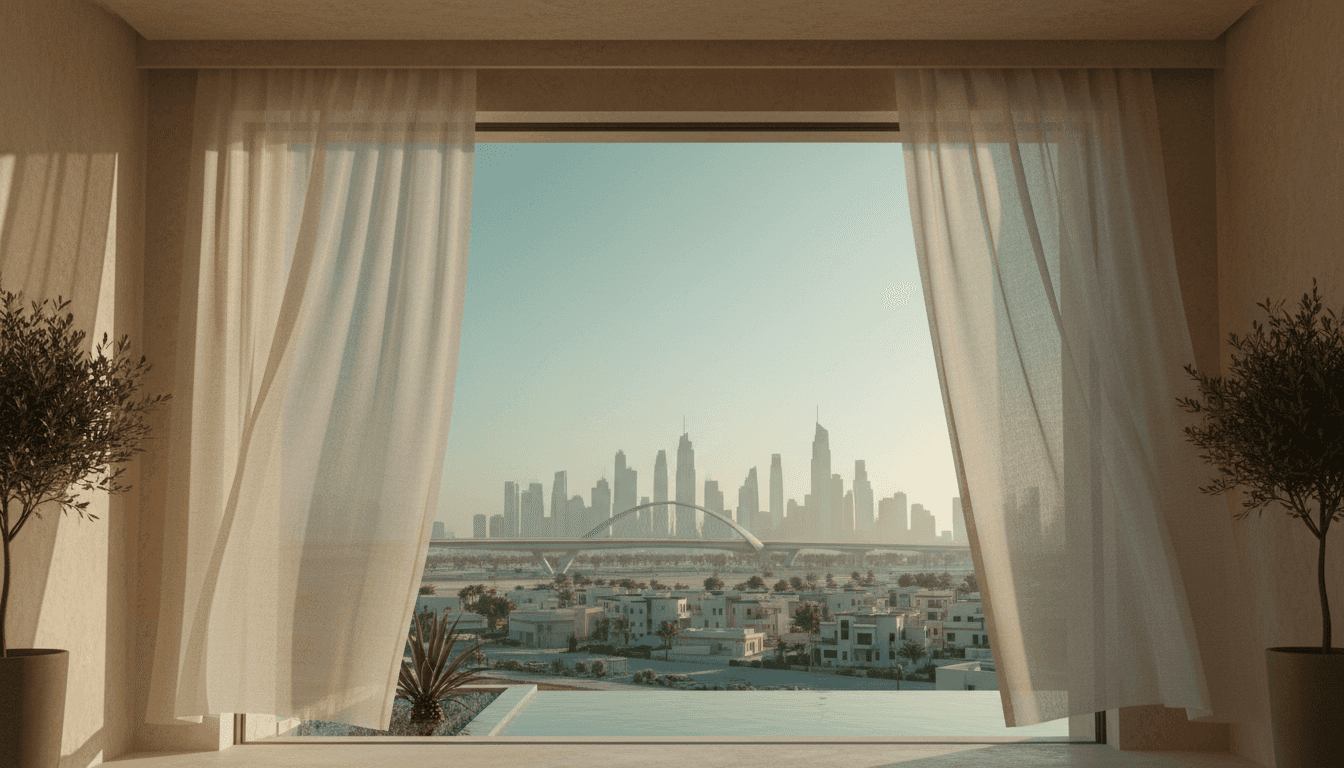
The Metro's Ripple Effect: Valuing Dubai's Next Commuter Hubs
I analyse how the expansion of the Dubai Metro, particularly the new Blue Line, is set to redefine property values in emerging commuter zones. This report quantifies the potential uplift and identifies key areas for future growth.

The link between public transport and property value is one of real estate’s foundational principles. Yet in a city as dynamic as Dubai, where the future is built at an astonishing pace, this connection is often priced in retrospectively. I believe this creates a significant, albeit temporary, market inefficiency for those willing to look beyond the present.
Here’s what we will explore:
- The established link between metro access and property premiums.
- The transformative potential of the Dubai Metro Blue Line.
- Identifying the next generation of commuter-centric communities.
- A deep dive into key zones: Dubai Creek Harbour, Meydan, and Dubai Silicon Oasis.
- A case study of Route 2020's impact on communities like Al Furjan.
- How to model the financial case for a commuter property investment.
- My verdict on where the most compelling opportunities lie.
The Metro Premium: From Theory to Dubai Reality
The concept of a 'transport premium' is simple: properties with better accessibility command higher prices and rents. In cities like London or Hong Kong, a property’s value is intrinsically tied to its proximity to a Tube or MTR station. This premium isn't just about convenience; it’s an economic asset. It expands the potential tenant pool, reduces household reliance on cars (a significant saving), and enhances overall quality of life. Decades of academic research have quantified this, generally finding a 5-15% value uplift for residential properties located within a 10-minute walk (roughly 800 metres) of a station, with the effect diminishing sharply as the distance increases.
In Dubai, this effect is observable but has historically been layered with other value drivers. For prime areas like Dubai Marina or Downtown Dubai, the Metro is part of a dense amenity stack that includes waterfront views, lifestyle destinations, and walkability. It’s difficult to isolate the Metro’s specific contribution from the value of being next to the Marina Mall or the Burj Khalifa. The real test, and the real opportunity, for the infrastructure impact Dubai property thesis lies in the city’s emerging, more car-dependent peripheral areas. Here, the arrival of a Metro line isn't just an added convenience; it's a fundamental transformation of the area's economic geography.
The initial Red and Green lines were instrumental in shaping the city's linear development along Sheikh Zayed Road. They connected established commercial and residential hubs, proving the concept and driving passenger numbers that justified further expansion. The game-changer, in my view, was the Route 2020 extension for the Expo. This project pushed the Metro deep into 'New Dubai', connecting areas like Discovery Gardens, Al Furjan, and what is now Expo City. It served as a real-world laboratory for the impact of new connectivity on master-planned suburban communities, and the results inform my entire outlook on the next phase of growth.
The Blue Line: Charting Dubai’s Next Growth Corridor
 Featured project
The next major catalyst for public transport property appreciation is the planned Dubai Metro Blue Line. Officially announced by the Roads & Transport Authority (RTA), this 30-kilometre line is a strategic piece of the Dubai 2040 Urban Master Plan. Its primary purpose is to bridge the gap between the existing Red and Green lines and service the rapidly growing population centres that currently lack direct rail access. According to the RTA, the Blue Line is projected to serve around 200,000 residents by 2030, and up to 320,000 by 2040.
While the final alignment is subject to detailed engineering studies, the proposed route is set to be transformative. It is expected to connect key hubs including Dubai Creek Harbour, Festival City, Meydan, Ras Al Khor, Dubai Silicon Oasis, and Academic City, before looping back to link with the Green Line at Creek station and the Red Line at Centrepoint station. This creates a vital orbital route that reduces reliance on the central Sheikh Zayed Road corridor, a critical step in building a more resilient, multi-nodal city. For the hundreds of thousands of residents and workers in these areas, it will slash commute times and provide a reliable alternative to road transport.
From an investment perspective, the Blue Line is the most significant piece of public infrastructure on the horizon. The project's timeline, with a target completion around 2029, creates a clear window of opportunity. The value uplift associated with new transport links is not a single event that occurs on opening day. It happens in phases:
1. Announcement Phase: A speculative bump in land values and off-plan sales as developers and informed investors move to secure positions. 2. Construction Phase: A gradual, more sustained appreciation as the project becomes tangible. Confidence builds as stations take shape and tracks are laid. This is often the phase with the most potential for capital growth in peripheral real estate Dubai. 3. Operational Phase: A final uplift and, crucially, a solidification of rental premiums as tenants move in to take advantage of the new connectivity. This is when the investment transitions from a capital growth play to a stable, yield-generating asset.
We are currently in the early stages of this cycle for the Blue Line. The route has been announced, and the initial excitement is palpable. However, the market has not yet fully and uniformly priced in the long-term impact across all the affected communities. This is where detailed, area-specific analysis becomes critical for anyone considering a commuter property investment Dubai.
Identifying the Zones of Maximum Impact
Not all areas along a new Metro line will experience the same degree of value uplift. The impact depends on a combination of factors: the existing character of the neighbourhood, the quality of the master plan, the developer's track record, and the 'before-and-after' change in accessibility. I focus my analysis on identifying areas where the arrival of the Metro will be most transformative — where it solves a genuine, existing pain point.
My primary candidates for significant uplift from the Blue Line fall into three broad categories:
- Emerging Mega-Projects: These are large-scale, long-term developments where the Metro is integral to the master plan. Dubai Creek Harbour by Emaar Properties is the prime example. Here, the Metro isn't just an add-on; it's the backbone of a future city-within-a-city. The value proposition is tied to the successful delivery of the entire ecosystem, with the Metro as its central artery.
- Established but Underserved Areas: These are mature communities that have developed over the last decade but remain heavily car-dependent. Think of Dubai Silicon Oasis or Academic City. These areas have a large, existing population of residents and workers who stand to benefit enormously from a direct rail link. The uplift here is about unlocking latent demand and improving quality of life for the current community.
- Future Growth Nodes: These are areas designated for major future development where the Metro acts as a catalyst. The Meydan district is a key example. While known for the racecourse and luxury villas, vast tracts of land are slated for high-density residential and commercial development. The Blue Line provides the transport infrastructure necessary to support this future density, de-risking the development and underpinning long-term land values.
In each of these cases, the investment thesis is slightly different. In a mega-project, you are buying into a developer's long-term vision. In an established area, you are betting on the immediate impact of improved connectivity on rents and desirability. In a future growth node, you are making a longer-term play on urban expansion, where the Metro provides the structural foundation for that growth. Understanding these nuances is key to aligning your investment strategy with the specific opportunity each area presents.
Deep Dive 1: Dubai Creek Harbour — A Metro-Centric City
Dubai Creek Harbour is perhaps the most compelling example of a community whose future is inextricably linked to the Metro. Developed by Emaar, it is envisioned as a waterfront city on a scale that rivals Downtown Dubai. The master plan features a blend of high-rise apartments, a marina, retail promenades, and the future Dubai Creek Tower. From its inception, the plan was designed around public transport, with an integrated network of trams and, most importantly, multiple stations on the future Blue Line.
Currently, Creek Harbour's primary weakness is its connectivity. Access by car requires navigating the busy Ras Al Khor Road, and while it's geographically close to Downtown, the psychological distance can feel greater during peak traffic. The Blue Line will completely change this dynamic. A direct train journey to Dubai International Airport or key business hubs like DIFC (via a transfer) will suddenly make Creek Harbour one of the best-connected communities in the city. This dramatic 'before-and-after' scenario is precisely the kind of catalyst I look for.
Looking at the numbers, a typical one-bedroom apartment in a newer building at Creek Harbour might currently rent for AED 85,000 to AED 100,000 per year. Comparable Emaar properties in Downtown or Dubai Marina with direct Metro access can command a 15-20% rental premium for that connectivity alone. As the Blue Line becomes operational, I anticipate a similar convergence. This suggests a strong potential for rental growth, which in turn will drive capital appreciation. An investor buying an off-plan or newly delivered property today is effectively acquiring that future rental premium at today's prices. The challenge, of course, is the time horizon, as the full benefits won't be realised until the line is running.
Deep Dive 2: Meydan and MBR City — The Next Urban Core
The area encompassing Meydan and Mohammed Bin Rashid City represents one of Dubai’s most ambitious urban expansions. It's a vast area transitioning from a low-density, equestrian-focused hub into a sprawling mixed-use district. Projects like Sobha Hartland and Sobha Hartland II are already delivering thousands of high-quality villas and apartments, attracting a mix of families and professionals. However, like Creek Harbour, its current public transport options are limited, making it a largely car-dependent community.
The proposed Blue Line route cuts directly through this corridor, with stations planned to serve the Meydan Racecourse area and surrounding residential developments. This is critical because the area's master plan calls for significant future density. Without the Metro, this density would lead to unsustainable traffic congestion. The Blue Line provides the solution, enabling the district to achieve its full potential as a vibrant urban core.
For investors, the opportunity here is multifaceted. There is potential for capital growth in established communities like Sobha Hartland as the Metro's arrival firms up values. There is also the opportunity to invest in new off-plan launches from developers like Emaar, Sobha, and others who will be launching projects strategically positioned around the future stations. These projects, purchased early in the development cycle, offer the chance to capture the dual uplift from both the maturation of the community and the arrival of critical infrastructure. My focus here would be on properties within a clear 10-15 minute walking radius of a proposed station, as this is where the premium is most pronounced.
“The most significant value creation doesn't happen when a Metro station opens; it happens in the years leading up to it, as the market gradually prices in a new future.”
Deep Dive 3: Silicon Oasis & International City — Unlocking Latent Value
Unlike the grand visions of Creek Harbour or Meydan, the investment case in Dubai Silicon Oasis (DSO) and Dubai International City is about unlocking the value in established, affordable communities. These areas are already home to a large and growing population. DSO is a successful free zone and integrated tech park, while International City offers some of the most affordable housing in Dubai. Their shared challenge has always been traffic and a reliance on buses or cars for commuting.
The Blue Line promises to be a revolution for residents here. A station in or near DSO would connect its thousands of workers and residents directly to the rest of the city. For International City, a Metro link would fundamentally upgrade its public transport infrastructure, making it a far more attractive option for a wider range of tenants. This is a classic case of infrastructure solving a last-mile problem. The potential impact on rental demand is enormous. I anticipate that the traditional rent gap between these areas and more central, Metro-connected communities will narrow significantly once the line is operational.
The Dubai Metro property value uplift here is less about spectacular percentage gains on luxury properties and more about firming up yields and ensuring high occupancy in the affordable to mid-market segments. For an investor focused on rental income, these areas present a compelling case. A one-bedroom apartment in International City might currently yield 7-9% gross, one of the highest in Dubai. The arrival of the Metro de-risks that investment significantly. It ensures future tenant demand, supports steady rental growth, and provides a clear catalyst for long-term capital preservation and appreciation. The key is to focus on well-maintained buildings within walking distance of the anticipated station locations.
Learning from Route 2020: The Al Furjan Case Study
To understand the future, we must study the past. The Route 2020 extension to the Red Line provides our best real-world model for the Metro's impact on an emerging suburban community. Al Furjan, a master-planned community by Nakheel, was one of the primary beneficiaries of this extension, with two dedicated stations (Al Furjan and Discovery Gardens) serving the area.
Before the Metro, Al Furjan was a pleasant but somewhat isolated villa and apartment community. Residents were entirely car-dependent. The announcement and subsequent construction of the Metro extension changed everything. We saw a clear uptick in buyer interest, particularly from end-users and long-term investors who understood the long-term value of connectivity. The period between 2017 (when construction was well underway) and 2021 (when it opened) saw a noticeable firming of prices, even against a softer city-wide market backdrop for part of that period.
Today, Al Furjan is a thriving commuter hub. A resident can walk to the station and be in Dubai Marina in 15 minutes or DIFC in 35 minutes, without touching their car keys. This has fundamentally altered its appeal. It's no longer just a suburban enclave; it's a connected urban village. This is reflected in both sales and rental values. Villas and townhouses in Al Furjan have seen robust appreciation, and apartments within walking distance of the station command a clear rental premium over those further away. The data validates the thesis: major infrastructure projects create tangible, measurable value, and Al Furjan is a prime example of this public transport property appreciation in action.
Modelling the Commuter Investment: A Cost-Benefit Analysis
Let's translate this theory into a practical financial model. Suppose an investor is considering a two-bedroom apartment in a hypothetical new development in the Meydan area, located 800m from a proposed Blue Line station. The purchase price is AED 2.0 million. The project is due for completion in 2027, and the Blue Line is expected to be operational by 2029.
Here is a breakdown of the initial acquisition costs, as per regulations from the Dubai Land Department (DLD).
- Purchase Price: AED 2,000,000
- DLD Transfer Fee (4%): AED 80,000
- Trustee Office Fee: AED 4,200 (approx. AED 4,000 + 5% VAT)
- Real Estate Agency Fee (2% + VAT): AED 42,000
- Initial Total Outlay: AED 2,126,200
Now, let's model the rental income. In 2027, upon handover and before the Metro is operational, the apartment might realistically rent for AED 120,000 per year. The annual service charges are, let's say, AED 18 per square foot on a 1,200 sq. Ft. apartment, which comes to AED 21,600 per year.
- Net Rental Income (Pre-Metro): AED 120,000 - AED 21,600 = AED 98,400
- Net Yield (Pre-Metro): (AED 98,400 / AED 2,126,200) = 4.63%
This is a respectable, if not spectacular, return. Now, fast forward to 2030, a year after the Blue Line has opened. The area's desirability has increased, and demand from tenants seeking Metro access has grown. Based on the premiums seen in other areas, it's conservative to assume a 15% rental uplift directly attributable to the Metro.
- New Annual Rent (Post-Metro): AED 120,000 * 1.15 = AED 138,000
- Net Rental Income (Post-Metro): AED 138,000 - AED 21,600 = AED 116,400
- New Net Yield on Original Cost: (AED 116,400 / AED 2,126,200) = 5.47%
More importantly, the capital value of the property will have repriced to reflect this higher, more resilient income stream. If the market prices the asset at a similar 4.63% net yield, the new capital value would be approximately AED 2.51 million (116,400 / 0.0463), representing a capital appreciation of over AED 500,000, or 25% on the initial property price. This demonstrates the powerful dual return stream — improving yield and significant capital growth, that defines a successful commuter property investment Dubai.
Investing in areas slated for new Metro connectivity is a long-term strategy that requires patience. The most substantial gains are not made overnight but are realised by buying ahead of the curve and allowing the infrastructure to mature, transforming a location's fundamental economic potential.
My Verdict: Where to Focus Now
As a market analyst, my job is to identify where the data points towards future value. In the context of Dubai's public transport expansion, the signals are clear. While the entire corridor set to be serviced by the Blue Line will benefit, I believe the opportunities are not all equal.
For investors with a high-risk tolerance and a very long-term view (10+ years), betting on the mega-projects of Dubai Creek Harbour and the wider Meydan district offers the highest potential beta. You are investing in the creation of new urban centres, where the Metro is a foundational element. The returns could be substantial, but they are tied to the successful execution of vast and complex master plans.
For more conservative investors focused on yield and stability, the smarter play may be in the established, underserved communities. A well-chosen, well-maintained building in Dubai Silicon Oasis, within walking distance of a future station, presents a lower-risk proposition. The community is already there, the demand is proven, and the Metro simply unlocks its next phase of growth. The percentage gains might be less spectacular than in a brand-new mega-project, but the income stream is likely to be robust and the risk of non-delivery is lower.
Ultimately, the expansion of the Dubai Metro is one of the most powerful and predictable drivers of property value for the decade ahead. It is a core pillar of the Dubai 2040 plan and a sign of the government's commitment to sustainable urban development. By understanding the mechanics of the 'metro premium' and applying a disciplined, research-led approach, investors can position themselves to benefit from one of the city's most significant and transformative projects. At Gaia Living, we continue to monitor these future growth areas Dubai with intense focus, guiding our clients to make informed decisions based not just on today's market, but on the shape of the city to come.
Sources
- Dubai 2040 Urban Master Plan: Government of Dubai
- Dubai Metro Blue Line Announcement: Roads & Transport Authority (RTA) (rta.ae)
- Property Registration and Fees: Dubai Land Department (DLD)
Questions, answered
- How much does the Dubai Metro increase property value?
- Studies from mature cities show a typical premium of 5-15% for properties within a 10-minute walk of a metro station. In Dubai's emerging areas, this 'metro premium' is still forming, presenting a potential value uplift as the infrastructure matures and ridership grows.
- Which new areas in Dubai will get a Metro line?
- The proposed Dubai Metro Blue Line is planned to connect key emerging zones. While the exact route is pending final approval, it's expected to service areas such as Dubai Creek Harbour, Meydan, Dubai Silicon Oasis, and International City, significantly enhancing their connectivity.
- Is buying property near a future Metro station a good investment?
- In my view, yes, provided you have a long-term horizon. The biggest capital appreciation from infrastructure projects like the Metro typically occurs between the announcement and the operational launch. Buying early in this cycle, especially in well-planned master communities, can be a strategic move.
- What are the costs of buying property near a future Dubai Metro station?
- The costs are standard for any Dubai property purchase. You'll need to budget for the property price, a 4% Dubai Land Department transfer fee, a trustee fee (approx. AED 4,000 + VAT), an agency fee (typically 2% + VAT), and any applicable mortgage arrangement fees and service charges.
- Will the Blue Line affect rental yields in Dubai?
- Yes, I expect it will have a positive impact. Improved public transport access makes areas more attractive to a wider pool of tenants, particularly mid-income professionals who rely on the Metro. This increased demand can support stronger rental rates and, consequently, higher rental yields over time.
- Which existing areas offer good value near the Metro?
- Communities on the Route 2020 extension, such as Al Furjan and Discovery Gardens, still offer relative value compared to more central hubs. They provide direct Metro access to Expo City and key business districts, making them strong candidates for long-term rental demand and steady appreciation.

Amara translates DLD transaction data, supply pipelines, and macro signals into clear calls on where Dubai's market is heading. She writes the numbers most brokers only feel.
Related stories
Parking: The Unsung Hero of Dubai Apartment Value
I explore how apartment parking allocation, from basement quality to visitor access, is a critical and often overlooked driver of property value and livability in Dubai.

Selling in a Dubai Boom: Your Strategic Playbook
A seller's market in Dubai offers immense opportunity, but achieving a record price requires more than just listing your property. This is your strategic guide to preparing, pricing, and positioning for peak demand.
How to Own Dubai Property: A Guide to Ownership Structures
Choosing the right ownership structure is one of the most critical, yet overlooked, decisions when buying Dubai property. This guide breaks down your options, from individual title to joint and corporate setups.
Echoes, in your inbox
One thoughtful email a month. Market insight, new launches, no spam.