

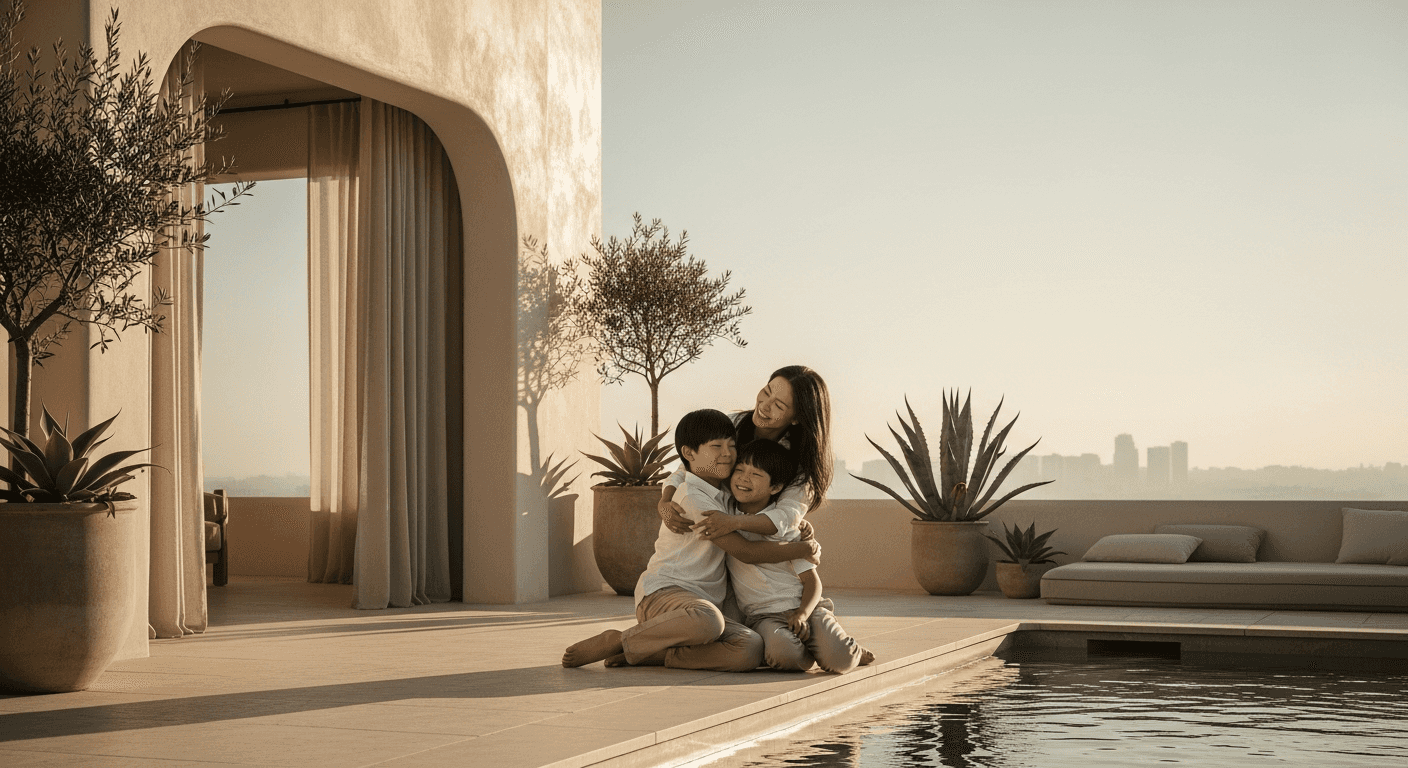
The Heartbeat of Home: Dubai's Best Family Communities
Beyond stunning villas and pristine parks, some Dubai communities cultivate a true sense of belonging. I explore the master-planned developments that use events and activities to build real connections for families.

When my clients, especially families, start their search for a new home in Dubai, the conversation quickly moves past square footage and marble finishes. The questions I hear most often are about life. Where will my kids make friends? Is it the kind of place where neighbours say hello? Will we feel like we belong? These aren't details on a brochure; they are the foundation of a happy life here. A beautiful villa in a soulless street is just a house. A slightly smaller home in a neighbourhood humming with life, laughter, and connection is a true home.
Here's what we'll explore:
- What 'community spirit' really means in a master-planned city.
- The pioneers: How legacy communities built the blueprint for belonging.
- The modern innovators: New communities raising the bar for social life.
- The crucial role of community management companies.
- How to evaluate a community's 'social calendar' before you buy.
- The costs involved: Are events part of your service charges?
- A case study: A day in the life of a truly connected neighbourhood.
- My verdict: The best active family communities in Dubai today.
What 'Community Spirit' Really Means
I’ve walked through hundreds of Dubai communities over the years. Some are immaculate, pristine, and almost silent. The landscaping is perfect, the architecture is impressive, but something is missing. There's a stillness that feels sterile. Then you visit another community, perhaps on a Friday afternoon, and the difference is immediate. You hear the distant sound of children’s laughter from a park, you see teenagers on skateboards heading to a community court, and you pass neighbours chatting over their garden walls. This intangible energy is what we call `community spirit Dubai`, and it’s the most valuable amenity a neighbourhood can offer.
In a city as dynamic and transient as Dubai, this sense of belonging is not something that happens by accident. It is designed, nurtured, and invested in. Real community spirit is the 'software' that runs on the 'hardware' of the development. The hardware is the pools, the parks, the gyms, and the homes themselves. The software is the calendar of `Dubai villa community events`, the resident-led clubs, the farmers' markets, the open-air movie nights, and the countless small interactions these activities foster. It’s the difference between having a shared swimming pool and having a neighbourhood pool party. It's the difference between a patch of grass and a park that hosts a weekly yoga class.
For families, this is everything. It translates into a support network, especially for those new to the city. It means your children have a ready-made circle of friends who live just a few doors down. It creates a safe and trusting environment where kids can have the kind of old-fashioned childhood that involves riding bikes around the block until dusk. When we at Gaia Living advise families, we stress that they should weigh this 'software' just as heavily as the physical property. The most beautiful villa will feel isolating if you don't connect with the people and the rhythm of the life around you. True community is an investment in your family's happiness and well-being, and its returns are measured in friendships and memories, not just financial appreciation.
The Pioneers: Emaar's Blueprint for Belonging
 Featured project
To understand how this focus on community became a hallmark of Dubai's best suburbs, you have to look back to the original blueprint: Arabian Ranches. When Emaar Properties launched this project in the early 2000s, it wasn't just building houses in the desert; it was importing the concept of the master-planned suburban community and adapting it for a modern, international city. I remember visiting it in its early days, and the vision was clear from the start. It was about creating a self-contained world for families.
The genius of Arabian Ranches was in its integrated design. It wasn't just rows of villas. Emaar built a town centre with a supermarket, cafes, and shops. They incorporated a top-tier golf course, an equestrian club, and most importantly, schools right inside the community gates. This meant that the daily rhythm of life — school runs, grocery shopping, weekend sport, could all happen within this curated environment. This created countless natural points of contact for residents. Parents met at the school gates, neighbours bumped into each other at the supermarket, and families gathered at the club for Friday brunch. This physical infrastructure was the fertile ground from which a real community could grow.
On top of this, Emaar Community Management was proactive from day one in programming the social calendar. They established traditions that residents came to anticipate and cherish. The Halloween street decorations and trick-or-treating in Arabian Ranches became legendary across Dubai. The National Day celebrations, festive markets, and community garage sales were not token gestures; they were large-scale, well-organised events that brought thousands of residents together. This created a powerful sense of shared identity and tradition. People weren't just living in 'Villa 12, Street 5'; they were living in 'The Ranches'. This model, successfully executed in other Emaar communities like The Springs and The Meadows, proved that you could, in fact, build community from the ground up. It set the standard that all subsequent developers have had to meet or exceed.
The Modern Innovators: Raising the Bar
While Emaar set the original standard, a new generation of developers has taken those lessons and is pushing the concept of community living even further. They are competing not just on the quality of their homes, but on the quality of the lifestyle and social connections they can offer. The most prominent example, in my view, is Dubai Hills. It takes the Arabian Ranches model and executes it on a grander, more contemporary scale. The sheer variety of amenities and organised activities is breathtaking. Dubai Hills Park is not just a green space; it's a major events hub with an amphitheatre, splash park, and skate park that hosts everything from concerts to fitness festivals. The community is an ecosystem, with its own hospital, multiple schools, business parks, and the vast Dubai Hills Mall, ensuring residents rarely need to leave.
Another standout innovator is Nshama with its flagship project, Town Square. I have a real soft spot for Town Square because its design is so explicitly focused on fostering interaction. The entire development radiates from a central, pedestrian-friendly square filled with cafes, a cinema, and water features. This creates a natural 'living room' for the entire community. Nshama's events team is incredibly active, organising some of the best `family-friendly events Dubai communities` have to offer, from carnivals to outdoor markets. It’s a textbook example of an `active family community Dubai` and has proven hugely popular with young families and professionals, offering a more accessible price point than the more established villa communities.
We're also seeing this focus on experiential living from developers like Damac. While known for luxury, their master communities like Damac Hills and Damac Hills II are packed with unique features designed to bring people together. The Malibu Bay wave pool at Damac Hills, for instance, is more than an amenity; it’s a social destination for the community on weekends. This trend extends beyond Dubai, too. In Sharjah, Arada has made community engagement a core pillar of its brand with developments like Aljada, which features a huge entertainment complex called Madar at its heart, designed by Zaha Hadid Architects. These modern communities understand that for today's buyer, lifestyle and connection are non-negotiable.
The Community Managers: The Unsung Heroes of Connection
While developers lay the groundwork, the long-term success of a community's social life rests in the hands of a group of people who are often overlooked: the community management team. These are the organisations — like Emaar Community Management, Nakheel Community Management, or Provis, that are responsible for the day-to-day running of the neighbourhood. Their most visible role is collecting service charges and ensuring the pools are clean and the security guards are on duty. But their most impactful role, in my opinion, is that of a community enabler.
A great community management company doesn't just maintain the assets; it activates them. They have dedicated community engagement managers whose job is to create and execute the social calendar. I’ve met many of these professionals over the years, and the best ones are passionate about bringing people together. They are part event planner, part social worker, and part town mayor. They are the ones who notice a group of residents are keen on yoga and then arrange for an instructor to hold classes in the park. They are the ones who turn an empty common area into a vibrant venue for a festive market, giving local home-based businesses a platform.
The difference between an average and an excellent community management team is stark. An average team might organise a bouncy castle for Eid. An excellent team will create a full 'Eid Carnival' with food trucks, traditional performances, kids' workshops, and activities for all ages, promoting it for weeks through the community portal and social media. They actively listen to resident feedback through surveys and town halls to tailor the `clubs and activities Dubai villas` residents actually want. They also facilitate resident-led initiatives, providing the framework and support for a parent to start a toddler playgroup or a group of neighbours to launch a running club. When you are choosing a community, the reputation and proactivity of the management company are just as important as the name of the developer.
“The true luxury in Dubai isn't just a private pool; it's your children having a pack of friends they can safely run out to play with on the street.”
Evaluating the Social Calendar: A Buyer's Checklist
So, how can you, as a prospective buyer or tenant, cut through the marketing slogans and find a community that genuinely delivers on its promise of a vibrant social life? It requires a bit of detective work. Brochures and websites will always paint a rosy picture, but you need to look for real-world evidence. Over the years, I've developed a checklist that we at Gaia Living share with our family clients to help them assess the 'spirit' of a place before they commit.
This isn't about a single visit; it's about building a complete picture. A community can feel very different on a Tuesday morning compared to a Friday evening. I always advise clients to visit their top choices multiple times, at different times of day and on different days of the week. Sit in the community cafe and observe. Are people interacting? Or is everyone silently staring into a laptop? The vibe of the central hub often tells you everything you need to know. Speaking directly to people who already live there is the gold standard of research. Most residents are happy to share their honest opinion, good or bad, about life in the neighbourhood.
Here is a practical checklist you can use to gauge the level of community engagement:
- Request the Event Calendar: Ask the community management office (or your agent) for the last three to six months of event calendars or newsletters. This shows you the actual frequency and variety of `family-friendly events Dubai communities` offer, not just the promises.
- Visit on a Weekend: Spend a Saturday afternoon walking through the main parks and recreational areas. Are they being used? Do you see families picnicking, kids playing organised sport, or is it empty?
- Scour Social Media: Search on Facebook for unofficial resident groups for the community. These can be a treasure trove of candid information. You'll see residents organising their own meet-ups, sharing information, and giving unfiltered feedback on community-run events.
- Talk to a Resident: If you see someone out walking their dog or watching their kids in the park, politely introduce yourself and ask for their opinion. Ask them directly: "What's the `community spirit Dubai` like here? Do you know your neighbours?"
- Check the Notice Boards: The humble notice board in the community centre or grocery store is often very revealing. Look for flyers for resident-led `clubs and activities Dubai villas` like book clubs, yoga classes, or language swaps. This is a strong sign of an engaged and proactive resident base.
- Assess the Facilities in Person: Don't just look at photos. Walk the jogging tracks, check the condition of the tennis courts, and see how clean the changing rooms at the pool are. Well-maintained and heavily used facilities are a sign of a healthy, active community.
The Hidden Costs: Service Charges and Event Budgets
It's wonderful to have a rich calendar of events, but these things don't happen for free. A crucial question clients ask is how this is all paid for. The answer lies in the annual service charges. Every homeowner in a freehold community in Dubai is required to pay an annual fee to the owners' association, which is managed by the community management company. These fees are regulated by the Dubai Land Department (DLD) and its regulatory arm, RERA, who must approve the annual budgets to ensure they are fair and transparent.
Service charges are calculated in AED per square foot per year. For villas, this is typically based on the plot area, not the built-up area. The rate can vary significantly from one community to another, generally ranging from AED 3 to AED 6 per sqft for most mainstream villa communities. The fee for a high-end, amenity-rich community like Al Barari with its extensive waterways and botanical gardens will naturally be at the higher end of the scale compared to a more straightforward community. These fees cover everything required to run the common areas of the neighbourhood: security, cleaning, landscaping, pool maintenance, gym operation, and, importantly, a budget line for community events and activities.
A well-run community will have a clear and detailed budget that shows exactly how these funds are allocated. While the specific percentages vary, a portion of your annual fee is always dedicated to fostering that community spirit. When you are considering a property, you have the right to ask for the approved budget to see what you are paying for. A healthy allocation to 'Community Events' is a strong indicator that the developer and management are serious about social engagement. Here is an illustrative breakdown of what that might look like for a typical family villa:
- Sample Annual Service Charge Breakdown (For a 5,000 sqft Plot at AED 4/sqft):
- Total Annual Fee: 5,000 sqft x AED 4.00 = AED 20,000
- Common Area Maintenance (roads, lighting): AED 7,000 (35%)
- Security Services (staff & technology): AED 5,000 (25%)
- Landscaping & Gardening: AED 3,000 (15%)
- Community Events & Activities: AED 1,600 (8%)
- Management Fee: AED 1,400 (7%)
- Sinking Fund (for future major repairs): AED 2,000 (10%)
As you can see, a tangible amount — AED 1,600 in this example, is specifically earmarked for the very events that create a vibrant neighbourhood. This transparency is vital and is something we always encourage our clients to review as part of their due diligence, as outlined in our buyer & investor guides.
A Day in the Life: A Case Study in Community
To make this concept less abstract, I want to paint a picture for you. I recently spent a full Saturday exploring Dubai Hills, deliberately trying to see it through the eyes of a family living there. The experience was a powerful reminder of what's possible when a community is designed for connection. My day started around 9 AM near the Dubai Hills Park. The place was already alive. On one field, a group of dads was coaching a gaggle of under-8s in football, complete with little matching kits. Nearby, a large outdoor yoga class was in session, and the paths were busy with joggers, cyclists, and families out for a morning stroll. The air was filled with energy and a sense of shared purpose.
By lunchtime, the central hub near the park was buzzing. Families were grabbing lunch at the cafes, and the kids' splash pad was a cacophony of joyful screaming. What struck me was how casual and comfortable the interactions were. People weren't just in the same space; they were connecting. Neighbours were pulling tables together, parents were comparing notes while watching their kids play, and teenagers were hanging out in groups at the skate park. This wasn't a special event day; this was just a normal Saturday. This is the ultimate sign of an `active family community Dubai` — when social life is woven into the fabric of a regular weekend, not just reserved for major holidays.
As the afternoon sun softened, I saw families setting up picnic blankets in the park. A community-organised 'Games in the Park' event was underway, with staff facilitating sack races and tug-of-war contests. Later in the evening, as I walked towards the Dubai Hills Mall, I passed a smaller neighbourhood park where a mobile screen was being set up for an outdoor movie night. Residents were already arriving with beanbags and popcorn. It was the culmination of a day that felt rich with connection and activity. This is what families are truly buying into. It's the promise that life outside your four walls will be as fulfilling as the life within them. It's the assurance that your weekend won't be spent wondering what to do, but rather choosing between multiple appealing options right on your doorstep.
My Verdict: The Top Communities for Family Connection
After years of watching communities evolve and helping countless families find their place, some clear winners have emerged in the race to build genuine connection. My recommendations are based not on marketing hype, but on consistent, long-term feedback from residents and my own on-the-ground observations. These are the places where the 'software' of community life is just as impressive as the 'hardware' of the real estate.
Choosing the right one depends on your family's specific priorities — be it budget, lifestyle, or location, but any of the communities on this list would be an excellent starting point for your search. Each has a proven track record of fostering a strong social fabric. They are the standard-bearers for `community spirit Dubai` and offer a compelling vision for modern family life in the city. If you are looking to browse properties for sale with a focus on lifestyle, these are the names that should be at the top of your list.
Here are my top picks for the best active family communities in Dubai:
- The Classic Choice: Arabian Ranches For a mature, established community feel, the original is still hard to beat. Its leafy streets, strong neighbourhood bonds, and time-honoured event traditions make it feel like a true suburb. It's less flashy than the newer options, but its sense of community is deep-rooted and authentic.
- The Modern All-Rounder: Dubai Hills In my opinion, this is currently the best all-around option for families in Dubai. The scale and quality of the amenities, from the central park to the mall and hospital, are unmatched. The community management is incredibly professional, delivering a constant stream of high-quality events for all ages.
- The Value Champion: Town Square Brilliantly designed around its central square, this community is purpose-built for social interaction. It offers a vibrant, youthful energy and a packed events calendar at a more accessible price point than many other villa communities. It's a fantastic choice for young families starting out.
- The Green Sanctuary: Al Barari For families who prioritise nature, wellness, and a more serene environment, Al Barari is in a class of its own. The community here is smaller and more tight-knit, with events often focused on wellness and nature, like workshops at its excellent 'The Farm' restaurant. The sense of being in a green oasis is unparalleled.
- The Golf Lifestyle: Jumeirah Golf Estates Home to two championship courses, the social life here naturally revolves around the impressive clubhouse. It functions as the community's living room, hosting regular social events, dinners, and family brunches. It’s an ideal choice for keen golfers who want that lifestyle integrated into their daily life.
The most successful family communities in Dubai are those that understand that their job doesn't end when the last villa is sold. They are intentionally designed and actively managed to bring people together, creating a sense of belonging that is the ultimate luxury for any family.
Finding a place that resonates with your family's soul is our passion at Gaia Living. It's about looking beyond the floor plan and understanding the life you want to live. If you're ready to find not just a house but a true community, my team and I are here to guide you.
## Sources - Dubai Land Department (DLD): https://dubailand.gov.ae - Real Estate Regulatory Agency (RERA): https://www.rera.gov.ae - UAE Government Portal: https://u.ae
Questions, answered
- Which Dubai communities are best for families with young children?
- Communities like Arabian Ranches, Dubai Hills Estate, and Town Square are consistently rated as top choices for families. They offer a blend of safe green spaces, dedicated kids' play areas, and a robust calendar of family-friendly community events.
- Are community events in Dubai included in the annual service charges?
- Yes, in most master-planned communities, the budget for organising events is included in the annual service charges paid by homeowners. This fee is regulated by Dubai's Real Estate Regulatory Agency (RERA) and covers the cost of activities like seasonal festivals, outdoor movie nights, and sports days.
- What is a good way to check the community spirit before moving in?
- I recommend visiting the community on a weekend to observe how residents use the public spaces. You can also check unofficial resident groups on social media for candid discussions and ask your real estate advisor for the latest community events calendar to see the frequency and variety of activities.
- Which developers are known for building communities with a strong social fabric?
- Emaar Properties is the pioneer in this area, with developments like Arabian Ranches and Dubai Hills setting the standard. Other developers like Nshama (Town Square) and Arada (in Sharjah) are also known for designing communities with social interaction at their core.
- How much are typical service charges in a Dubai villa community?
- Service charges for villa communities in Dubai generally range from AED 3 to AED 6 per square foot, calculated on the plot area. The exact amount depends on the developer, the age of the community, and the extent of the amenities and services provided.
- What kind of clubs and activities can you find in Dubai's family villa communities?
- Beyond developer-organised events, many communities have resident-led clubs for running, cycling, book-reading, and various parent-and-toddler groups. Community management often facilitates these by providing space or promotion through community portals and notice boards.

Sophia profiles Dubai's villa communities — schools, commute times, green space, and the intangible feel of a neighbourhood. She writes for families putting down roots.
Related stories
Off-Plan vs Ready: The Dubai Investor's Guide
A detailed comparison for apartment investors in Dubai, weighing the capital appreciation potential of off-plan against the immediate returns of ready properties.
Clearing Disputes for a Smooth Dubai Sale
Unseen property disputes or financial encumbrances can derail your Dubai property sale. I'll share my strategic playbook for identifying and resolving these issues before they cost you time and money.
Selling Inherited Property in Dubai: The Complete Guide
Navigating the sale of an inherited property in Dubai requires a clear understanding of the specific legal and financial steps. This guide covers the entire process, from obtaining a succession certificate to the final transfer.
Echoes, in your inbox
One thoughtful email a month. Market insight, new launches, no spam.