

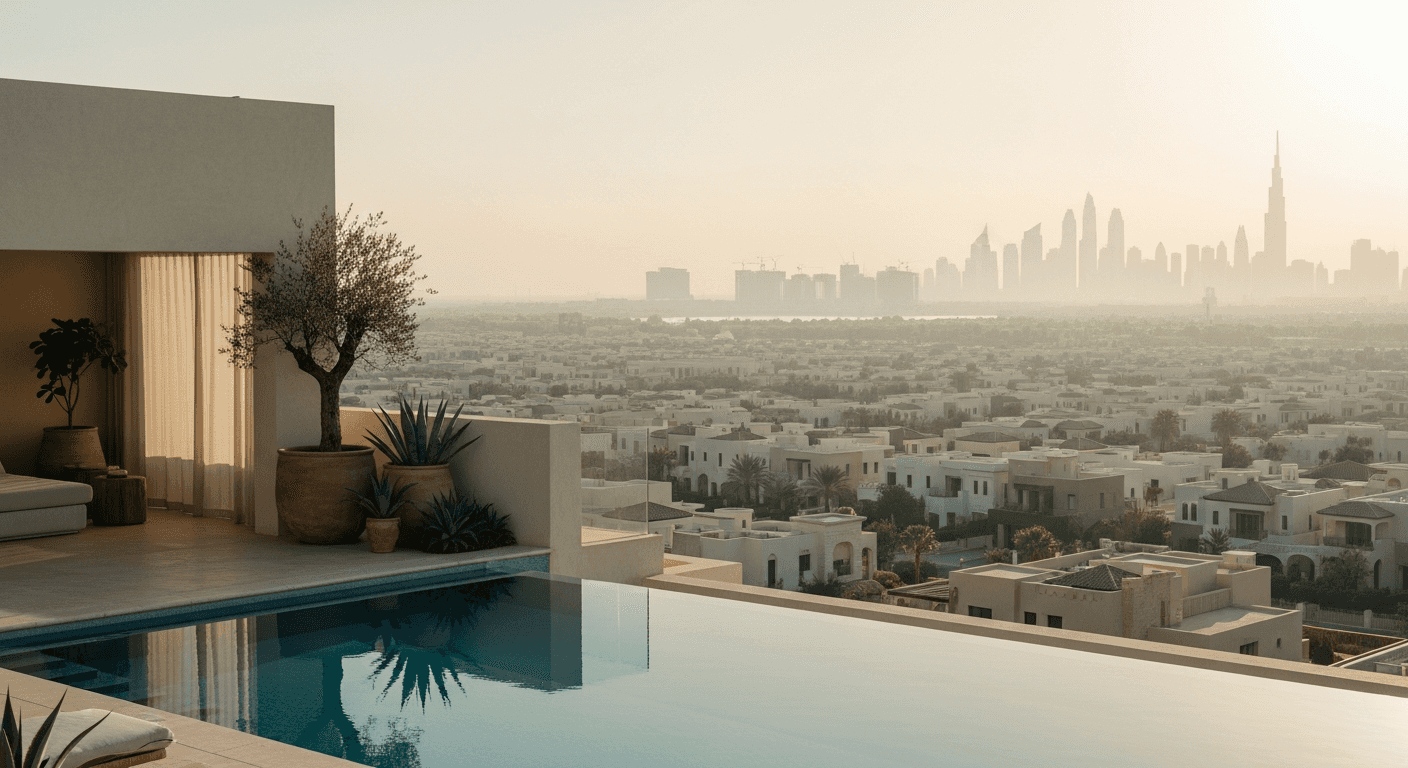
The Great Unbundling: Dubai's Villa & Townhouse Market Shift
A fundamental shift is underway in Dubai's property market as buyers prioritise space, privacy, and community over high-rise living. This deep dive analyses the drivers, costs, and future of the city's surging demand for villas and townhouses.

The narrative of Dubai real estate has long been written vertically, in the glass and steel of the world’s tallest towers. For decades, the archetypal Dubai property was an apartment with a view. Today, that story is being rewritten on a horizontal axis, across sprawling, landscaped communities. The surge in the Dubai villa market is more than a fleeting trend; in my view, it represents a structural realignment of the city’s housing landscape, a 'great unbundling' of home, work, and lifestyle.
Here is the ground we will cover in this analysis:
- The fundamental drivers behind the demand shift from apartments to houses.
- The central role of master-planned communities in the 'villa dream'.
- A breakdown of the supply pipeline and developer strategies.
- A detailed, line-by-line look at villa prices Dubai and associated costs.
- The dynamics of the ultra-luxury villa market Dubai.
- Why townhouses have become the crucial bridge for aspiring homeowners.
- The investment case: yields vs. Capital growth.
- My final verdict on the market's future trajectory.
The 'Why': Unpacking the Drivers of Demand
To understand the current market, we have to rewind to the global inflection point of the early 2020s. The pandemic didn’t create the desire for more space, but it acted as a powerful accelerant, forcing a worldwide re-evaluation of what 'home' means. In Dubai, a city known for its dynamism, this shift was particularly acute. The enforced period of confinement made the limitations of apartment living starkly clear for many. The balcony, once a prized feature, suddenly felt insufficient. The need for a home office, a garden for the children, or simply a greater sense of privacy became paramount. This psychological shift laid the groundwork for the initial demand spike.
However, psychology alone doesn't sustain a market transformation of this magnitude. The true engine has been the UAE government's visionary residency reforms. The expansion of the Golden Visa program, in particular, has been a game-changer. By offering 10-year renewable residency to investors, entrepreneurs, and skilled professionals, the government sent a clear signal: Dubai is not just a place to work for a few years, but a place to build a life. This has fundamentally altered the buyer mindset. The confidence that comes with long-term residency makes the commitment of purchasing a large family home a logical next step, rather than a risky over-investment for a transient stay. At Gaia Living, we have observed this shift firsthand in our conversations with clients who are now planning their lives here on a decadal scale.
This policy shift has coincided with a significant demographic evolution. Dubai's post-pandemic population boom has brought in a new wave of residents from Europe, North America, and other parts of Asia. Many of these families are accustomed to suburban living and arrive with the expectation of owning a house with a garden. They are not just seeking a job; they are seeking a lifestyle, and for many, that lifestyle is defined by the space and autonomy of a villa. This influx of global wealth, seeking a safe and stable hub, has disproportionately targeted larger, premium properties, further fuelling the top end of the market and creating a ripple effect across all segments of the family homes Dubai market.
Community Living: The New Dubai Dream
 Featured project
The appeal of a Dubai villa extends far beyond its four walls and private garden. The most successful and sought-after properties are located within meticulously designed master communities. This concept of community living Dubai is a core part of the value proposition and a key reason for the market's strength. Developers like Emaar Properties, Nakheel, and Meraas didn't just build houses; they built entire ecosystems, and buyers are purchasing a membership to a curated lifestyle.
A prime example is Dubai Hills Estate, which I consider the benchmark for modern community planning in the city. It's a microcosm of Dubai itself: a championship golf course, a destination mall, high-performing schools, clinics, and a vast central park, all interconnected by cycling tracks and landscaped walkways. When you buy a villa here, you are not just buying a property; you are buying access to this entire infrastructure. This is a powerful draw for families who value convenience and a safe, self-contained environment for their children. The success of Dubai Hills has become a template that many newer developments are trying to emulate.
In contrast, a community like Arabian Ranches offers a different, but equally compelling, appeal. As one of Dubai’s most established villa communities, it has a maturity that newer projects lack. The trees are taller, the landscaping is lush, and the sense of community is deeply ingrained. It has its own schools, community centres, and retail offerings, creating a stable, suburban feel that has been popular for nearly two decades. The sustained demand here, even with the launch of dozens of newer communities, speaks to the 'stickiness' of a well-executed master plan. Buyers know what they are getting, and they are willing to pay a premium for that certainty. The townhouse sub-communities within the Ranches also provide an accessible entry point into this coveted lifestyle.
This focus on the 'software' of a community — the events, the farmers' markets, the security, the pristine maintenance, is what differentiates a great development from a mere housing tract. It creates a powerful sense of place and belonging, which in turn protects property values. When we advise clients, a significant part of the conversation revolves around matching their lifestyle needs to the right community. Are they golfers? Do they have young children needing specific school curricula? Do they prioritize proximity to Downtown or a quieter, more suburban feel? The answers to these questions are as important as the property's square footage, because in the modern Dubai villa market, you are buying the neighbourhood as much as the house.
Analyzing the Supply: Can It Keep Pace?
The intense surge in townhouse demand Dubai and for villas has put enormous pressure on the supply side of the market. For years, the development pipeline was heavily skewed towards apartments, which are faster and often more profitable per square foot of land to construct. Building villa communities is a more land-intensive and capital-heavy endeavour. Consequently, the ready inventory of high-quality villas and townhouses was quickly absorbed in 2021 and 2022, leading to the rapid price escalation we witnessed.
Dubai's major developers, however, are not ones to miss a clear market signal. We have seen a significant pivot in strategy. Emaar, Damac, Nakheel, and Aldar have all launched a flurry of new villa and townhouse communities or new phases within their existing master plans. The sheer scale of projects like Emaar South, The Valley, and Damac Hills 2 is a direct response to this demand. The relaunch of the ambitious Palm Jebel Ali project by Nakheel, with a heavy focus on beach-front villas, is perhaps the most significant indicator that the city's developers are betting big on the long-term future of high-end, spacious living.
One of the most interesting dynamics to watch is the off-plan market. Many of the villas and townhouses sold in the last two to three years are still under construction. As these units are handed over, we will see a substantial increase in the available supply. This will likely have a moderating effect on the frantic pace of price growth in the secondary market, which is a healthy and necessary development. However, the demand for off-plan launches remains robust, particularly from developers with a proven track record. Buyers are willing to wait two to three years for a brand-new property in a promising new community, often benefiting from attractive payment plans that allow them to stagger their investment.
Here are some of the key supply-side trends I'm observing:
- Focus on Amenities: New communities are competing on the quality and uniqueness of their amenities — crystal lagoons, sports facilities, wellness centres, and expansive green spaces are now standard.
- Rise of the Townhouse: Developers are increasingly focusing on 3 and 4-bedroom townhouses. This product hits the sweet spot for a huge segment of the market: families moving up from apartments who find large standalone villas financially out of reach.
- Branded and Boutique: At the highest end, we're seeing an increase in branded villas (partnering with luxury hospitality or fashion brands) and bespoke projects from boutique developers like AHS Properties, catering to UHNWIs who demand complete customisation.
- Geographic Expansion: Development is pushing further out from the city's traditional centre, into areas like Dubai South and along the E311 and E611 corridors, where large land parcels are available to create the sprawling communities that buyers now crave.
The Price Point: A Deep Dive into Villa & Townhouse Costs
Conversations about the villa market inevitably turn to cost. The price appreciation has been significant, but it's crucial to understand the nuances across different segments and the total cost of ownership. The phrase villa prices Dubai can mean anything from a AED 2 million townhouse to a AED 200 million mega-mansion, so a granular breakdown is essential.
Broadly, I segment the market into three tiers. The entry point is the townhouse market, which has become one of the most active segments. In communities like Al Furjan, Town Square, or the newer phases of Damac Lagoons, a three-bedroom townhouse can be found in the range of AED 2 million to AED 3.5 million. These offer incredible value for families, providing space and a private garden for a price that is often comparable to a two-bedroom apartment in a prime area like Dubai Marina. Moving up, the mid-market for standard villas (typically 4-5 bedrooms) in established communities like Arabian Ranches, Jumeirah Golf Estates, or The Springs is priced roughly between AED 4 million and AED 8 million. These properties form the heart of the family home market. The premium segment, in areas like Dubai Hills Estate, certain parts of Palm Jumeirah, and Al Barari, generally starts from AED 10 million and can go up to AED 50 million for larger, upgraded, or better-located villas.
However, the sticker price is just the beginning. At Gaia Living, we always counsel our buyers to budget for the total upfront acquisition cost, which is significantly more than just the down payment. Based on regulations from the Dubai Land Department (DLD), the costs are transparent and predictable. Let's run through a line-by-line breakdown for a hypothetical AED 5,000,000 villa purchase using a mortgage:
- Property Price: AED 5,000,000
- Down Payment (for residents, 20%): AED 1,000,000
- DLD Transfer Fee (4% of price): AED 200,000
- DLD Admin Fee: AED 4,200 (a fixed fee)
- Property Registration Fee (Trustee Office): AED 4,200
- Mortgage Registration Fee (0.25% of loan amount on AED 4M loan): AED 10,000
- Real Estate Agency Fee (2% of price): AED 100,000
- VAT on Agency Fee (5%): AED 5,000
- Bank Processing & Valuation Fees: Approx. AED 7,000
- Total Upfront Cash Required: AED 1,326,400
This calculation shows that a buyer needs nearly 27% of the property's value in cash to complete the transaction. It's a substantial figure that first-time villa buyers must be prepared for. On top of this are the ongoing costs. The good news is that villa service charges are significantly lower than apartments. While a tower resident might pay AED 15-25 per sqft annually for building maintenance, gym, pool, and AC, a villa owner typically pays just AED 2.50-6 per sqft for the upkeep of the community's common areas, roads, parks, and security. For a 4,000 sqft villa, this can mean an annual saving of over AED 50,000 compared to a similarly sized apartment, a major factor in the total cost of ownership.
The Luxury Segment: A Market Unto Itself
While the entire villa market has seen growth, the luxury villa market Dubai operates on another level entirely. This is less about housing and more about the global market for trophy assets. The city has firmly established itself alongside London, New York, and Hong Kong as a primary destination for the world's ultra-high-net-worth individuals (UHNWIs), and their real estate of choice is overwhelmingly the standalone, statement villa.
“The ultra-luxury villa market isn't about finding a home; it's about acquiring a trophy asset that doubles as a statement of arrival in one of the world's most dynamic cities.”
What defines luxury in this context? It’s a combination of location, scale, design, and exclusivity. The most coveted addresses are in communities like Emirates Hills, often called the 'Beverly Hills of Dubai,' where massive plots allow for custom-built palaces. Palm Jumeirah's 'Fronds' offer waterfront living with private beaches and views of the city skyline, with certain streets now known globally as 'Billionaires' Row.' More recently, the discreet and ultra-exclusive Jumeirah Bay Island has set new benchmarks for price per square foot, attracting a rarefied group of global billionaires who value privacy above all else.
In this segment, the developer's brand is often replaced by the brand of the architect and interior designer. We are seeing renowned international and local architects being commissioned to create one-of-a-kind masterpieces. The focus is on unique features: multi-car basement garages with showcase turntables, private cinemas, elaborate spa and wellness suites, and art galleries. The materials are sourced from around the world, and the technology integrated into the home is state-of-the-art. These are not just homes; they are personal resorts. The price tags reflect this, with transactions regularly exceeding AED 100 million and occasionally pushing past the AED 200 million mark for exceptional properties. This tier of the market is largely disconnected from local mortgage rates or economic cycles; it is driven by global wealth flows and Dubai's magnetic appeal as a safe, low-tax, high-lifestyle haven.
Townhouses: The Accessible Bridge to Villa Living
While headlines are often dominated by record-breaking villa sales, the unsung hero of this market shift, in my opinion, is the humble townhouse. Townhouses represent the crucial 'missing middle' of the property ladder, providing an accessible bridge for families aspiring to move from apartment living to a home with a garden. The boom in townhouse demand Dubai has been a defining feature of the market over the past few years, and it's easy to see why.
For many young families, a standalone 5-bedroom villa in a premium community is financially unattainable. However, a 3 or 4-bedroom townhouse in a community like Villanova, Town Square, or Jumeirah Village Circle (JVC) offers a compelling alternative. It delivers the most sought-after features of a villa — a private entrance, multiple floors of living space, a small garden for children to play in, and dedicated parking, but at a significantly lower price point and with a more manageable footprint. This product is the perfect trade-up from a two or three-bedroom apartment. A family can gain substantial indoor and outdoor space without taking on the cost and maintenance burden of a large, independent villa.
Developers have been quick to recognise this sweet spot. A large proportion of new community launches are heavily weighted towards townhouses. They are more land-efficient to build than standalone villas, allowing developers to create density while still delivering on the promise of a private home. This has created a vibrant and competitive market segment, with a wide range of options in terms of style, size, and location. From the Mediterranean-inspired designs in communities by Dubai Properties to the minimalist modern aesthetic favoured by Arada in its Sharjah-based communities, there is a townhouse style to suit most tastes.
The investment case for townhouses is also strong. They tend to offer a balanced profile of respectable rental yields and strong potential for capital appreciation. Their appeal to the core demographic of young, professional families ensures consistent rental demand. At Gaia Living, when we advise clients looking for their first family home, the townhouse versus apartment debate is a frequent one. The choice often comes down to priorities: the convenience and amenities of a high-rise in a central location like Downtown Dubai versus the space, privacy, and community feel of a townhouse that might be a 20-minute drive away. Increasingly, we see families choosing the latter.
Investor Perspective: Yields, Capital Appreciation, and Long-Term Strategy
How should an investor approach this transformed market? The calculus for villas and townhouses is different from that of apartments, and it requires a shift in perspective. For years, the Dubai investment mantra was simple: buy a small apartment in a prime location and target high rental yields. While that strategy is still viable, the villa market offers a different, but equally compelling, proposition focused more on capital growth and tenant quality.
Let's be clear: gross rental yields on villas are almost always lower than on apartments. A typical one-bedroom apartment in a popular area might yield 6-8%, whereas a villa in an established community will likely generate a yield of 3-5%. This is a simple function of the higher capital value of the asset. However, the story changes when you look at capital appreciation. Over the past three years, the value of prime villas in Dubai has, in many cases, risen by over 100%, far outstripping the growth seen in the apartment sector. This is due to the supply/demand imbalance we've discussed. For investors who entered the market in 2020 or 2021, the total return (yield + appreciation) has been phenomenal.
Beyond the numbers, the nature of the tenancy is different. Villa tenants are typically families, often on corporate contracts or with established businesses in Dubai. They tend to sign longer leases, exhibit lower turnover, and treat the property as their own home, resulting in less wear and tear. This stability can be highly attractive to landlords who prefer a more passive, long-term investment rather than the higher churn associated with smaller rental units. This creates a more predictable income stream, even if the headline yield is lower.
An investor's strategy should depend on their risk appetite and time horizon. Here are two common approaches we discuss with our clients:
1. The Growth Play: Purchase an off-plan townhouse or villa in a new, upcoming master community from a top-tier developer. The goal here is to maximise capital appreciation by getting in at the launch price. This requires a longer time horizon and a belief in the developer's ability to deliver a thriving community. The risk is higher, but so is the potential reward. 2. The Income & Stability Play: Purchase a ready villa in a mature, established community like Arabian Ranches or The Springs. The potential for explosive capital growth may be lower than in a new launch, but you are buying into a known entity with proven rental demand and a stable community infrastructure. This is a lower-risk strategy geared towards wealth preservation and steady, reliable income.
The decision to invest in a villa or townhouse should be driven by a strategy that prioritizes capital growth and tenant stability over pure rental yield. The market's fundamentals suggest that well-located family homes will remain a sought-after asset class, underpinned by Dubai's demographic growth and its increasing appeal as a long-term home.
My Verdict: The Future of the Dubai Villa Market
Looking ahead, I am convinced that the structural shift towards villas and townhouses is permanent. The market has matured. The transient, short-term mindset that once defined a large segment of Dubai's population has been replaced by a desire for permanence, stability, and a higher quality of life. The single professional in a high-rise apartment is still a part of the Dubai story, but the family putting down roots in a suburban community is now an equally, if not more, important protagonist.
The frantic, double-digit price growth of the post-pandemic recovery is, in my professional opinion, unlikely to be sustained indefinitely. A moderation to more sustainable, single-digit annual growth is not only likely but healthy for the long-term stability of the market. However, the baseline level of demand will remain fundamentally elevated compared to the pre-2020 era. Dubai's economic agenda (D33), its growing population, and its continued success in attracting global talent and wealth provide a solid foundation for the housing market.
The next frontier for villa development will be centered on sustainability and technology. We are already seeing developers incorporate solar power, water recycling, and smart home systems as standard features rather than optional upgrades. Buyers are becoming more sophisticated and environmentally conscious, and they will increasingly demand homes that are not only spacious but also efficient and future-proof.
While potential headwinds like global economic uncertainty or a significant oversupply in specific sub-markets should always be monitored, the core thesis holds strong. The demand for space, privacy, and community is not a fleeting preference but a deep-seated human desire that Dubai's real estate market is now brilliantly catering to. The city has proven its ability to deliver a world-class suburban lifestyle, and for thousands of families from across the globe, that is an offer that is simply too good to refuse. The era of the villa is here to stay.
## Sources - Dubai Land Department (DLD): https://dubailand.gov.ae/ - Central Bank of the UAE: https://www.centralbank.ae/ - UAE Government Portal: https://u.ae/
Questions, answered
- Why is there such high demand for villas and townhouses in Dubai now?
- The demand stems from a post-pandemic 'race for space,' coupled with residency reforms like the Golden Visa which encourage long-term settlement. This has prompted families and professionals to seek larger homes with private amenities like gardens and home offices.
- Are villas a better investment than apartments in Dubai?
- It depends on your goals. Villas have shown stronger capital appreciation recently due to high demand and relative scarcity. However, apartments typically offer higher rental yields. Villas often attract more stable, long-term family tenants.
- What is the starting price for a townhouse in Dubai?
- Entry-level townhouses in communities like Al Furjan, Damac Hills 2, or areas within Dubai South can typically be found starting in the range of AED 2 million to AED 3.5 million, depending on size, location, and developer quality.
- What are the main upfront costs when buying a villa in Dubai?
- Beyond the property price, you must budget for a 4% Dubai Land Department (DLD) transfer fee, a 2% real estate agency fee (+5% VAT), trustee and admin fees of around AED 8,400, and mortgage registration fees if you are financing. Expect total upfront costs to be around 7-8% of the property's value.
- Which are the best communities for family living in Dubai?
- Established communities like Arabian Ranches are known for their mature landscaping and strong sense of community. Dubai Hills Estate is a popular modern option with a central park and premium amenities. For those seeking value, communities in Al Furjan and Dubai South offer excellent family-friendly facilities.
- How much are annual service charges for a villa in Dubai?
- Service charges for villas are significantly lower than for apartments as they don't cover costs like high-rise facade cleaning or elevators. Expect to pay between AED 2.50 to AED 6.00 per square foot annually, which covers maintenance of community roads, parks, security, and amenities.
Omar tracks the announcements that move the market — new launches, regulation, mega-projects, and developer moves — and tells you what they actually mean for buyers.
Related stories
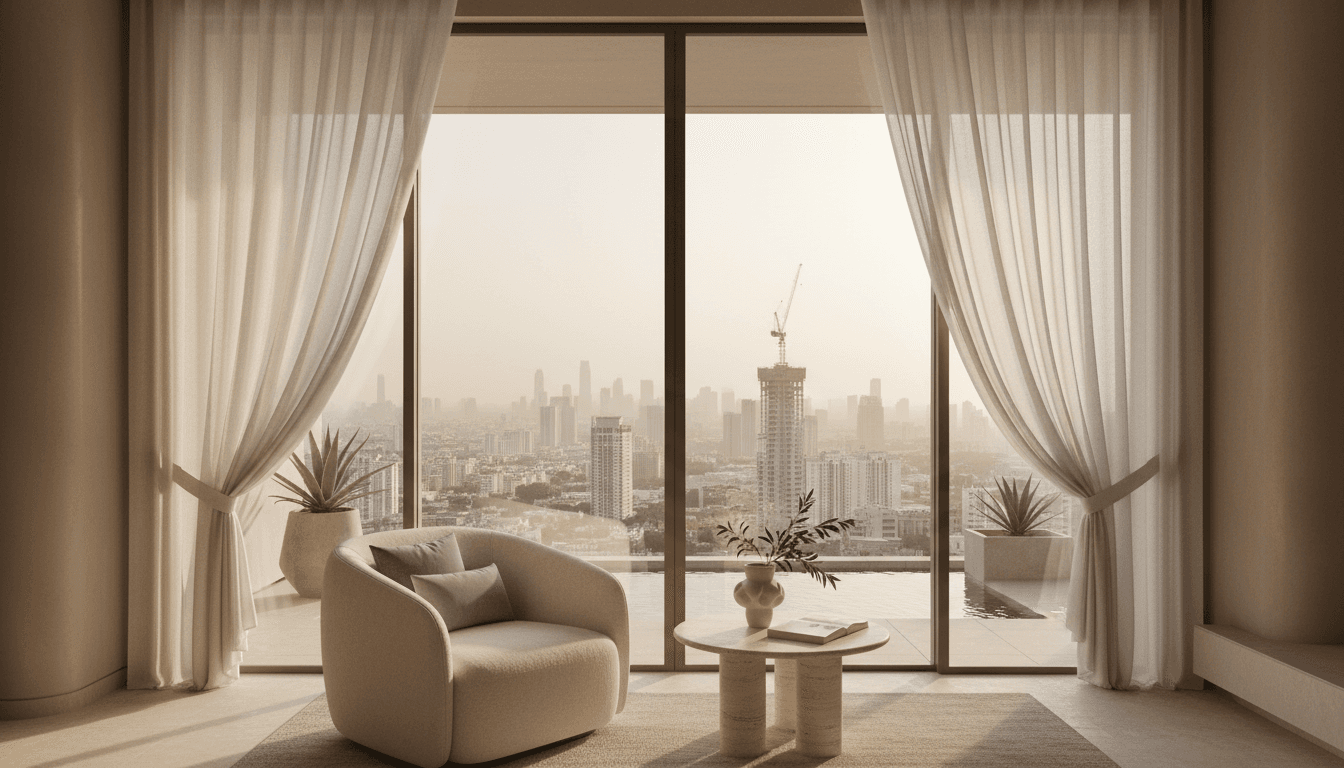
Calculating ROI on Dubai Rental Upgrades
As a landlord in Dubai, you can't just follow trends. I'll show you how to calculate the precise ROI of minor property upgrades to genuinely increase your rental yield.
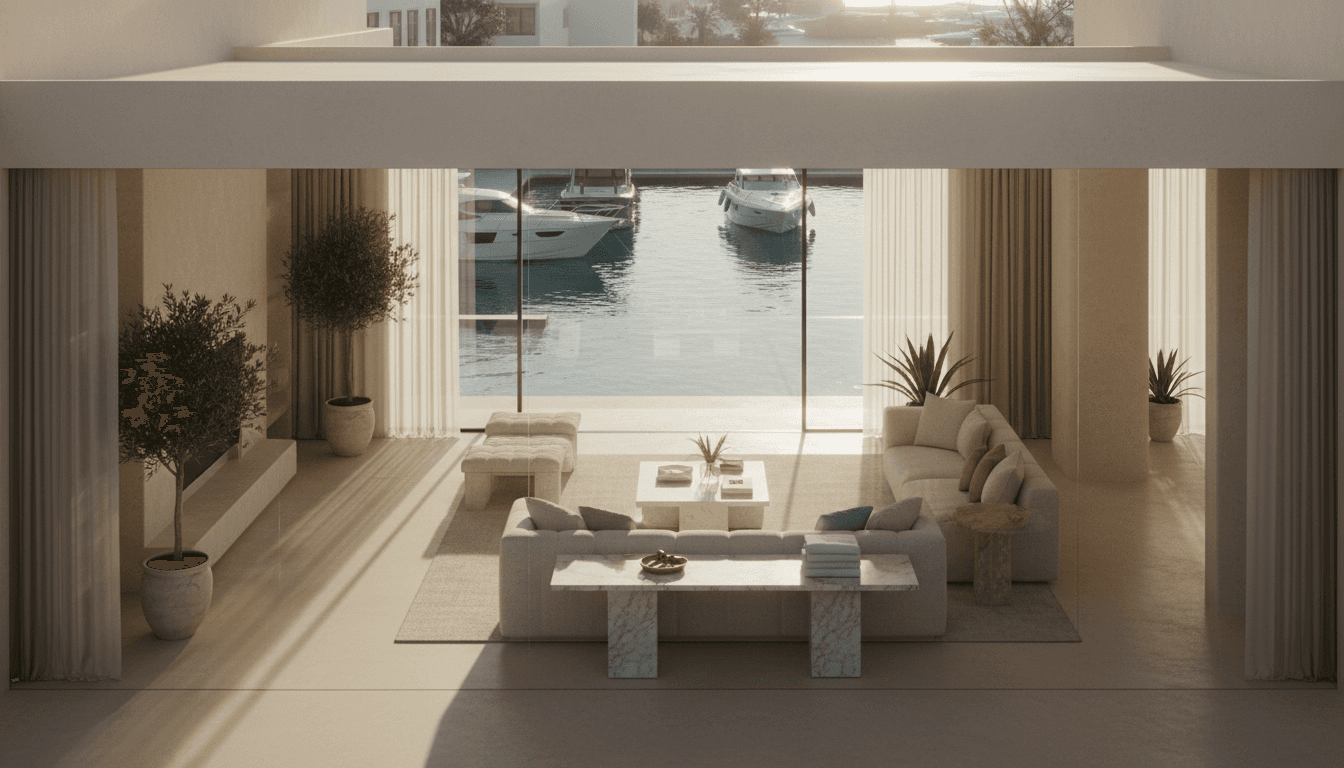
Off-Plan vs Ready: The Real Cost of Capital
I analyse the fundamental trade-off every Dubai investor faces: the lure of off-plan capital growth versus the security of immediate rental income from a ready property.
Beyond the Gates: Dubai's Boutique Villa Sanctuaries
I'm exploring the small, exclusive villa communities that offer a real sense of place, moving beyond the well-trodden path of Dubai's famous megaprojects to find homes with genuine character.
Echoes, in your inbox
One thoughtful email a month. Market insight, new launches, no spam.