

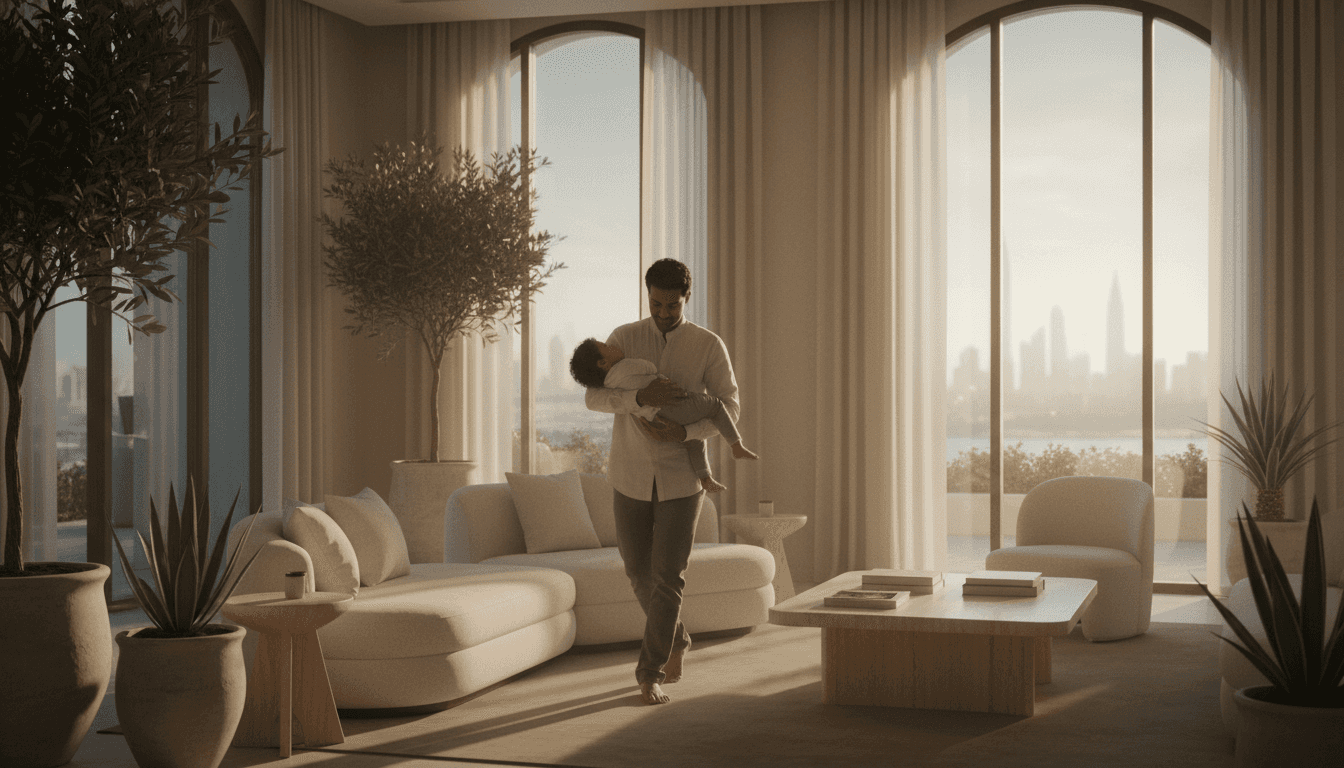
The Art of Silence: Dubai's Quietest Neighbourhoods
It’s the ultimate Dubai paradox: craving the city’s energy while seeking a peaceful home. As a lifestyle specialist, I'll guide you through the city’s genuinely quiet areas and what it takes to secure your sanctuary.

It’s the ultimate Dubai paradox: craving the city’s energy while seeking a peaceful home. As a lifestyle specialist, I'll guide you through the city’s genuinely quiet areas and what it takes to secure your sanctuary.
At Gaia Living, we're often tasked with finding the impossible. Clients want the dynamism, the world-class amenities, the sheer convenience of Dubai, but they also want to come home to silence. Here's how we approach this search for what I call 'structured tranquility'.
- The real meaning of 'quiet' in a global city like Dubai.
- The 'Sanctuary Spectrum': From leafy suburbs to insulated urban cores.
- Deep dives into Dubai's most serene communities and what they cost.
- The architectural and construction factors that create a peaceful home.
- A practical guide to vetting a property for noise pollution.
- The financial breakdown: Analysing the premium you pay for peace.
- My personal verdict on whether the investment in silence is worth it.
Redefining 'Quiet' in a 24/7 City
When clients ask for a quiet home in Dubai, my first question is always, "What does 'quiet' mean to you?" The definition is deeply personal. For some, it's the absence of traffic hum. For others, it's not hearing your neighbours through the walls. For a growing number, it's about being surrounded by the sounds of nature — birdsong, rustling leaves, flowing water, rather than the sounds of the city. In a metropolis that has grown at a dizzying pace, achieving this requires a deliberate and informed property search. It’s about seeking out pockets of intentional calm, areas master-planned for peaceful living Dubai homes.
True tranquility in Dubai isn’t found by accident. It is designed. It’s a feature engineered by visionary developers who understand that in the 21st century, silence is the ultimate luxury. This can manifest in several ways. The most obvious is physical distance. Sprawling villa communities with large plots and winding, tree-lined streets inherently diffuse sound. Think of the established layouts of The Meadows or the grander scale of Emirates Hills. Here, space itself is the primary sound buffer. The low density means fewer cars, fewer people, and a general sense of calm that's hard to replicate in a high-rise tower.
Then there's the acoustic engineering of modern buildings. This is where the search for tranquil urban living gets technical. It involves scrutinising the quality of construction. I'm talking about high-performance, double-glazed windows with a specific Sound Transmission Class (STC) rating, solid-core doors, and acoustic insulation within party walls. Developers at the premium end of the market, like Omniyat or Muraba, make this a key selling point. They understand that their clientele will pay a premium not just for a view, but for the guarantee that the sounds of Business Bay or the Palm Jumeirah stay outside when the door is closed. This is the new frontier of soundproof homes Dubai is beginning to champion.
Finally, there’s the psychological element of quiet, which is achieved through biophilic design — the integration of nature into the built environment. This is the magic of a community like Al Barari. It feels quiet not just because it’s low-density, but because the soundscape is dominated by nature. The rustle of leaves in its dense foliage, the trickle of water in its streams, the calls of birds in its gardens, these sounds actively mask the distant hum of the city and have a proven calming effect on the human nervous system. This is a far more sophisticated approach to quiet than simply being far away from a highway. It’s about creating a positive and serene auditory environment, a concept that is central to a serene property investment.
The Sanctuary Spectrum: Finding Your Place
 Featured project
Not all quiet is created equal. I like to think of Dubai’s peaceful areas as existing on a spectrum. At one end, you have the absolute, almost rural silence of ultra-low-density, nature-first communities. At the other, you have meticulously engineered apartments within vibrant urban districts that offer a silent refuge from the city at your doorstep. Understanding where you want to be on this spectrum is the first step to narrowing your search. Each point on the spectrum comes with its own lifestyle, price point, and set of trade-offs.
At the far end — what I call 'Total Immersion Sanctuaries', you find Al Barari. This community is, in my opinion, the gold standard for quiet living in Dubai. With over 60% of its area dedicated to landscaped gardens, lakes, and streams, the defining feature is its profound connection to nature. The density is incredibly low. You buy a villa or an apartment here because your primary goal is tranquility. The trade-off? You are more disconnected from the city's main arteries. A trip to DIFC or Dubai Marina is a conscious journey, not a quick jaunt. The price point is also at the pinnacle of the market, reflecting this unique proposition. Service charges are also higher, as they must cover the extensive maintenance of the botanical gardens and waterways that create this unique environment.
Moving slightly along the spectrum, we find 'Luxe Suburban Enclaves'. This category includes communities like the newer phases of Arabian Ranches by Emaar Properties and Sobha Hartland and Sobha Hartland II. These areas masterfully balance a peaceful, family-friendly suburban feel with excellent connectivity. Sobha Hartland, for instance, is remarkably close to Downtown Dubai, yet its focus on green space and, in Hartland II, the expansive lagoons, creates a sense of being a world away. The villas and townhouses are set on quieter residential streets, while the apartment buildings are generally low to mid-rise, reducing the feeling of overwhelming density. This is a popular choice for families and professionals who want a serene home base without sacrificing proximity to work and leisure hubs.
Finally, we have 'Engineered Urban Retreats'. This is where the concept of soundproof homes Dubai truly comes into play. These are individual buildings or small clusters of towers in otherwise bustling areas, designed from the ground up for acoustic privacy. Think of the Muraba Residences on the Palm Jumeirah or select towers in Bluewaters Island. Here, tranquility is not achieved through distance but through superior engineering: floor-to-ceiling glass that blocks out noise, advanced insulation, and layouts that ensure minimal sound transfer between units. The appeal is obvious: you can live in the heart of the action, with restaurants and attractions at your doorstep, but your home remains a silent sanctuary. This is a serene property investment for those who refuse to compromise on either lifestyle or peace.
Deep Dive: Al Barari, The Gold Standard
When a client's primary, non-negotiable requirement is peace, my mind immediately goes to Al Barari. It's more than a residential community; it's a statement. Located off Sheikh Mohammed Bin Zayed Road (E311), its name translates to 'the wilderness', and it lives up to it. The developer had a singular vision: to create a botanical haven in the desert. Driving into Al Barari feels like entering another ecosystem. The air cools slightly, the urban hum fades, and the dominant visual is green. This isn't the manicured, golf-course green of other communities; it's a dense, layered, and slightly wilder form of landscaping that genuinely feels like a forest.
What makes it so quiet? First, the numbers. The community is vast, but the built-up area is deliberately small. This extreme low density is the foundational element of its tranquility. There are simply fewer people, fewer cars, and more space between homes. The villas, such as The Residences and The Nest, are set on large plots, often backing onto waterways or thick gardens, providing natural privacy and sound absorption. Even the apartment buildings — Seventh Heaven and Ashjar, are designed to feel integrated with the landscape. The Ashjar collection, for example, is a series of low-rise buildings broken into small clusters, designed to feel like 'trees in the forest', ensuring no single block feels imposing or dense.
The lifestyle here is unique and self-contained. Residents have access to The Farm, a beautiful restaurant set amidst the gardens, and a state-of-the-art health club, Body Language. There's a sense that you don't need to leave the community for your daily wellness and relaxation. This creates a very different pattern of life compared to more connected neighbourhoods. It’s a destination in itself. This, however, is also its primary consideration. If your life revolves around constant meetings in DIFC or social events in the Marina, the commute can become a factor. It is for those who have prioritised home life and tranquility above all else.
Financially, this level of peace commands a significant premium. A 2-bedroom apartment in Al Barari might start around AED 4.5 to 5.5 million, while villas can easily range from AED 15 million to over AED 50 million. The rental market is equally robust, attracting high-net-worth individuals seeking privacy. Service charges are also at the higher end of the Dubai market, typically ranging from AED 25 to 35 per square foot for apartments. This is not just a fee; it's an investment in the upkeep of the very ecosystem you're paying to live in — the maintenance of the waterways, the care of the thousands of plants, and the security that preserves the enclave's exclusivity. It’s a clear example of paying for a lifestyle, not just square footage.
Deep Dive: Sobha Hartland II, The New Contender
For those who find Al Barari a bit too remote or its price point too steep, Sobha Hartland and Sobha Hartland II presents a compelling alternative. Located in Meydan, just a stone's throw from Downtown Dubai, it offers a remarkable blend of tranquility and urban accessibility. I've been watching the Sobha Hartland development closely since its inception, and the developer, Sobha, has shown a deep commitment to creating a quality living environment. Their backward-integration model, where they control everything from design to construction materials, allows for a level of quality control that is evident in the final product.
What makes Sobha Hartland II particularly interesting in the context of quiet residential areas is its masterplan, which is centred around a series of swimmable blue lagoons. Water is a powerful tool for creating a sense of calm. The visual of the clear blue water, combined with the soft sounds of the beachfront, creates a resort-like atmosphere in the middle of the city. The developer has dedicated a significant portion of the land to green spaces, parks, and tree-lined walkways. The layout is designed to feel open and spacious, a stark contrast to the dense verticality of nearby Business Bay.
This community offers a wider range of properties than Al Barari, from high-end apartments to spacious townhouses and expansive villas. This makes it accessible to a broader audience of buyers seeking peaceful living Dubai homes. The villas, especially, are designed with privacy in mind, many with enclosed gardens and pools. The apartment buildings are strategically placed to maximise views over the lagoons and parklands, rather than staring directly into a neighbour's window. This thoughtful site planning is crucial for creating a sense of peace in a multi-building development.
“The most overlooked element of a quiet home isn't the thickness of the walls; it's the intelligence of the masterplan. A community that directs traffic away from homes and buffers residences with green space is quiet by design, not by chance.”
The value proposition here is strong. You get a serene, green, and water-focused lifestyle with the Burj Khalifa visible in the distance. You can be at the Dubai Mall in 10-15 minutes. This combination is rare and highly sought after. Prices for a 1-bedroom apartment might start in the region of AED 1.5 to 2 million, with 5-bedroom villas fetching upwards of AED 20 million. It represents a middle ground on the Sanctuary Spectrum — more connected than Al Barari but significantly more tranquil than living in Downtown itself. It’s a serene property investment for the modern professional or family who wants to have their cake and eat it too.
The Architecture of Silence: What to Look For
Beyond the neighbourhood, the physical structure of your home is the last line of defence against unwanted noise. As an agent, I've learned to look past the fancy finishes and assess the bones of a building for its acoustic properties. Securing a truly quiet residence involves a bit of detective work. There are specific architectural and construction features that contribute to a peaceful indoor environment, and knowing what to look for can make all the difference.
First and foremost is the quality of the glazing. Windows are the weakest point for sound entry. The gold standard is double or even triple glazing with a laminated glass layer and an air or argon gas gap between the panes. You should ask about the STC (Sound Transmission Class) rating of the windows. A standard window might have an STC of 26-28, while high-performance acoustic windows can have ratings of 40 or higher. This difference is not trivial; it's the difference between hearing every car that passes and hearing almost nothing. Also, check the seals around the windows and balcony doors. Even the best glass is useless if the frames are poorly sealed.
Next, consider the walls and floors. In apartments, the 'party walls' shared with neighbours are critical. A solid concrete block wall is inherently better at blocking sound than a simple drywall partition. Top-tier developers often use multiple layers of acoustic-grade plasterboard with an insulating layer in between. When viewing a property, you can sometimes get a sense of this by knocking on the wall — a solid, dull thud is a good sign. For floors, look for buildings constructed with thick concrete slabs and an acoustic underlay beneath the final flooring. This is especially important for mitigating impact noise, like footsteps or dropped objects from the apartment above.
Here’s a practical checklist you can use when viewing a potential property:
- Windows & Doors: Are they double-glazed? Ask for the STC rating if possible. Are the seals tight? Are the internal doors solid-core or hollow? Solid doors help isolate sound between rooms.
- Wall Construction: Ask the agent or developer about the construction of the party walls. Is it solid blockwork or a stud wall? If it's a new build, this information should be in the technical specifications.
- HVAC System: Turn on the air conditioning. Is the internal unit loud? A constant, low-frequency hum from a cheap AC unit can be just as disruptive as external noise. High-end systems are designed for near-silent operation.
- Location Within the Building: An apartment that doesn't face the main road will be quieter. A unit away from the lifts, rubbish chutes, and building amenities (like the gym or pool pump room) will have fewer sources of internal noise pollution.
- Visit at Different Times: This is my most important piece of advice. Visit the property on a weekday evening and during a weekend afternoon. This will give you a real sense of the ambient noise from traffic, neighbours, and local activity.
Vetting a Property for Noise: A Practical Guide
Beyond the physical inspection of the property itself, a comprehensive assessment of noise requires looking at the bigger picture. The soundscape of a neighbourhood is dynamic, influenced by factors that may not be immediately obvious during a 30-minute viewing. It's your responsibility as a buyer, and our duty at Gaia Living, to investigate these factors before you commit. A serene property investment is one that remains serene for years to come, not just on the day you visit.
First, master the map. Before you even visit, study the area on a satellite map. Identify potential noise sources. How close is the nearest major highway or interchange? Is the property under a primary flight path for Dubai International Airport (DXB) or Al Maktoum International Airport (DWC)? Check the Dubai Land Department's (DLD) public data or the Dubai Pulse portal for zoning information. Is the plot next to your potential villa zoned for commercial use or, even worse, future construction? The quiet park next door might be a temporary pleasure if it's slated to become a 40-storey tower in two years. We help our clients do this due diligence, looking at the Dubai Urban Master Plan 2040 to understand the long-term vision for a district.
Second, listen to the community. Spend time in the neighbourhood outside of your scheduled viewing. Go for a coffee at a local café, walk through the community park on a weekend. What do you hear? The laughter of children in a playground is a very different kind of 'noise' from the roar of supercars on a main road. Talk to people who already live there. Most residents are happy to share their honest experiences about the noise levels, the community management, and any recurring issues. This anecdotal evidence is invaluable and provides a layer of insight you won't find in a sales brochure.
Third, be aware of the invisible noise source: construction. Dubai is in a perpetual state of growth. That serene plot of empty sand next to your dream home might be the site of a major project next year. It is crucial to investigate the surrounding area for any upcoming off-plan launches. A good agent will be aware of the development pipeline in their area of specialisation. You can also check the websites of major developers like Emaar Properties, Nakheel, and Aldar for announcements. While you can't predict everything, you can significantly de-risk your investment by choosing a home in a more mature, largely completed community like The Meadows or in a masterplan where the construction phasing is clear and the heavy work is already finished.
The Price of Peace: A Cost Breakdown
The premium for tranquility is real, and it’s quantifiable. It's not just an abstract concept; it's reflected in the purchase price, the service charges, and the overall cost of ownership. Let's break down the tangible costs associated with securing a quiet home. Understanding these figures is essential for making an informed investment decision.
Let’s compare two hypothetical 3-bedroom apartments, both around 2,000 sq. Ft., to illustrate the premium for a quiet residential area. One is in a standard, high-density tower in a bustling area like JVC or Business Bay. The other is in a premium, low-density, quiet-focused community like Sobha Hartland.
Example Property A: Standard High-Density Tower - Purchase Price: AED 3,000,000 - Service Charge: AED 18 per sq. Ft. (AED 36,000 annually)
Example Property B: Premium Quiet Community (Sobha Hartland) - Purchase Price: AED 4,000,000 - Service Charge: AED 22 per sq. Ft. (AED 44,000 annually)
The 'Quiet Premium' on the purchase price here is AED 1,000,000, or 33%. This premium covers the developer's investment in a larger land plot per unit, extensive landscaping, superior master planning, and higher-quality construction materials designed to mitigate noise.
Now, let's look at the upfront transaction costs for Property B, based on official regulations from the Dubai Land Department (DLD).
Upfront Costs for a Quiet AED 4M Property: - Purchase Price: AED 4,000,000 - DLD Transfer Fee (4% of price): AED 160,000 - DLD Registration Fee: AED 4,200 (for properties > AED 500k) - Real Estate Agency Fee (2% of price): AED 80,000 - Mortgage Registration Fee (0.25% of loan): AED 8,000 (assuming an 80% loan of AED 3.2M) - Bank Processing & Valuation Fees: ~AED 10,000 (varies by bank) - No Objection Certificate (NOC) Fee: ~AED 1,000 - 5,000 (paid to developer) - Total Upfront Costs (approx.): AED 263,200
This doesn't include the mandatory down payment. For a resident expatriate, the Central Bank of the UAE mandates a minimum 20% down payment for a first property under AED 5 million. So, you would need an additional AED 800,000 in cash. In total, you're looking at over AED 1 million in liquid funds to secure this peaceful property. Is it worth it? That's a personal calculation of value versus cost.
Investing in a quiet home is not an expense; it's an investment in your quality of life. The financial premium you pay is for tangible assets: more green space, better construction, and intelligent design. In a world of increasing sensory overload, a peaceful home is a powerful asset that will always command demand and hold its value.
My Verdict: Is the Investment in Silence Worth It?
After years of walking clients through this exact decision, my answer is an unequivocal yes — with a caveat. The investment is worth it if, and only if, you have accurately identified what 'quiet' means to you and have chosen a property that delivers it without compromising the other essential aspects of your lifestyle.
In my experience, buyers who stretch their budget to secure a home in a genuinely tranquil community never regret it. The daily dividend paid in mental clarity, better sleep, and reduced stress is immeasurable. These homes become true sanctuaries, places to recharge from the high-energy pace of professional life in Dubai. On top of that, from a pure investment perspective, properties in well-managed, low-density, green communities have shown remarkable resilience. They attract a discerning tenant base and consistently command strong resale values. The demand for peaceful living Dubai homes is not a trend; it's a fundamental shift in buyer priorities.
However, the mistake I see some make is pursuing silence at all costs. Buying in a location that is profoundly quiet but adds an hour to your daily commute can simply trade one form of stress for another. This is why a nuanced approach, understanding the 'Sanctuary Spectrum', is so important. For many, the sweet spot isn't the absolute silence of a remote villa but the engineered peace of a well-built apartment in a location like Sobha Hartland or a townhouse in a community like Arabian Ranches, where tranquility and connectivity coexist.
Ultimately, finding your quiet place in this vibrant city is one of the most rewarding journeys in Dubai real estate. It requires research, diligence, and an honest self-assessment of your priorities. It’s about looking beyond the square footage and the marble countertops to evaluate the intangible — the feeling you get when you close the door and the world outside fades away. As your advisor, our goal at Gaia Living is to help you find not just a house, but a home that genuinely enhances your well-being. And in a city as dynamic as Dubai, there is no greater luxury than a pocket of peace to call your own.
Sources
- Dubai Land Department (DLD): https://dubailand.gov.ae/en/
- UAE Government Portal (Property Purchase Information): https://u.ae/en/information-and-services/housing/buying-and-renting-a-home
- Central Bank of the UAE (Mortgage Regulations): https://www.centralbank.ae/
Questions, answered
- What is the quietest residential area in Dubai?
- For ultimate tranquility, Al Barari is often considered Dubai's quietest area, known for its extreme low density, lush botanical gardens, and focus on nature. However, other serene options include Sobha Hartland II for its lagoon-centric living and The Meadows for established, peaceful villa communities.
- Are new Dubai apartments soundproof?
- Soundproofing quality varies significantly by developer and building age. Premium developers like Omniyat and Muraba often use high-spec acoustic insulation and double-glazing, but it's not a universal standard. It's crucial to inspect a property personally and ask the developer or agent about specific acoustic engineering details.
- Can I find a quiet home near Dubai's city centre?
- Yes, it's possible but requires careful selection. Communities like Sobha Hartland offer a surprisingly tranquil environment just minutes from Downtown Dubai, thanks to their masterplan design focused on green space and lagoons. Similarly, pockets of Jumeirah offer quiet villa living close to the coast and central areas.
- How much more does a 'quiet' property cost in Dubai?
- A premium for peace is definite and can range from 15-30% or more compared to a similar-sized property in a noisier, denser area. This premium pays for larger plots, extensive landscaping, high-quality construction (including soundproofing), and exclusive, low-traffic masterplans.
- Which developers are known for building quieter homes?
- Developers focused on the luxury and ultra-luxury market tend to prioritise quiet living. Emaar Properties is known for well-planned villa communities like Arabian Ranches. Al Barari's developer is synonymous with tranquility, while newer players like Sobha are making a name for themselves with projects like Sobha Hartland and Sobha Sanctuary.
- What are the key factors that make a Dubai community quiet?
- The main factors are low population density (fewer homes per square kilometre), extensive green space that absorbs sound, a masterplan that minimises through-traffic, and high-quality construction with good acoustic insulation. Distance from major highways, flight paths, and construction zones is also critical.

Yusuf writes about how Dubai actually lives — waterfront mornings, community dining, walkability, and the lifestyle premium built into an address.
Related stories
Dubai Off-Plan: The Due Diligence Beyond the SPA
Signing the Sales and Purchase Agreement for a Dubai off-plan property is a milestone, not the finish line. True investor security comes from rigorous pre-purchase legal checks that look far beyond the contract's pages.

A Buyer's Guide to Community Management in Dubai
When you buy property in Dubai, you're also buying into a community with its own rules and costs. This guide demystifies Owners Associations, service charges, and your rights and responsibilities as a homeowner.
Dubai Apartments: Tower vs. Community—Which Holds More Value?
Choosing between a standalone apartment tower and a master-planned community is a core decision for any Dubai buyer. I'll break down the real-world differences in lifestyle, costs, and long-term value to help you decide.
Echoes, in your inbox
One thoughtful email a month. Market insight, new launches, no spam.