

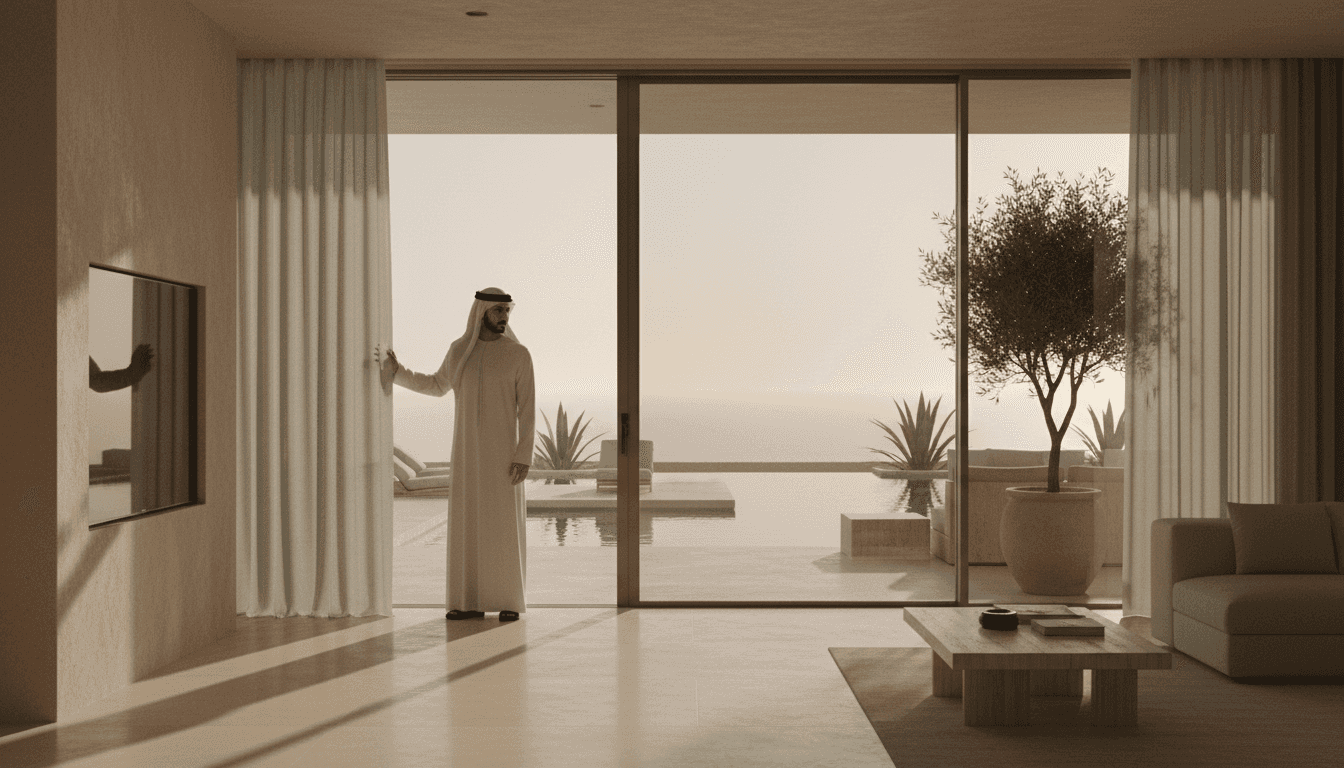
The Art of Hosting: Dubai's Ultimate Homes
More than just space, a true entertainer's home is a carefully choreographed experience. I'll explore the architectural features and communities that define the art of hospitality in Dubai real estate.

In my years navigating Dubai's property landscape, I've seen countless beautiful houses. But I've learned that a beautiful house isn't automatically a great home for hosting. The art of entertaining is written in the architecture itself — in the flow of a floor plan, the generosity of a kitchen, and the quiet dignity of a guest suite. It’s a quality that transcends square footage.
Here’s what we’ll explore:
- The philosophy behind a true entertainer's home
- Key architectural features: flow, zones, and privacy
- The heart of the home: the role of gourmet kitchens
- Indoor-outdoor living: mastering Dubai's climate
- Guest comfort: the non-negotiable guest suite
- Spotlight on communities designed for hosting
- The real cost of an entertainer's home: a budget breakdown
- My final verdict on investing in a host-friendly property
The Soul of a Host's Home
What makes a property an entertainer's paradise? It's a question we at Gaia Living are asked frequently, and the answer is more nuanced than simply 'a big villa'. I have walked through 15,000-square-foot mansions that felt cold and disjointed, where guests would feel lost and disconnected. Conversely, I’ve been in 2,500-square-foot apartments that hummed with social energy, where every corner was designed to bring people together. The soul of a host's home lies not in its size, but in its intention. It's about designing a space that anticipates the needs of both the host and the guest, creating an environment of effortless comfort and connection.
In Dubai, this concept takes on a unique significance. For many of us, our friends are our chosen family. We've come from all corners of the globe, and our social lives are built within the walls of our homes. Holiday celebrations, weekend barbecues, impromptu dinners — these are the rituals that bind our communities together. A home that supports this lifestyle isn't a luxury; it's a fundamental part of a fulfilling life here. This is why the demand for `hosting friendly residences Dubai` has become such a defining feature of the modern property search. It’s a search for a home that can hold the life you want to live.
The philosophy of a true entertainer's home is rooted in empathy. It asks: Where will my guests put their coats and bags? Is there a clear, welcoming path from the entrance to the main social area? Can I prepare a meal while still being part of the conversation? Is there a quieter space for someone who wants a moment away from the main group? Can my overnight guests retreat to a space that feels like a private sanctuary, not an afterthought? When a floor plan answers these questions intuitively, you have found a space with the grammar of good hospitality. It's a home that works for you, allowing you to be a gracious, present host rather than a frantic, behind-the-scenes coordinator.
This intentional design is what separates a mere building from an `entertainer's paradise Dubai properties` are often marketed as. It’s the difference between a sprawling living room that feels like a hotel lobby and a zoned space that encourages intimate conversation. It’s the distinction between a kitchen hidden away in the back of the house and one that serves as the vibrant, beating heart of the gathering. As we look at the specific architectural elements, remember this core idea: great hosting isn't about showing off your home, it's about sharing it in a way that makes everyone feel completely at ease. That is the true art form.
Architecture of Connection: Flow, Zones, and Privacy
 Featured project
The most successful homes for entertaining guests are choreographed spaces, where the architecture guides movement and mood. The first and most critical element is flow. When you enter, the path to the primary social space should be immediate and obvious. I've seen far too many villas in older communities where you enter into a confusing warren of small, formal rooms. Guests are left hovering awkwardly, unsure of where to go. A great entertainer’s home, by contrast, often features a generous foyer that opens up, drawing you towards the light and the sounds of the gathering. A direct line of sight from the front door through to the main living area or even to the garden beyond creates an instant sense of welcome and openness.
Within the main social area, zoning is key. A single, cavernous room is rarely comfortable. The best `spacious living areas Dubai homes` offer are actually a collection of interconnected zones. Think of it as creating multiple destinations within one space. You need a primary seating area for the main group, perhaps a smaller, more intimate cluster of armchairs for quieter conversations, and a clear, uncluttered dining area that feels distinct yet connected. Developers like Emaar Properties have mastered this in their villa communities, such as in Arabian Ranches. Their floor plans often use subtle architectural cues — a slight change in ceiling height, a wide archway, or a feature wall, to delineate these zones without closing them off. This allows a party to feel cohesive while accommodating different energy levels and social dynamics.
Privacy is the third, and often overlooked, pillar of entertaining architecture. This applies on two levels: privacy for the hosts and privacy for the guests. For the hosts, this means having a clear separation between the 'front of house' social areas and the 'back of house' private family spaces. A well-designed floor plan ensures that a guest doesn't need to walk past your children's messy bedrooms to find the powder room. The powder room itself should be conveniently located off the main foyer or living area, not tucked away in a private corridor. This separation allows the family to live in the house without feeling constantly 'on display' and allows the hosts to retreat when needed. For overnight guests, privacy is paramount, which we will explore further, but even for an evening, the design should respect personal space.
Finally, consider the service flow. How does catering or a delivery arrive? Is there a service entrance that leads directly to the kitchen, or must delivery drivers troop through your main living room? In larger villas, a secondary 'wet' kitchen or a well-equipped pantry, hidden from the main entertaining kitchen, is a mark of truly thoughtful design. This allows for the mess of serious cooking or the logistics of a catered event to happen out of sight, preserving the calm and elegance of the main social space. It’s these practical, behind-the-scenes details that separate the amateur from the professional in home design. A property that understands this service flow is one that is genuinely built for high-level, stress-free hosting.
The Heart of the Home: The Role of Gourmet Kitchens
Years ago, the kitchen was a purely functional space, hidden away from guests. Today, it is the undisputed heart of the modern home, especially one designed for entertaining. The rise of the open-plan layout has transformed the kitchen into a social stage. I believe a home's capacity for hosting can be judged almost entirely by the design and quality of its kitchen. It's no longer just a place to cook; it's where conversations start, where drinks are poured, and where the energy of a gathering is centered. When clients search for `gourmet kitchens Dubai real estate`, they are searching for this new social hub.
“The kitchen island has become the new campfire — the central point around which we gather for warmth, nourishment, and connection.”
The single most important feature in an entertainer's kitchen is the island. It acts as a crucial buffer, a demarcation line that allows guests to be near the action without getting in the cook's way. It serves as a natural buffet for canapés and drinks, a perch for friends to sit and chat, and a functional workspace. A poorly designed kitchen might be large, but if it lacks an island or a peninsula, it fails the primary test of social cooking. Top-tier developers understand this implicitly. Look at the penthouses by Omniyat or the larger villas in communities like Al Barari; their kitchens are conceived as social furniture, with huge, sculptural islands often crafted from single slabs of marble, designed to be seen and used.
The quality of appliances and finishes is another critical factor. A true gourmet kitchen is equipped for performance. This means integrated, high-end appliances from brands like Miele, Gaggenau, or Siemens. It means double ovens, a five-burner gas hob (a feature passionate cooks actively seek out), a powerful but quiet extraction hood, and a wine fridge. Storage is also paramount. A walk-in pantry or, at the very least, an abundance of full-height cabinetry is non-negotiable. It allows the visible countertops to remain uncluttered and serene, even when you're preparing for twenty guests. The choice of materials — durable quartz or granite countertops, resilient cabinetry, and easy-to-clean backsplashes, all contribute to a kitchen that is not just beautiful but also a practical workhorse.
Beyond the hardware, the layout determines its success. The classic 'kitchen triangle' — the logical flow between the sink, the refrigerator, and the cooker, is still relevant, but in a large, open-plan kitchen, it evolves. We now think in terms of work zones. There should be a 'prep zone' with clear counter space and easy access to the sink and bins; a 'cooking zone' centered around the hob and ovens; and a 'service zone', often the island, for plating and interacting with guests. When this ergonomic mapping is done correctly, the host can move fluidly and efficiently, making the act of cooking look effortless. This smooth functionality is the hidden genius behind the best `gourmet kitchens Dubai real estate` has to offer. It transforms hosting from a stressful chore into a joyful performance.
Mastering the Climate: The Art of Indoor-Outdoor Living
In Dubai, for at least six to seven months of the year, our gardens, terraces, and balconies are our most valuable living spaces. A home designed for elegant entertaining must master the transition between indoors and out. This is about more than just having a set of French doors; it's a deliberate architectural strategy to merge two environments into one cohesive entertaining area. The most successful `hosting friendly residences Dubai` are those that erase the boundary between the living room and the terrace, creating a single, expansive social arena. This smooth flow dramatically increases your usable space and allows for larger, more dynamic gatherings where guests can move freely between the comfort of the indoors and the pleasure of the open air.
This is achieved primarily through the use of floor-to-ceiling sliding or bi-fold glass doors. When fully retracted, they should virtually disappear, leaving a wide, unobstructed opening. The effect is transformative. A key detail I always look for is a flush threshold — where the indoor and outdoor flooring are at the same level. A raised step, even a small one, breaks the flow, both visually and physically. It’s a trip hazard and a subtle psychological barrier. Premium developers like Nakheel on Palm Jumeirah or Meraas on Bluewaters Island pay close attention to this detail in their luxury villas and apartments, ensuring the tile or decking outside continues the visual line from the interior flooring, creating a unified canvas for your event.
Of course, a beautiful terrace is useless if it's not designed for the Dubai climate. Thoughtful shade is essential. This can come from a deep roof overhang, a permanent pergola, or a high-quality retractable awning. This provides a comfortable, shaded zone for daytime use even on the fringes of the hotter months. An outdoor kitchen or a dedicated barbecue area with its own counter space and sink elevates the space from a simple patio to a true outdoor living room. Add in ceiling fans for air circulation, integrated outdoor speakers for music, and layered lighting for evening ambiance, and you have a space that is usable and inviting day or night. The garden villas in Jumeirah and Umm Suqeim are classic examples, often featuring mature gardens that provide natural shade and a sense of established tranquility.
In apartments, the same principles apply, but the terrace or balcony becomes even more critical. A generous, usable terrace can double the living space of a two-bedroom apartment. I’ve seen spectacular gatherings hosted on the terraces of apartments in Dubai Marina and Emaar Beachfront, with the dazzling skyline as the backdrop. Key features to look for are power outlets, water taps (for plants and cleaning), and solid privacy screens between you and your neighbours. The size and shape matter — a long, narrow balcony is far less useful than a deeper, squarer terrace that can comfortably accommodate an outdoor dining table or lounge seating. When viewing apartments, I always advise clients to spend as much time assessing the outdoor space as they do the interior. For anyone who loves to host, it's not an accessory; it's a primary room.
The Sanctum: Designing the Perfect Guest Suite
For those of us with family and friends living abroad, a spare bedroom is not enough. True hospitality requires providing a private, comfortable, and self-sufficient space for our guests. This is the essence of the dedicated guest suite, a non-negotiable feature in any serious entertainer’s home. The search for `luxury properties with guest suites Dubai` is a search for a home that can welcome loved ones for extended stays without disrupting the household's daily rhythm. A well-designed guest suite functions almost like a luxury hotel room within your own home, offering your visitors a genuine sanctuary.
What elevates a bedroom into a suite? Several key elements. First and foremost is an ensuite bathroom. It is the absolute minimum requirement. Guests should never have to cross a public hallway in a towel to use a shared family bathroom. The ideal ensuite is well-appointed, with a quality walk-in shower, good lighting, and ample vanity space. Second is privacy, which is achieved through location. The best guest suites are positioned away from the main family bedrooms and noisy living areas. In a villa, a ground-floor guest suite is a fantastic solution. It's accessible, separate from the upstairs family quarters, and often has its own view or access to the garden. In larger homes, a completely detached 'guest house' or 'majlis' with its own entrance represents the pinnacle of guest accommodation.
Beyond the basics, thoughtful details make all the difference. Ample storage in the form of built-in wardrobes is essential so guests can fully unpack and feel settled, rather than living out of a suitcase. A small desk or seating area provides a private space for them to work, read, or simply have a quiet moment. Other considerations I point out to clients include: blackout blinds or heavy curtains for a restful sleep, plenty of accessible power outlets for charging devices, and good Wi-Fi coverage. Some of the most luxurious guest suites I've seen in communities like Emirates Hills or on Jumeirah Bay even include a small kitchenette with a coffee machine and a mini-fridge, giving guests complete autonomy for their morning coffee or a late-night snack.
This level of comfort and independence benefits the host as much as the guest. It removes the pressure of having to constantly attend to your visitors' needs. You can go about your day knowing they have everything they require. This is particularly important for longer stays. When your parents or overseas friends visit for several weeks, this separation of space is what keeps the relationship harmonious and the visit a pleasure for everyone. When evaluating a property, I urge buyers to literally put themselves in their future guest's shoes. Walk the path from the front door to the guest room. Spend five minutes sitting in the room. Does it feel like a welcoming retreat or a forgotten corner? The answer will tell you a great deal about the home's true capacity for hospitality.
Spotlight on Hosting Havens
Certain communities in Dubai are intrinsically designed for a lifestyle of entertaining. Their master plans, property types, and resident demographic all align to create environments where hosting is the norm. For those seeking the classic villa lifestyle with gardens perfect for large gatherings, Arabian Ranches remains a benchmark. The original Ranches, with its mature landscaping and spacious, traditional layouts, offers a sense of established community. The newer phases, and its sister community Arabian Ranches III, feature more contemporary open-plan designs, but the ethos is the same: family-centric living with plenty of space for indoor-outdoor entertaining.
For those who demand ultimate luxury and privacy, Al Barari is in a league of its own. It's less a suburb and more a botanical reserve. The villas here are not just homes; they are private resorts, set within lush, themed gardens with their own lakes and waterways. The defining feature is the sheer integration with nature. Floor-to-ceiling glass walls disappear to merge vast living spaces with sprawling terraces and private pools. The plot sizes are generous, ensuring total privacy from neighbours. Hosting a party in Al Barari is an immersive experience, a world away from the city's buzz. The kitchens are invariably state-of-the-art, and guest suites are palatial. Of course, this comes at a significant price premium, but for a certain calibre of buyer, it's a price worth paying for an unparalleled lifestyle.
If your vision of entertaining involves dazzling skyline views and a more urban energy, then waterfront apartment communities are where you should focus your search. Bluewaters Island by Meraas is a prime example. The apartments are known for their exceptionally large terraces, which act as genuine outdoor rooms. The views over the sea, JBR, and the Ain Dubai are simply breathtaking, providing an instant 'wow' factor for any event. Similarly, the residences on Palm Jumeirah offer iconic views and access to a world-class beach lifestyle. Penthouses here are the ultimate `entertainer's paradise Dubai properties`, often featuring private rooftop pools and expansive terraces capable of hosting major events. Communities like Emaar Beachfront combine the beach club vibe with sleek, modern apartments, all designed to maximize sea views and provide generous balcony spaces for soaking it all in.
We shouldn't overlook the importance of community amenities in supporting a host's lifestyle. Even if your own space is slightly more modest, living in a community with excellent shared facilities can be a game-changer. For example, many Emaar and Nakheel communities feature high-quality community pools with barbecue stations and bookable event spaces. These are perfect for hosting larger children's birthday parties or casual community get-togethers that might overwhelm your own home. When evaluating a community, I always advise clients to look beyond the four walls of the property and consider the entire ecosystem. A great community park, a local coffee shop for morning catch-ups, or a walkable promenade for after-dinner strolls all contribute to a richer, more connected, and more hospitable life.
The Real Cost of an Entertainer's Home
Acquiring a home that truly excels at hosting is a significant investment, and it’s crucial to understand the full financial picture beyond the headline price. Let's break down the real costs associated with purchasing a secondary-market entertainer's villa, which is a common scenario for buyers looking for established communities and larger plots. We'll use a hypothetical but realistic example of a 5-bedroom villa in a desirable community like Arabian Ranches or Meadows with a purchase price of AED 8,000,000.
The upfront costs are substantial and must be factored into your budget from day one. These are the mandatory fees payable at the time of transfer, regulated primarily by the Dubai Land Department (DLD). Here’s a typical line-by-line breakdown:
- Purchase Price: AED 8,000,000
- DLD Transfer Fee (4% of purchase price): AED 320,000
- Trustee Office Fee: AED 4,200 (This is a fixed fee for properties over AED 500k)
- Agency Fee (2% of purchase price): AED 160,000
- VAT on Agency Fee (5% of fee): AED 8,000
- Developer No Objection Certificate (NOC) Fee: AED 500 - AED 5,000 (Varies by developer; let's budget AED 1,500)
- Total Upfront Costs (excluding property price): AED 493,700
So, to acquire this AED 8 million villa, you need to have nearly AED 8.5 million in liquid funds if you are a cash buyer. If you are financing the purchase, the picture changes. According to Central Bank of the UAE regulations, a non-UAE national buying a property over AED 5 million must provide a minimum down payment of 35%. In this case, that would be AED 2,800,000. You would also need to pay a mortgage registration fee to the DLD, which is 0.25% of the loan amount. If your loan is AED 5,200,000 (8M - 2.8M), the registration fee would be AED 13,000. Your total immediate cash outlay for a mortgaged purchase would be the down payment plus all the upfront fees: AED 2,800,000 + AED 493,700 + AED 13,000 = AED 3,306,700.
Beyond the purchase, you must account for ongoing running costs, primarily service charges. These charges cover the maintenance of all common areas in the community — landscaping, security, pools, parks, and roads. For villas, service charges are calculated based on the plot size, not the built-up area (BUA). This is a critical distinction. A villa with a small BUA on a huge plot can have higher service charges than a larger villa on a smaller plot. For premium villa communities, you can expect annual service charges to range from AED 3 to AED 6 per square foot of the plot area. If our AED 8M villa sits on an 8,000 sq ft plot, at a rate of AED 4/sq ft, the annual service charge would be AED 32,000. This is a significant, recurring cost that must be part of your financial planning.
A home designed for entertaining is an investment in a lifestyle, but it demands rigorous financial planning. The sticker price is only the beginning. Understanding the full spectrum of costs — from DLD fees and down payments to recurring service charges, is the first step to making a sustainable and joyful investment in your social life.
My Verdict: An Investment in Connection
After years of observing how people live in this city, my perspective is clear: investing in a home designed for hospitality is one of the most rewarding decisions you can make in Dubai. It’s an investment not just in an asset, but in your quality of life, your friendships, and your sense of belonging. In a transient city, the connections we forge are our anchor. A home that nurtures these connections is, in my view, invaluable. The architectural elements we've discussed — the smooth flow, the social kitchen, the private guest suite, the indoor-outdoor harmony, are not frivolous luxuries. They are the essential tools for building a rich and fulfilling social life.
Of course, this doesn't mean everyone needs a sprawling villa in Al Barari. The principles of good hospitality design are scalable. They can be found in a well-laid-out townhouse in JVC, a duplex with a generous terrace in Dubai Marina, or a three-bedroom apartment with an open-plan living area in Creek Harbour. The key is to be intentional in your search. Look past the glossy finishes and ask yourself: how would this home feel with twenty people inside? Where would my parents stay for a month? Can I cook and still be part of the party? Prioritising these questions will lead you to a space that genuinely supports your lifestyle.
From a financial perspective, properties that excel at hosting often hold their value exceptionally well. Their thoughtful layouts, larger plots or terraces, and desirable features like proper guest suites make them perpetually in demand, both for sale and for rent. They appeal to a broad segment of the market — families, senior professionals, and anyone who values a vibrant social life. While the initial investment might be higher, the long-term desirability and utility often justify the premium. When it comes time to sell, these are the homes that stand out from the cookie-cutter inventory, commanding attention and strong offers.
Ultimately, the 'art of hosting' is about generosity. It’s about creating a space where people feel welcomed, cherished, and comfortable. A home that allows you to do that with ease and grace is more than just a collection of rooms; it is a platform for creating memories. It is the backdrop to the story of your life in Dubai. And finding the right backdrop is what we at Gaia Living specialise in. It’s a privilege to help our clients find not just a house, but a home that will be filled with laughter, conversation, and connection for years to come.
Sources
- Dubai Land Department (DLD): dubailand.gov.ae
- Central Bank of the UAE (CBUAE): centralbank.ae
- UAE Government Portal: u.ae
Questions, answered
- What are the key features of a home built for entertaining in Dubai?
- The best homes for hosting feature open-plan layouts with distinct zones for socialising, dining, and relaxing. Key elements include a gourmet kitchen with an island, smooth indoor-outdoor flow to a terrace or garden, and a private, well-appointed guest suite with an ensuite bathroom.
- Which Dubai communities are best for finding entertainer-style homes?
- For villas, communities like Arabian Ranches, Emirates Hills, and Al Barari are renowned for their spacious layouts and gardens. For apartments, look to Bluewaters Island, Palm Jumeirah, and Emaar Beachfront for large terraces and stunning views perfect for hosting.
- What is the typical size of a guest suite in a Dubai luxury property?
- In luxury properties, a proper guest suite is more than just a spare bedroom. It's typically a spacious room of at least 20-25 square metres with a dedicated ensuite bathroom, built-in wardrobes, and sometimes a small private balcony or seating area.
- Are gourmet kitchens a standard feature in new Dubai developments?
- In the luxury segment, yes. Developers like Emaar, Omniyat, and Sobha often partner with high-end European brands for appliances and cabinetry. Features like large kitchen islands, integrated appliances, and durable countertops are becoming standard in premium apartments and villas.
- How much should I budget for service charges on an entertainer's villa?
- Service charges for villas are based on the plot area, not just the built-up area. In prime communities, expect to pay between AED 3 and AED 6 per square foot of your total plot size annually. A 6,000 sq ft plot could therefore incur annual service charges of AED 18,000 to AED 36,000.
- What are the main upfront costs when buying a property in Dubai?
- Beyond the property price, you must budget for the Dubai Land Department (DLD) transfer fee of 4% of the sale price, a trustee office fee of around AED 4,200, a 2% agency fee plus 5% VAT, and any applicable mortgage registration fees. For a secondary market purchase, you also need an NOC from the developer, which costs between AED 500 and AED 5,000.

Yusuf writes about how Dubai actually lives — waterfront mornings, community dining, walkability, and the lifestyle premium built into an address.
Related stories
Dubai Branded Residences: A Net Yield Reality Check
Branded residences command a significant price premium in Dubai, but do their rental returns actually justify the cost? I break down the numbers to compare their true net yield against non-branded luxury apartments.
Managing Your Dubai Property From Abroad
The real work for an overseas investor begins after handover. Here’s a detailed guide to the practical challenges and running costs of remote property ownership in Dubai.
A First-Timer's Guide to Future Resale Value in Dubai
As a first-time buyer in Dubai, your first property should be a home and a smart investment. I'll walk you through the key factors that drive long-term appreciation and protect your resale value.
Echoes, in your inbox
One thoughtful email a month. Market insight, new launches, no spam.