

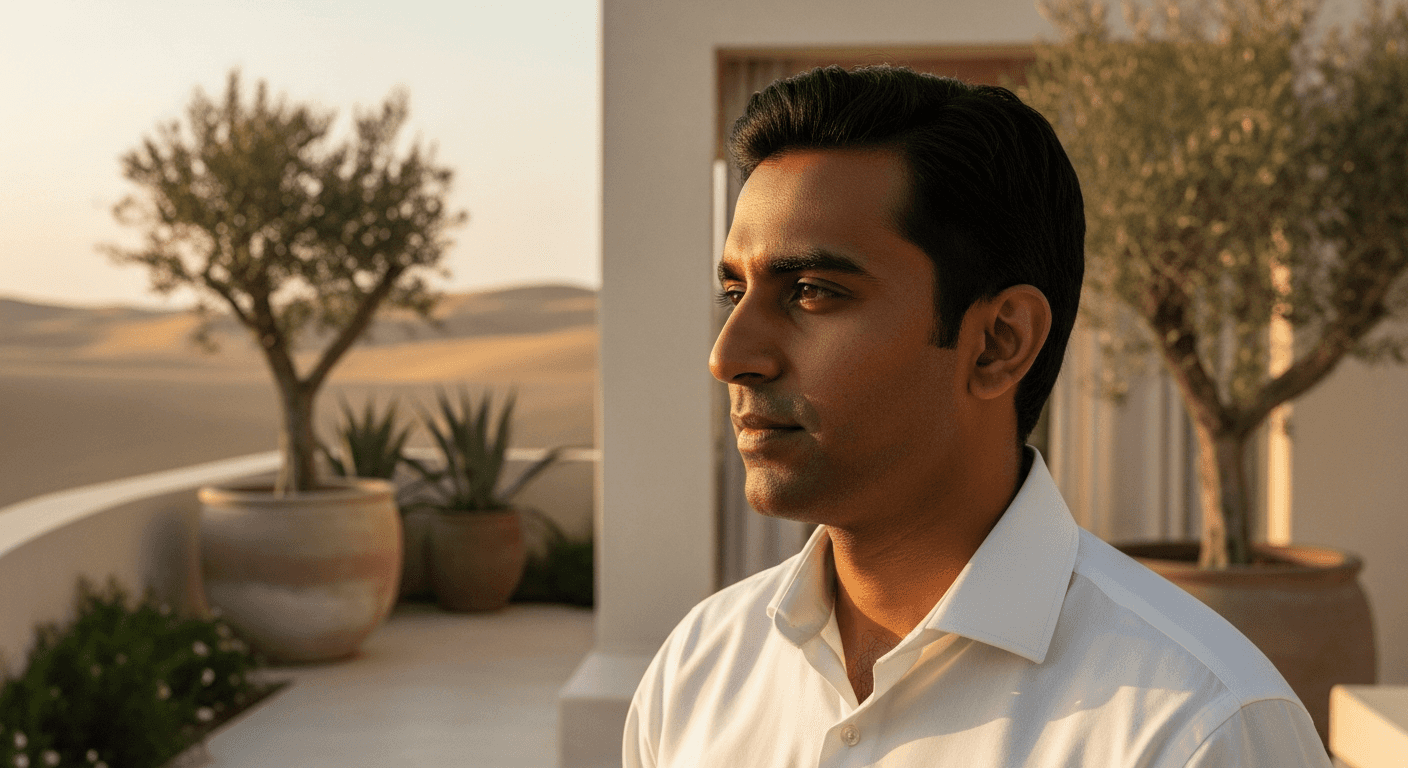
The Allure of the Edge: Dubai's Desert Homes
Beyond the city's iconic skyline lies a different kind of luxury—the profound tranquility and expansive beauty of desert-edge living. I'll explore why these homes offer a unique proposition for those seeking space, quiet, and a deeper connection to the landscape.

In a city defined by its ambition to touch the sky, there's a powerful counter-narrative unfolding on the ground. It’s a story I’ve watched evolve for years, whispered not in the gleaming corridors of skyscrapers, but across the serene, ochre-hued dunes at the city’s edge. This is the story of Dubai’s desert homes, a choice that represents a fundamental shift in what many of us seek in a luxury lifestyle.
Here’s what we'll explore:
- The true meaning of a “desert-edge” residence in the Dubai context.
- The pioneering communities that first defined this lifestyle, led by Arabian Ranches.
- The new generation of desert developments focused on wellness, design, and sustainability.
- A detailed breakdown of the real costs involved in purchasing and owning a desert home.
- The day-to-day realities and lifestyle logistics of living on the urban fringe.
- The investment potential of these unique properties.
- My final thoughts on who this life is truly for.
The Definition of the Desert Edge
When people hear ‘Dubai’, the mind conjures immediate, powerful images: the spire of the Burj Khalifa, the sail of the Burj Al Arab, the vibrant, man-made archipelago of Palm Jumeirah. It’s a vertical city, a metropolis of glass and steel that reflects the sun and the sea. But for a growing number of residents, the ultimate luxury isn't found by looking up, but by looking out — towards the vast, uninterrupted horizon of the Arabian desert. This is the core appeal of the `Dubai desert homes` that we at Gaia Living see attracting a specific and discerning type of buyer.
These are not simply suburban developments. A true desert-edge community is one where the master plan actively engages with the surrounding landscape. The final street doesn’t end at a concrete wall, but gives way to a protected nature reserve, a rolling dune, or a ghaf-tree-lined trail. The architecture often reflects this connection, with homes designed to maximize views and blur the lines between indoor and outdoor living. Think floor-to-ceiling windows that frame a view of a wandering gazelle, private gardens that transition into a shared natural landscape, and colour palettes that borrow from the sand, stone, and sky. The goal is to create a sense of place that is fundamentally tied to the natural environment, offering a profound contrast to the thrilling density of Downtown Dubai.
The promise is one of tranquility. It's the simple, profound pleasure of stepping outside in the morning with a coffee and hearing nothing but the wind. It’s the ability to see a blanket of stars at night, undimmed by the city's glow. This is what we mean by `serene living Dubai`. It’s a deliberate choice to trade the 24/7 energy of the urban core for space, privacy, and a different kind of pace. For many of our clients, particularly families and those who have lived in the city's busier nodes for years, this trade-off feels less like a compromise and more like a necessary evolution of their life in the Emirates.
This lifestyle is about reclaiming a sense of scale. In a high-rise, your world can feel contained within the four walls of your apartment and the building's amenities. On the desert's edge, your backyard feels infinite. This psychological shift is powerful. It encourages a different way of living — more time spent outdoors, more connection with the seasons, and a greater appreciation for the quiet moments. It’s a modern reinterpretation of the Bedouin’s historical relationship with the landscape, now facilitated by incredible infrastructure, world-class amenities, and thoughtfully designed real estate. The appeal is not about escaping Dubai; it's about experiencing a different, more grounded side of it.
The Pioneers: Arabian Ranches and the Original Vision
 Featured project
To understand the appeal of desert-edge living today, you have to look back to its origins. The blueprint was arguably laid down by one of Dubai's most ambitious and successful master-planned communities: Arabian Ranches. When developer Emaar Properties launched the first phase in the early 2000s, it was a genuinely pioneering move. At the time, Dubai's development was intensely focused on the coastline and Sheikh Zayed Road. The idea of creating a sprawling, premium community so far 'out' in the desert was a bold gamble.
The gamble paid off spectacularly. Arabian Ranches wasn't just a collection of villas; it was a fully-formed concept of suburban life, executed with a level of detail that was unprecedented. Emaar created a self-sufficient ecosystem. At its heart was the Arabian Ranches Golf Club, a stunning green centerpiece, but the vision went much further. They integrated schools of excellent repute, like Jumeirah English Speaking School (JESS), community centres with pools and tennis courts, and a retail souk with shops and restaurants. This meant residents didn't *need* to drive 30 minutes for a carton of milk or a morning coffee. The essentials of a high-quality family life were right on their doorstep.
The design of the homes themselves was a key part of the appeal. Instead of cookie-cutter boxes, the villas in communities like Saheel, Mirador, and Alvorada offered different architectural styles — predominantly Spanish and Arabic, with private gardens, quality finishes, and a sense of individuality. The streetscapes were landscaped, green, and pedestrian-friendly. It felt safe, established, and welcoming. For expatriate families coming from Europe, North America, or Australia, it offered a familiar suburban comfort but with a distinctly Dubai level of quality and security. It became the gold standard for family living and one of the most sought-after `quiet desert communities` in the emirate.
As the original Arabian Ranches matured, Emaar expanded the vision with Arabian Ranches II and, more recently, Arabian Ranches III. Each new phase has built on the success of the last, refining the concept and responding to changing buyer demands with more contemporary layouts and a greater variety of property types, including townhouses. The success of the Ranches model proved the market's deep appetite for this lifestyle and paved the way for a host of other communities across the `Dubailand` district and beyond. It demonstrated that with the right infrastructure and a clear focus on community, the desert was not a barrier but a canvas for creating some of the city's most desirable addresses.
The New Wave: Wellness, Design, and Sustainability
If the first wave of desert communities was about creating a suburban family haven, the new wave is about curating a highly specialized lifestyle. Today’s desert-edge developments are pushing the boundaries of luxury, wellness, and environmental consciousness, appealing to a buyer who wants more than just a big garden. They want a home that actively enhances their well-being. The most prominent example of this, in my opinion, is Al Barari. Driving into Al Barari feels like entering another world. The name itself means 'the wilderness' in Arabic, but what the developer Al Barari has created is a lush, botanical paradise.
Over 60% of the development is dedicated to green space, with landscaped gardens, freshwater streams, and themed botanical parks. It is, without a doubt, the greenest community in Dubai, a staggering achievement on the edge of the desert. The properties here, from the magnificent tiered villas in The Nest to the modern apartments in Seventh Heaven, are built around this philosophy of nature-infused living. The community is home to the famous farm-to-table restaurant, The Farm, a state-of-the-art health club, and a destination spa. Al Barari isn't selling real estate; it's selling a holistic wellness lifestyle. It’s an ultra-luxury `city escape Dubai` for those who prioritize health and a connection to nature above all else, and are willing to pay the significant premium for it.
Alongside this wellness trend is a growing focus on sustainability. The legacy of Expo 2020 is a key driver here, with Expo City now transforming into a fully-fledged residential and commercial hub. It aims to be a blueprint for sustainable urban living, free of single-use plastics, with buildings that meet high green standards and a layout that prioritizes pedestrians and cyclists. The residential offerings here, like the Expo Valley villas, are being designed with nature, space, and sustainability at their core. This represents a significant shift. Buyers are increasingly aware of their environmental footprint, and developers are responding with properties that feature solar panels, water recycling systems, and passive cooling designs.
Other major developers are also innovating on the desert fringe. Damac Properties has created vast communities like DAMAC Hills and DAMAC Hills II, which combine villas and townhouses with unique attractions like a world-class golf course designed by Tiger Woods, wave pools, and sports facilities. These communities are aimed at providing an active, resort-style life. Further out, the master plans for Dubai South, the area surrounding Al Maktoum International Airport, envision entire cities built from scratch with a focus on livability, connectivity, and green spaces. These new projects demonstrate the confidence developers have in `desert view properties`. The appeal is no longer just about escaping the noise; it's about choosing a specific, elevated, and often purpose-driven way to live.
The True Cost of Serenity: A Financial Breakdown
So, what does this tranquil, spacious lifestyle actually cost? It's a question we at Gaia Living address with our clients every day, and the answer requires looking beyond the sticker price. The dream of a `Dubai desert home` is achievable at various price points, but it's crucial to understand both the upfront investment and the ongoing financial commitments. The spectrum is wide: a three-bedroom townhouse in a newer community like Town Square might start around AED 1.8 million, while a large, upgraded villa in the original Arabian Ranches could command AED 8 million or more. At the highest end, a signature villa in Al Barari can easily exceed AED 20 million.
Let’s walk through a realistic, line-by-line breakdown for a secondary market purchase. Imagine you're buying a four-bedroom villa in a community like DAMAC Hills for AED 4,500,000. If you are an expatriate resident requiring a mortgage, here are the approximate upfront costs you would need to prepare for, based on regulations from the Dubai Land Department (DLD) and the Central Bank of the UAE.
Example Upfront Costs for an AED 4,500,000 Villa:
- Purchase Price: AED 4,500,000
- Down Payment (20% for residents): AED 900,000
- Dubai Land Department (DLD) Transfer Fee (4% of price): AED 180,000
- DLD Administration Fee: Approximately AED 4,200 (including VAT)
- Real Estate Agency Fee (2% of price + 5% VAT): AED 94,500
- Mortgage Registration Fee (0.25% of the loan amount of AED 3.6M): AED 9,000
- Property Trustee Registration Fee: Approximately AED 4,200 (including VAT)
- Bank Mortgage Arrangement & Valuation Fees: Approximately AED 8,000 - AED 10,000 (varies by bank)
- Initial Total Outlay: Approximately AED 1,199,900
As you can see, the total cash required is nearly 27% of the property's price. This is a critical figure to budget for. But the costs don't stop there. Ongoing ownership expenses are a significant part of the financial picture for villa living. The most important of these are the service charges. Unlike apartments, where charges are based on the internal area, villa service charges are typically calculated on the total plot size. For a community like Arabian Ranches or DAMAC Hills, you can expect to pay between AED 3 and AED 6 per square foot of your plot annually. For a villa on a 6,000 sq ft plot, this translates to AED 18,000 to AED 36,000 per year, covering the maintenance of community parks, pools, security, and landscaping.
In addition to service charges, you are responsible for all the running costs of your home. DEWA (electricity and water) bills will be higher than in an apartment, especially if you have a garden to irrigate and a swimming pool to run. You'll also need to budget for regular maintenance: garden landscaping, pool cleaning services, and preventative servicing for your AC systems, which work hard in the Dubai climate. These can easily add up to another AED 20,000 to AED 40,000+ per year, depending on the size of your property and garden. Understanding this complete financial picture is essential. The serenity of desert living is a wonderful goal, but it must be built on a foundation of sound financial planning.
Lifestyle and Logistics: The Daily Reality
The financial spreadsheets tell one story; the daily experience tells another. What is it actually *like* to live in one of these quiet desert communities? The biggest logistical factor, and the one I discuss most with clients, is the commute. There's no getting around it: you will be more reliant on your car. While Dubai's road network is superb, a drive from Arabian Ranches to DIFC during morning rush hour can take 40-50 minutes. From communities further out, like DAMAC Hills II, you could be looking at over an hour. This is the primary trade-off. However, the development of remote and hybrid working models has made this much more palatable for many professionals. If you only need to go to the office two or three times a week, a longer commute becomes a minor inconvenience in exchange for major lifestyle gains.
What you trade in proximity, you gain in self-sufficiency. The developers of these master communities understand that they need to provide a complete living solution. You are not moving to a remote outpost. Within a 5-10 minute drive, you will find excellent supermarkets (Spinneys, Carrefour), clinics, pharmacies, pet stores, and schools. These communities are dotted with their own retail centers, like The Ranches Souk, the Town Square community centre, or the retail hubs in DAMAC Hills. You can do your weekly shop, grab a coffee, have dinner, and go to the gym, all without leaving your neighborhood. Beyond that, Dubai's incredible delivery infrastructure extends everywhere. Your favorite restaurant from JLT or a grocery order from an app will find your desert-edge villa just as easily as it would a tower in the Marina.
The defining characteristic of the lifestyle, however, is the quiet. It’s a tangible quality. After a day in the bustling city, turning off the main highway and into the calm, landscaped streets of your community feels like a genuine decompression. The lack of ambient traffic noise, the space between homes, and the open skies create an atmosphere of peace that is hard to quantify but deeply felt by residents. It's a haven for families. Children can ride their bikes on the streets, play in the numerous parks, and join community sports teams. There's a sense of neighborliness that can sometimes be lost in the anonymity of a high-rise tower. You see the same faces at the community pool or the local café, fostering a genuine community spirit.
“The desert doesn't just offer you a view; it offers you a new rhythm for your life. The question is whether that rhythm is one you want to learn.”
Of course, this life isn't for everyone. If you thrive on the spontaneous energy of a city, the ability to walk out your door and be in the thick of a dozen restaurants and bars, then the curated calm of a desert community might feel isolating. Your social life may require more planning. But for those seeking a sanctuary — a place to unwind, to raise a family, and to connect with a more natural environment, the daily reality of life on the desert's edge is not one of compromise, but one of immense privilege and fulfillment.
The Investment Case for Desert-Edge Properties
While the primary motivation for most buyers of desert homes is lifestyle, the investment perspective is equally compelling. As an advisor, I always encourage clients to consider the long-term financial performance of any property they purchase, and the track record of Dubai's established desert communities is very strong. It’s important to state that no investment is guaranteed, but by analyzing the market dynamics, we can identify several factors that support the investment case for these properties.
First, capital appreciation. Well-built, master-planned communities in prime locations have consistently proven to be resilient and have shown steady growth over the long term. Arabian Ranches is a prime example. Early investors have seen the value of their properties multiply several times over. The key is the master developer's commitment to maintaining and enhancing the community over time. Developers like Emaar continue to invest in landscaping, security, and amenities, which protects and grows property values. For newer communities, the investment case is often tied to future growth. Buying into a new phase or a new project in an area like Dubai South or near the Expo City site is a bet on the area's future development and infrastructure, which can lead to significant capital gains as the community matures.
Second, rental demand and yield. While the gross rental yields for villas (typically 4-6%) may not always reach the heights of smaller apartments in dense areas like JVC or Dubai Marina (which can be 7-8%+), the nature of the rental income is often more stable. Desert-edge villas and townhouses attract long-term tenants, primarily families. These tenants often sign multi-year contracts and take immaculate care of the property as if it were their own. This results in lower vacancy rates, less frequent turnover, and reduced maintenance costs between tenancies. For an investor, this predictability can be more valuable than a slightly higher but more volatile yield.
Finally, the future outlook is favorable. The Dubai 2040 Urban Master Plan explicitly focuses on enhancing the quality of life, increasing green spaces, and developing integrated service centers across the emirate. This government-led vision directly supports the value proposition of established and upcoming desert communities. The global shift in priorities post-pandemic, with a greater emphasis on space, privacy, and well-being, also acts as a powerful tailwind for these types of properties. As Dubai continues to grow and its urban core becomes denser, the demand for high-quality `city escape Dubai` properties that offer a different lifestyle is, in my professional view, only set to increase. These homes are not just a niche market; they are an essential and increasingly popular part of Dubai's diverse real estate landscape.
My Verdict: Is a Desert Home Right for You?
After years of guiding clients through the high-rises of the Marina, the penthouses of Downtown, and the garden villas of the desert, I've come to see the choice of a home as a choice of identity. Where you live in Dubai says a great deal about what you value. The decision to buy a home on the desert's edge is perhaps one of the most definitive lifestyle statements you can make in this city. It's a conscious step away from the relentless energy of the core and a step towards something quieter, more expansive, and more personal.
But it is a choice with clear trade-offs. The romance of a desert sunrise is balanced by the reality of a morning commute. The luxury of a private pool and garden is paid for not just in the purchase price, but in ongoing service charges and maintenance. The peace and safety of a gated community can, for some, feel isolating compared to the vibrant, walkable street life of areas like JBR. There is no right or wrong answer, only what is right for you and your family at this stage of your life.
To help you find your answer, I often ask my clients to reflect on a few key questions. Be honest with yourself:
- What is your tolerance for a daily commute? Map the route to your office and your children's schools. Do the drive during peak hours. Can you embrace a podcast or audiobook, or will the time in the car frustrate you?
- How important is spontaneity in your social life? Do you love being able to walk to a dozen different restaurants, or are you happy to plan your evenings out and host friends at home?
- What does 'luxury' mean to you? Is it a glittering view from the 50th floor, or is it the silence of your own garden under a starry sky?
- Have you budgeted realistically? Look beyond the mortgage. Have you accounted for the service charges, the DEWA bills, the gardener, and the pool maintenance? These are not small expenses.
- Who are you today, and who do you want to be in five years? If you are a young couple, will you soon be a family needing parks and schools? If your children are older, will an empty nest make a large villa feel too quiet?
The unique appeal of Dubai's desert-edge residences lies in their ability to offer a lifestyle of tranquil spaciousness without sacrificing the convenience and quality of a modern city. It is a calculated choice for those who value privacy, family, and a connection to the landscape, and are willing to accept the trade-offs of a car-dependent, suburban life. For the right person, it is not an escape from Dubai, but a deeper way of living within it.
Ultimately, my advice is to experience it firsthand. Spend a weekend visiting these communities. Walk through the parks in Arabian Ranches, have lunch at The Farm in Al Barari, see the scale of the new projects taking shape. We at Gaia Living can help guide you through the options, from the established classics to the exciting new off-plan launches. The desert has a unique way of speaking to people. You just have to be willing to drive out and listen.
Sources
- Dubai Land Department (DLD): dubailand.gov.ae
- Central Bank of the UAE: centralbank.ae
- UAE Government Portal - Real Estate Laws: u.ae
Questions, answered
- Are Dubai's desert communities too far from the main city hubs?
- While they offer a distinct escape, most desert-edge communities are well-connected by major highways like the E311 and E611. Commutes to business hubs like Downtown Dubai or Dubai Marina typically range from 25 to 45 minutes, a trade-off many residents find acceptable for the added space and tranquility.
- What are the typical service charges for a villa in a desert community?
- Service charges are a significant ongoing cost. They are calculated per square foot of the plot area and typically range from AED 3 to AED 6 per sqft annually in communities like Arabian Ranches or DAMAC Hills. For a 5,000 sqft plot, this would be approximately AED 15,000 to AED 30,000 per year.
- Can foreigners buy freehold property in these desert communities?
- Yes, the vast majority of Dubai's desert-edge communities, such as Arabian Ranches, Al Barari, and DAMAC Hills, are located in designated freehold zones. This means non-GCC nationals can purchase property with full ownership rights, as regulated by the Dubai Land Department.
- Besides large villas, are other types of properties available in desert-edge locations?
- Absolutely. While spacious villas are common, many of these communities offer a diverse range of properties. You can find modern townhouses, smaller semi-detached homes, and even some low-rise apartment complexes, catering to different family sizes and budgets.
- Is buying a home in a desert community a good investment?
- These properties have historically shown strong potential for long-term capital appreciation, particularly in well-established master communities. While rental yields might be slightly lower than in dense urban areas, they attract stable, long-term family tenants, which can mean lower vacancy rates and more predictable income.

Yusuf writes about how Dubai actually lives — waterfront mornings, community dining, walkability, and the lifestyle premium built into an address.
Related stories
Calculating ROI on Dubai Rental Upgrades
As a landlord in Dubai, you can't just follow trends. I'll show you how to calculate the precise ROI of minor property upgrades to genuinely increase your rental yield.
Off-Plan vs Ready: The Real Cost of Capital
I analyse the fundamental trade-off every Dubai investor faces: the lure of off-plan capital growth versus the security of immediate rental income from a ready property.
Beyond the Gates: Dubai's Boutique Villa Sanctuaries
I'm exploring the small, exclusive villa communities that offer a real sense of place, moving beyond the well-trodden path of Dubai's famous megaprojects to find homes with genuine character.
Echoes, in your inbox
One thoughtful email a month. Market insight, new launches, no spam.