

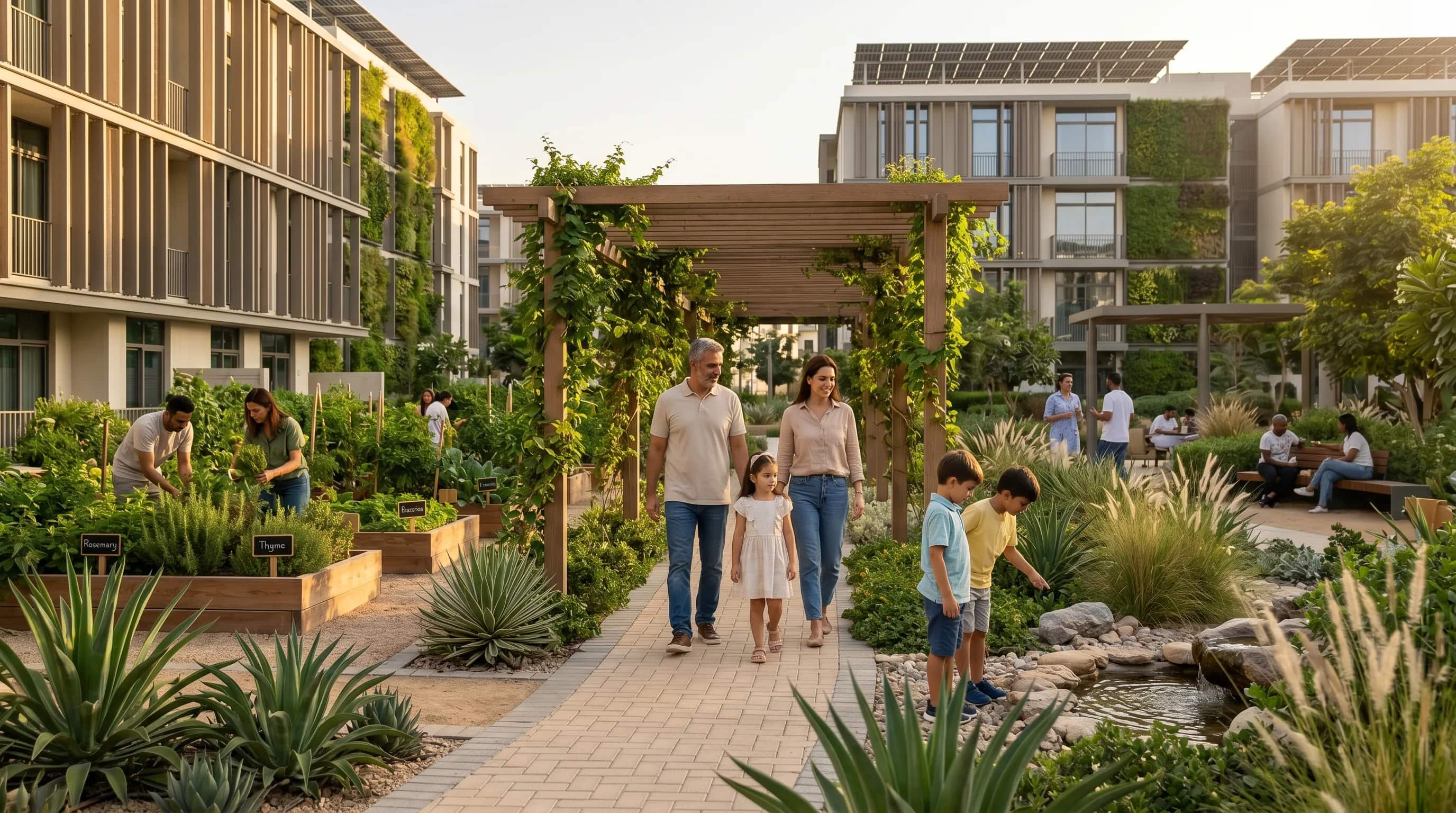
Sustainable Apartments in Dubai: Green Certifications and What They Mean
Sustainable apartments in Dubai are everywhere, but what do the green certifications actually mean? Here's LEED, Al Sa'fat, and what's worth paying for.
There is hardly any new apartment complex or house in Dubai that does not trumpet its eco-consciousness. From "sustainable living" to "eco-design" to "energy efficiency," buzzwords fill brochures and advertising. However, despite all the talk, there is a lot of truth behind it as, within the past ten years, the regulation of buildings in Dubai has become more stringent and the climate goals that Dubai sets for itself are very serious indeed.
Nevertheless, as far as the potential buyer is concerned, there is still a catch here. The word sustainable itself does not mean much on its own, and the green logo on the sales board is a fairly poor guide to action. The most important aspect is whether the building has been certified, what level of certification has been achieved, and whether it actually translates into more economical utility bills and greater comfort at home.
The purpose of this guide is precisely to demystify this process. We will tell you how sustainable apartments in Dubai have become standard, instead of an added value. We will talk about the certifications you may encounter when looking for such a place – LEED, Al Sa'fat, Estidama, WELL – and what they really mean, in simple language. We will discuss what kind of benefits a sustainable building can bring in real dollars and comfort points and where their promises fail.
Finally, we will recognize the difference between certification and actual savings since they do not always go hand in hand. For instance, being awarded an eco-badge in the entrance lobby does not necessarily mean that the utility bill from DEWA will be reduced if management is inefficient or the apartment gets a lot of afternoon sun. Let's get started.
Why Sustainable Is Becoming the Default, Not the Premium
Here is something the marketing will not tell you, because it undercuts the premium. A lot of what gets sold as green is now simply the law.
Dubai made its green building rules mandatory years ago. Every new building has to meet a baseline of energy and water efficiency, and the city layered its own rating system, Al Sa'fat, on top of that to push standards higher. So a brand-new apartment that calls itself sustainable may just be meeting the same rules every other new building meets. That is not a knock on it. It is a reason not to overpay for a label that is now standard issue.
The bigger picture explains why. The UAE has committed to reaching net zero by 2050, and Dubai has its own clean energy and urban planning strategies aimed at cutting emissions and energy use across the city. Dubai even built an entire district, Expo City, around low-carbon design, and you can read about it in our Expo City area guide. Building rules are one of the main tools for getting to those targets, so they keep tightening. What counts as green today is the floor, not the ceiling.
What this means for you as a buyer, in plain terms:
- A new apartment almost certainly meets a mandatory efficiency baseline, certified or not.
- The word sustainable on a brochure is not, by itself, a premium feature worth extra money.
- The real differentiator is a higher-level certification, like LEED Gold or Platinum, that goes beyond the minimum.
- Older buildings, built before the rules tightened, are where the genuine efficiency gaps usually sit.
- The newer the building, the more likely good efficiency is simply baked in.
So the question is not really "is this apartment sustainable." Most new ones are, to a point. The better question is "how far beyond the minimum does it go, and does that show up in my bills." That reframes the whole thing, and it is the lens we will use for the rest of this guide.
The Green Certifications, Decoded
You will see a handful of names on Dubai buildings, and they are not interchangeable. Some measure energy and water. Some measure how healthy the building is to live in. Here is what each one actually is, without the jargon.
LEED is the big international one. Run by the US Green Building Council, it scores buildings on energy, water, materials, and more, and awards one of four levels, Certified, Silver, Gold, or Platinum. Gold and Platinum are the ones that signal a building went well beyond the basics. It is the certification most likely to carry real weight with international buyers and tenants. You can read how it works on the US Green Building Council site.
Al Sa'fat is Dubai's own system, run by the city and mandatory for new buildings. It has its own tiers, from a green baseline up to higher gold and platinum levels, and it is built around Dubai's specific climate and rules. Because it is mandatory, a basic Al Sa'fat rating is common. A higher one means the building reached further than it had to.
A few others you may come across:
- Estidama Pearl Rating: Abu Dhabi's system, scored in Pearls from one to five. You will see it on UAE buildings outside Dubai, and it works on similar principles.
- WELL Building Standard: this one is about people, not just energy. It scores air quality, water, light, and comfort, so it tells you how healthy a building is to actually live in.
- BREEAM: a long-running British system, less common here but solid, focused on overall environmental performance.
- Fitwel: another health-focused rating, lighter than WELL, increasingly seen on residential towers.
The simplest way to hold all this in your head. LEED, Al Sa'fat, and Estidama mostly answer "how efficient is this building." WELL and Fitwel answer "how good is it for the people inside it." A genuinely strong sustainable apartment often carries one of each, an efficiency rating and a health one, because they measure different things and both matter.
One word of caution. A logo is not a level. "LEED" on a sign means nothing until you know whether it is Certified or Platinum, which are worlds apart. Always ask for the level, and ideally the certificate, not just the brand. The UAE's wider sustainability targets and rules are set out on the UAE government portal if you want the official backdrop to all of this.
What a Green Certification Actually Gets You
So you find a properly certified building, at a real level. What do you actually get for it, beyond a nicer story to tell? Here is the honest answer, the good and the limits.
The biggest payoff is running costs. A well-built efficient apartment uses less energy to keep cool, which in Dubai is the bulk of your utility bill. Better glazing, better insulation, and efficient cooling can meaningfully cut what you pay DEWA every month. Over years of ownership that adds up to real money, and you can get a feel for the tariffs and what drives a bill on the DEWA site.
Beyond the bill, here is what a strong green building tends to deliver:
- Lower cooling costs, the single biggest saving in this climate, thanks to better insulation and glazing.
- Lower water bills, from efficient taps, showers, and fittings that use less without you noticing.
- More comfortable rooms, with fewer hot spots near windows and steadier temperatures through the day.
- Better air quality, especially in WELL-rated buildings, which matters more than people think for sleep and health.
- More natural light, since good design pulls daylight in and cuts the need for the lights during the day.
- A potential resale and rental edge, because efficient, certified homes are getting easier to sell and let as buyers wise up.
That resale point is worth sitting with. As more buyers and tenants start asking about running costs and certifications, the efficient buildings get more desirable and the energy-hungry ones get harder to shift. If you want to see what is currently on the market across the city, our property listings are updated regularly. A green rating is slowly turning from a nice-to-have into something the market quietly prices in.
To put rough numbers on it, summer cooling for a larger or poorly insulated apartment in Dubai can run into the hundreds, and sometimes over a thousand dirhams a month at the peak. An efficient unit in the same size bracket can shave a meaningful slice off that, month after month, right through the hottest half of the year. On any single bill it is not life-changing. Across years of ownership it adds up to a real number, and it is exactly the saving that justifies caring about efficiency in the first place rather than treating it as a box to tick.
But be realistic about the limits. A certificate rates how a building was designed and built. It does not promise your specific bill, which still depends on how you use the place, which way your unit faces, and whether the building is actually run well. A platinum-rated tower with a badly managed cooling system can still surprise you. The badge improves your odds. It does not hand you a guarantee.
What to Actually Look For, Beyond the Badge
Certifications are a useful shortcut, but the real efficiency lives in the building itself. If you want to judge a place on its merits rather than its sticker, these are the features that actually move the needle, each on one line:
- Glazing: double-glazed or low-emissivity windows cut the heat pouring in, which is the biggest single driver of cooling cost here.
- Insulation: proper wall and roof insulation keeps the cool air in and the heat out, quietly saving money every month.
- Cooling system: the efficiency of the air conditioning or district cooling is the largest lever of all, since cooling dominates the bill.
- Orientation and shading: a unit shaded from the harsh afternoon sun costs noticeably less to keep cool than one that bakes all day.
- Water fittings: low-flow taps, showers, and dual-flush toilets trim the water bill without changing how the home feels.
- Smart metering: the ability to see your energy and water use helps you cut it, and the better buildings build this in.
- Solar: rare on individual apartments, but some newer communities feed shared solar into the common areas, which can ease service charges.
The pattern is simple. The features that deal with heat and cooling matter most, because that is where a Dubai home spends its energy. Everything else is helpful at the margins. If you only check one thing on a viewing, check how the unit handles the sun and how the cooling is set up.
Here is a practical move most buyers skip. Ask to see actual utility bills for the unit, or for a comparable one in the same building. A real DEWA bill tells you more than any certificate, because it is the building performing in the real world rather than on paper. A seller with an efficient home is usually happy to show you. A reluctant one is telling you something too.
The badge gets you into the right neighbourhood. These features, and a real bill, tell you whether the home actually lives up to it.
The Catch: Certified Does Not Always Mean Cheap to Run
Time for the honest downside, because green building has its own gap between promise and reality. A certificate is a strong signal, not a guarantee, and here is where the two come apart.
- The rating is about design, not daily life. A building can be certified on paper and still run up high bills if it is managed poorly or you use it heavily.
- Greenwashing is real. Some developers lean on the word sustainable far harder than the actual specification justifies, so check the level and the features, not the slogan.
- District cooling has its own bills. Many Dubai communities use shared cooling, which can be efficient but comes with its own charges and capacity fees that surprise new owners.
- Premium pricing creeps in. A genuinely high certification can carry a price premium, so make sure the saving on bills actually justifies the extra you pay up front.
- Older stock lags. A certified new tower may run far cheaper than a tired older building, so the comparison that matters is against real alternatives, not against perfection.
- Service charges can still be high. Green and cheap to run is not the same as cheap to own, since service charges depend on the whole building, not just its efficiency.
None of this is a reason to ignore certifications. It is a reason to treat them as one input among several. Pair the badge with the real features, a real bill, and a sensible price, and you are making a genuinely informed call rather than buying a slogan.
If you want to see which new buildings are coming to market with real efficiency credentials rather than just the language, our property launches page is a good place to compare what is actually being built.
And if you want help reading the difference between a genuinely green home and a greenwashed one, our property buying service can walk you through the specifics on any building you are weighing up.
What We Would Actually Do
A summary can be made from the above statement that having a sustainable apartment in Dubai is a good idea; however, the word itself holds little significance. In most cases, the buildings have reached the necessary level of efficiency, and the issue is whether a specific dwelling surpasses it and whether its energy consumption actually provides comfort and reduces bills.
In case your friend needed some advice regarding this issue, we would recommend the following: Do not spend extra money because it will soon become common sense to construct buildings using sustainable methods. Make sure that your potential investment receives the appropriate certification—LEED Gold or Platinum, as well as Al Sa'fat—rather than simply has a logo. Pay attention to what makes your home efficient: glazing, insulation, cooling system, and orientation toward the Sun. In case you have any chance to do so, ask for the receipt proving actual costs.
The best course of action in real estate is to stick to facts rather than to the advertising campaign. The mentioned certification levels, receipts, and a decent price will be much more effective than all those green claims.
In conclusion, the truth is that when implemented effectively, a sustainable building in Dubai is less expensive to maintain, more comfortable to live in, and easier to sell later on. In case you base your purchase decision only on the word sustainability and its popularity, you may end up paying extra for the privilege of living near another building where it is applied without additional costs.
If you want a straight read on whether a specific building's green credentials are real or just well-marketed, we look at these projects closely and are happy to tell you what holds up. Get in touch and we will take it from there.
Related stories
Dubai's Established Charm: The Case for Older Homes
In a city focused on the future, I believe the smartest move for many buyers is to look back. Dubai's seasoned communities offer space, character, and surprising value that new builds often can't match.

The True Cost of Owning a Dubai Property
Beyond the purchase price, your annual budget for a Dubai home must account for service charges, utilities, and maintenance. I'll break down every ongoing expense you need to plan for.
Calculating ROI on Dubai Rental Upgrades
As a landlord in Dubai, you can't just follow trends. I'll show you how to calculate the precise ROI of minor property upgrades to genuinely increase your rental yield.
Echoes, in your inbox
One thoughtful email a month. Market insight, new launches, no spam.