

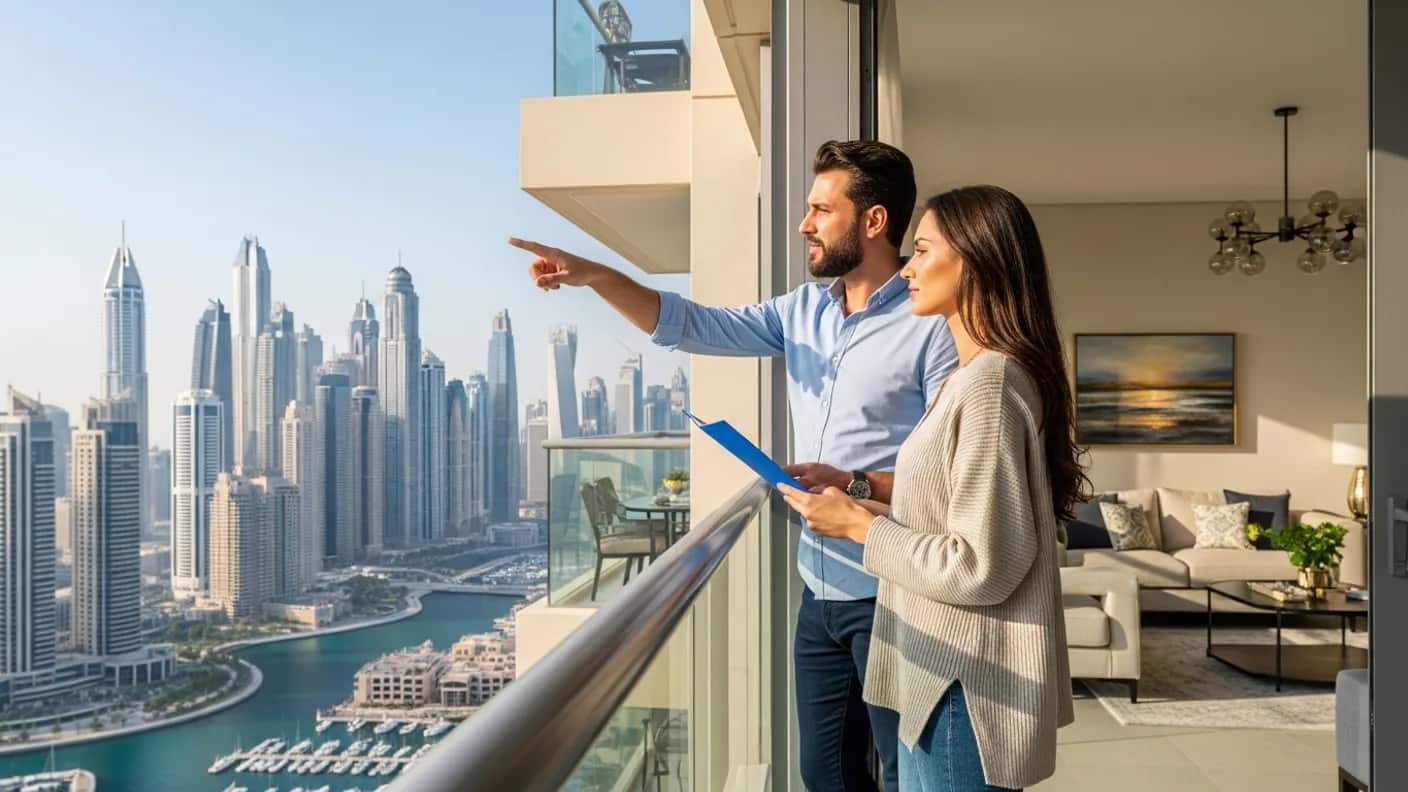
Setting Your Price: A Strategic Guide for Dubai Sellers
Pricing your Dubai property is not just about picking a number; it's the most critical strategic decision you'll make. This guide offers a playbook for valuing your asset to maximise your sale price and speed.

As a seller’s strategist, I see the same story play out time and again. A beautiful property, perfectly located, languishes on the market for months. The culprit is almost always the same: a flawed pricing strategy. Setting your asking price is the single most powerful marketing tool you have, and it’s the one decision that will dictate the entire trajectory of your sale. This is our definitive guide on how to price property for sale Dubai, moving beyond guesswork to a place of strategic confidence.
Here’s the playbook we'll walk through:
- The psychology of price and buyer perception
- The critical dangers of overpricing your property
- How to conduct a professional-level Comparative Market Analysis (CMA)
- Valuing the intangibles: views, upgrades, and layout
- Understanding the role and cost of official RERA valuations
- The three strategic pricing tiers and when to use them
- Crafting a launch plan to build market momentum
- A detailed, line-by-line breakdown of a seller's closing costs
The Psychology of Price: More Than Just a Number
Before we touch a single spreadsheet or property portal, we need to understand a fundamental truth: your listing price is a message. It communicates value, seriousness, and market awareness before a buyer ever steps through your door. In the sophisticated Dubai market, buyers are incredibly well-informed. They have access to the same data we do — transaction histories, comparable listings, and market trends. They set up alerts on portals with firm upper price limits. Your price is the first filter, and if you fail that test, you’re invisible to your most likely buyer.
Think about the psychological effect of pricing. An apartment listed at AED 1,995,000 feels significantly more accessible than one at AED 2,010,000. The first number appears in searches for properties 'up to AED 2 million', while the second is excluded. This small difference can mean being seen by hundreds, if not thousands, of additional potential buyers. This is a classic retail tactic, but it’s rooted in a cognitive bias called 'left-digit bias', where buyers anchor on the first digit they see. It's a small detail, but in a competitive market, small details add up.
Beyond that, your price sets the tone for negotiation. A price that is clearly aligned with the market data signals that you are a serious, well-advised seller. It invites reasonable offers and a smooth transaction. Conversely, a wildly inflated price signals that you are either uninformed or unrealistic. This doesn't invite a lowball offer; it often invites no offer at all. Serious buyers and their agents don't want to waste time on a property where the seller's expectations are divorced from reality. They will simply move on to one of the other excellent options available in communities like Downtown Dubai or across the water at Emaar Beachfront.
The Cardinal Sin: Why Overpricing is a Seller's Worst Enemy
 Featured project
Every seller wants to achieve the highest possible price. That's natural. But the path to the highest price is not paved with an aspirational, overpriced listing. In my experience, this is the most destructive mistake a seller can make. To `avoid overpricing Dubai property` is not just good advice; it is the cornerstone of a successful sale. When a property is overpriced, it suffers from a cascade of negative consequences that are very difficult to reverse.
The most critical period for any new listing is the first two to three weeks. This is when it is 'fresh'. It appears at the top of portal searches, it’s sent out in new listing alerts to saved searches, and it garners the most attention from active agents and their buyers. A well-priced property will be flooded with viewing requests during this window, creating a buzz and a sense of urgency. An overpriced property, however, sits in silence. It misses this golden window of opportunity entirely. The buyers who are most qualified and ready to transact — the 'low-hanging fruit', will see the price, compare it to the recent sales they have been tracking, and dismiss it immediately.
What happens next is predictable. After a few weeks of inaction, the seller is forced to consider a price reduction. This first reduction is a public admission that the initial strategy was wrong. The listing now carries a 'price reduced' tag, which can be perceived as a sign of desperation. The property loses its novelty and becomes stale. Subsequent small reductions have an even weaker effect, barely registering with buyers who may have already mentally discarded it. Eventually, after months on the market and several price cuts, the property often sells for a price *lower* than what could have been achieved had it been priced correctly from the start. The market punishes overconfidence. Buyers ask, "What's wrong with it? Why has it been on the market for so long?" and factor that perceived risk into their offer.
“Pricing isn't about what you need to get; it's about what the market is willing to pay. The strategy is bridging that gap.”
Mastering the CMA: A Seller's Guide to Comparable Market Analysis
A professional pricing strategy is not based on emotion, what you paid for the property, or how much you've spent on renovations. It is anchored in data. The tool for this is the Comparative Market Analysis, or CMA. This is the core of any good `Dubai real estate valuation guide seller`. A CMA is a detailed report that analyses recently sold properties (the 'comparables' or 'comps') that are as similar to yours as possible. This isn't just a casual glance at what's for sale now; it's a deep dive into what has actually been transacted and registered with the Dubai Land Department (DLD).
At Gaia Living, when we build a CMA for a client, we are looking for specific data points. The goal is to find 3-5 sales that are the closest possible match to your property. Here’s what makes a good comparable:
- Recency: The sale should have closed within the last 3-6 months. The Dubai market moves quickly, and a sale from a year ago is historical data, not a current market indicator.
- Location: The comp must be in the same building or, for villas, the same sub-community. A sale in a different tower in Dubai Marina, even one next door, might not be a valid comp if one tower is by Emaar Properties and the other by a different developer with lower-quality facilities. For villas in a community like Arabian Ranches, a comp must be from the same phase and type (e.g., a Palmera vs. A Saheel).
- Size & Layout: The square footage should be very similar. More importantly, the layout must match. A two-bedroom with a study is not comparable to a standard two-bedroom. A Type 2E villa in Arabian Ranches is not comparable to a Type 1M.
- View & Floor: For apartments, view is paramount. A full sea view on Palm Jumeirah can command a 20-30% premium over an identical unit with a road view. We look for comps with the same or very similar views and on a similar floor level (low, mid, high zone).
- Condition: This is where an agent's insight is vital. Was the sold property in original condition, or was it fully upgraded? We must adjust the comp's price up or down to account for these differences.
Once we have our comps, we create a price-per-square-foot baseline. For example, if three similar apartments in your tower recently sold for an average of AED 2,000 per sq. Ft., and your unit is 1,500 sq. Ft., your baseline valuation is AED 3,000,000. From here, we begin making adjustments. Is your view slightly better? Add 3-5%. Are your kitchen and bathrooms fully renovated compared to the comps? Add another 5-10%. Is your unit a rare corner layout? That scarcity has value. This methodical process removes guesswork and builds a defensible, data-driven pricing recommendation. This process is how you find an `accurate property value Dubai`.
Beyond the Numbers: Valuing the 'Unquantifiable' in Your Property
While a CMA provides the essential data-driven foundation, a truly `strategic property pricing Dubai` approach acknowledges that not all value can be captured in a spreadsheet. Some of the most compelling features of a home are qualitative. The art of valuation lies in translating these unique attributes into a justifiable price premium. This is where an agent's market knowledge and experience become invaluable, as they have seen firsthand what buyers are willing to pay extra for.
Consider the view. A direct, unobstructed view of the Burj Khalifa and Dubai Fountain from an apartment in Downtown Dubai is not just a feature; it's a world-class, trophy asset. It can easily add 25% or more to the value compared to an identical apartment on a lower floor or facing a different direction. Similarly, in Jumeirah Golf Estates, a villa directly overlooking the Earth Course will always command a significant premium over one that backs onto another villa. These are not subjective opinions; they are consistent market realities. My role is to quantify that premium based on recent transactions for properties with and without that specific attribute.
Upgrades are another critical factor. However, a common mistake sellers make is assuming they will recoup 100% of their renovation costs. This is rarely the case. The market pays a premium for *tasteful*, high-quality upgrades that appeal to a broad audience. A custom-designed kitchen with high-end European appliances and quartz countertops might add significant value. In contrast, highly personalized or niche renovations (like converting a bedroom into a home cinema) may not add any value and could even detract from it if the next buyer needs that bedroom. The key is to evaluate the quality and market appeal of the finishes. A professionally landscaped garden with a mature tree canopy and a temperature-controlled pool in a community like Al Barari is a huge selling point and justifies a higher price than a basic plot.
Lastly, there's scarcity. This could be a rare layout, such as a corner penthouse with a wraparound terrace, a ground-floor apartment with a large private garden, or a villa on a single-row plot that offers superior privacy. In buildings where most units are small one-bedrooms, a large, consolidated three-bedroom unit becomes a unique and sought-after asset. When we encounter these properties, we can't rely solely on price-per-square-foot metrics from standard units. We have to look for other scarce properties that have sold and analyse the premium they achieved. This involves expanding the search for comps to other similar-caliber buildings and making informed, experience-based adjustments. Articulating this scarcity in the marketing narrative is just as important as reflecting it in the price.
The Official Stamp: Understanding RERA Valuations and Their Role
While a CMA is your primary internal tool for setting a strategic asking price, you will almost certainly encounter the term 'RERA valuation' during your selling process. It’s important to understand what this is, when it’s needed, and how it relates to your asking price. A RERA valuation is a formal, legally recognized report prepared by an independent valuation company that is licensed by Dubai's Real Estate Regulatory Agency (RERA). This is not the same as an agent's CMA, which is a marketing and pricing tool.
The most common scenario requiring a formal valuation is when your buyer is financing their purchase with a mortgage. Before a bank in the UAE lends money against a property, they must have an independent assessment of its worth to ensure their loan is secure. The buyer typically commissions and pays for this valuation, though the report is for the bank's benefit. The cost for a standard apartment or villa valuation usually ranges from AED 2,500 to AED 5,000 + VAT, payable by the buyer. The valuer will physically inspect your property, take measurements and photographs, and then conduct their own analysis using DLD transaction data to arrive at a final figure.
So, how does this official valuation impact you as a seller? The bank will typically only lend a percentage (e.g., 80% for a first-time resident buyer) of the *lower* of the purchase price or the official valuation. For example, if you agree on a sale price of AED 3,000,000, but the bank's valuation comes in at AED 2,800,000, the bank will only lend 80% of AED 2.8M, not AED 3M. This creates a shortfall for the buyer, who would suddenly need to find an extra AED 200,000 in cash for their down payment. This can, and often does, cause deals to collapse. This is another powerful argument for pricing your property in line with the data from the start. A price supported by the CMA is very likely to be supported by the bank's valuer, leading to a smooth financing process for your buyer.
Occasionally, a cash buyer might request to conduct their own valuation for peace of mind, or a valuation might be needed for other purposes like inheritance proceedings or legal disputes. As a seller, you are obligated to provide access to the property for the valuer. While the valuation report is a snapshot of value on a specific day, it serves as a crucial, unbiased data point. If a bank valuation comes in lower than the agreed price, it can become a point of re-negotiation. Being prepared for this possibility and understanding the mechanics behind it puts you in a much stronger position.
Choosing Your Strategy: The Three Tiers of Property Pricing
Once you have a solid, data-backed value range from your CMA, the next step is to choose a specific pricing strategy. This decision depends on your personal goals: are you prioritizing maximum price, speed of sale, or a balance of both? I generally counsel my clients to consider one of three strategic tiers. This is a core part of a `strategic property pricing Dubai` framework.
1. Market Price: This is the sweet spot and the strategy I recommend for over 90% of sellers. It involves pricing your property directly in line with the most recent and relevant comparable sales. If the data shows similar units are selling for between AED 2.45M and AED 2.55M, you list at AED 2.5M. This strategy attracts the largest possible pool of qualified, serious buyers who are actively looking in that price bracket. It projects confidence and fairness. You are not trying to test the market; you are meeting it. This approach typically generates strong initial interest, a healthy number of viewings, and leads to offers at or very close to the asking price within a reasonable timeframe (e.g., 4-8 weeks in a balanced market).
2. Aggressive (or 'Urgent') Pricing: This strategy involves listing your property intentionally 3-5% *below* the most recent comparable sale. If the last comp sold for AED 2.5M, you might list at AED 2.4M. This might seem counterintuitive, but it can be incredibly effective for sellers who prioritize a quick, certain sale. The goal here is to create a frenzy of immediate interest. By appearing as the best value in its category, the property can attract multiple buyers who then compete against each other, often bidding the price back up to, or even slightly above, the true market value. This is a powerful tactic in a buyer's market or for a seller who has already committed to another purchase and needs to liquidate their asset quickly. It requires confidence and a strong nerve, but it can result in a sale in days, not weeks.
3. Aspirational Pricing: This is the riskiest strategy and should be reserved for truly unique, one-of-a-kind 'trophy' properties with no direct comparables. Think of a custom-built mansion in Emirates Hills or a full-floor penthouse in a landmark tower like those in Bluewaters Island. Here, you might price 5-10% above what the data suggests, with the thesis that the property's rarity and prestige will attract a specific type of buyer who is less price-sensitive and values exclusivity. This is a high-risk, high-reward play. It can lead to a record-breaking sale, but it can also lead to the property sitting on the market for an extended period (6-12+ months) and eventually requiring a significant price correction if that one special buyer doesn't emerge. This is not a strategy for a standard apartment or villa.
Your Launch Plan: Turning Your Price into Market Momentum
A strategic price is only as good as the launch that supports it. You cannot simply upload a number to a portal and hope for the best. The launch of your property onto the market, particularly in the first 14 days, is a coordinated event designed to convert your pricing strategy into tangible momentum: viewings, interest, and offers. A successful launch ensures that every qualified buyer looking for a property like yours sees it, and sees it presented in its best possible light.
First, the property must be ready. Before we even think about a price, I insist on professional photography and, in many cases, professional staging. The photos are your property's first showing. They must be bright, clean, and compelling enough to make a buyer stop scrolling. For a vacant property, staging is non-negotiable in my view. It helps buyers visualize the space, understand the scale of the rooms, and create an emotional connection. These elements must justify the price you are asking. High-quality marketing materials signal a high-quality property and a serious seller, reinforcing the message sent by your fair market price.
Second, we control the rollout. We don't just put the property on one portal. At Gaia Living, we launch it across a network of portals simultaneously, syndicate it to our extensive database of partner agents, and feature it in our own targeted marketing campaigns. The goal is to achieve maximum exposure in the shortest possible time. This concentrated burst of activity creates a sense of competition and scarcity. When buyers see a new listing pop up everywhere and their agents are all calling them about it, they understand that they need to act quickly. This is the opposite of a slow trickle, which allows a property to get lost in the noise.
Finally, we manage the viewing schedule strategically. We aim to group viewings together, often holding an 'open house' or block-viewing day. When potential buyers see other buyers at the property, it provides powerful social proof. It validates their interest and confirms that the property is desirable and well-priced. This subtle psychological pressure can accelerate decision-making and encourage stronger, cleaner offers. A strategic price gets them in the door, but a well-managed launch process is what turns that interest into a successful transaction at the best possible terms.
The Hidden Costs: Calculating Your True Net Proceeds
Perhaps the most important calculation for any seller is not the final sale price, but the net amount you will receive in your bank account after all costs are paid. Many first-time sellers are surprised by the various fees and charges involved in a Dubai property transaction. Understanding these costs upfront is essential for accurate financial planning and for evaluating offers correctly. A higher offer with complicated terms may not be as attractive as a slightly lower, simpler cash offer once all costs are factored in.
Let's walk through a realistic example for the sale of an apartment with an agreed sale price of AED 3,000,000. It's crucial to remember that some costs are fixed, while others are percentages. The responsibility for the DLD transfer fee is commonly split 50/50 between buyer and seller, but this is a point of negotiation.
Here is a typical breakdown of seller's costs:
- Sale Price: AED 3,000,000
- Costs to be Deducted:
- Dubai Land Department (DLD) Transfer Fee: The total fee is 4% of the sale price (AED 120,000). Assuming a 50/50 split, the seller's share is 2%.
- *Seller's Cost: AED 60,000*
- Real Estate Agency Fee: The standard fee is 2% of the sale price, plus 5% VAT on the fee itself.
- *Fee: AED 60,000 (2% of 3M) + VAT: AED 3,000 (5% of 60k) = Total: AED 63,000*
- Trustee Office Fee: This is a fixed fee paid to the registration trustee who facilitates the transfer at the DLD. This is approximately AED 4,200 (including VAT).
- *Seller's Cost: AED 4,200*
- Developer No Objection Certificate (NOC) Fee: The developer must issue an NOC to confirm you have no outstanding service charges or other liabilities. The fee for this varies by developer but typically ranges from AED 500 to AED 5,000. Let's use a common figure.
- *Seller's Cost: AED 1,575 (including VAT)*
- Mortgage Settlement Fee (if applicable): If you have an outstanding mortgage, you will need a liability letter from your bank, and there may be early settlement fees. Per Central Bank of the UAE regulations, this is capped at 1% of the outstanding balance or AED 10,000, whichever is lower.
- *Seller's Cost (example): AED 10,000*
Total Estimated Seller's Costs: AED 60,000 (DLD) + AED 63,000 (Agency) + AED 4,200 (Trustee) + AED 1,575 (NOC) + AED 10,000 (Mortgage) = AED 138,775
Net Proceeds to Seller: AED 3,000,000 (Sale Price) - AED 138,775 (Total Costs) = AED 2,861,225
This calculation reveals that the seller receives approximately 95.4% of the sale price. It's also important to remember that you will need to settle any outstanding service charges up to the day of transfer. This is usually done by the seller paying the full current period and then being reimbursed by the buyer on a pro-rata basis at closing. Understanding this net sheet is the final, critical piece of your pricing puzzle.
Your initial listing price is your single most powerful marketing tool. It’s not an opening bid in a long negotiation; it's a strategic signal to the entire market. Get it right, and you create competition, urgency, and achieve a sale at true market value. Get it wrong, and you create a stale listing that the market ignores, ultimately costing you both time and money.
## Sources - Dubai Land Department (DLD) - dubailand.gov.ae - Central Bank of the UAE - centralbank.ae
Questions, answered
- What is the biggest mistake sellers make when pricing their property in Dubai?
- The most common and damaging mistake is overpricing from the start. This kills crucial initial momentum, makes the property look stale online, and often leads to selling for less than if it were priced correctly from day one.
- How much does it cost to get an official RERA property valuation?
- A formal valuation report from a RERA-approved company typically costs between AED 2,500 and AED 5,000. This is often required by the buyer's mortgage lender to approve the loan.
- Should I list my property slightly higher to leave room for negotiation?
- Building in a small negotiation margin is standard, but significant overpricing is counterproductive. A strategic price based on data attracts a wider pool of serious buyers and can create a competitive environment, sometimes eliminating the need to negotiate down at all.
- Are online valuation tools accurate for Dubai properties?
- They can offer a very rough estimate but are not a reliable way to get an accurate property value in Dubai. These tools cannot account for critical factors like views, specific upgrades, layout variations, or the property's current condition, which heavily influence the final price.
- What are the main closing costs for a seller in Dubai?
- Typically, a seller's major costs include their share of the 4% Dubai Land Department transfer fee, the 2% agency fee (+5% VAT), a trustee office fee of approximately AED 4,200, and the developer's No Objection Certificate (NOC) fee, which can range from AED 500 to AED 5,000.

Lena writes exclusively for owners looking to sell. Staging, listing timing, agent selection, and how to read a lowball offer — she's in the seller's corner.
Related stories

Dubai's AC Dilemma: The Real Cost of Cooling
Your apartment's air conditioning is more than just a utility—it's a major factor in your monthly budget and comfort. I'll break down the real costs and benefits of Dubai's two main cooling systems, helping you choose your next home wisely.

Managing Multiple Offers: A Dubai Seller's Playbook
Receiving multiple offers on your Dubai property is an excellent problem to have, but handling it incorrectly can cost you time and money. Here’s my strategic playbook for managing competitive bids to secure the best possible outcome.

Gifting Property to Family in Dubai
Thinking of transferring a Dubai property to a family member? Learn how to navigate the DLD's rules for gifting to first-degree relatives and significantly reduce your transfer costs.
Echoes, in your inbox
One thoughtful email a month. Market insight, new launches, no spam.