

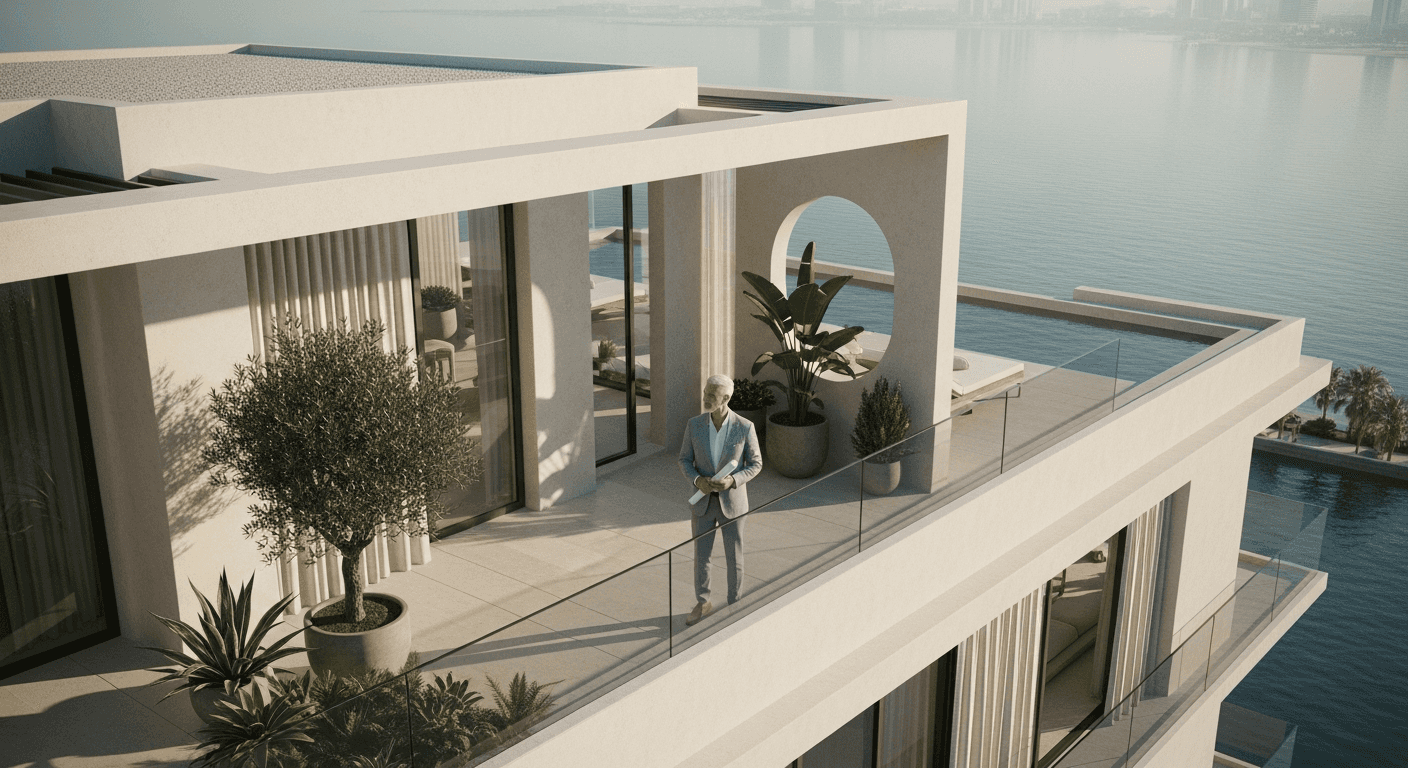
Securing Your Dubai Property Title Deed (Mulkia)
A complete guide to understanding, obtaining, and verifying your Dubai property title deed, or Mulkia, the ultimate proof of your real estate ownership.

As a first-time buyer specialist, I find the moment a client receives their property title deed is one of the most rewarding. In Dubai, this document is known as the 'Mulkia', and it represents the successful culmination of your property journey — the absolute, government-backed proof that you own your home. This guide will walk you through everything you need to know about this critical document.
Here’s what we'll explore:
- What a Title Deed (Mulkia) is and its legal importance
- The role of the Dubai Land Department (DLD) in safeguarding your ownership
- The step-by-step process for obtaining a title deed for a ready property
- How the process differs for off-plan purchases, from Oqood to Mulkia
- A line-by-line breakdown of all the fees and costs involved
- How to read your title deed and verify its authenticity
- Common mistakes and how to avoid them during the transfer process
- The power of your title deed for securing visas, loans, and planning your inheritance
What is a Title Deed (Mulkia) and Why It's Your Most Important Document
Let’s start with the basics, because understanding the terminology is the first step to feeling confident. A Dubai property title deed, or *Mulkia* (ملكية) in Arabic, is the single most important document you will possess as a property owner. It is an official certificate issued by the Dubai Land Department (DLD) that legally proves and registers your ownership of a specific property. It is not just a receipt; it is the definitive entry in Dubai's official real estate ledger that states you, and only you, are the owner of that asset. This document is the bedrock of property rights in the emirate and the reason why investors from around the world trust the Dubai market.
In my experience, many first-time buyers are familiar with various documents they encounter during the purchase process — the Memorandum of Understanding (MOU), the Sale and Purchase Agreement (SPA), or the No-Objection Certificate (NOC). While all are important steps, none of them confer ownership. They are agreements and permissions that lead to the final goal. The title deed is the goal itself. It supersedes all previous agreements. Once your name is on that Mulkia, your ownership is irrefutable, protected by the full legal framework of the Government of Dubai. It contains all the essential details of your property: your full name, the exact plot or unit number, the size in square metres, the community, and whether there is a mortgage registered against it.
For those buying off-plan, it's crucial to distinguish between an *Oqood* and a Title Deed. An Oqood is an initial registration document for a property still under construction. It secures your right to that future property and is registered with the DLD, but it is not the final title deed. Think of it as a place-holder that proves you are the contracted buyer. Only when the property is complete, fully paid for, and handed over will the developer initiate the process to convert the Oqood into the final Mulkia. The importance of the final title deed cannot be overstated. You will need it to sell the property in the future, to legally rent it out, to use it as collateral for a loan, or to pass it on to your heirs. It is the key that unlocks the full value and potential of your real estate investment.
The Foundation of Ownership: DLD and the Dubai Real Estate Registry
 Featured project
To appreciate the security that a title deed provides, you need to understand the institution that issues it: the Dubai Land Department (DLD). Established in 1960, the DLD is the government body responsible for all real estate registration and regulation in the Emirate of Dubai. Its primary function is to create and maintain a secure, transparent, and legally binding property registry. Every single property transaction, whether it's a sale, mortgage, gift, or inheritance, must be recorded with the DLD. This centralised system is the source of truth for all property ownership in the city.
The DLD's registry system is one of the most advanced in the world. Gone are the days of dusty paper ledgers. Today, ownership is recorded in a sophisticated digital database. This digital transformation has culminated in tools like the Dubai REST (Real Estate Self Transaction) app, a platform that allows owners to view and manage their property portfolio directly from their phones. This move towards digitisation means that your ownership record is not just a piece of paper that can be lost or damaged; it's a secure digital entry protected by multiple layers of government security. When a title deed is issued, it is printed from this central, immutable record.
It’s also important to understand that your title deed will specify the nature of your ownership. In Dubai, expatriates can purchase property in designated 'freehold' areas. In these zones, you own the property outright and indefinitely. Popular freehold areas include communities like Dubai Marina, Downtown, and Arabian Ranches. The title deed for a freehold property grants you this perpetual ownership. In other 'leasehold' areas, ownership is for a fixed term, typically up to 99 years. Your title deed will clearly state the type and term of your ownership, providing absolute clarity on your rights. The robustness of this system, managed by the DLD, is what gives your Mulkia its power and what underpins the confidence in the market.
The Title Deed Process for Secondary Market (Ready) Properties
For most first-time buyers, your first property will likely be in the secondary market — a home that is already built and owned by someone else. The process of transferring ownership and obtaining your first title deed is highly structured and regulated by the DLD. As your agent, our role at Gaia Living is to guide you through every step, but it's important for you to understand the journey.
The process formally begins after you and the seller agree on a price and sign a Memorandum of Understanding (MOU), also known as Form F. At this point, you pay a deposit (typically 10% of the purchase price), which is held in trust. The next crucial step is for the seller to obtain a No-Objection Certificate (NOC) from the property's master developer, such as Emaar Properties or Nakheel. The NOC confirms that the seller has no outstanding service charges or other liabilities on the property. This is a critical protection for you as the buyer. The developer will not issue the NOC if there are pending debts, preventing the transfer from proceeding until the seller settles them. This process can take a few days to a week and usually involves a small fee paid by the seller.
Once the NOC is issued, we move to the final transfer appointment. This does not happen at the DLD's main office anymore. Instead, it takes place at a DLD-approved Real Estate Registration Trustee office. These are private service centres licensed to handle the final transfer of ownership on behalf of the DLD. At this appointment, you (the buyer), the seller, and your respective agents will be present. If you are taking a mortgage, a representative from your bank will also be there. All parties present their identification, the original property title deed, the NOC, and the signed MOU. Here, the final payments are exchanged via manager's cheques — one for the seller for the remaining balance of the property price, and several others for the DLD fees, trustee fees, and agency commissions. The trustee verifies all documents and payments, enters the transaction into the DLD system, and upon confirmation, your new title deed is printed right then and there. You walk out of the office holding the Mulkia, a registered property owner.
To ensure a smooth transfer day, being prepared is everything. I always provide my clients with a clear checklist. Here is a typical list of documents you, as the buyer, will need for the transfer:
- Your original Emirates ID (for UAE residents) or Passport (for non-residents).
- Manager's Cheques made out to the specified beneficiaries for the agreed amounts (DLD, seller, agency, etc.). Personal cheques are not accepted.
- Signed Memorandum of Understanding (MOU / Form F).
- If using a mortgage, your bank's final offer letter and a representative from the bank must be present.
The Title Deed Process for Off-Plan Properties
The journey to securing your title deed for an off-plan property is quite different and unfolds over a longer period. It begins not with an MOU, but with a Sale and Purchase Agreement (SPA) directly with the developer. Once you sign the SPA and pay the initial deposit and Oqood registration fees, the developer registers this sale with the Dubai Land Department. This generates an *Oqood* certificate in your name. As I mentioned earlier, the Oqood is not a title deed, but it is a legally recognised document that protects your rights to the property while it is under construction. It is proof of your initial ownership stake and is a critical document in its own right.
For the next few years during construction, you will make payments according to the developer's payment plan. The Oqood remains your primary ownership document throughout this period. The real action for the title deed begins as the project nears completion. The developer will notify you of the anticipated handover date. Before you can receive the keys, you must settle the final payment instalment. Following this, the developer will invite you for a process called 'snagging', where you inspect the finished property and list any minor defects or issues that need to be rectified. Once you are satisfied and have formally accepted the property, the handover is complete.
Only after the handover and the settlement of all outstanding payments can the developer apply to the DLD for the issuance of the final title deed. The developer typically handles this process on behalf of all buyers in the project. They submit the necessary completion certificates and proof of payments to the DLD. The DLD then officially converts the Oqood registration into a full title deed registration. You will be notified by the developer when your title deed is ready for collection. For large projects with hundreds of units, like those in master communities such as Dubai South or Creek Harbour, this final step can sometimes take a few months after handover, so a little patience is required. Once you collect it, this Mulkia replaces your Oqood entirely and serves as the final, permanent proof of your ownership.
A Detailed Breakdown of Fees and Costs for Securing Your Title Deed
One of my most important jobs is to ensure my clients have no financial surprises. Securing your title deed involves a series of mandatory fees that go beyond the property's sticker price. Budgeting for these closing costs — which typically amount to 6-8% of the purchase price, is essential. Let's break down the costs for a hypothetical purchase of an apartment in a community like Jumeirah Village Circle (JVC) for AED 2,000,000.
“Many first-time buyers focus solely on the purchase price, but it's the 6-8% in closing costs — dominated by the DLD transfer fee, that often comes as a surprise. Budget for it from day one.”
Here is a line-by-line breakdown of the typical fees you would expect to pay at the Registration Trustee office on the day of transfer. Please note these are based on current regulations and can be subject to change by the authorities.
Example: AED 2,000,000 Property Purchase (Cash Buyer)
- Dubai Land Department (DLD) Transfer Fee: 4% of the purchase price. This is the largest single cost. *Calculation: 4% of AED 2,000,000 = AED 80,000 - DLD Admin Fees: A fixed admin fee is payable to the DLD. *Calculation: AED 580 - Registration Trustee Fees: These offices charge a fixed fee for their services. For properties over AED 500,000, this is typically: *Calculation: AED 4,000 + 5% VAT = AED 4,200 - Title Deed Issuance Fee: A fee for printing the new title deed. *Calculation: AED 580 - Real Estate Agency Fee: The standard commission for the buyer's agent. *Calculation: 2% of AED 2,000,000 + 5% VAT = AED 42,000 - Total Closing Costs (Cash Buyer): Approximately AED 127,360
If you are purchasing with a mortgage, there are additional costs. The Central Bank of the UAE mandates a minimum down payment (20% for expatriates buying their first property under AED 5 million). On top of that, you must pay a mortgage registration fee to the DLD.
Additional Fees for a Mortgaged Property:
- DLD Mortgage Registration Fee: 0.25% of the total loan amount, plus an admin fee. *Example: For an 80% loan (AED 1,600,000), this would be 0.25% of AED 1,600,000 = AED 4,000. - DLD Mortgage Admin Fee: A fixed fee for processing the mortgage registration. *Calculation: AED 290 - Bank Processing/Valuation Fees: Your bank will also charge fees for processing the mortgage and conducting a property valuation, which can range from AED 3,000 to AED 5,000.
As you can see, the costs add up quickly. Understanding and preparing for these expenses is just as important as securing your financing. We always prepare a detailed statement of costs for our clients well in advance of the transfer date to ensure complete transparency.
How to Read and Verify a Dubai Property Title Deed
Once you have your title deed, it’s important to understand the information it contains and, crucially, how to verify its authenticity. The modern Dubai title deed, which is often an electronic version accessible via the Dubai REST app, is a clean, secure document. It will have the official crest of the Dubai government and the DLD logo at the top. The key information is clearly laid out.
When you receive your Mulkia, you should check the following fields carefully:
1. Certificate Number and Date: Each deed has a unique number and issuance date. 2. Owner Information: Your full name, as it appears on your passport, along with your nationality and passport number. If buying jointly, all owners will be listed with their respective ownership shares (e.g., 50% / 50%). 3. Property Details: This section is vital. It includes the land or plot number, the building name, the unit/apartment/villa number, and the specific use (e.g., 'Residential'). 4. Community/Project Name: The name of the area, such as Jumeirah Golf Estates or City Walk. 5. Property Size: The area of the property is listed in square metres (sq. M.). 6. Mortgage Information: If the property is mortgaged, this section will clearly state 'Mortgaged to [Bank Name]' along with the registered mortgage value. If there is no mortgage, it will be blank.
One of the most powerful features of the modern title deed is the QR code printed on it. This is your key to instant verification. The importance of verifying your Dubai property ownership independently cannot be stressed enough, and the DLD has made it incredibly simple. By downloading the official Dubai REST app from the DLD's website, you can confirm your ownership in seconds. The process is straightforward: open the app, select the option to verify a certificate, and point your phone’s camera at the QR code. The app will instantly connect to the DLD's live database and display the property's official record, confirming the owner's name, property details, and any mortgage status. This feature effectively eliminates the possibility of fraud using fake documents and provides every owner with immediate peace of mind.
Common Pitfalls and How to Avoid Them
While the DLD title deed process is designed to be secure and transparent, as with any major transaction, there are potential pitfalls, especially for first-time buyers. Part of my role is to anticipate and navigate these issues for my clients. Awareness is the best prevention.
One of the most common — and easily avoidable, issues is a mismatch of names. The name on the MOU, your passport, and your bank account must be identical. A small discrepancy, like a missing middle name, can cause delays at the trustee office. Always ensure your full, official name is used consistently on all documents from the very beginning. Another frequent hiccup is a delay in the seller obtaining the developer NOC. This is almost always due to the seller having outstanding service charges. As a buyer, you are protected because the transfer cannot proceed without the NOC, but it can delay your move-in date. A good agent will follow up proactively with the seller's agent to ensure these dues are settled well in advance of the planned transfer date.
If the seller has an existing mortgage on the property, the process involves an extra layer. The seller must obtain a liability letter from their bank, and on the transfer day, part of your payment will go directly to the seller's bank to clear the mortgage. This coordination between the seller's bank, your bank (if you are getting a loan), and the trustee office can be complex. Delays in the seller's bank providing the necessary clearance can stall the transaction. This is a scenario where having an experienced real estate agent and a qualified conveyancer is invaluable. They manage this multi-party coordination to ensure a smooth process. At Gaia Living, we have managed hundreds of these transactions and can foresee and resolve these banking-related hurdles effectively.
Finally, a lack of understanding of the process itself can be a source of stress. Some buyers are surprised on transfer day by the number of manager's cheques required or the exact sequence of events at the trustee office. I make it a point to walk my clients through a 'dress rehearsal' of the transfer day, explaining who will be there, what documents they'll sign, and which cheques they'll hand over. This preparation demystifies the final step and replaces anxiety with confidence. All these potential pitfalls are easily managed with foresight and professional guidance, which you can find in our other buyer & investor guides.
The Title Deed's Role Beyond Ownership: Mortgages, Visas, and Inheritance
Securing your Mulkia is the end of the buying process, but it's the beginning of what you can do with your asset. The importance of the Mulkia certificate extends far beyond simply proving you own your home. It is the legal instrument that allows you to use your property's value. For example, once you have built up some equity, you might decide to remortgage or take out an equity release loan to fund another investment or a major life expense. No bank will consider such a loan without a clear title deed in your name, which they can then register a new mortgage against.
The title deed has also become a cornerstone of the UAE's popular Golden Visa program. The government offers long-term residency visas to property investors, and the primary evidence required for this application is the title deed. For instance, according to the current rules outlined by the UAE Government, purchasing a property worth at least AED 2 million grants you eligibility for a 10-year Golden Visa. Your application to the DLD's Cube centre for this visa will be centred around submitting your title deed as proof that you meet the investment threshold. This has made property ownership a direct pathway to long-term residency for many expatriates, and your Mulkia is your ticket.
Beyond that, the title deed is fundamental to effective inheritance planning. For non-Muslim expatriates, having a clear title deed in your name is the first step. To ensure your property is passed to your chosen heirs according to your wishes, rather than local Sharia law, it is highly advisable to register a will. The DIFC Wills and Probate Registry provides a common-law framework for non-Muslims to bequeath their Dubai assets. When you register a will, you specify who should inherit your property, and your title deed is the document that identifies the asset to be passed on. Without a clear title, the process becomes significantly more complicated for your family. Holding your Mulkia ensures that your most valuable asset can be managed and transferred smoothly according to your long-term plans.
My Final Advice: Your Title Deed is Your Peace of Mind
After walking hundreds of first-time buyers through the journey of registering property ownership in Dubai, I can tell you that the process is one of the safest and most efficient in the world. It can feel daunting with its acronyms and steps — MOU, NOC, DLD, Trustee, but every step is there for a reason: to protect you, the buyer. The system is designed to ensure that when you make the biggest financial commitment of your life, your ownership is absolute and unchallengeable.
The final act of receiving your title deed is more than a formality. It’s the moment the abstract idea of 'owning a home' becomes a concrete reality, backed by the full power of the Dubai government. It's the key to your front door, the foundation for your family's future in the city, the security for your financial portfolio, and the pathway to long-term residency.
My advice to any aspiring homeowner is to embrace the process. Ask questions. Understand the costs. Work with a professional you trust to guide you. When you finally hold that Mulkia in your hand — or, more likely, view it on your Dubai REST app, you will know that you have not just bought a property; you have secured a tangible, valuable, and protected stake in one of the most dynamic cities in the world. That feeling is one of profound security and accomplishment, and it's a feeling I wish for every one of my clients.
Your Dubai property title deed, or Mulkia, is more than just a piece of paper; it is the digitally-secured, government-guaranteed proof of your ownership. Understanding the DLD process, budgeting for all associated fees, and verifying the final document are the essential steps to securing your investment and gaining complete peace of mind.
Sources
- Dubai Land Department (DLD): dubailand.gov.ae
- Dubai REST Application Information: dubailand.gov.ae/en/eservices/dld-and-rera-apps/dubai-rest/
- UAE Government Portal (Property Purchase Information): u.ae
- Central Bank of the UAE (Mortgage Regulations): centralbank.ae
Questions, answered
- What is a Mulkia in Dubai?
- A Mulkia is the official property title deed issued by the Dubai Land Department (DLD). It is the definitive legal proof of ownership for a property in Dubai.
- How much does it cost to get a title deed in Dubai?
- The main cost is the DLD transfer fee, which is 4% of the property's purchase price. Additional fees for registration trustees, agency commission, and mortgage registration can add another 2-4% to the total cost.
- How long does it take to get a title deed in Dubai?
- For a ready property, the title deed is typically issued on the same day as the transfer appointment at a DLD-approved Trustee Office, provided all documents and payments are in order. For off-plan, it's issued after the final payment and property handover.
- What is the difference between Oqood and a Title Deed?
- Oqood is an initial registration for an off-plan property, securing the buyer's rights during construction. The Title Deed (Mulkia) is the final, official ownership document issued by the DLD once the property is completed and fully paid for.
- Can I get a title deed for a mortgaged property?
- Yes. You will receive the original title deed, but it will clearly state that the property is mortgaged to a specific bank. The bank may hold the original document until the loan is fully repaid, but you are the registered owner.
- How can I verify a Dubai title deed?
- You can instantly verify any Dubai title deed's authenticity using the Dubai REST mobile application. Simply scan the QR code on the deed or enter the certificate number to confirm the ownership details directly from the DLD's official records.

Hana demystifies the buying journey for first-timers and expats — mortgages, visas, escrow, and the paperwork. No jargon, no assumptions.
Related stories
Calculating ROI on Dubai Rental Upgrades
As a landlord in Dubai, you can't just follow trends. I'll show you how to calculate the precise ROI of minor property upgrades to genuinely increase your rental yield.

Off-Plan vs Ready: The Real Cost of Capital
I analyse the fundamental trade-off every Dubai investor faces: the lure of off-plan capital growth versus the security of immediate rental income from a ready property.
Beyond the Gates: Dubai's Boutique Villa Sanctuaries
I'm exploring the small, exclusive villa communities that offer a real sense of place, moving beyond the well-trodden path of Dubai's famous megaprojects to find homes with genuine character.
Echoes, in your inbox
One thoughtful email a month. Market insight, new launches, no spam.