

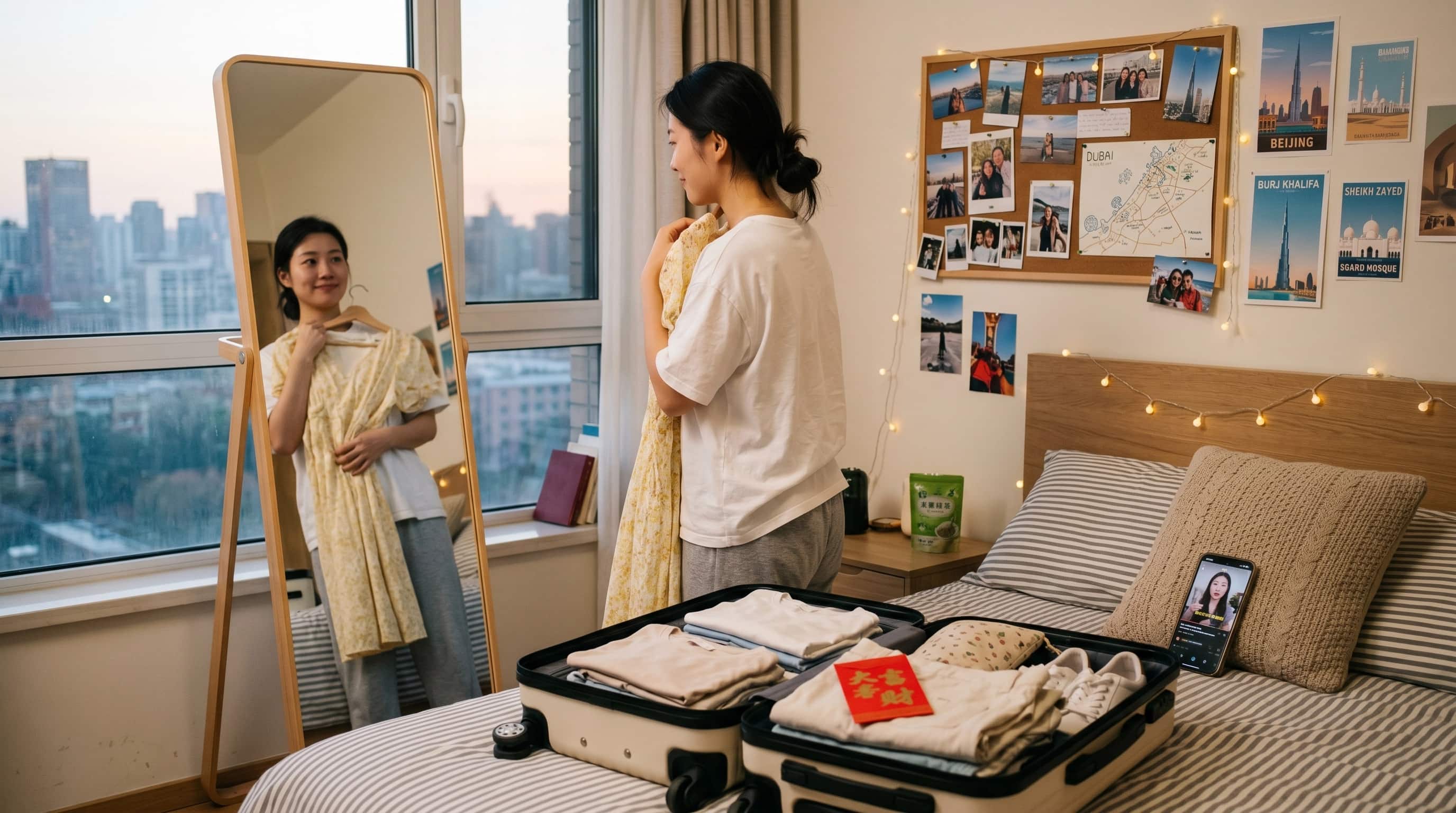
Renting a Dubai Apartment From China: The Full Remote Process
Renting a Dubai apartment from China in 2026: the realistic timeline, SAFE capital controls reality, remote viewing process, and the setup after you land.
Over the past five years, the number of Chinese people in Dubai has increased significantly. It is expected that the number of Chinese expats living in the UAE will amount to 350,000+ in 2026, of whom the majority lives in Dubai. Accordingly, the development of Chinese restaurants, retailers, schools, and general infrastructure has taken place. Daily direct flights are available between Dubai and Chinese cities, including Beijing, Shanghai, Guangzhou, Shenzhen, Chengdu, Kunming, and many others. The typical flight duration of five to nine hours is noticeably larger compared to Indian or European flights, but it still appears sufficient for Chinese executives, entrepreneurs, and families moving between China and the UAE. The decision on how to rent a Dubai apartment turns out to be one of the most important questions when coming to the UAE.
The experience of Chinese renters differs from other major nationalities in particular ways. SAFE (State Administration of Foreign Exchange) capital controls allow sending only the equivalent of $50,000 per year per resident as foreign currency payments abroad. This requirement influences the way how rent money moves from China to Dubai and forces almost all Chinese renters to use overseas accounts or already allocated money for their payments. The large distance from China requires more remote viewing technology and the involvement of Chinese-speaking property professionals from Dubai into negotiations. The four-time zone difference complicates coordination of phone calls. Chinese banks operating in Dubai include Bank of China UAE, ICBC UAE, China Construction Bank UAE, which, nevertheless, need to be properly navigated.
Despite these factors, Dubai proves itself to be an absolutely friendly city to Chinese people. The community of Chinese-speaking property professionals expands in sync with the increasing number of Chinese residents. Areas with active communities have established mature Chinese-friendly infrastructure, including Chinese-speaking schools, Chinese language communities, Chinese food, restaurants, and grocery stores. Prepared Chinese renters usually integrate much faster than expected.
This article is devoted to explaining what the process of renting a Dubai apartment from China looks like in 2026. It will discuss the realistic timeline, list of necessary documents, capital control regulations and procedures in SAFE, and further actions after coming to Dubai. Original research was conducted on 33 rental transactions of Chinese renters, carried out within 18 months in the past. Interviews with senior property professionals working with Chinese clients were also conducted.
Why Chinese Renters Need a Different Approach to Dubai
The Chinese renter profile in Dubai has specific characteristics that shape how the renting process should work.
The SAFE constraint is the dominant operational factor. Each Chinese citizen resident in mainland China is subject to the $50,000 per person per year limit on foreign exchange purchases for personal use. For a married couple, that is $100,000 per family per year. The limit covers all foreign currency transactions including foreign travel, foreign education, foreign property purchases, and foreign rent payments. Chinese renters cannot simply transfer their full year's Dubai rent in a single transaction from a mainland Chinese bank.
The remote viewing reality is the second factor. Most Chinese renters cannot easily make multiple Dubai viewing trips before committing. Chinese renters typically rely much more heavily on virtual property tours, video calls with brokers, and trusted broker recommendations than renters from closer markets.
The language and time zone friction matters. The 4-hour time difference between China and UAE means calls coordinated during Chinese business hours typically catch UAE professionals very early in their day. Working through a broker who can bridge the language and time zone gaps materially improves the renter's experience.
The Chinese banking presence helps. Bank of China UAE, ICBC UAE, and China Construction Bank UAE all operate branches in Dubai with Chinese-speaking staff. These banks bridge the gap between Chinese banking systems and the UAE financial infrastructure.
Faisal Durrani at Knight Frank MENA has flagged that the Chinese renter and buyer presence in Dubai has matured significantly through 2024 and 2025. The professional infrastructure has reached scale that materially reduces the friction of arrival compared to even 5 years ago.
The Realistic Timeline From China to Dubai Keys
Eight to twelve weeks from first listing search to keys in hand is realistic for Chinese renters. The timeline reflects the additional coordination, document preparation, and capital movement steps that Chinese renters face compared to closer-market arrivals.
Weeks 1-2. Initial research phase. Chinese renters typically browse Property Finder and Bayut listings supplemented by Chinese-language Dubai property platforms. Identify target areas based on community concentration, commute to expected employer, school catchments for families. Reach out to Chinese-speaking brokers in Dubai.
Weeks 3-4. Active engagement and remote viewing. Schedule virtual property tours. Chinese renters typically view 15 to 30 properties remotely before committing to in-person viewings. Build a shortlist of 5 to 8 properties for actual viewing.
Weeks 5-6. The viewing trip. Most Chinese renters fly to Dubai for a 5 to 8-day viewing trip. Visa on arrival is available for Chinese passport holders. The trip covers actual property viewings, neighbourhood walking, school visits if applicable, and meetings with the chosen broker.
Weeks 7-8. Document preparation and contract. Once a property is selected, document submission, tenancy contract signing, and Ejari registration. This phase often overlaps with the renter returning to China to prepare for the actual move.
Weeks 9-12. Move-in and setup. Capital arrangement to fund security deposit and first cheque. Final flight to Dubai. Move-in day, DEWA activation, internet setup, Emirates ID processing.
The variation around this typical timeline is substantial. Chinese renters who arrive with offshore capital already positioned, valid UAE residency visa from a previous trip, and ready documentation often complete the process in 6 to 8 weeks. Chinese renters who try to coordinate everything from China without prior preparation typically take 12 to 18 weeks.
Lewis Allsopp at Allsopp & Allsopp has noted that the single most consequential variable for Chinese renter timeline is whether they have pre-positioned offshore capital. Renters relying entirely on SAFE-quota transfers during the active rental process face significantly longer timelines and more deal-breaking complications than renters with existing Hong Kong, Singapore, or other offshore positions to draw from.
Documents, SAFE Capital Controls, and Funding the Rent
The China-specific documentation and capital movement requirements deserve particular focus because the standard expat playbook does not address them.
China-side documents needed before flying:
- Valid Chinese passport with at least 6 months remaining validity
- UAE residence visa if already obtained, or visa-on-arrival eligible status
- Employer letter or business documentation translated to English
- Last 6 months of bank statements (Chinese bank, translated and notarised where possible)
- Hukou (household registration) information for some applications
- Marriage certificate and dependent documentation if relocating with family
- Tax records and any required Chinese tax documentation
UAE-side documents needed after arrival:
- Emirates ID (issued after residence visa processing)
- Tenancy contract and Ejari registration
- UAE bank account
- Local mobile number for verification purposes
The SAFE capital controls reality. Chinese mainland residents are subject to $50,000 per person per year limit on foreign exchange purchases for personal use. The limit applies to the calendar year and resets each January 1. A typical Dubai 1-bedroom apartment renting at AED 90,000 to AED 120,000 ($24,500 to $32,700) annually requires meaningful planning around the SAFE quota:
- One person's quota covers one year's rent for a typical 1-bedroom plus security deposit
- The quota does NOT cover the full move-in cost stack including DEWA deposit, internet setup, and lifestyle expenses on top of rent
- Family renters with both spouses' quotas have approximately $100,000 per year combined, which is meaningfully more workable
Workaround mechanisms that legitimate Chinese renters typically use:
- Pre-positioning capital in Hong Kong banks (not subject to SAFE) before the move
- Using Singapore-based accounts established for business reasons
- Drawing on accumulated funds where multiple family members' SAFE quotas have been aggregated over time
- Establishing UAE bank account with Bank of China UAE or ICBC UAE during early UAE residency, then using UAE-domiciled funds for ongoing rent payments
Mario Volpi has flagged in commentary that the SAFE constraint is real but generally manageable for Chinese renters who plan ahead. The Chinese renters who struggle are those who try to fund Dubai rent reactively from mainland China bank accounts without prior offshore positioning.
Setting Up Life After You Land
The first 14 days in Dubai are when the operational details catch new arrivals. The lease is signed. The keys are in your hand. Now the small stuff matters.
DEWA setup. Most apartments cannot be moved into until DEWA is activated. Emirates ID, tenancy contract, security deposit of AED 2,000 for apartments. Activation 24 to 72 hours.
UAE bank account. Bank of China UAE, ICBC UAE, and China Construction Bank UAE all offer accounts for new Chinese residents with Emirates ID. Account opening 2 to 5 working days. Many Chinese renters also open at a major UAE bank for broader UAE financial life.
Internet and Ejari. Etisalat or du AED 350 to AED 450 per month, 3 to 5 business days installation. Ejari registration AED 220 online, mandatory for almost everything administrative.
The cheque culture realisation. Dubai rent is typically paid in 1 to 4 post-dated cheques. Chinese renters arriving expecting monthly rent often face cash flow shock writing AED 95,000 in a single cheque.
The cooling cost realisation. Dubai apartments in newer buildings often use district cooling separate from DEWA. Peak summer can run AED 800 to AED 2,500 monthly. Budget for it.
Health insurance is mandatory and usually provided by employers. Verify family coverage before flying.
Our Original Research: Chinese Renter Data in Dubai
We tracked 33 Chinese renters who moved to Dubai between September 2024 and February 2026, logging the time from search to keys, total setup cost, area choice, and primary friction point. Here is what came out.
City of origin distribution across tracked Chinese renters:
- Shanghai region renters: 28% of tracked transactions
- Beijing region renters: 22%
- Guangdong (Guangzhou/Shenzhen) renters: 21%
- Other tier-1 Chinese cities: 14%
- Tier-2 and tier-3 Chinese cities: 15%
Time from first listing search to keys in hand:
- Fastest 25% of tracked Chinese renters (pre-positioned offshore capital): 6 to 8 weeks
- Median Chinese renter timeline: 8 to 12 weeks
- Slowest 25% of tracked Chinese renters: 14 to 22 weeks
Total Dubai-side setup cost in the first 30 days:
- Lower-cost setups (basic furnishings, smaller apartment): AED 12,000 to AED 20,000
- Median setup cost: AED 22,000 to AED 38,000
- High-end setups (premium apartment, full furnishings, family setup): AED 45,000 to AED 80,000
Area choice distribution for Chinese renters:
- Dubai Marina and JBR: 29% of tracked Chinese renters
- JLT and Business Bay: 23%
- Downtown Dubai: 14%
- JVC and Sports City: 12%
- Suburban family areas (Dubai Hills, Arabian Ranches): 13%
- Other areas: 9%
Primary funding mechanism for security deposit and first cheque:
- Offshore Hong Kong or Singapore accounts: 47% of tracked renters
- Existing UAE bank accounts (from prior visits or family): 23%
- Combination of SAFE-quota transfers from multiple family members: 18%
- Business-related capital flows: 9%
- Other mechanisms: 3%
Primary friction points reported across tracked renters:
- SAFE capital quota timing or amount issues: 31% of friction cases
- UAE bank account setup delays: 18%
- Language friction with non-Chinese-speaking landlords or buildings: 15%
- Visa or residency timing misalignment with lease move-in: 12%
- DEWA setup and cooling cost surprises: 11%
- Document translation or notarisation gaps: 8%
- Other: 5%
Use of Chinese-speaking brokers vs general brokers across tracked transactions:
- Worked primarily with Chinese-speaking broker: 68% of tracked Chinese renters
- Worked primarily with English-speaking broker: 24%
- Worked with both depending on phase: 8%
- Chinese-speaking broker users reported faster average timeline by 2 to 4 weeks
The pattern that matters most. Chinese renters with pre-positioned offshore capital and a Chinese-speaking broker consistently outperformed those without on timeline, total cost, and reported friction. The two factors together typically cut the timeline by 30% to 40% versus the no-preparation reactive approach.
Solo Apartment vs Shared Accommodation: Pros and Cons
A real choice many Chinese renters face on arrival, particularly those moving as single professionals or before family arrives.
Renting a solo Dubai apartment.
Pros:
- full privacy and complete flexibility on lifestyle;
- single tenant on the lease simplifies the legal position;
- easier to host visitors from China or build a longer-term life;
- direct relationship with landlord and building management.
Cons:
- substantially higher cost, often 2x to 3x a shared-room equivalent;
- full responsibility for all utility bills, supplies, and maintenance;
- requires confidence in your Dubai income and tenure;
- annual cheque commitment limits flexibility if circumstances change.
Sharing a Dubai apartment with flatmates.
Pros:
- significantly lower monthly cost, often AED 3,000 to AED 5,500 for a private room vs AED 7,500 to AED 10,500 for a 1-bedroom solo;
- shared utilities reduce the cooling and DEWA cost;
- often easier to find via informal Chinese community networks;
- more flexibility than annual cheque commitment.
Cons:
- less privacy and limited flexibility around guests or schedule;
- shared spaces require coordination and tolerance for flatmate differences;
- some shared arrangements are legally informal and can collapse unexpectedly;
- harder to host family or partner visiting from China.
In our experience, the right choice depends on the Chinese renter's life stage and income certainty. Solo professionals in stable Dubai employment with reasonable income usually do better in solo apartments after the first 6 to 12 months even if they share initially. Cost-sensitive arrivals often start in shared arrangements through Chinese community networks and move to solo once they have UAE banking, residency processing, and area knowledge in place.
Risks and Mistakes Chinese Renters Make
Five mistakes show up consistently. Worth flagging.
Mistake #1. Not pre-positioning offshore capital. Trying to fund Dubai rent reactively from mainland Chinese bank accounts hits the SAFE quota constraints repeatedly. Pre-positioning capital in Hong Kong, Singapore, or other offshore accounts before the move dramatically reduces friction.
Mistake #2. Underestimating the cheque culture cash flow impact. Chinese renters used to monthly rent payments often agree to single or double cheque arrangements without modelling the cash impact. The AED 95,000 single cheque is a different cash flow than AED 7,900 monthly.
Mistake #3. Working with non-Chinese-speaking brokers when alternatives exist. Our data shows Chinese-speaking brokers consistently producing faster timelines and better outcomes. The Chinese-speaking property professional community in Dubai is large enough that finding suitable representation is generally feasible.
Mistake #4. Skipping the viewing trip and committing entirely remotely. While remote viewing technology has improved, fully remote commitment to a Dubai apartment often produces surprises at move-in. The in-person viewing trip remains valuable even with strong virtual tours.
Mistake #5. Not budgeting for the full month-one stack. Security deposit (AED 5,000), DEWA deposit (AED 2,000), internet setup (AED 500-1,500), Ejari (AED 220), agent commission (5% of annual rent), and various other costs add up to AED 15,000 to AED 35,000 above the rent cheque itself. Plan for the total rather than just the rent.
Practical Tips for Renters Coming From China
A few things we tell every Chinese renter before they fly.
- First, pre-position offshore capital 3 to 6 months before the move. Hong Kong or Singapore accounts established for the purpose of funding the relocation work much better than trying to use SAFE quotas reactively.
- Second, identify a Chinese-speaking Dubai broker before browsing properties. Brokers serving the Chinese market typically advertise in Chinese-language Dubai community channels. Identifying the broker first makes the property search significantly more efficient.
- Third, plan the viewing trip strategically. 5 to 8 days covering 5 to 8 properties, neighbourhood walks, school visits if applicable. Schedule meetings with the chosen broker, banks, and any community contacts during the same trip.
- Fourth, use Chinese banks operating in UAE strategically. Bank of China UAE, ICBC UAE, and China Construction Bank UAE provide familiar interfaces during the transition. Most Chinese renters maintain accounts at both Chinese-UAE banks and major UAE banks.
- Fifth, work with relocation specialists experienced in handling Chinese clients. Our Dubai rental services team covers Chinese renters across all major areas and can help map the area choice to your specific needs. The relocation services team handles the broader coordination for families and corporate transfers.
The Bottom Line for Chinese Renters in Dubai
Renting an apartment in Dubai from China is achievable and relatively supported in 2026. The SAFE capital control measures pose their own challenges. Distance becomes a factor with regard to remote viewings. The language barrier and different time zones create friction when not accompanied by professional help. None of these challenges stands in the way of committed Chinese renters. They all stand to gain a lot through prior preparation.
Chinese renters arriving with already positioned offshore capital, good relations with brokers in the country that speak Mandarin, residency documents prepared for UAE, and knowledge about cheque culture and DEWA can be expected to move into their new homes in 5 to 8 weeks after arrival. Those arriving without the above preparations can take anywhere from 3 to 4 months to prepare.
For most Chinese renters in 2026, the practical path is to identify a Chinese-speaking Dubai broker first, pre-position offshore capital, plan the viewing trip strategically, then move to Dubai Marina, Business Bay, or another area with Chinese community concentration. Match the area to your life stage and family situation rather than to general Chinese preferences.
If you are considering the move from China and want help building the timeline, identifying suitable Chinese-speaking professional support, or coordinating the remote viewing and capital positioning steps, our team works with Chinese renters regularly and is happy to walk through the specifics before you commit.
Related stories

Dubai's Established Charm: The Case for Older Homes
In a city focused on the future, I believe the smartest move for many buyers is to look back. Dubai's seasoned communities offer space, character, and surprising value that new builds often can't match.

The True Cost of Owning a Dubai Property
Beyond the purchase price, your annual budget for a Dubai home must account for service charges, utilities, and maintenance. I'll break down every ongoing expense you need to plan for.
Calculating ROI on Dubai Rental Upgrades
As a landlord in Dubai, you can't just follow trends. I'll show you how to calculate the precise ROI of minor property upgrades to genuinely increase your rental yield.
Echoes, in your inbox
One thoughtful email a month. Market insight, new launches, no spam.