

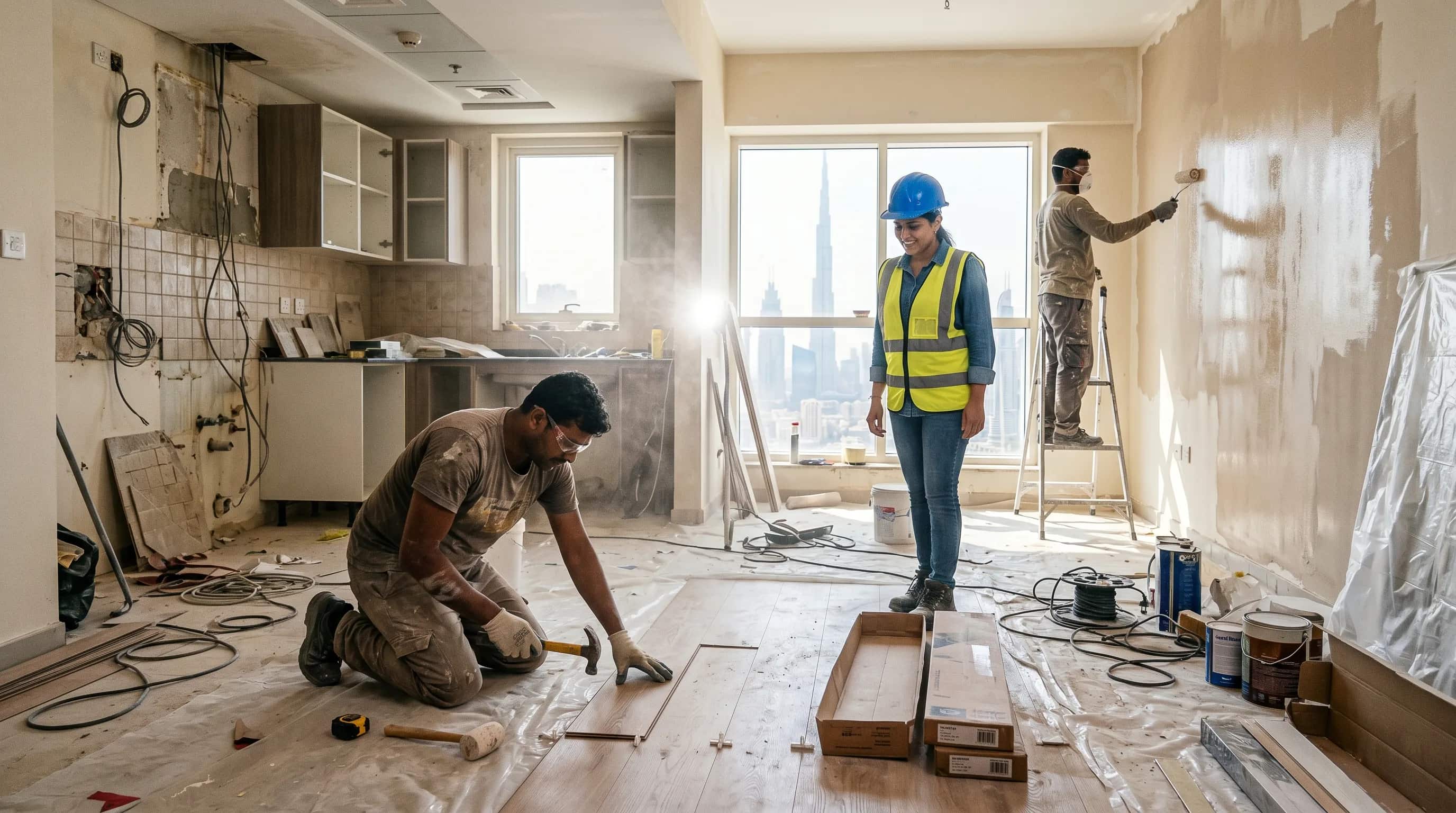
Renovating a Resale Property in Dubai: Costs, Permits, and ROI
The renovation of an outdated apartment has merit to it. Resale apartments, especially the old ones, generally sell at reduced prices simply due to their age, and a smart renovation could…
The renovation of an outdated apartment has merit to it. Resale apartments, especially the old ones, generally sell at reduced prices simply due to their age, and a smart renovation could make up for this deficit, turning an outdated apartment into a more appealing home, a more profitable rental or simply an increased-value asset. This is a good example of the old value-add principle, which involves buying a good apartment at discounted prices, renovating it, and making money from this very price differential. If done properly, this brings profits, but otherwise, losses are inevitable.
A renovation of a resale unit in Dubai consists of three essential factors: costs, permits, and payback. The former are unpredictable and likely to rise, while the latter are stricter than what some beginners expect as Dubai doesn't tolerate random alterations. And finally, a return is needed as a good renovation should have a positive ROI, which isn't always possible. When all three factors are managed correctly, the result is profitable. If any of these are dealt with improperly, it ends badly.
And the goal of this article is to address these three elements in order: to explain why the renovation is worth it; what permits and approvals should be obtained before work begins; standard cost structures for renovation projects; and whether such renovations ever pay, with possible mistakes that might make them unprofitable. Some important preliminary information needs to be given. First of all, renovation costs differ greatly and depend on numerous variables, so every figure here is provided just to give an idea and should be confirmed with actual bids. Permits are not constant and differ between buildings and types of work, so check the latest ones with the developer, community management and municipality. Return-on-investment data should be treated similarly and used as guidelines.
Why Renovate a Resale at All?
Resale and older properties have one big thing going for them, they are often cheaper than newer equivalents, sometimes meaningfully so. The trade is condition. A unit that has not been touched in years, with a dated kitchen, tired bathrooms, and old finishes, sells for less than the same space done up nicely, and that price gap is the opportunity a renovation goes after.
For an investor, this is the value-add play. You buy a fundamentally sound unit below the price a refreshed one would fetch, spend sensibly on improving it, and aim to capture more value than you spent, either as a higher resale price or as higher rent and lower voids. It pairs naturally with buying below market in the first place, which is why value-add and distressed buying often go together, and our distressed property deals selection is exactly the kind of below-market stock that can suit a renovate-and-add-value approach, as long as the property is sound underneath.
Here is why people renovate a resale:
- It is cheaper to buy. Dated units sell below refreshed ones, leaving room to add value.
- The value-add gain. Spend less on the work than it adds in price or rent, and you capture the difference.
- Higher rent. A refreshed unit can command more rent and sit empty for less time.
- Better resale. A done-up property sells faster and higher than a tired one in the same building.
- Make it yours. For an owner-occupier, renovation turns a compromise into the home you actually want.
- Buy below, lift to standard. Pairing a below-market purchase with a sensible refresh is a proven approach.
None of this is automatic, which is the theme of the whole guide. The property ownership and community framework you are working within is set out through the UAE government portal, and renovating within it has rules, costs, and limits that decide whether the value-add is real. A renovation that is too expensive, unapproved, or pitched above what the building can support does not add value, it destroys it.
So the honest starting point is that renovating a resale can be a genuinely smart move, the value is real when the sums work, but it is a calculated play, not a sure thing. The price gap between tired and refreshed is the prize. The costs, the permits, and the ROI are what decide whether you actually win it, and that is what the rest of this covers.
Permits and Approvals: Get These First
Here is where newcomers get caught out. Dubai does not let you renovate freely. The emirate has real rules about what you can change and who must approve it, and starting major work without the right approvals can mean fines, being ordered to undo the work, and serious problems when you come to sell.
The approvals depend on the scope. For cosmetic work, paint, flooring, non-structural updates, you usually still need a no-objection certificate from your developer or the building's owners association, because communities control what owners do to their units. For anything bigger, moving or removing walls, changing layouts, plumbing or electrical work, you typically need a permit from Dubai Municipality on top, and the work must be done by an approved, licensed contractor. Utility changes bring the relevant authority into it too. The exact requirements vary by building, by community, and by the work, and they change, so the first step in any renovation is to find out precisely what your specific project needs.
Here is the approvals picture:
- Community NOC. Your developer or owners association usually must approve the work, even cosmetic work.
- Municipality permit. Structural or major changes generally need a Dubai Municipality permit on top.
- Utility approvals. Electrical or plumbing changes bring the relevant utility authority into the process.
- Licensed contractors. Major work must be done by approved, registered, and insured contractors, not anyone cheap.
- Building rules. Communities often restrict what you can do, and when, including working hours and noise.
- Verify the specifics. Requirements vary by building and work, so confirm yours before you start anything.
The reason this matters so much is the cost of getting it wrong. Unauthorized work can be fined, may have to be reversed at your expense, and tends to surface at resale, because a buyer's due diligence and the transfer process can flag unapproved changes, holding up or sinking your sale. The official property and registration framework sits with the Dubai Land Department, and a clean, approved renovation keeps your unit's records and saleability intact, while an unapproved one can quietly create a problem you only discover when you try to sell.
Because all of this is part of buying and improving a ready, existing property, it is worth approaching the whole thing, purchase and renovation, as one process, and our ready property service is built around exactly that kind of secondary-market buying, where knowing the renovation rules before you commit is part of buying well. The rule to carry away is simple, approvals first, always, before a single wall comes down.
What It Actually Costs
Renovation cost is the question everyone asks and the one with the least tidy answer, because it depends entirely on scope and quality. Still, it helps to think in tiers, from a light refresh to a full gut, each with a very different price.
A cosmetic refresh, repainting, new flooring, light fittings, minor updates, is the cheapest, often somewhere in the region of AED 50 to 150 per square foot, though this varies widely. A mid-level renovation, redoing the kitchen and bathrooms and upgrading finishes, costs more, perhaps AED 150 to 350 per square foot. And a full gut renovation, changing layouts, replacing everything, doing structural work, is the priciest, easily AED 350 to 700 or more per square foot at the higher end. Kitchens and bathrooms are the most expensive areas per square foot in any renovation, because of the plumbing, the fittings, and the finishes. On top of the build cost sit design or architect fees for major work, the approval and permit costs, and, always, a contingency.
Here is the rough shape of the costs:
- Cosmetic refresh. Paint, flooring, and light updates, often around AED 50 to 150 per square foot.
- Mid-level renovation. New kitchen, bathrooms, and finishes, perhaps AED 150 to 350 per square foot.
- Full gut renovation. Layout changes and structural work, easily AED 350 to 700 or more per square foot.
- Kitchens and bathrooms. The priciest areas per square foot, wherever your project sits on the scale.
- Design and permits. Architect or design fees for major work, plus the approval and permit costs.
- Contingency. A ten to twenty percent buffer, because renovations almost always overrun.
That contingency line is not optional, it is essential, because renovations overrun more often than they come in on budget. Hidden problems behind walls, price changes, scope creep, and delays all push costs up, and a project planned to the last dirham with no buffer is a project heading for a nasty surprise. Build in ten to twenty percent and treat it as part of the real cost, not a maybe.
Because getting the work itself done well, on budget, and to the right standard is its own skill, many owners use a fit-out or renovation company to design, cost, and manage the project, and our fit-out service does exactly that, which also helps keep the spending focused on what actually adds value rather than on what simply runs up the bill. The honest takeaway on cost is to get real quotes for your specific scope, add a proper contingency, and never trust a per-square-foot rule of thumb, including this one, as anything more than a rough starting point.
Does It Actually Pay? The ROI Question
Here is the question that decides everything, does the renovation add more value than it costs? Because that, and only that, is what makes a renovation a good investment rather than an expensive way to improve a property you will sell at a loss anyway.
The logic is simple even if the answer is not. You spend on the work, and the property is worth more or rents for more as a result. If the value or rent uplift comfortably beats the cost, the renovation paid. If it does not, it lost money, however nice the result looks. The improvements that tend to pay best are the visible, high-impact ones, kitchens, bathrooms, flooring, paint, and lighting, because they change how a property feels and shows for a relatively contained spend. The ones that tend not to pay are over-personalized choices, expensive structural changes that do not add proportional value, and, above all, over-improving beyond what the building and area can support.
Here is what tends to pay, and what does not:
- Kitchens and bathrooms. The highest-impact spend, usually recovering well in value or rent.
- Flooring, paint, and light. Cheap relative to their effect on how a property shows and feels.
- Decluttering and presentation. The cheapest improvement of all, often with an outsized effect on sale.
- Over-personalization. Bold, taste-specific choices that the next buyer or tenant may not share.
- Over-improving for the area. Luxury spend in a mid-market building rarely comes back in full.
- Heavy structural change. High cost that does not always add value to match.
The single biggest ROI trap is the building's ceiling. Every building and area has a price level the market will pay, and renovating a unit far above that level does not lift it past the ceiling, it just spends money you cannot recover. A beautiful, high-end renovation in a modest building will not sell for high-end money, because buyers price the building and the area, not just your finishes. So the smartest renovations lift a tired unit up to the area's standard, not past it. For resale especially, this is the difference between a renovation that helps you sell higher and faster and one that simply costs you, and our property selling service can advise on what a given building will actually support before you spend.
The honest way to handle ROI is to run the numbers before you start. Estimate the realistic value or rent uplift, compare it to the full renovation cost including contingency, and only proceed if the gap is genuinely in your favour. Picture buying a tired unit well below a refreshed one, spending sensibly to lift it to standard, and selling or letting at the refreshed level, that is the value-add working. Spend more than the uplift, or push past the building's ceiling, and the maths simply does not.
How to Renovate Without Losing Money
So how do you renovate a resale and actually come out ahead? The method is mostly discipline, getting the boring things right, keeping the spend focused, and respecting the limits, so the value-add stays an add and never becomes a loss.
We lined up the rules for renovating without losing money, each on one line:
- Approvals first: get the NOC and any permit before you start, since unauthorized work means fines and resale trouble.
- Licensed contractors only: use registered, insured firms, because cheap unlicensed work usually costs more to fix.
- Budget a contingency: add ten to twenty percent, as renovations almost always overrun.
- Spend on high-impact areas: kitchens, bathrooms, floors, and light return the most, so prioritize them.
- Renovate to the area's standard: do not over-improve past the building's ceiling, or you will not recover it.
- Count the void cost: factor the income or use you lose while the unit is being worked on.
A few of these deserve a closer word. The void cost is one people forget, because a property being renovated usually cannot be lived in or let, so there is a stretch of weeks or months with no income or use while the costs of owning it continue, and that lost time belongs in your sums. The contingency is another, because the question is not whether a renovation will throw up a surprise but when, and a buffer is what keeps a surprise from becoming a crisis.
Utility work is worth flagging on its own, since changes to electrical or plumbing systems are exactly the kind of work that needs proper approval and a licensed hand, not a cheap shortcut. Anything touching power or water runs through the relevant authority, with DEWA handling electricity and water, and getting these changes done properly and approved protects both your safety and your saleability. Cutting corners on the systems behind the walls is exactly where unlicensed, unapproved work causes the most damage and the biggest resale problems later.
The thread through all of it is discipline over excitement. It is easy, mid-renovation, to keep adding, to upgrade past the plan, to chase a finish the building does not justify. The owners who do well are the ones who decide the scope and budget up front, based on the area's ceiling and a real ROI calculation, and then hold the line. The renovation that pays is almost always the disciplined one, not the ambitious one.
What We Would Actually Do
As an overall assessment of this scenario, renovating a second-hand property in Dubai could be seen as a wise move in creating a value add, as long as all expenses, permits and ROI projections are matched. The difference between an old and a renovated house is where the profit lies. Quotation with a contingency, proper permits before starting the process, and the level of renovation matching the standard of the building but not exceeding it allows making this profit.
For a friend who considers renovating a second-hand property, we will provide three recommendations. Firstly, ensure that you get all approvals for the project – this includes getting a NOC for the community and permits from municipality and working only with licensed and insured companies. Otherwise, you will have problems with penalties, half-done projects and resale process later on. Secondly, realistically evaluate your ROI prior to investing money – compare the estimated increase in either value or rent with the total cost (including contingency) and only undertake the project if the profit is clear. Thirdly, do not overbuild – improve the unit up to the standard of the building but not more because you do not earn on excessive expenditure.
As for the two secondary considerations in the budget, there is contingency, as it is always possible to exceed the budget in renovations. And there is vacancy, as it needs to be calculated in advance how much will you lose during this time frame when the apartment cannot be used or rented out.
And the main mistake that is often made by owners is improving apartments for their pleasure and beyond what building standards allow. In the end, owners renovate just for fun and expect market to pay for it back to them. But if ROI is what owners seek to reach, then do it based on reality, not desires.
If you want help judging whether a renovation pays on a specific resale unit, from the buying to the build to the realistic uplift, that is exactly the kind of thing we do. Our property buying service brings an honest eye to whether the value-add maths actually works.
And if you want a straight conversation about a resale-and-renovate plan for your budget and goals, we are glad to help. Get in touch and we will take it from there.
Related stories

Dubai's Established Charm: The Case for Older Homes
In a city focused on the future, I believe the smartest move for many buyers is to look back. Dubai's seasoned communities offer space, character, and surprising value that new builds often can't match.

The True Cost of Owning a Dubai Property
Beyond the purchase price, your annual budget for a Dubai home must account for service charges, utilities, and maintenance. I'll break down every ongoing expense you need to plan for.

Calculating ROI on Dubai Rental Upgrades
As a landlord in Dubai, you can't just follow trends. I'll show you how to calculate the precise ROI of minor property upgrades to genuinely increase your rental yield.
Echoes, in your inbox
One thoughtful email a month. Market insight, new launches, no spam.