

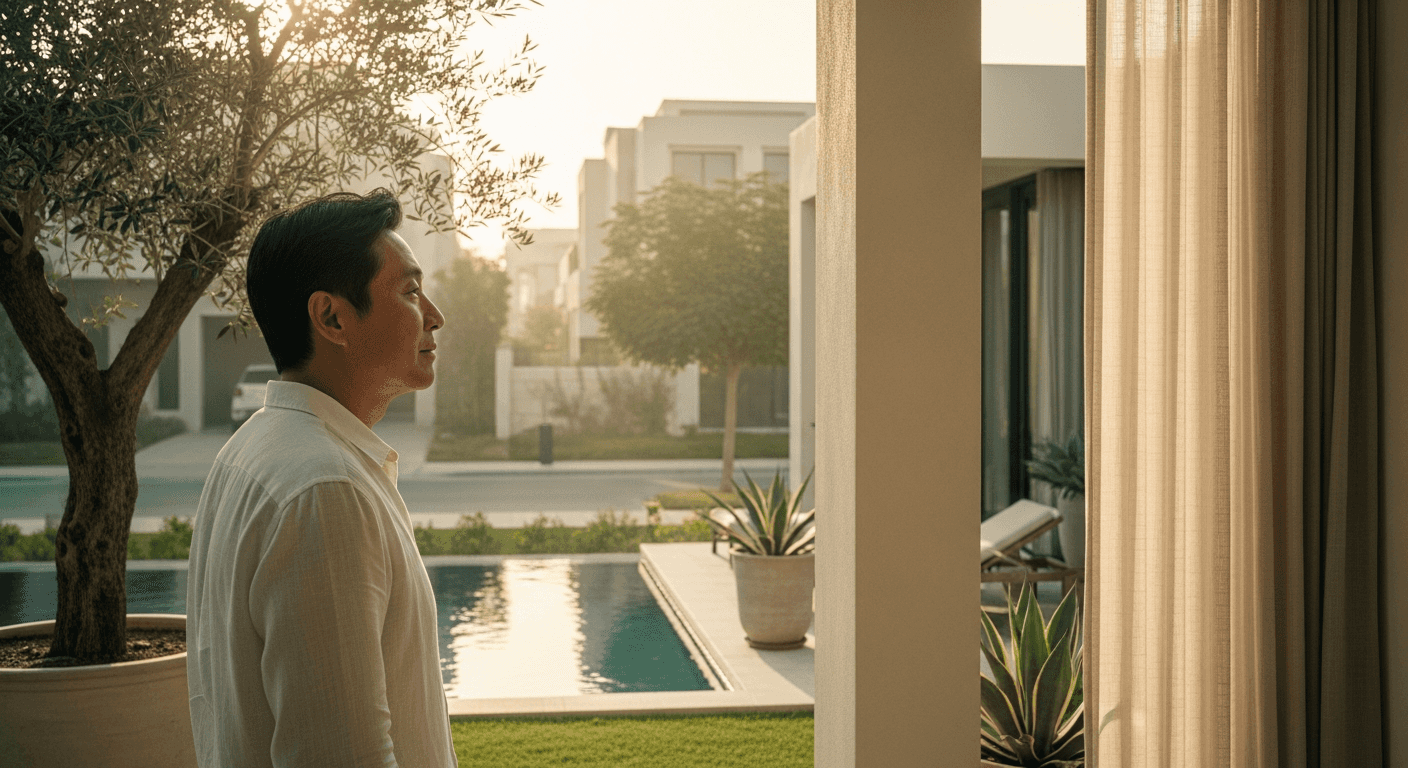
More Than a Villa: Finding Dubai's Best Communities
A home is more than just walls and a roof; it's the connections you forge. I explore the Dubai villa communities that excel at creating a genuine neighbourhood spirit.

For many of us who have made Dubai our home, the search for property goes far beyond architecture and square footage. We’re looking for a place to belong. This is where the concept of `connected villa living` becomes not just a marketing term, but the defining factor between a house and a home.
Here's what we'll explore in this guide:
- The real meaning of a 'connected community' in the context of Dubai.
- A deep dive into the original blueprint: the enduring appeal of Arabian Ranches.
- The modern evolution of community living at Dubai Hills Estate.
- How challenger communities like DAMAC Hills and Al Furjan build their spirit.
- The practical costs: how service charges fund the fellowship.
- The essential ingredients for successful resident engagement.
- A look at the next generation of community-focused developments.
- My final verdict on where to find your perfect neighbourhood tribe.
The True Meaning of Community in Dubai
When I first started in Dubai real estate years ago, the focus was overwhelmingly on the product: the scale of the villa, the gloss of the marble, the view from the window. These things are still important, of course. But over the last decade, I’ve seen a profound shift in what our clients prioritise. The conversation has moved from 'what am I buying?' to 'how will we live here?'. In a city that attracts people from every corner of the globe, creating a sense of place and fostering genuine connections has become the ultimate luxury. A strong community provides an anchor, a support system, and a social life right on your doorstep — priceless assets, especially for families new to the city.
So, what separates a truly connected neighbourhood from a mere collection of houses? It isn't just about having a shared pool and a gym. It’s about the deliberate, thoughtful design and management that encourages interaction. It's the walkable pathways that lead to a central park, the local café where you become a regular, the well-organised `family-friendly community activities` that fill your weekends. It’s the organic blossoming of resident-led book clubs, jogging groups, and street parties. True `resident engagement Dubai` is a partnership between a proactive developer and an active, invested population.
In my view, the master developers who understood this earliest are the ones whose communities remain the most sought-after today. They recognised they weren't just in the construction business; they were in the business of placemaking. They invested in full-time community management teams, planned extensive events calendars, and designed public realms that invited people to linger and connect. This foresight created a powerful brand loyalty and a resilience in property values that has outlasted market cycles. It's the human infrastructure, not just the physical, that creates enduring value.
The Original Blueprint: Arabian Ranches
 Featured project
When you talk about `neighbourhood spirit communities` in Dubai, the conversation almost always starts with Arabian Ranches. Developed by Emaar Properties in the early 2000s, it set the benchmark for suburban family life in the emirate, and honestly, it’s a standard that many newer projects still aspire to. Driving through the mature, tree-lined streets of the original Ranches (now often called 'Ranches 1'), you get a sense of establishment that is rare and comforting. This isn't a place that feels brand new; it feels settled, lived-in, and loved. This is the result of over two decades of families putting down roots.
The genius of Arabian Ranches lies in its simple, human-scale design. Emaar created a masterplan that prioritised community from day one. The Arabian Ranches Golf Club is its green heart, but radiating from it are countless parks, lakes, and swimming pools, all connected by a web of walking and cycling trails. You don't have to drive everywhere. You can walk your kids to the school, stroll to the community centre for groceries, or cycle to a friend's house for a barbecue. This physical layout naturally encourages the casual, unplanned encounters that are the bedrock of neighbourhood life. The community centres in both Ranches 1 and 2 are genuine hubs, with restaurants, shops, and fitness centres that residents actually use daily.
This physical framework is brought to life by one of the most robust schedules of `community events Dubai villas` residents could ask for. Emaar's community management team is famous for its programming. We're talking about everything from large-scale celebrations for Christmas, Diwali, and Halloween, to regular farmers' markets, outdoor movie nights by the pool, and community-wide fun runs. These events are exceptionally well-attended because they are part of the social fabric of the community. Beyond the official events, Arabian Ranches has an incredibly strong substratum of resident-led activity. The community Facebook groups are legendary — a bustling digital town square for recommendations, lost pets, and organising informal get-togethers. This is the ultimate sign of a healthy community: when residents take ownership and build connections themselves.
The Modern Evolution: Dubai Hills Estate
If Arabian Ranches was the perfect first draft, then Dubai Hills Estate is Emaar’s magnificent, feature-packed second edition. It takes all the lessons learned from the Ranches and applies them on a much grander and more contemporary scale. Where the Ranches feels like a charming village, Dubai Hills feels like a self-sufficient green city. It's a vast, multifaceted community that offers a version of the villa lifestyle for almost every taste and budget, from compact townhouses in Maple and Sidra to the palatial mansions of Hills Grove Villas.
What sets Dubai Hills apart is the sheer ambition of its amenity offering. The developer didn't just include a park; they built Dubai Hills Park, an 180,000 square metre green lung with a skate park, splash pad, sports courts, and more. They didn't just build a retail centre; they built Dubai Hills Mall, a major destination with hundreds of stores and a cinema. The inclusion of a championship golf course, King's College Hospital, and multiple top-tier schools like GEMS Wellington Academy means that for many families, there is little reason to ever leave the community's boundaries. This 'city within a city' concept is incredibly powerful for fostering connection; shared reliance on these world-class facilities creates a strong common identity among residents.
“The best communities are not just built, they are programmed. The ongoing investment in events and resident communication is what transforms a development into a neighbourhood.”
The approach to `resident engagement Dubai` here is professional and polished. Emaar's community management team runs a slick operation, with a dedicated app for residents to book facilities, report issues, and stay updated on events. The events themselves are often larger and more spectacular than in older communities, reflecting the premium nature of the development. Think wellness festivals in the park, large-scale concerts, and holiday markets that feel like major public events. While some might argue this feels less 'organic' than the grassroots vibe of the original Ranches, the effect is undeniable. It provides a constant, reliable stream of high-quality `family-friendly community activities` that make it incredibly easy for new residents to meet people and feel part of something.
The Challenger Model: DAMAC Hills and Al Furjan
While Emaar has often been the standard-bearer for community living, other developers have carved out their own successful niches with different approaches. Two of the most interesting examples, in my opinion, are Damac Hills and Damac Hills II by Damac, and Al Furjan by Nakheel. They represent two distinct strategies for creating a vibrant neighbourhood. DAMAC has focused on 'destination amenities' — big, bold, headline-grabbing features that act as a powerful draw for residents. The Trump International Golf Club Dubai is the centrepiece of DAMAC Hills, but it’s complemented by unique attractions like the Malibu Bay wave pool, a skate park, stables, and a petting farm. These aren't just amenities; they are experiences.
This strategy creates natural gathering points. The wave pool on a Friday afternoon is a social hub for families, and the various sports courts foster friendly competition and team spirit. DAMAC's community management team is very active in using these spaces, programming a busy calendar of events, from outdoor cinema nights at the amphitheatre to seasonal festivals and sports tournaments. The result is a community that feels lively and full of energy. The vibe is perhaps a bit more resort-like and less understated than an Emaar community, but for many buyers, this is a huge part of the appeal. It offers a lifestyle that feels like being on a permanent holiday, which strongly encourages residents to get out and socialise.
In contrast, Al Furjan by Nakheel offers a more grounded, accessible, and quietly successful model of `connected villa living`. Its strength lies not in headline amenities, but in its incredibly thoughtful and practical master plan. The community is famous for its 'Quortaj' and 'Dubai' style villas and townhouses, many of which are arranged in terraces that back onto shared, landscaped walkways and gardens. This simple design feature is transformative. It creates semi-private communal spaces where neighbours' children can play together safely and adults can interact casually. This is a level of neighbourly connection that is harder to achieve in communities where every villa is an isolated island. Al Furjan also benefits from two excellent community retail centres, the Al Furjan Pavilions, and direct access to the Dubai Metro, making it one of the best-connected suburban communities. The neighbourhood spirit here feels very genuine and resident-driven, a sign of a master plan that put people first.
The Financials of Fellowship: Understanding Service Charges
It's wonderful to talk about lush parks, sparkling pools, and festive events, but these features don't appear by magic. They are funded by annual service charges paid by every homeowner. As a prospective buyer, understanding these fees is critical, not just for budgeting, but for gauging the quality of life you can expect. In Dubai, service charges are regulated by the Real Estate Regulatory Agency (RERA), and owners' associations must submit detailed budgets for approval. These fees are calculated on a per-square-foot basis against your property's total built-up area (BUA). My advice is to never look at the fee in isolation; instead, consider what it delivers.
A community with very low service charges might seem attractive initially, but it could also mean neglected landscaping, poorly maintained facilities, non-existent security, and a complete lack of community events. Conversely, a high fee isn't automatically a bad thing if it translates into pristine common areas, state-of-the-art gyms, robust security, and a community management team that is actively enhancing your living experience. The communities we've discussed generally fall into a reasonable mid-to-upper range, reflecting their investment in the 'software' of community life. For example, you might expect rates in Arabian Ranches or Dubai Hills to be between AED 3.50 and AED 5.50 per square foot, while a community with fewer large-scale amenities might be closer to AED 2.50 to AED 4.00.
To make this concrete, let’s break down the potential annual cost for a hypothetical villa. This illustrates what your investment in the community's upkeep and lifestyle might look like.
Sample Annual Service Charge Breakdown:
- Property: 4-bedroom villa in Dubai Hills Estate
- Built-Up Area (BUA): 3,800 sq. Ft.
- Assumed Service Charge Rate: AED 4.75 per sq. Ft./year
- Total Annual Service Charge: 3,800 sq. Ft. x AED 4.75 = AED 18,050
This annual fee is typically allocated across several key areas:
- Common Area Maintenance: ~30% (Landscaping, street cleaning, pathway repairs)
- Utilities: ~15% (Electricity and water for streetlights, pools, gyms)
- Security: ~20% (Manned gates, patrols, CCTV monitoring)
- Management & Admin: ~15% (Community management staff, office costs, insurance)
- Amenities & Lifestyle: ~10% (Pool/gym maintenance, event funding, decorations)
- Master Community Levy/Sinking Fund: ~10% (Contribution to the wider master plan and long-term capital repairs)
Viewing service charges through this lens transforms them from a simple cost into an investment in your lifestyle and, ultimately, your property's long-term value.
The Anatomy of Engagement: What Makes a Community Tick?
Having observed dozens of communities across Dubai over the years, I've come to believe that the most successful ones share a few non-negotiable ingredients. It's a formula that combines physical design, professional management, and resident participation. A developer can get one or two right, but it's the synergy of all elements that creates the magic. When clients ask me how to spot a truly vibrant community, I suggest they look for evidence of these key pillars. It's a checklist that we at Gaia Living use internally when evaluating the lifestyle quality of a neighbourhood.
First and foremost is Thoughtful Master Planning. This is the foundation. You can't retrofit a sense of community into a poorly designed, car-centric suburb. The best communities prioritise pedestrians with ample sidewalks, dedicated cycling tracks, and safe underpasses. They cluster amenities in central, walkable hubs rather than scattering them at the periphery. Small design choices, like front porches instead of high walls, or shared gardens instead of entirely private plots, can have an outsized impact on social interaction.
Second is Proactive Community Management. This is the engine room of resident engagement. A dedicated team that is empowered and well-funded to plan events, communicate clearly with residents, and swiftly address maintenance issues is essential. Developers like Emaar and DAMAC have invested heavily in their own management arms, ensuring a consistent standard of service and a packed events calendar. This professional touch elevates the resident experience from satisfactory to exceptional. This team also acts as a crucial liaison, listening to resident feedback and adapting their strategy accordingly.
Finally, and perhaps most importantly, is the space for Resident-Led Initiatives. The best community managers know that their role is to be a catalyst, not a controller. They create the conditions for residents to take the lead. This means supporting resident-run committees, providing community notice boards (both physical and digital), and allowing residents to book communal spaces for their own activities, like yoga classes or book clubs. A thriving ecosystem of resident WhatsApp and Facebook groups is one of the strongest health indicators of a community. This is where the true `neighbourhood spirit communities` are forged, turning neighbours into friends.
Essential Ingredients for a Connected Community:
- Walkable Design: Interconnected paths, shaded walkways, and centrally located parks and retail.
- Diverse Amenities: Facilities that cater to all ages and interests, from toddler playgrounds to teen skate parks and quiet gardens.
- Professional Management: A visible, responsive community management team with a clear communication strategy.
- Robust Events Calendar: A year-round schedule of both large festivals and smaller, regular gatherings.
- Digital Platforms: A user-friendly community portal or app for payments, bookings, and announcements.
- Empowered Residents: Encouragement and support for resident-led groups, clubs, and social initiatives.
Beyond the Big Names: Emerging Hubs of Connection
While the likes of Arabian Ranches and Dubai Hills Estate often dominate the conversation, Dubai's property landscape is constantly evolving. Several other established and emerging communities are making a strong case for themselves by prioritising connection and lifestyle. Jumeirah Golf Estates, for instance, was initially perceived purely as a haven for golf enthusiasts. However, over the years, it has blossomed into a fully-fledged family community. The central clubhouse serves as a fantastic social hub with restaurants, a gym, and pools, and its community management hosts a sophisticated calendar of events, from seasonal markets to culinary festivals, that extends a warm welcome far beyond the golfing fraternity.
Looking toward the future, it's fascinating to see how developers of new mega-projects are embedding the lessons of the past two decades into their master plans from day one. Areas like Dubai South, the vast district surrounding Al Maktoum International Airport, are a prime example. The Residential District within Dubai South is being meticulously planned with a focus on walkability, integrated public transport, and a tiered system of community amenities. The intention is to create a series of interconnected villages, each with its own character but sharing a common infrastructure of schools, parks, and retail. This is an attempt to build community at a city-wide scale, learning from the successes and challenges of earlier developments.
Another community that I believe deserves mention is Town Square by Nshama. Although it has a higher concentration of apartments and townhouses, its core philosophy is deeply rooted in community. The central Town Square Park is a masterpiece of public realm design, constantly buzzing with activity. With an outdoor cinema, a carousel, a splash pad, and dozens of surrounding cafes and restaurants, it functions as the neighbourhood's living room. The developer has been relentless in its focus on `family-friendly community activities` and providing amenities that are both high-quality and accessible. This approach has attracted a vibrant, youthful demographic and fostered a level of `resident engagement Dubai` that many more expensive villa communities could learn from. It proves that a strong community spirit isn't solely the preserve of the ultra-luxury market.
My Verdict: Finding Your Tribe in Dubai
After years of walking the streets, attending the events, and speaking with the residents of Dubai's many villa communities, my conviction remains firm: the right neighbourhood can transform your life here. The physical villa is just the starting point. The real value lies in the welcome you feel, the friendships you make, and the memories you create in the parks and pools just outside your door. The search for a home is a search for your tribe. The good news is that Dubai offers a fantastic array of options, each with its own distinct personality.
My professional guidance, tailored to different priorities, usually breaks down like this. For those seeking a timeless, established, and deeply rooted community feel with mature greenery and an almost village-like atmosphere, the original Arabian Ranches is still, in my opinion, unmatched. For families who prioritise modern design, world-class amenities on a grand scale, and the convenience of a self-contained 'city within a city', Dubai Hills Estate is the undisputed modern champion. It offers an aspirational lifestyle that is impeccably managed and incredibly comprehensive.
If your personality leans towards the energetic and you value unique, resort-style amenities, the lively environment of Damac Hills and Damac Hills II is a compelling choice. It delivers a fun-focused lifestyle with a constant buzz of activity. And for those who are looking for outstanding value, superb connectivity, and a community where neighbourly bonds are forged on shared walkways and in local parks, Al Furjan represents one of the smartest and most heartwarming choices on the market. It demonstrates that thoughtful design can be more powerful than extravagant features.
When choosing your villa, dedicate as much time to researching the community as you do the house itself. Visit on a weekend, talk to residents, check the state of the common areas, and look for signs of an active community life. This is the due diligence that pays the highest dividends in happiness. At Gaia Living, this is a core part of our advisory process — we don't just find you a property; we help you find your place. Browse our curated listings in these and other top Dubai communities to begin your search.
Sources
- Dubai Land Department (DLD): dubailand.gov.ae
- Real Estate Regulatory Agency (RERA): For information on service charge regulation.
- UAE Government Portal: u.ae
Questions, answered
- Which Dubai villa community is best for families?
- Communities like Arabian Ranches and Dubai Hills Estate are consistently top choices for families, offering mature greenery, excellent schools, large parks, and a packed calendar of family-friendly community activities. The choice often depends on whether you prefer an established, classic feel (Ranches) or modern, large-scale amenities (Dubai Hills).
- What are typical community service charges for a villa in Dubai?
- Villa service charges in Dubai typically range from AED 2.50 to AED 6.00 per square foot of the property's built-up area annually. For a 4,000 sq. Ft. villa, this could mean an annual fee of AED 10,000 to AED 24,000, covering security, landscaping, pool maintenance, and community events.
- Which developers are known for building strong communities?
- Emaar Properties is widely regarded as the leader in creating master-planned communities with strong resident engagement, as seen in Arabian Ranches and Dubai Hills Estate. Nakheel and DAMAC also have a strong focus on community, though with different approaches to amenities and event programming.
- Do community events really make a difference in choosing a home?
- In my experience, yes, absolutely. For many residents, especially expatriate families, organised community events are crucial for building a social network and feeling settled. This neighbourhood spirit is a huge factor in long-term happiness and can significantly influence a property's desirability and value.
- Are there more affordable villa communities with a good neighbourhood feel?
- Yes, communities like Al Furjan and the townhouse sections of DAMAC Hills II offer more accessible price points while still fostering a strong sense of community. Al Furjan, in particular, is known for its walkable layout and resident-led initiatives that create a very neighbourly atmosphere.
- How can I gauge a community's spirit before buying?
- I always advise clients to visit at different times, especially on a weekend afternoon. Walk through the parks, visit the community centre, and have a coffee. You can also look for official community social media pages or resident-run Facebook groups, which often give a transparent view of the day-to-day life and resident engagement.

Sophia profiles Dubai's villa communities — schools, commute times, green space, and the intangible feel of a neighbourhood. She writes for families putting down roots.
Related stories
Off-Plan vs Ready: The Dubai Investor's Guide
A detailed comparison for apartment investors in Dubai, weighing the capital appreciation potential of off-plan against the immediate returns of ready properties.
Clearing Disputes for a Smooth Dubai Sale
Unseen property disputes or financial encumbrances can derail your Dubai property sale. I'll share my strategic playbook for identifying and resolving these issues before they cost you time and money.
Selling Inherited Property in Dubai: The Complete Guide
Navigating the sale of an inherited property in Dubai requires a clear understanding of the specific legal and financial steps. This guide covers the entire process, from obtaining a succession certificate to the final transfer.
Echoes, in your inbox
One thoughtful email a month. Market insight, new launches, no spam.