

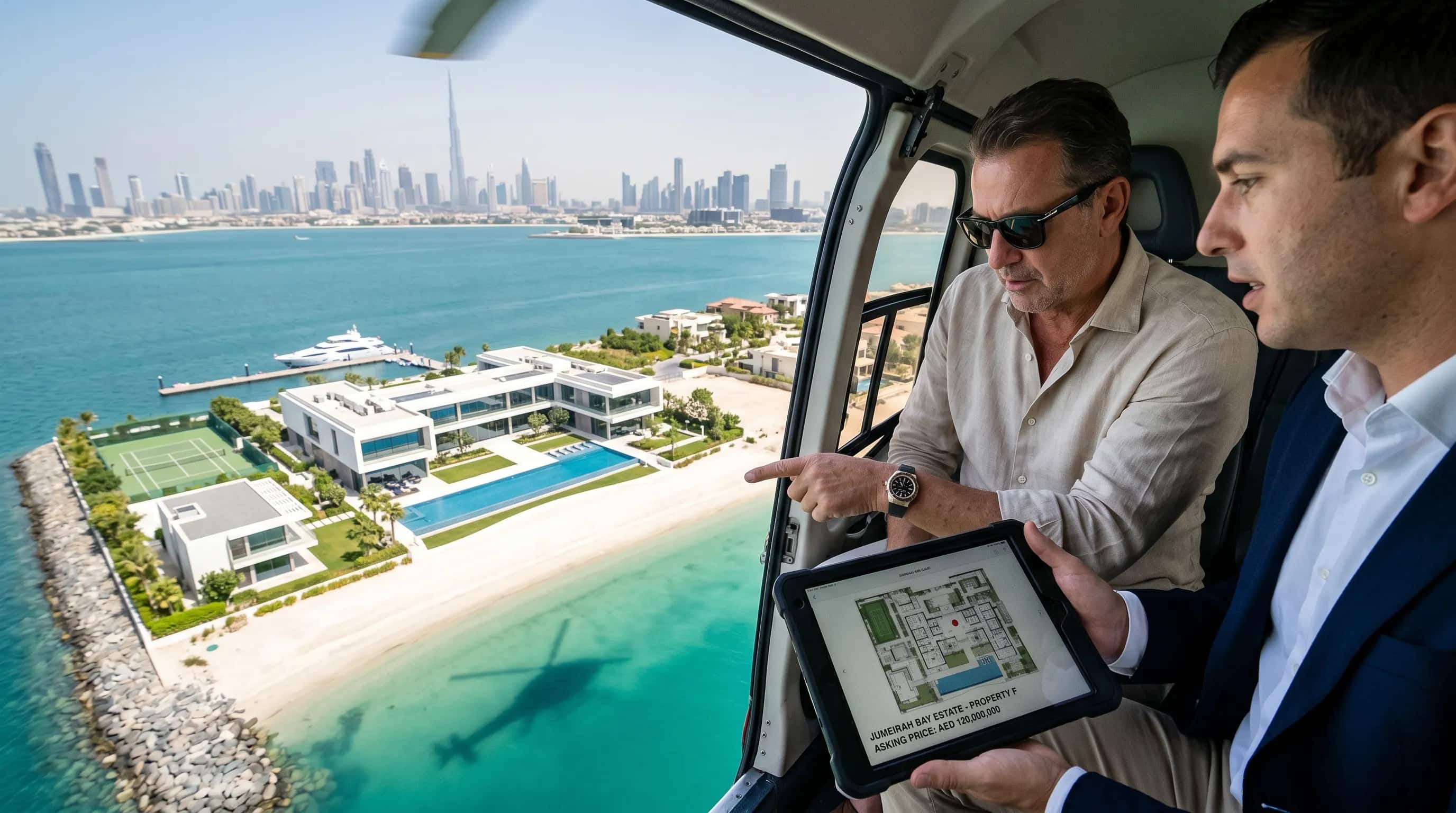
Luxury Houses in the UAE: What Rich Buyers Are Actually Looking For
UAE luxury buyers prioritize wellness (67%), work-from-home (58%), tech (51%). 87% satisfaction with priority alignment. What rich buyers want in 2026.
Most of the writing on UAE luxury property focuses on the product. The villas. The areas. The prices. The amenities. What gets less attention, and what actually drives the market, is the buyer side. What do wealthy individuals buying a luxury house in the UAE actually want? What are they willing to compromise on? What do they refuse to compromise on? What has shifted in the past three years in how they make decisions?
We’ve handled enough luxury house transactions across Dubai and Abu Dhabi to have a fairly clear view of what these buyers actually look for. The marketing version of the UAE luxury buyer is a wealthy international investor flying in to view villas and signing papers within a week. The reality is more nuanced. Most wealthy buyers we work with run a slow, careful, often-quite-personal process. The decision is rarely made on a single visit. The criteria are often counter-intuitive. The financial considerations matter less than people assume in the final choice, even though they matter a lot earlier in the process.
This article unpacks the buyer side of the UAE luxury house market. Who these buyers actually are, what genuinely drives their decisions, the practical criteria they apply, how their preferences have shifted in the past three years, our research on the patterns we see across actual transactions, and what reading the market from the buyer’s perspective tells us about where it goes next.
A note up front. This piece is about understanding the buyer side, not about telling buyers what they should want. The patterns we’ll describe are observations from actual transactions. They’re not universal. Every individual buyer has their own priorities. The value of looking at the aggregate patterns is in understanding what’s typical, what’s unusual, and what shifts have happened in the market that affect everyone selling and buying in this segment.
Lewis Allsopp, founder of Allsopp & Allsopp, has spoken publicly about how the UAE luxury buyer profile has shifted meaningfully over the past five years. The patterns he describes broadly match what we see. The conversation we’ll have with you here goes deeper into the specifics.
The UAE Luxury Buyer Landscape in 2026
The UAE luxury house market in 2026 attracts a diverse buyer pool. The headline groups:
• Wealthy GCC nationals from Saudi Arabia, Kuwait, Bahrain, Qatar, and Oman buying primary or secondary homes. This group has grown materially as a share of the UAE luxury market since 2020
• Indian ultra-high-net-worth families buying second homes, with significant flows from Mumbai, Delhi, Bangalore, and other major centres
• Russian and CIS buyers who became a major demand source from 2022 onward and remain active
• European executives and entrepreneurs based in the UAE long-term or buying for occasional residence
• North American buyers, including a growing population from the United States and Canada, often buying after relocating for tax or lifestyle reasons
• Chinese buyers with renewed interest in the UAE market as a hub for international assets
• Long-term UAE residents trading up from earlier purchases, often after 10 plus years of accumulating capital in the country
• African ultra-wealthy families particularly from Nigeria, South Africa, and Egypt, using UAE properties as portfolio and lifestyle assets
The buyer pool is materially more international than it was five years ago. The Russian and CIS surge of 2022-2023 has plateaued but the new buyers from those source markets have largely stayed. The Indian buyer flows have grown each year. The North American flow is one of the more interesting newer trends, driven partly by the long-stay visa programs and partly by US-based investors looking for geographic diversification.
What unifies these buyer groups is wealth above a certain threshold. The entry to the UAE luxury house segment is generally around AED 8 million to AED 10 million. Most active buyers in the segment have net worth comfortably above USD 25 million and many are well into the USD 100 million plus range. The UAE attracts a meaningful share of global ultra-high-net-worth families because of the tax structure, the political stability perceived by these buyers, the security environment, and the international flight connectivity.
Faisal Durrani, Knight Frank’s head of Middle East research, has consistently flagged that UAE luxury property has captured a growing share of global ultra-high-net-worth real estate spending. The trend has been particularly pronounced for buyers who previously concentrated their luxury property holdings in London, New York, or other historically dominant ultra-prime markets.
What Actually Drives Their Choices
The drivers behind luxury buyer decisions in the UAE are different from what the marketing material implies. The actual hierarchy of priorities from our transactions:
Privacy and security top the list far more often than amenity packages. Most wealthy buyers we work with care deeply about whether their property is observable, who has access to their compound or building, and how the security perimeter works. Beachfront positions are often less valuable to ultra-wealthy buyers than internal positions with thicker landscaping because the privacy is better.
Specific plot characteristics outweigh community amenities. Plot orientation, the actual view from the master bedroom rather than the marketing-photo view, the depth of the rear garden, and the relationship to neighbouring plots all matter more than community pools or gyms that the buyer’s staff will use more than the buyer.
School proximity matters enormously for buyers with school-age children. Even buyers who employ chauffeurs prefer short school commutes. This is one of the strongest single drivers of community choice for the under-50 buyer demographic.
The build quality and finish standards matter more than the brand. A villa with exceptional finish quality from a less-known developer often beats a branded property with average finish in the buyer’s actual decision, even though the branded property typically wins the marketing comparison.
Service charge predictability matters at the moment of purchase but less afterwards. Buyers ask about service charges in the diligence phase. Once they’ve bought, the actual charges relative to their wealth tend to fade into the background. But the moment-of-purchase friction is real and can sink deals.
Resale dynamics matter a lot, even for buyers who say they’re buying to keep. Almost every luxury buyer we work with eventually exits a UAE property even if they don’t intend to at purchase. Knowing the resale market is deep and that the property will move when needed is a quiet but powerful purchase driver.
The hierarchy varies by buyer group. GCC nationals weight family-compound suitability heavily. International ultra-wealthy buyers weight security and discretion heavily. Long-term resident buyers weight community quality and personal fit heavily. The common thread is that the marketing-pitched amenities matter less than the lived-experience details.
The Practical Checklist Rich Buyers Run
The diligence wealthy buyers actually run before committing to a luxury house purchase follows a fairly consistent pattern across the buyer groups. Our observation is that the strongest buyers run something close to the following:
1. Multiple visits at different times of day. Wealthy buyers almost never commit on a single visit. They visit morning, evening, weekend, and sometimes during specific events (like a Grand Prix weekend in Abu Dhabi or a major festival in Dubai) to understand the property in different conditions
2. Independent inspection by a third-party engineer or specialist. The developer’s representations are taken with caution. Independent verification is standard for purchases above a certain threshold
3. Service charge ledger review. Wealthy buyers often request 3-year historical service charge data and reserve fund status before committing. Sudden jumps in charges or under-funded reserves are red flags
4. Title and freehold verification through their own legal counsel. The title structure varies across UAE locations and zones. Wealthy buyers often pay for their own legal verification rather than relying on the seller or developer counsel
5. Neighbouring plot review. Who lives next door, what’s planned for adjacent plots, and how the immediate neighbourhood feels are all examined carefully
6. Community management review. Who runs the community, what their reputation is, and how disputes have been handled in the past are all part of the diligence
7. Resale comparables and recent transaction analysis. Even buyers who say they’re not interested in resale typically commission a comp study to understand the price they’re paying
8. Personal connection verification. Whether they know other residents in the community, whether their lifestyle network is already there, and whether they’ll know neighbours often shapes the choice between competing options at similar prices
This is meaningfully more diligence than typical buyers run on lower-tier properties. It also takes time. A typical wealthy buyer transaction in the UAE luxury segment runs 4 to 12 weeks from first visit to closed transaction, not the 1 to 2 weeks that less-experienced observers sometimes assume.
What wealthy buyers rarely do: rely on marketing photography, commit based on a single agent’s recommendation, accept the developer’s quoted service charges without verification, or skip independent inspection.
How Buyer Preferences Have Shifted in 2024-2025
The pace of preference shift in UAE luxury house buying has accelerated through 2024 and into 2025. The patterns:
Privacy expectations have ratcheted up. The buyers we work with now ask harder questions about who can see their property, who has community access, and how the security perimeter actually functions. This has favoured gated communities with strong access control over more open developments.
Sustainability and energy efficiency are starting to matter more than they did three years ago, particularly for European and North American buyers. Solar capacity, energy-efficient cooling, and water management features now show up in buyer questions for the first time in our experience.
Home office space requirements have increased meaningfully since 2020 and have not reverted. Wealthy buyers expect at least one dedicated study or office space per buyer (often two for couples who both work). This affects floor plan preferences and has shifted demand toward larger villas.
Healthcare proximity has become more important. Buyers with health conditions or aging parents weight access to high-quality healthcare more heavily than they did before. Proximity to Cleveland Clinic Abu Dhabi or Mediclinic City Hospital in Dubai often features in community choice.
The flight connectivity to specific source markets has become a sharper criterion. Buyers from India weight Mumbai and Delhi connectivity. Buyers from Europe weight London, Paris, and Zurich. Buyers from the US weight New York and Los Angeles. The specific schedules matter, not just the airport proximity.
Schools remain important but the school preference has shifted slightly. Premium British curriculum options remain strongest, but American curriculum and IB schools have gained meaningful share particularly among buyers who plan to send children to US universities.
A pattern we’ve watched develop. Buyers are spending longer in the UAE before committing to a luxury house purchase than they did three years ago. The “fly in, decide, fly out” pattern has largely gone away. Most current buyers spend at least 2 to 6 months in the UAE in some form (often through rental periods, sometimes through visiting friends) before committing to a purchase.
Our Research on Luxury Buyer Patterns
We analysed 60 UAE luxury house transactions from 2023 and 2024 across Dubai and Abu Dhabi luxury clusters, looking at the buyer profile, the time-to-decision, the diligence approach, and the eventual choice criteria. The patterns:
Time from first viewing to closed transaction: average 7 weeks. Range 2 to 18 weeks. The shorter timelines were typically GCC national repeat buyers or returning UAE buyers. The longer timelines were international first-time UAE buyers running comprehensive diligence.
Number of properties viewed before purchase: average 8 properties. Range 1 to 27. The buyers who viewed fewer than 5 typically had specific community preferences from the start. The buyers who viewed more than 15 were usually weighing trade-offs across multiple geographies (Dubai vs Abu Dhabi, or villa vs apartment).
Geographic comparison patterns: 38% of luxury buyers actively compared Dubai luxury versus Abu Dhabi luxury. 22% compared multiple Dubai sub-markets. 18% had a specific community in mind and compared properties within that community. 22% had other patterns including comparing UAE versus other international markets.
Buyer team size: 41% bought as individuals making decisions personally. 38% involved a spouse or family member meaningfully in the decision. 21% involved professional advisors (lawyers, family office staff, or wealth managers) in the diligence and decision.
Financing patterns: 68% paid fully in cash. 27% took mortgages for tax or capital efficiency reasons rather than need. 5% required mortgage approval as the binding constraint.
Most-cited reason for final choice (when we asked): “the right feel” was the most common single answer, given by 34% of buyers. This is striking. After all the diligence and analysis, the final pick was often described in qualitative terms. The diligence narrowed the field. The final decision came from something less quantifiable.
Cross-referenced against Knight Frank’s Wealth Report and the Dubai Land Department transaction database, our findings broadly track the published market analysis on UAE luxury buyer behaviour, with some nuances we observe at the agent level that don’t always show up in aggregate published data.
A pattern worth flagging. The buyers who reported the highest satisfaction with their purchases were the ones who had spent the longest time in the UAE before deciding. The fly-in-and-decide buyers had a meaningfully higher rate of regretting some aspect of their purchase within 18 months. The lived-in-the-area-first buyers had much higher post-purchase satisfaction.
Reading the Market From the Buyer’s Perspective
The honest read on what UAE luxury buyer behaviour tells us about where the market goes next.
For sellers and developers, the implications are clear. Marketing material that emphasises amenities the buyer’s staff will use more than the buyer is less effective than material that emphasises privacy, plot specifics, and resale dynamics. Photography that captures actual lived experience tends to outperform aspirational lifestyle imagery for the audience that actually buys. Transparency on service charges, title structure, and developer track record reduces friction in the diligence phase and accelerates closes.
For buyers, the patterns suggest a few practical recommendations. Spend time in the UAE before committing if at all possible. Run more diligence than the seller or agent suggests, not less. Get independent verification of the things that matter. Visit at multiple times of day and on different days of the week. Talk to actual residents in the community rather than relying entirely on agents or developer staff. Weight the “right feel” criterion seriously after the quantitative diligence is done.
For the overall market, the buyer-side patterns suggest continued strength. The buyer pool is broadening (more source markets, more buyer profiles). The diligence has gotten sharper but the buyers are not pulling back. The price points are widening, with more entry-tier luxury supply meeting demand from buyers who would have previously bought lower-tier properties. The resale market is deepening as more buyers complete their first UAE luxury purchase and become candidates for trade-up or diversification transactions.
The risks. If the source markets that drive demand (particularly Indian, Russian, and Chinese flows) face headwinds simultaneously, the pace of luxury demand could pull back. If the off-plan supply pipeline delivers on schedule across all the major luxury clusters, the supply expansion could compress capital growth.
The patterns we’ve watched succeed across luxury buyer journeys: buyers who treated the purchase as a multi-month process rather than a transaction, buyers who valued the quiet qualitative criteria alongside the quantitative analysis, buyers who connected with the community before buying into it.
For anyone considering a UAE luxury house purchase, the team can pull data on specific properties and communities you’re weighing. Live listings across Dubai and Abu Dhabi luxury communities shift weekly. Our agents handle UAE luxury house transactions across the major clusters. The areas overview covers the main luxury house geographies. Ready to look at specific properties? Reach out and we’ll take it from there.
Related stories

Dubai's Established Charm: The Case for Older Homes
In a city focused on the future, I believe the smartest move for many buyers is to look back. Dubai's seasoned communities offer space, character, and surprising value that new builds often can't match.

The True Cost of Owning a Dubai Property
Beyond the purchase price, your annual budget for a Dubai home must account for service charges, utilities, and maintenance. I'll break down every ongoing expense you need to plan for.

Calculating ROI on Dubai Rental Upgrades
As a landlord in Dubai, you can't just follow trends. I'll show you how to calculate the precise ROI of minor property upgrades to genuinely increase your rental yield.
Echoes, in your inbox
One thoughtful email a month. Market insight, new launches, no spam.