

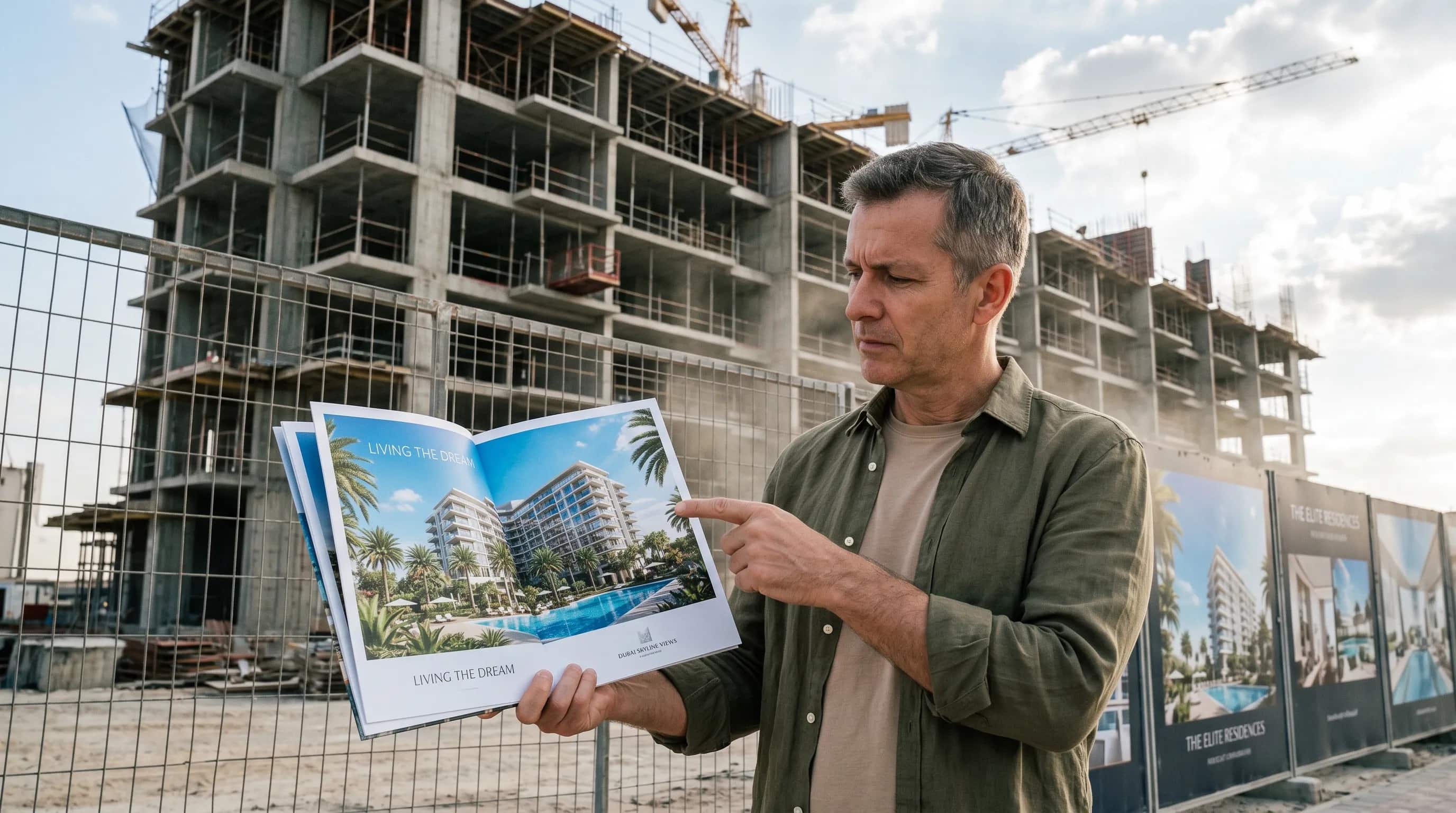
How to Read a Dubai Property Brochure: What's Real and What's Marketing
These property brochures are visually enticing, containing stunning renders, picturesque views of golden sunsets, and happy people sipping coffee from their balconies with a clear view of…
These property brochures are visually enticing, containing stunning renders, picturesque views of golden sunsets, and happy people sipping coffee from their balconies with a clear view of the cityscape around them. They are designed in such a way that evoking an emotion precedes verifying any facts about the property in them. And they achieve this quite easily, emphasizing once again the importance of learning how to decode brochures.
Learning how to decode a Dubai property brochure simply requires separating two aspects: facts and feelings. These brochures are combinations of verifiable information—like size, price, and payments—and the non-verifiable content—the description of the lifestyle and renders included therein. The idea here is to filter out the latter, leaving only verifiable facts. This way, the brochure will be a helpful tool; believing in it blindly could result in undesired consequences.
Here is where this guide comes in: the reasons why the brochure is just a sales tool rather than an agreement to anything; what is marketing content and needs to be ignored; what is real and needs to be extracted; step-by-step instructions on reading these documents. Most importantly, the focus is on recognizing that it is the contract, not the brochure, that represents the actual purchase made.
First things first: no, this guide does not assume that brochures are meant to deceive you or that developers plan to trick you into buying something different. In most cases, marketing is intended to showcase a product in its best possible way. As a prospective buyer, you must avoid being cynical; instead, you should understand what the brochure is trying to convey. Let's now see how.
A Brochure Is a Sales Tool, Not a Promise
Start with the right mindset, because it changes how you read everything that follows. A brochure exists to sell. That is its entire job, and there is nothing wrong with that, but it means a brochure is not a neutral document, and it is certainly not a contract. What it shows you is the product at its absolute best, the dream version, beautifully presented.
That does not make brochures lies. The size on the floor plan is usually real. The location is real. The developer is real. But woven through those facts is a layer of marketing designed to make you feel something, and the two are easy to confuse if you are not paying attention. The trick is to read a brochure the way you would read any advert, enjoying the pitch while quietly asking, what here is a checkable fact, and what is just a nice feeling.
Here is the mindset to read a brochure with:
- It is selling. The brochure's job is to make you want the property, not to give you a balanced view.
- Facts and feelings are mixed. Hard numbers sit right next to soft marketing, and they look equally trustworthy.
- It is not a contract. Nothing in a brochure binds anyone. The contract is what binds, and it can differ.
- Renders are aspiration. The images show the intended result, not a guarantee of what you will get.
- Numbers are checkable. Sizes, prices, and terms can be verified. Adjectives cannot.
- Enjoy it, but verify. There is no harm in loving the vision, as long as you check the facts behind it.
The most useful habit is to mentally split a brochure in two as you read. On one side, the facts, the unit size, the price, the payment plan, the location, the developer. On the other, the marketing, the adjectives, the renders, the lifestyle imagery, the projected returns. Read the first side carefully and verify it. Read the second side with a smile and a pinch of salt.
None of this requires you to be cynical or suspicious. The general framework around buying property and verifying the facts is set out on the UAE government portal, and the protections for buyers are real. The point is simply to be clear-eyed, to know which parts of a brochure you can lean on and which parts are there to charm you. Get that distinction, and the rest of reading a brochure is easy.
What's Marketing: Ignore These
Let's name the parts of a brochure that look like information but are really persuasion. The marketing is easy to spot once you know the tells, and none of it should drive your decision.
Start with the adjectives. Words like world-class, iconic, exclusive, luxury, premium, and unparalleled appear in almost every brochure, and they mean almost nothing, because they cannot be verified or compared. Then the renders, those gorgeous computer-generated images, which show the intended look, not a contractual guarantee, and usually carry a small artist's impression disclaimer for exactly that reason. Then the lifestyle imagery, the yachts and sunsets and beautiful people, which sells a feeling, not a floor plan. And watch hardest for guaranteed returns, because no one can truly guarantee your rental income or your profit. For a real sense of returns, market research from firms like Knight Frank beats any brochure projection.
Here is what to treat as marketing and discount:
- The adjectives. World-class, iconic, exclusive, luxury, premium, all unverifiable, all there to impress, not inform.
- The renders. Beautiful images of the intended result, not a guarantee of the finish you will actually receive.
- Lifestyle imagery. Sunsets, yachts, and smiling people sell a feeling, not the specifics of the property.
- Guaranteed returns. Promises of guaranteed yield or profit are a sales hook, since no one controls the market.
- Starting from prices. The headline price is the cheapest, smallest, least desirable unit, not the one you want.
- Projected appreciation. Up-to-X-percent growth figures are projections, never promises, and often optimistic ones.
A few of these deserve a closer look. Starting from is a classic, the brochure leads with the lowest price in the building, perhaps starting from AED 800,000, often a small studio on a low floor facing a wall, while the unit you actually want might be AED 1.2 million or more. Minutes from a landmark is another, where the stated travel times tend to assume empty roads and a fast driver. And selling fast or limited units is pure urgency, designed to stop you taking the time to verify anything.
The honest point is not that any of this is wrong to include. It is marketing, and marketing is allowed to be flattering. The mistake is letting it carry weight in your decision. So when you read a brochure, mentally strike through every adjective, every render, every lifestyle shot, and every projection, and see what information is actually left. What remains is the part worth reading, which is the next section.
What's Real: Extract These
Now the good part, the facts, the verifiable information worth pulling out of any brochure. These are the things you actually base a decision on, and they are mostly hard numbers and checkable claims.
The single most useful fact is the unit size, the floor area in square feet, usually printed on the floor plan. That is a real, comparable number, and it lets you work out the price per square foot and compare units honestly. Next is the price, but the price for your specific unit, not the starting from headline. Then the payment plan terms, the deposit, the schedule, and what is due at handover. Then the service charges, the annual running cost per square foot, which a brochure often downplays but which matters enormously. And then the verifiable project facts, the developer, the project registration, the escrow account, all of which you can confirm with the Dubai Land Department rather than taking the brochure's word.
Here is what to extract and verify:
- The unit size. The floor area in square feet, a hard number that lets you compare and value properly.
- Your unit's price. Not the starting from figure, the actual price of the specific unit you want.
- The payment plan. The deposit, the schedule, and what falls due at handover, in detail.
- The service charges. The annual per-square-foot running cost, a real expense the brochure may understate.
- The developer and registration. Who is building it, and confirmation the project is registered with an escrow account.
- The handover date. The intended completion, which you then check against the contract's actual terms on delays.
The specification is the one most buyers miss. A brochure shows you a beautiful render, but what you are contractually owed is set out in the specifications schedule, the document that lists the actual materials, finishes, and fittings. The render is the dream, the spec is the deal. Always ask for the specifications, and read them against the images, because that is where the difference between what is promised and what is delivered usually lives.
The honest summary is that the real information in a brochure is mostly numbers and verifiable facts, the size, the price, the plan, the costs, the developer, the spec. Extract those, confirm them with official sources, and you have the genuine substance of the property. Everything else is decoration.
How to Read One, Step by Step
Here is the whole method as a simple routine you can run on any brochure, off-plan or ready. Follow it and you will get the real value out of a brochure without being swept away by it.
- Read it once for the feeling, then put it down. Enjoy the vision, get a sense of the property, then switch your brain into fact-finding mode.
- Strike out the marketing. Mentally cross off every adjective, every render, every lifestyle shot, and every projection.
- Pull out the hard numbers. Note the unit size, your specific unit's price, the payment plan, and the service charges.
- Find the specifications. Ask for the spec schedule and read what materials and finishes you are actually owed, not just the render.
- Verify the developer and project. Confirm who is building it and that the project is properly registered, through official channels.
- Check the real location. Put the plot on a map yourself and check actual distances, not the brochure's optimistic minutes from.
- Distrust every guarantee. Treat any guaranteed return or projection as marketing, and run your own numbers on real data.
- Read the contract, not the brochure. The sale agreement is what binds, so read it carefully before you sign anything.
A couple of these are worth dwelling on. Verifying the developer matters because the name behind a project tells you a lot about whether the render will become reality. A developer with a long record of delivering what they promised is a different proposition from an unknown, and you can get a sense of who is who through our developers overview.
And because so many brochures are for off-plan projects, where you are buying a promise of a finished building, the verification matters even more. If you are looking at off-plan, our property launches page lists genuine, registered projects, which is a far safer starting point than a brochure that arrives from nowhere. Apply the same method either way, enjoy the vision, then check every fact behind it.
The method is not about being negative. It is about being effective. A buyer who reads a brochure this way still gets to love a property, but loves it for what it actually is, the real size, the real price, the real spec, in a real, verified project, rather than for the sunset and the adjectives.
The Brochure vs the Contract
Here is the single most important thing in this whole guide. The brochure is not what you buy. The contract is. The glossy document that made you fall in love has no legal force, while the sale agreement you sign is what actually binds the developer to deliver. When the two differ, the contract wins, every time, which is why what is written in it matters far more than what is pictured in the brochure.
So the smart move is to translate every brochure claim into a contract check. We lined up the common brochure claims against what you should actually verify, each on one line:
- Luxury or world-class finishes: check the exact specifications schedule in the contract, not the render.
- A gorgeous render: treat it as an artist's impression, and confirm what is contractually built and finished.
- Starting from a low price: get the actual price for the specific unit you intend to buy.
- A guaranteed return: ignore it, and run your own numbers on real market data instead.
- Minutes from a landmark: check the genuine distance and drive time on a map yourself.
- An intended handover date: read the contract's actual terms on the date, and on what happens if it slips.
The pattern is clear. Every appealing brochure claim has a matching, concrete thing to verify, and the verification almost always lives in the contract and the specifications, not the marketing. So once a brochure has done its job of interesting you, your real work is to get the contract and the spec schedule and read them properly, ideally with help, because that is the document that determines what you actually receive.
Two checks deserve special attention. The service charges, because a brochure rarely dwells on the annual running cost, yet it is a real, recurring expense that a good agent or manager can tell you about up front. Our property management team deals with these running costs daily and can tell you what a community really costs to live in, beyond the brochure's silence on the subject.
And the whole purchase, because reading a brochure well is only the start of buying well. If you want an experienced eye to read the brochure, the spec, and the contract alongside you and tell you straight what is real and what is marketing, that is exactly what we do. Our property buying service helps you see past the render to the deal.
What We Would Actually Do
In a way, an analysis of a Dubai real estate brochure boils down to a single discipline – distinguishing between facts and emotions. Renderings, adjectives, lifestyles, and guaranteed profits belong to marketing efforts that are meant to convince buyers and must not sway your decision. However, the factual part of the brochure – the square footage of the unit, the cost of the unit, the payment scheme, the service charges, the developer, and the specifications schedule – is what you are buying.
When our friend shows us their brochure, which they find fascinating, we advise them of the following course of action. First, enjoy it. Then, ask for details. What are the exact square footage and the price of the unit in question, rather than a "starting from" figure? What is the payment scheme and the service charges? Who is the developer, and are all the necessary certificates provided? But most importantly, what exactly do you receive with the specifications other than a beautiful set of pictures? Knowing the answers will help you find the actual real estate property.
We also remind you of the key rule of thumb – always pay more attention to the contract than to the brochure. It might seem like a great deal, thanks to a variety of adjectives and images in the brochure, but only the sale agreement and the specifications are legally binding. Consequently, the brochure should never become an excuse for not doing your research thoroughly, and you should always look for essential information in contracts.
It goes without saying that the intention behind this advice is not to make you feel suspicious about a product or a broker. We are simply trying to emphasize the fact that the brochure is there to attract you. The best property usually comes with the most convincing brochure as well. Your task is to rely on factual evidence when making a purchase while letting your emotions affect your enjoyment.
If you want an experienced, honest eye to help you read a brochure, a spec, and a contract, and tell you plainly what is real and what is marketing, we are glad to help. Get in touch and we will take it from there.
Related stories

Buying in Dubai By Selling Assets Abroad
A detailed guide on how to strategically sell your international property or investments to fund your home purchase in Dubai. I'll walk you through the entire process, from legal and tax considerations to transferring funds and proving their origin.

Exit Strategy: The Key to Total Return in Dubai Property
Many investors focus only on annual rental yield. I'll explain why your exit strategy and understanding total return are far more critical for a successful Dubai property investment.

The Professional's Retreat: Dubai Villas for Work & Family
For professionals balancing careers and family, finding the right Dubai villa is crucial. I explore the communities that masterfully blend dedicated home offices with exceptional family living.
Echoes, in your inbox
One thoughtful email a month. Market insight, new launches, no spam.