

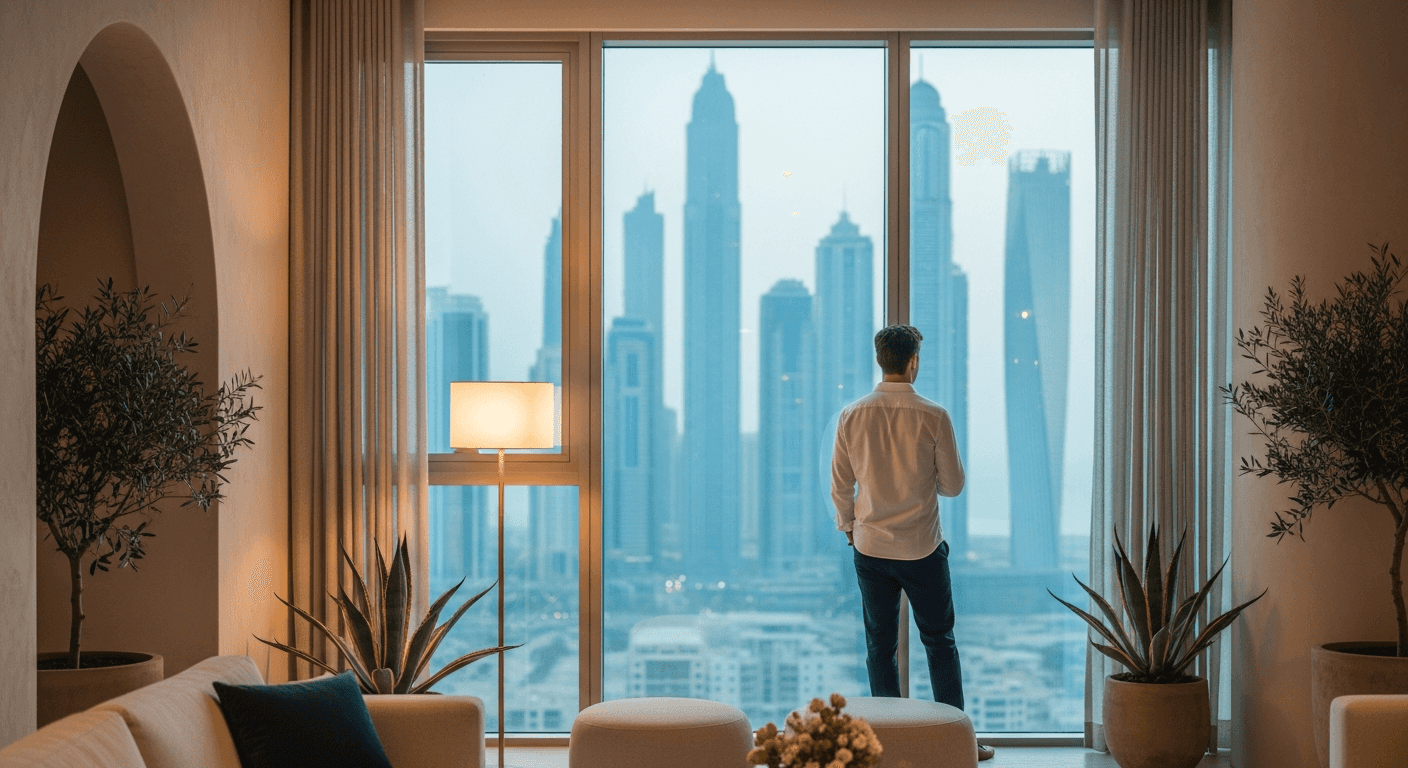
Global Capital & Dubai Property: The New Calculus
A deep analysis of how shifting global capital flows are reshaping Dubai's real estate investment landscape, moving it from a safe haven to a strategic core holding for international investors.

For decades, Dubai's property market has been described as a 'safe haven'. My thesis is that this term, while not incorrect, is now insufficient. The sheer scale and nature of recent international capital Dubai real estate has attracted point to a more profound, structural rerating of the city's role in the global investment landscape.
Here’s the argument I’ll unpack in this report:
- The primary drivers of global investment flows UAE are experiencing, moving beyond simple risk aversion.
- How UAE policy, particularly visa reforms, has acted as a powerful magnet for foreign capital.
- The mechanics of how these flows manifest in the market, from ultra-luxury to the mid-market.
- The tangible geopolitical impact Dubai property has absorbed from specific regional and global events.
- A granular look at the source markets for this capital and their distinct investment behaviours.
- The rise of the branded residence as a vehicle for foreign direct investment Dubai property.
- A balanced view of the risks and opportunities this new paradigm presents for investors.
- My final verdict on the sustainability of these trends and what they mean for the future.
The Anatomy of a Global Safe Haven
To understand the present, we have to correctly diagnose the past. The 'safe haven' narrative traditionally frames Dubai as a beneficiary of instability elsewhere. When geopolitical or economic turmoil strikes a region, capital seeks security, and Dubai, with its political stability and pegged currency, has been a logical recipient. This is the classic theory of capital flight real estate Dubai and it certainly holds true. We’ve seen this pattern repeat over the last two decades, with waves of investment from across the Middle East, South Asia, and the CIS region correlating with periods of uncertainty back home.
However, what we're witnessing today is different in both scale and character. The capital is not just fleeing *from* somewhere; it is strategically moving *to* somewhere. The current influx feels less like a temporary parking of funds and more like a deliberate, long-term allocation. This shift is underpinned by three core pillars. First, the UAE’s decisive and effective handling of the global pandemic reinforced its reputation for competent governance and resilience. While other major economies faltered, Dubai demonstrated an ability to protect public health while keeping the economy open, a feat that was not lost on global high-net-worth individuals (HNWIs) and business owners.
Second, the geopolitical landscape has become increasingly fragmented. The traditional financial centres in Europe and North America are facing their own internal pressures, from political polarisation to shifting tax regimes. This has led many international investors to diversify their holdings away from these markets, seeking jurisdictions that offer not just stability but also a pro-business, low-tax environment. Dubai is no longer just a regional safe haven; it has ascended to become a global one. The neutrality of the UAE's foreign policy has become a significant economic asset, allowing it to maintain strong relationships with a diverse range of countries and making it an acceptable and accessible hub for capital from all corners of the globe.
Finally, the market's own maturity is a critical, often overlooked, factor. The legal and regulatory frameworks governing Dubai real estate have been methodically strengthened over the past fifteen years. The establishment of the Real Estate Regulatory Agency (RERA), the introduction of escrow accounts for off-plan sales, and the clarity of freehold ownership laws via the Dubai Land Department (DLD) have built a level of transparency and security that simply did not exist in earlier market cycles. This institutional maturity gives sophisticated global investors the confidence to deploy significant capital, knowing their rights are protected by a robust legal system. This is not the speculative, high-frontier market of 2008; this is a regulated, mature asset class.
Policy as a Magnet: The Golden Visa and Beyond
 Featured project
Strategic government policy has been the accelerator for these structural shifts. While the UAE has always been business-friendly, recent reforms have been exceptionally potent in attracting both human and financial capital. The most significant of these has undoubtedly been the expansion and clarification of the UAE Golden Visa program. By creating a direct, accessible pathway to long-term residency through property investment, the government forged an unbreakable link between real estate ownership and a tangible lifestyle benefit.
An investment of AED 2 million (approximately USD 545,000) in property now secures a 10-year renewable visa for the investor and their family. This has fundamentally altered the investment calculus. A property purchase is no longer just a financial asset; it's a key to a new life, a base for a business, or a second home in a stable and vibrant city. This has been a game-changer, particularly for individuals from countries with limited travel freedom or those seeking a secure long-term plan for their families. It directly converts real estate demand into foreign direct investment Dubai property can measure.
Beyond the Golden Visa, a raft of other legal and social reforms has broadened Dubai's appeal. Changes to company ownership laws, allowing for 100% foreign ownership of mainland companies in many sectors, have encouraged entrepreneurs to move their entire operations to the emirate. This, in turn, creates organic demand for both commercial and residential real estate. Social reforms, such as the decriminalisation of cohabitation for unmarried couples and updates to personal status laws, have made Dubai a more comfortable and inclusive place for a wider demographic of expatriates to call home, encouraging them to transition from renting to owning.
These policies work in concert. A business owner from Europe might be initially attracted by the 100% ownership law, moves their company here, and then secures a Golden Visa through a property purchase in a community like Arabian Ranches for their family. An tech entrepreneur from Asia might set up in a freezone like Dubai Science Park, and after a few years of renting, decide to buy an apartment in JVC. This ecosystem effect — where one policy reinforces another, creates a sticky environment for capital. It ensures that the money flowing into Dubai doesn't just pass through; it puts down roots, creating sustained demand for housing, schools, and services, and further embedding the city as a permanent hub for global talent and wealth.
How Capital Flows Manifest: From Palm Jumeirah to JVC
When we talk about global capital, it's easy to picture a monolithic flow of money. The reality on the ground is far more nuanced. Different pools of capital target different segments of the market, driven by varying motivations. At Gaia Living, we observe these patterns daily, and they paint a picture of a multi-layered market.
At the very top end, the demand is for trophy assets. This is where the geopolitical impact Dubai property is most visible. Ultra-high-net-worth individuals from Europe, Asia, and the CIS region are acquiring landmark properties on Palm Jumeirah, Jumeirah Bay, and in exclusive inland enclaves like Al Barari. For this buyer profile, the primary driver is wealth preservation and the acquisition of a world-class asset in a secure jurisdiction. Price is a secondary consideration to exclusivity, privacy, and brand. Developers like Omniyat and Emaar Properties have catered to this demand with meticulously designed, often branded, residences that command global-level pricing. These are not typically buy-to-let investments; they are legacy assets and personal residences.
“Dubai is no longer just a place to park capital during a storm; it's becoming a core allocation in global portfolios, chosen for its structural strengths, not just its temporary safety.”
Moving down the price spectrum, we find a significant flow of capital into the AED 2 million to AED 5 million bracket. This is the sweet spot for the Golden Visa investor. These buyers are often a mix of end-users and investors. They might be families looking for a villa in a community like Dubai Hills Estate or Damac Hills and Damac Hills II, or professionals buying a large apartment in a well-connected urban area like Business Bay. Here, the investment calculus is a blend of lifestyle aspirations and financial returns. They are buying a home, but they are also acutely aware of the potential for rental income and capital appreciation. The purchase must make sense as both a place to live and a sound investment.
Finally, there is a huge and often underestimated volume of international investment in the sub-AED 2 million segment. This is the domain of the pure yield-focused investor. These buyers, often from the UK, India, Pakistan, and increasingly from China, target smaller apartments in high-density, high-demand rental areas like Jumeirah Village Circle (JVC), Arjan, and Al Furjan. Their strategy is simple: acquire assets that generate strong, consistent rental returns. With net yields in these areas often ranging from 6% to 9% pre-use, the proposition is compelling compared to the meagre returns available in many of their home markets. This segment is less about capital flight and more about a rational search for yield in a global low-interest-rate environment. The sheer volume of transactions in these areas, driven by developers like Binghatti and Nshama, forms the bedrock of the Dubai property market's activity.
Geopolitical Triggers and Market Reactions
The theoretical drivers of capital flow become starkly real when you map them against specific geopolitical events. The last few years have provided a series of powerful case studies. The most significant, without question, has been the conflict in Eastern Europe. This event triggered an immediate and substantial movement of capital and people from the CIS region into the UAE. The impact was not subtle; it was a seismic event for the prime and super-prime segments of the Dubai property market.
We saw an immediate surge in demand for ready-to-move-in luxury properties, particularly large villas and waterfront apartments. Buyers were looking for immediate solutions, places where they could relocate their families and businesses with minimal friction. Communities like Palm Jumeirah, Dubai Marina, and Emirates Hills saw transaction volumes and prices spike. This was a classic example of capital flight, but with a twist. Many of these new residents were not just parking money; they were highly skilled professionals and entrepreneurs who began setting up businesses, enrolling children in schools, and integrating into the city's economic fabric. This has created a lasting demand profile that has persisted long after the initial shock.
Another key trigger has been the economic and political uncertainty in parts of Europe. Concerns over rising taxes, energy insecurity, and a less favourable business environment have led many European HNWIs, particularly from Germany, France, and the UK, to establish a base in Dubai. For them, the UAE's zero income tax policy and pro-enterprise stance are powerful draws. This cohort often targets high-quality, modern communities with a strong sense of community and excellent amenities. Areas developed by Emaar, such as Dubai Hills Estate and Arabian Ranches, and projects by Sobha in Sobha Hartland and Sobha Hartland II, have been particularly popular. This flow is less about panic and more about strategic relocation and tax optimization.
We must also consider the ongoing economic rebalancing in Asia. As wealth grows across the continent, particularly in India and China, investors are increasingly looking to diversify their portfolios internationally. Dubai's geographical proximity, excellent connectivity, and deep cultural ties with the Indian subcontinent make it a natural choice. For Chinese investors, who have re-emerged as a significant force post-pandemic, Dubai offers a secure, dollar-pegged asset class that is seen as a hedge against domestic market volatility. Their investment patterns are diverse, ranging from yield-focused apartments in areas like JVC to significant investments in new launches from major developers, indicating a long-term confidence in the market's growth trajectory. The master-planned vision for new areas like Dubai Creek Harbour resonates strongly with this buyer demographic.
Source Markets: A Mosaic of Motivations
Digging into the primary source markets for global investment flows UAE reveals a fascinating mosaic of motivations. Attributing demand to a single country is a simplification; within each nationality, there are distinct buyer personas with different goals. Understanding these nuances is key to forecasting market trends.
1. The CIS Investor: Post-2022, this group became a dominant force, particularly at the luxury end. The initial wave was driven by a need for immediate relocation and wealth preservation. They favoured large, ready properties in prime locations. A typical purchase might be a 5-bedroom villa on the Palm Jumeirah or a full-floor penthouse in Dubai Marina. The transaction is often in cash, and the timeline is compressed. However, a second wave is now emerging: more considered, long-term investors who are launching businesses and buying off-plan properties with a 3-5 year view. They are active in new luxury launches in places like Emaar Beachfront and Meydan.
2. The European Investor: This is often a lifestyle-driven buyer, but one with a sharp eye on financial logic. They are drawn by the quality of life, security, and tax efficiency. A German family might buy a villa in Dubai Hills Estate for the proximity to excellent schools and golf courses. A British professional might opt for a townhouse in a community managed by Nakheel for its community feel and strong rental potential. They are typically more reliant on financing than some other groups, so are sensitive to interest rate changes. The following is a representative cost breakdown for a European investor buying a property for AED 3,000,000 with a mortgage:
- Purchase Price: AED 3,000,000
- Down Payment (20% for non-resident): AED 600,000
- Dubai Land Department (DLD) Fee (4%): AED 120,000
- DLD Registration Fee: AED 4,200
- Real Estate Agency Fee (2%): AED 60,000
- Mortgage Arrangement Fee (~1% of loan): AED 24,000
- Mortgage Registration Fee (0.25% of loan): AED 6,000
- Property Valuation Fee: ~AED 3,000
- Total Upfront Cost (approx.): AED 817,200
This highlights that even with financing, the upfront cash requirement is significant, close to 27% of the property's value. This is a crucial detail for international buyers to understand.
3. The Indian Investor: A historically significant and deeply embedded investor group. Indian buyers are present across all market segments. At the top, HNWIs acquire luxury apartments in Downtown Dubai and villas on the Palm. The burgeoning upper-middle class, however, is a powerful force in the mid-market and off-plan sectors. They are savvy investors, often buying multiple smaller units in areas like JVC or Business Bay to build a rental portfolio. Payment plans offered by developers are a major attraction. Their deep understanding of the Dubai market, built over generations, makes them confident and decisive buyers.
4. The Chinese Investor: After a hiatus during the pandemic, Chinese capital is returning with force. These investors are often focused on new-build properties from reputable master developers like Emaar, Nakheel, and the Abu Dhabi-based Aldar. They appreciate the scale and vision of large master-planned communities like The Valley or the new islands. There is also a strong appetite for branded residences, which offer the dual assurance of a quality build and a recognized luxury name. They are sophisticated in their use of payment plans and are often investing with a view towards both yield and long-term capital growth.
Branded Residences: The Ultimate Safe Haven Asset
The explosive growth of the branded residence sector is a direct consequence of the global capital influx. For an international HNWI investor, a branded residence solves several problems at once. It provides an assurance of quality, management, and service that is globally recognized. A brand like Four Seasons, Baccarat, or Bugatti attached to a property acts as a powerful signifier of quality and a mitigator of risk.
This is particularly appealing to investors who may not be physically present in Dubai year-round. They are buying a hassle-free asset. The brand manager handles the maintenance, security, and often, the rental pool, providing a turnkey investment solution. This lock-and-leave convenience commands a significant price premium, often 20-30% or more over comparable non-branded properties in the same location. Investors are willing to pay this premium for peace of mind and the cachet the brand confers.
The developers behind these projects, such as Omniyat and Binghatti with its Bugatti and Jacob & Co collaborations, are masters of creating scarcity and desire. These are not just apartments; they are limited-edition collectibles. This appeals to a UHNW client base that is often motivated by the acquisition of rare and exclusive items. The purchase of a branded residence is as much a lifestyle statement as it is a real estate transaction. This has created a new, ultra-luxury tier in the market that is somewhat insulated from the cyclical trends of the broader property landscape.
From a market analysis perspective, the rise of branded residences is a sign of maturation. It demonstrates that Dubai can now support a level of luxury and service on par with global capitals like London, New York, and Hong Kong. It also creates a 'halo effect', where the high price points achieved by these projects help to lift the perceived value of the entire sub-market. A new launch on the Dubai Water Canal by a top luxury brand makes every property on that canal seem more valuable. This is a critical mechanism for how foreign direct investment translates into broad-based market appreciation.
Risks and the Sustainability Question
No market analysis is complete without a sober assessment of the risks. The current strength of the Dubai market is undeniable, but it's crucial to distinguish between sustainable trends and cyclical froth. The primary risk, as always in Dubai, is that of future supply. The success of the market has spurred a huge number of new project launches, and the key question is whether the sustained inflow of capital will be sufficient to absorb this new stock for market in 2-4 years.
My view is that we need to look at supply on a granular level. While the headline number of new units may seem high, the supply of high-quality, well-located properties in prime areas remains constrained. The supply of beachfront villas or premium apartments in Downtown Dubai is finite. Therefore, I anticipate a market bifurcation, where prime properties hold their value or continue to appreciate, while secondary locations with a glut of similar products may face pricing pressure and declining rental yields. Investor diligence will become increasingly important.
Another risk is external. Dubai's economy is open and deeply integrated with the rest of the world. A significant global economic downturn would inevitably impact demand. Similarly, as a dollar-pegged economy, the UAE is imported US monetary policy. A sustained period of high interest rates could dampen domestic demand from mortgaged buyers, even if it has less impact on the cash-flush international segment. We must also be mindful of the source of the capital. An unforeseen political or economic stabilization in a key source market could, in theory, slow the flow of funds or even lead to some repatriation of capital, although the 'stickiness' created by the Golden Visa and business relocation mitigates this risk to some extent.
Finally, there's the risk of complacency. The market is strong, but developers and investors must maintain discipline. Over-using, speculative flipping, and a decline in build quality are the classic warning signs of an overheating market. Thus far, the regulatory environment, with its stricter financing rules (like the Central Bank's 20-25% down payment requirement) and DLD oversight, has helped to keep the most speculative excesses in check. Maintaining this discipline through the cycle will be the true test of the market's maturity.
The current influx of global capital into Dubai's property market represents a structural re-evaluation of the emirate's global standing. While risks of oversupply and external shocks remain, the combination of strategic government policy, geopolitical tailwinds, and the market's own regulatory maturity suggests this is not a transient boom but a new, elevated baseline for investment.
Verdict: From Haven to Core Holding
After analysing the drivers, the mechanics, and the risks, my conclusion is firm. The role of Dubai in the world of property investment has fundamentally changed. The 'safe haven' label, while still relevant, is a rearview mirror description. It describes the trigger, but not the long-term outcome.
International investors are no longer just using Dubai as a temporary shelter for their capital. They are integrating it into their lives and their core investment strategies. The purchase of a property here is increasingly the first step in a deeper commitment, which includes business setup, family relocation, and long-term wealth planning. The policies enacted by the UAE government have been instrumental in fostering this stickiness, turning transient capital into embedded foreign direct investment.
The international capital Dubai real estate is attracting is not uniform. It is a complex ecosystem of different buyer types with different motivations, from the UHNWI seeking a trophy asset to the small investor chasing yield. This diversity is a source of strength and resilience. If one segment cools, another may remain robust, preventing the kind of market-wide collapse seen in less diversified, more speculative cycles of the past.
For the individual investor looking at this market, the key is to understand which of these currents they are swimming in. Are you a yield-seeker who should be focused on areas like Dubai Studio City or International City? Are you a Golden Visa applicant looking for a family home in a community with schools and parks? Or are you a wealth preservationist looking for an irreplaceable asset on the water? The correct strategy depends entirely on the answer to that question. The opportunities are real and substantial, but clarity of purpose has never been more important. Dubai's property market has graduated. It is now, in my opinion, a core holding for any globally diversified real estate portfolio.
Sources
- Dubai Land Department (DLD) for transaction data and regulations: https://dubailand.gov.ae
- Real Estate Regulatory Agency (RERA) for market conduct rules: https://rera.gov.ae
- Central Bank of the UAE (CBUAE) for mortgage caps and monetary policy: https://www.centralbank.ae
- The UAE Government Portal for visa and legal information: https://u.ae
Questions, answered
- How do global events affect Dubai's property market?
- Global instability, whether economic or geopolitical, often drives international capital towards markets perceived as stable and business-friendly. Dubai's pro-business policies, currency peg to the USD, and reputation as a safe haven make its property market a primary beneficiary of these capital shifts, often referred to as 'capital flight'.
- Is Dubai just a destination for 'capital flight'?
- While Dubai certainly benefits from capital seeking safety, my analysis suggests a more structural shift. Investors are increasingly viewing Dubai not just as a temporary haven but as a long-term strategic allocation due to its maturing market, strong rental yields, and sophisticated legal and financial infrastructure.
- What is the UAE Golden Visa and how does it impact real estate?
- The UAE Golden Visa is a long-term residency visa granted to investors, entrepreneurs, and skilled professionals. A key pathway is through real estate investment of AED 2 million or more, which has been a major driver of foreign direct investment into the property market by creating a clear link between ownership and long-term residency.
- Are foreign investors mainly buying luxury properties in Dubai?
- While ultra-luxury properties on islands like Palm Jumeirah and Jumeirah Bay capture headlines, a significant volume of international capital flows into mid-market segments. Communities like JVC and Arjan are popular for their strong rental yields and more accessible price points, attracting a different, yield-focused investor profile.
- What are the main risks for foreign investors in Dubai real estate?
- Risks include potential oversupply from new projects impacting rental yields and capital appreciation, fluctuations in global economic conditions affecting a key buyer pool, and changes in local regulations or fees. As an analyst, I believe a key risk is also misinterpreting short-term demand spikes as permanent structural shifts.
- How does the US dollar peg affect Dubai's property market?
- The UAE Dirham's peg to the US dollar provides currency stability, a major draw for international investors. It eliminates currency risk for those holding USD and makes pricing transparent. However, it also means Dubai's market is directly influenced by US Federal Reserve monetary policy; when the Fed raises interest rates, mortgage rates in the UAE typically follow.

Amara translates DLD transaction data, supply pipelines, and macro signals into clear calls on where Dubai's market is heading. She writes the numbers most brokers only feel.
Related stories
Dubai's Big Squeeze: Smaller Plots, Denser Living
Dubai real estate is undergoing a fundamental shift towards smaller plot sizes and higher density. We analyse the economic drivers, the impact on property values, and what this new era of compact urban living means for both homebuyers and investors.
Resort Living as Your Dubai Reality
Explore how to trade temporary staycations for a permanent home with five-star amenities in Dubai. I'll break down the real costs, best communities, and lifestyle trade-offs of embracing high-end resort living every day.
Finding Your Tribe in Dubai's Villa Communities
I explore which of Dubai's renowned villa communities attract specific expat nationalities and lifestyle groups, offering insights to help you find a place that feels like home.
Echoes, in your inbox
One thoughtful email a month. Market insight, new launches, no spam.