

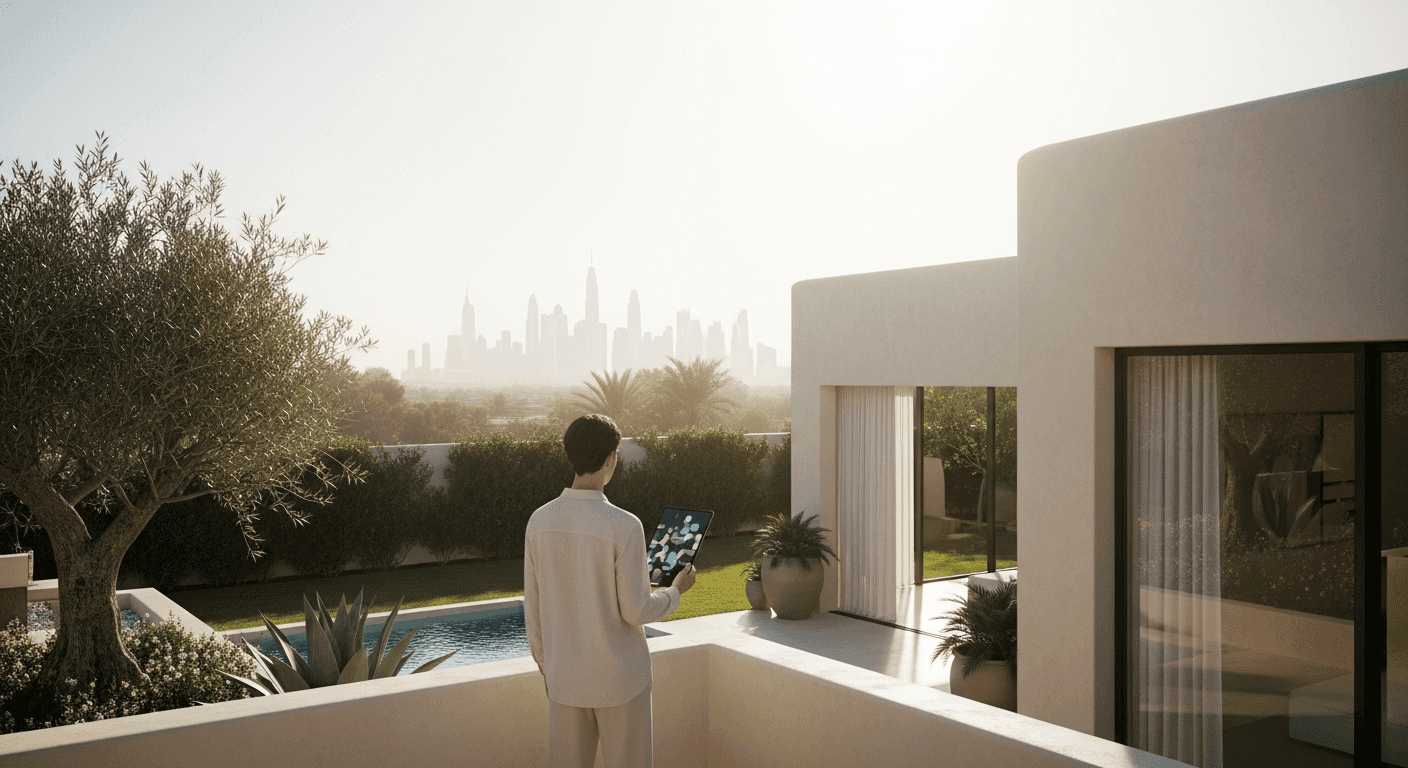
Gauging the Smart City Effect on Property Value
Dubai's extensive smart city infrastructure is no longer a futuristic concept but a present-day reality that is creating a measurable, though complex, impact on property valuations across the emirate.

As the head of market research at Gaia Living, I spend my days parsing data, trying to isolate the signals that drive property valuations from the noise of market chatter. For years, the term 'smart city' has been part of that chatter. Today, I'm confident in stating that it has firmly crossed over into a signal. The various initiatives that fall under the Dubai smart city umbrella are no longer just ambitious plans; they are tangible infrastructure, both digital and physical, that are actively shaping property values. The question is no longer *if* they have an impact, but *how much* of a premium they command, and whether that premium is sustainable. My analysis shows the effect is real, but it is far from uniform, requiring a nuanced understanding to identify true value.
Here's what we'll explore in this report:
- The foundational government strategies driving Dubai's tech evolution.
- Distinguishing between the 'hard' and 'soft' layers of smart infrastructure.
- Case studies on the valuation impact in communities like Dubai Hills and City Walk.
- The role of master developers as creators of these tech-enabled ecosystems.
- A concrete breakdown of how smart tech affects a property's running costs.
- The rental market's response: Are tenants paying a premium for smart features?
- How appraisers and banks are beginning to factor in technology.
- My final checklist for investors looking to buy into Dubai's smart future.
The Government's Blueprint: Dubai's Smart City Mandate
To understand the value of a smart home in Dubai, you must first understand the vision for the smart city that contains it. The influence on property values doesn't start at the front door of an apartment; it begins with strategic, top-down government policy. The initial 'Smart Dubai' strategy was a powerful declaration of intent, aiming to make Dubai the happiest and smartest city on earth. While timelines and names evolve, the core mission persists, embedded in every facet of the emirate's governance. The significant Dubai government tech investment property markets feel today is a direct result of this long-term, centrally-driven vision. It provides the stability and overarching framework that individual developers and communities build upon.
This framework materialises in city-wide services that create a smooth urban experience. The DubaiNow app, for instance, consolidates over 120 government and private sector services, from paying a DEWA bill to settling traffic fines, into a single, intuitive interface. The Dubai Paperless Strategy, which successfully eliminated all government paper transactions, is another example. These aren't real estate initiatives per se, but they cultivate a culture of digital efficiency that residents experience daily. This normalisation of high-tech convenience raises expectations. A resident accustomed to managing their visa and bills on an app is naturally more receptive to, and will eventually demand, a similar level of digital integration in their own home and community. This creates a powerful, market-driven pull for smart features in real estate.
Beyond that, the government's commitment is visible in the very fabric of the property transaction process itself. The Dubai Land Department's suite of digital services, particularly the Dubai REST app, has revolutionised how we interact with the market. The ability to conduct title deed verifications, process rental contracts (Ejari), and view real-time transaction data provides a level of transparency and efficiency that was unthinkable a decade ago. This digital trust layer reduces friction and perceived risk for international investors, which in turn buoys the entire market. It’s this foundational investment in digital governance that allows a property in a 'smart community' to be more than just a marketing gimmick; it's a node in a functioning, city-wide network. That network effect has real, tangible financial value.
Defining 'Smart': Hard and Soft Infrastructure
 Featured project
The term 'smart' is often used as a catch-all, and this ambiguity can be costly for an investor. In my analysis, I find it critical to separate the 'hard' and 'soft' layers of smart infrastructure. The hard infrastructure is what you can often see or touch: the physical assets. This includes the ubiquitous fibre optic cables that provide high-speed internet, the network of sensors monitoring traffic flow and air quality, the charging stations for electric vehicles, and the automated waste collection systems. In communities like Expo City or Dubai South, designed with logistics and future mobility in mind, you see this in the physical layout — wider corridors for autonomous delivery bots or dedicated routes for electric buggies. This is the essential hardware of a smart community.
Soft infrastructure, on the other hand, is the invisible brain and nervous system running on top of the hardware. It comprises the software platforms, the data analytics engines, the open-data policies, and the digital governance frameworks. The DubaiNow app is soft infrastructure. The AI-powered systems that adjust traffic light timings based on real-time congestion data are soft infrastructure. The community app for Emaar Properties that lets you book a tennis court, pay your service charges, and receive security alerts is a hyper-local example of soft infrastructure. It’s this layer that turns a collection of sensors into a responsive, learning environment. Without robust, secure, and user-friendly soft infrastructure, the hard assets are just expensive, underused equipment.
From a property valuation perspective, the presence of both is what creates a defensible premium. A buyer might be impressed by a building's futuristic facade, but the long-term value is determined by the efficiency of its underlying systems. For example, a building with a sophisticated Building Management System (BMS) that uses AI to predict maintenance needs for the HVAC system (soft infrastructure) will have more stable service charges and fewer breakdowns than one that simply has shiny new AC units (hard infrastructure). The integration of hard and soft infrastructure is where the magic, and the money, lies. The most successful smart communities Dubai impact on value is seen where these two layers are planned in unison, creating an ecosystem where the whole is far greater than the sum of its parts.
Case Study 1: The Integrated Master Community - Dubai Hills Estate
When clients ask us at Gaia Living for a real-world example of how smart infrastructure translates into durable value, I often point them towards Dubai Hills. Developed as a joint venture between Emaar and Meraas, it was conceived from the outset as a fully integrated 'city within a city'. This holistic planning is precisely what allows its smart features to generate a quantifiable value premium. The technology here is not an afterthought; it's woven into the master plan. The road network was designed with traffic flow analysis to minimize congestion, and this is now actively managed with a network of sensors. The security is a layered system, combining physical patrols with extensive CCTV coverage monitored from a central command centre, all accessible to residents via their community app.
This integration creates a superior user experience that residents are willing to pay for, both in sales price and rent. A family choosing between a villa in Dubai Hills and a similar-sized, similar-aged villa in an older, more fragmented community will experience a tangible difference. In Dubai Hills, the park is a short walk away on a dedicated path, the school run is smoother due to managed traffic, and community announcements arrive instantly on their phone. This smooth quality of life is the real luxury, and it directly supports the area's property valuations. When we analyse DLD data, we consistently see properties in Dubai Hills command a significant per-square-foot premium over comparable properties in less integrated communities. This premium isn't just because of the golf course; it's the result of a master plan that uses technology to deliver on its promise of a better lifestyle.
“The true premium isn't in a smart fridge; it's in a smart grid. Investors must learn to distinguish between a gimmick and infrastructure.”
On top of that, the developer's role in managing this ecosystem is crucial. Emaar's continued investment in the community app and digital services ensures the technology remains relevant and functional. This is a stark contrast to older communities where different buildings are managed by different entities, making any kind of integrated tech rollout nearly impossible. In Dubai Hills, the single-developer ecosystem creates a 'sticky' environment. Residents become accustomed to the high level of service and convenience, making them less likely to move and more willing to accept price escalations. For an investor, this translates into lower vacancy rates, higher-quality tenants, and a more resilient asset during market fluctuations. The Dubai smart city property value proposition is at its strongest here.
Case Study 2: The Urban Tech Hub - City Walk & Bluewaters
While Dubai Hills demonstrates the value of smart tech in a sprawling suburban setting, developments like City Walk and Bluewaters Island showcase its impact in a high-density, urban context. These Meraas projects are masterclasses in using technology to curate a vibrant, pedestrian-centric experience that drives both retail footfall and residential demand. Here, the 'smart' focus is on managing the public realm to perfection. Think of smart parking systems that guide you to an empty spot via an app, eliminating the friction of city parking. Think of interactive digital wayfinding, ambient public Wi-Fi, and a meticulously managed events calendar pushed to visitors' phones to animate the space.
The commercial logic is clear: by creating a smooth and enjoyable environment, Meraas increases visitor dwell time and spending in the ground-floor retail and F&B outlets. This, in turn, makes the commercial units more valuable and attracts high-end tenants. The genius is how this commercial success is leveraged to boost the value of the residential apartments above. The residents of City Walk or Bluewaters don't just buy an apartment; they buy into a curated, constantly evolving lifestyle. The vibrant, well-managed environment downstairs becomes a direct amenity, one that is impossible to replicate in a standalone residential tower.
This strategy has a clear impact on valuations. Apartments in these mixed-use, tech-enabled environments often trade at a premium compared to purely residential buildings in adjacent areas. The rental yields can also be stronger, attracting a demographic of tenants — young professionals, corporate renters, and tourists, who place a high value on convenience and lifestyle and are willing to pay a premium for it. The technology is the enabler of this entire model. It allows the developer to manage a complex, high-traffic environment with an efficiency that creates a sense of effortless urban cool. This perceived effortlessness is, of course, the result of a massive investment in underlying IoT real estate Dubai technology, but for the resident or investor, the outcome is a highly desirable, premium asset.
The IoT in Your Home: Quantifying the Impact on Running Costs
Moving from the macro-level of the community to the micro-level of the individual property, the impact of smart technology becomes even more direct and quantifiable, particularly for a property’s operational expenses. The most immediate benefit of Internet of Things (IoT) devices in a home — such as smart thermostats, automated lighting, and remote-controlled blinds, is energy efficiency. While these gadgets appeal to our desire for convenience, their real financial power lies in their ability to reduce utility consumption. A smart thermostat that learns your schedule and optimises the air conditioning can cut cooling costs significantly in Dubai's climate. Automated blinds that close during the hottest part of the day reduce the thermal load on the building. These are not trivial savings; over the course of a year, they add up.
To illustrate this, let's consider a line-by-line cost comparison for a hypothetical 1,200 sq. Ft. two-bedroom apartment in Dubai, one 'standard' and one 'smart-enabled'. The numbers are directional but are based on typical consumption patterns and costs.
Annual Cost Estimate: Standard vs. Smart Apartment
1. Standard Apartment (1,200 sq. Ft.) - DEWA (Utilities): Assuming average usage with manual AC control. - Electricity: ~18,000 kWh/year @ ~AED 0.38/kWh = AED 6,840 - Water: ~100,000 imperial gallons/year @ ~AED 0.04/gallon = AED 4,000 - *Total DEWA:* ~AED 10,840 - Service Charges: Assuming AED 18/sq. Ft./year for a standard quality building. - 1,200 sq. Ft. x AED 18 = AED 21,600 - TOTAL ANNUAL COST: AED 32,440
2. Smart-Enabled Apartment (1,200 sq. Ft.) - DEWA (Utilities): Assuming ~15% savings from smart thermostat & lighting. - Electricity: ~15,300 kWh/year @ ~AED 0.38/kWh = AED 5,814 - Water: (No significant change) = AED 4,000 - *Total DEWA:* ~AED 9,814 - Service Charges: Assuming AED 20/sq. Ft./year for a building with a modern BMS and smart features (slight premium for tech upkeep). - 1,200 sq. Ft. x AED 20 = AED 24,000 - TOTAL ANNUAL COST: AED 33,814
At first glance, the smart apartment appears more expensive. However, this simple calculation misses the bigger picture. The higher service charge in the smart building often funds a sophisticated Building Management System (BMS). This system can lead to far more efficient central operations — optimizing chiller plant performance, running elevators more effectively, and enabling predictive maintenance that prevents costly emergency repairs. Over time, a well-managed smart building should see more stable, or even reduced, service charges compared to a standard building facing aging equipment. Beyond that, the 15% energy saving is a direct return to the occupant. For an investor-owner, advertising a property with verifiably lower utility bills is a powerful marketing tool that can justify a higher rent, quickly offsetting the marginal increase in service fees.
The Renter's Premium: Are Tenants Willing to Pay?
For the majority of investors in Dubai, the critical question is how smart infrastructure impacts rental income and yield. A higher valuation is only meaningful if it is supported by strong, consistent rental returns. My analysis of the rental market suggests a clear, but segmented, willingness among tenants to pay a premium for smart features. The effect is most pronounced at the top end of the market. In prime areas like Downtown Dubai, Palm Jumeirah, or DIFC, we see corporate tenants, high-net-worth individuals, and tech-savvy professionals actively seeking out fully automated homes. For this demographic, the convenience of controlling lighting, climate, and security from a phone, or the prestige of living in a technologically advanced building, is a value proposition they will pay for. In this segment, a 5-10% rental premium for a truly smart, well-executed property is realistic.
In the much larger mid-market segment, the calculation is different. A family looking for a three-bedroom villa in Arabian Ranches or an apartment in JVC is primarily driven by budget, space, and proximity to schools and amenities. A smart thermostat is unlikely to be their top priority. However, where smart technology plays a crucial role is as a powerful 'tie-breaker'. Faced with two identical apartments at the same price point, the one offering smart home features, better community connectivity, or lower utility bills will almost always be rented first. This reduces vacancy periods, which is a huge, often underestimated, factor in an investor's annual return. A property that rents a month quicker each year because of its tech-enabled appeal has effectively increased its annual yield by over 8%.
Therefore, for investors, the strategy should not necessarily be to chase a huge rental premium, but to use smart features to create a more desirable, stickier product. This includes community-level tech as much as in-unit gadgets. A community with a great app for booking facilities, an efficient digital system for visitor access, and reliable, high-speed internet included in the rent creates a frictionless living experience. Tenants in such communities are often more satisfied and more likely to renew their leases, even with modest rent increases. This stability and reduced churn are gold for an investor, providing a more predictable income stream and protecting the asset's long-term value, which is a core component of the future of Dubai real estate technology.
Developer Strategy: Smart Tech as a Differentiator
In Dubai's dynamic and competitive real estate market, developers are constantly searching for an edge. Increasingly, that edge is technology. Smart home and smart community features have moved from being a niche luxury to a core part of the marketing and value proposition for new off-plan launches. Major developers like Emaar, Damac, and Nakheel now routinely highlight the technological integration of their projects, appealing to a new generation of buyers who expect digital convenience as standard. This is a strategic response to market demand. As a baseline level of tech-savviness increases across the population, properties that feel analogue and disconnected are perceived as dated.
It is crucial for buyers to read the fine print on these promises. There is a significant difference between a home that is 'smart-ready' and one that is 'fully smart'. 'Smart-ready' typically means the developer has provided the essential wiring and infrastructure — like extra CAT6 cabling and neutral wires for smart switches, but the owner is responsible for purchasing and installing the actual devices. 'Fully smart' implies a turnkey solution is included in the purchase price. We advise our clients at Gaia Living to clarify this distinction and understand the potential future costs. A 'smart-ready' home offers flexibility and is a great future-proofing feature, but it's not the same as a move-in ready automated residence.
This embrace of technology is also reshaping development itself. Developers are now data companies as much as they are construction companies. They use analytics to decide where to build, what amenities to offer, and how to price their products. Post-handover, they use community management platforms to maintain a direct relationship with residents, offering services and gathering feedback. This creates a powerful ecosystem. For example, owning an Emaar property might grant you benefits through their loyalty programs, all managed through a single app that also controls your home access and service charge payments. This integration creates a compelling brand proposition that can justify a premium price point from the very first day of sales and helps sustain that value long after handover.
The Future of Valuation: How Appraisers and Banks See 'Smart'
This is perhaps the most critical and least understood part of the puzzle. While buyers may be swayed by smart features, the official valuation of a property — the one used by a bank for a mortgage, is a more conservative science. Historically, bank-appointed valuers have focused on tangible, easily comparable metrics: location, square footage, bedroom count, view, and the sale prices of similar, nearby properties (known as 'comps'). A collection of smart home gadgets has, until recently, been treated like furniture, a nice-to-have feature for the seller to market, but not something that adds a specific, quantifiable amount to the official valuation report.
However, I see clear signs that this is changing. The shift is slow, but it is definite. As we move from standalone gadgets to integrated, community-wide smart infrastructure, the value becomes harder to ignore. A valuer can't easily assign a price to a Nest thermostat, but they can and do assign a premium for a property located within a well-managed, high-demand community like Dubai Hills. As the market matures, valuers are developing more sophisticated models that account for the impact of technology on operational efficiency and rental potential. For example, if an apartment building has a verifiable history of 15% lower energy costs due to its smart grid integration, that can be factored into its net operating income, which directly influences a commercial valuation.
For a residential buyer seeking a mortgage, this has profound implications. A higher valuation from the bank allows for a larger loan amount. Under the Central Bank of the UAE's regulations, a first-time expatriate buyer can typically borrow up to 80% of the property value. If a 'smart' property is valued at AED 2.2 million while a comparable 'standard' one is valued at AED 2.0 million, the buyer can secure a loan of AED 1.76 million versus AED 1.6 million. That additional AED 160,000 in financing can be the difference that makes the property attainable. As data on the performance of smart properties becomes more robust, we will see banks and valuers more confidently assign these premiums, creating a positive feedback loop that further cements the value of smart infrastructure.
My Verdict: Investing in the Smart City Future
After analysing the data, observing market trends, and speaking with buyers, sellers, and developers, my verdict is clear: The premium for smart city infrastructure in Dubai is real, tangible, and set to grow. However, it is not a blanket premium. The greatest value lies not in individual devices but in integrated ecosystems. The investor who buys a standalone villa and fills it with expensive gadgets will not see the same value appreciation as one who buys a simpler home within a truly smart, master-planned community. The value is in the network — the smooth integration of security, traffic management, energy grids, digital services, and community management.
This is where the future of Dubai real estate technology is headed. The most successful investments will be in properties where technology solves real problems — reducing running costs, simplifying daily tasks, enhancing security, and creating a more pleasant living environment. These are the factors that create lasting desirability, which in turn underpins strong rental demand and capital appreciation. The hype around 'smart' will fade, but the value created by efficiency, sustainability, and convenience will endure. For any investor or homebuyer looking at the Dubai market today, considering the technological quotient of a property is no longer optional; it is a fundamental component of due diligence.
Before you invest, I recommend asking a specific set of questions to cut through the marketing and assess the true 'smart' value. This goes beyond simply asking if it has home automation. A savvy buyer needs to understand the underlying infrastructure and its long-term viability.
Investor's Smart Tech Due Diligence Checklist:
- Who manages the infrastructure? Is it a reputable master developer like Emaar, a professional owners' association management company, or a small third-party tech vendor? The long-term support and upgrade path depend on this.
- What are the recurring costs? Are there mandatory subscriptions for the community app or smart home platform? Are maintenance fees for the tech bundled into the main service charges?
- Is the system proprietary or open? Proprietary systems (from a single company) can be smooth but risk becoming obsolete if the company folds. Systems built on open standards (like Matter, Zigbee, or Z-Wave) offer greater flexibility to upgrade and integrate new devices in the future.
- What is the data privacy policy? Who owns the data generated by your home and community? Ensure the policies are clear and align with your comfort level.
- What is the back-up plan? What happens if the internet goes down or the central server fails? Can you still control essential functions like locks, lights, and AC manually?
Investing in Dubai's smart properties is a bet on efficiency and experience. The premium you pay today is for a property that will be cheaper to run, easier to rent, and more desirable to the next buyer in an increasingly tech-savvy world. Focus on the quality of the community-wide ecosystem, not just the gadgets in the kitchen. That is where the durable value is being created.
## Sources - Dubai Government Portal: Smart Dubai Initiative - Dubai Land Department (DLD): dubailand.gov.ae - Dubai REST (Real Estate Self Transaction) App: dubairest.gov.ae - Central Bank of the UAE: centralbank.ae
Questions, answered
- Do smart homes in Dubai really have a higher value?
- Yes, but the premium varies. The highest value uplift is seen in properties within fully integrated smart communities where technology improves everything from traffic flow to energy usage, rather than just from standalone gadgets in an apartment.
- Which Dubai communities are considered 'smart'?
- Master-planned communities like Dubai Hills, Expo City, and Dubai South have smart infrastructure built-in. Urban developments by developers like Meraas, such as City Walk and Bluewaters Island, also feature extensive smart technology.
- Can smart technology lower my property service charges in Dubai?
- In the long term, yes. Smart building management systems can reduce operational costs through predictive maintenance and optimized energy and water usage. While not always an immediate reduction, it contributes to the building's financial health and long-term value.
- Are renters in Dubai willing to pay more for a smart apartment?
- The rental premium for smart features is most significant in the executive and luxury segments, where convenience is highly valued. For mid-market properties, smart features are becoming a strong 'tie-breaker' that can lead to lower vacancy rates, indirectly boosting an investor's returns.
- How does the Dubai government support smart real estate?
- The government drives the entire ecosystem through city-wide initiatives like the Dubai Paperless Strategy and by providing digital services via platforms like the Dubai REST app. This top-down investment in digital infrastructure creates a stable foundation for developers and homeowners to build upon.
- Is investing in smart real estate technology a safe bet for the future?
- In my opinion, yes, provided you invest in integrated systems over isolated gadgets. The core value comes from infrastructure that improves efficiency, sustainability, and quality of life — factors that will only become more important in property valuation over time.

Amara translates DLD transaction data, supply pipelines, and macro signals into clear calls on where Dubai's market is heading. She writes the numbers most brokers only feel.
Related stories

Beyond the Gates: Dubai's Boutique Villa Sanctuaries
I'm exploring the small, exclusive villa communities that offer a real sense of place, moving beyond the well-trodden path of Dubai's famous megaprojects to find homes with genuine character.

Off-Plan vs Ready: The Dubai Investor's Guide
A detailed comparison for apartment investors in Dubai, weighing the capital appreciation potential of off-plan against the immediate returns of ready properties.

Clearing Disputes for a Smooth Dubai Sale
Unseen property disputes or financial encumbrances can derail your Dubai property sale. I'll share my strategic playbook for identifying and resolving these issues before they cost you time and money.
Echoes, in your inbox
One thoughtful email a month. Market insight, new launches, no spam.