

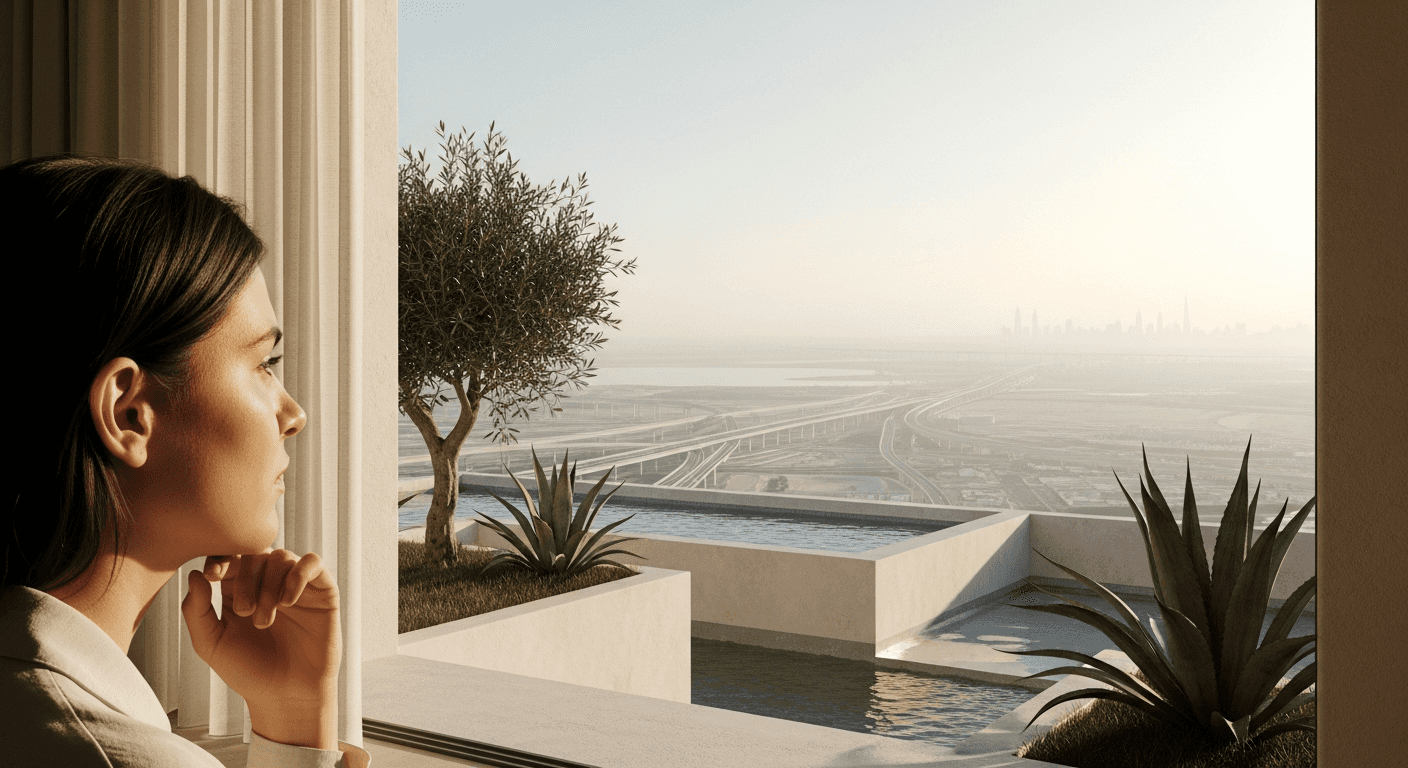
Future-Proofing Off-Plan: Infrastructure's Impact
A deep dive into how Dubai's ambitious infrastructure projects, from new metro lines to megaprojects, will shape future property values for off-plan investors.

When you buy an off-plan property in Dubai, you are not just purchasing a future apartment or villa. You are buying a stake in the city's ambition. The real art of successful off-plan investing lies less in the floor plan and more in your ability to read the city's blueprint for the future.
Here is what I will analyse for you:
- The Dubai 2040 Urban Master Plan as an investment roadmap.
- The specific infrastructure catalysts that create tangible value.
- A deep dive into the Al Maktoum Airport expansion and Dubai South.
- The impact of the new Metro Blue Line on emerging communities.
- The investment thesis behind the revived Palm Jebel Ali megaproject.
- How to evaluate developer risk against government promises.
- A detailed financial breakdown of an off-plan purchase and its future potential.
- My final checklist for future-proofing your investment.
The Master Plan as Your Investment Thesis
For any serious investor looking at off-plan launches, the first document to study isn't a developer's glossy brochure — it's the Dubai 2040 Urban Master Plan. This strategic document, approved by Dubai's leadership, is the government's definitive statement of intent. It outlines where the city will grow, what that growth will look like, and which areas are prioritised for development over the next two decades. Understanding the `master plan impact real estate` is not optional; it is the fundamental basis for any long-term property investment in this city. It is the closest thing we have to an official investment roadmap, and ignoring it is equivalent to navigating without a map.
The plan is built on several key pillars that directly influence property values. It aims to double the population to nearly 8 million by 2040 while focusing new development in five main urban centres, some existing and some new. These centres are Deira/Bur Dubai (the historic heart), Downtown Dubai/Business Bay (the financial hub), Dubai Marina/JBR (the tourism and entertainment hub), and two new centres: Expo City (a hub for events and smart logistics) and Dubai Silicon Oasis (a science and technology hub). The plan explicitly states that development will be concentrated around mass transit stations, with the goal of having 55% of the population living within 800 metres of public transport. This single detail is a powerful signal for investors: proximity to a metro station is no longer just a perk, it's a core tenet of the city's entire urban strategy.
What this means for an investor is that you can begin to identify the `future growth areas Dubai` with a higher degree of confidence. The plan isn't just about zoning; it’s about channelling resources. When the government designates an area for growth, it signals that public funds will be directed towards the necessary infrastructure: roads, public transport, schools, hospitals, and parks. These are the building blocks of a thriving community and the drivers of sustainable capital appreciation. An off-plan project in an area aligned with the 2040 plan is backed by more than just a developer's capital; it's theoretically backed by the full weight of Dubai's strategic vision. Your job as an investor is to assess the credibility and timeline of that vision turning into concrete and asphalt.
Decoding Infrastructure Catalysts: What Really Moves the Needle?
 Featured project
While the 2040 Master Plan provides the 'where', understanding the 'what' and 'when' of infrastructure delivery is crucial for `assessing future development Dubai`. Not all infrastructure is created equal in its ability to generate an `off-plan value increase`. I group the most powerful catalysts into three categories: connectivity, economic hubs, and social fabric.
First and foremost is connectivity. Nothing transforms a patch of desert into a desirable address faster than efficient transport links. The expansion of the Dubai Metro is the most potent example. The upcoming 30km Blue Line, for instance, will connect existing Red and Green lines and bring metro access to previously isolated but growing communities like Mirdif, Al Warqa'a, and International City. Off-plan projects in these corridors, which may currently seem remote, will see their investment case completely transformed upon the line’s completion. It is a direct and quantifiable value addition. Similarly, major road network upgrades, like the ongoing improvements to Hessa Street and Garn Al Sabkha Street, are designed to ease congestion and improve access to key communities like JVC, Dubai Hills, and Town Square. For an off-plan property with a 3-4 year completion timeline, buying before these roadworks are finished means you are essentially acquiring the property at a discount to its future, better-connected self.
Second are economic hubs. People live where they work. The creation of new free zones or specialised industrial and commercial districts is a powerful engine for localized rental demand and, consequently, capital growth. The vast ecosystem being built in Dubai South around the airport is a prime example. It’s not just an airport; it's a collection of dedicated zones for logistics, aviation, commerce, and exhibitions. Each of these zones will create thousands of jobs, and those employees will need homes. An investor who buys a residential unit in Dubai South today is making a calculated bet on the successful population of these economic clusters. This is a more complex bet than simply banking on a metro station, as it depends on the government's ability to attract international companies and talent, but the potential rewards are commensurately higher.
Finally, there's the social fabric — the infrastructure that turns a collection of buildings into a place people want to live. This includes high-quality schools, modern hospitals, expansive public parks, and compelling retail and leisure destinations. Developers like Emaar Properties have mastered this, making it a core part of their value proposition in communities like Dubai Hills and Arabian Ranches. When you assess an off-plan project in a new area, look beyond the tower's amenities. Is a reputable school operator announced for the community? Is there a significant park or green space integral to the master plan? Is a major shopping mall or retail spine part of the developer's phased delivery? The presence of this 'soft' infrastructure is often what differentiates a community that achieves premium pricing from one that stagnates. It’s what secures the long-term end-user demand that underpins a healthy and resilient property market.
Case Study 1: The DWC Expansion & Dubai South
There is no single `Dubai infrastructure projects off-plan` investors should watch more closely than the reactivation and expansion of Al Maktoum International Airport (DWC) in Dubai South. The recent government announcement to move all operations from Dubai International (DXB) to DWC over the next decade, backed by a staggering AED 128 billion investment, is the most significant catalyst for property value in the emirate for the next generation. This isn't just an airport expansion; it's the creation of an entirely new city core, an 'aerotropolis' five times the size of the current DXB, with a projected capacity for 260 million passengers. For property investors, this is a landscape-altering event.
The investment thesis for Dubai South is straightforward: you are buying into the very early stages of what is planned to be one of the world's most significant global logistics and transport hubs. The area is designed as a self-sufficient city with dedicated districts for aviation, logistics, commerce, and residential living. The sheer scale of the project will create a gravitational pull for employment and population growth that will ripple across the entire southern corridor of Dubai. We are talking about projected demand for up to one million residents within the Dubai South ecosystem alone. This creates a long-term, structural demand for housing that is almost unprecedented.
For an off-plan investor today, this presents a unique opportunity. Property prices in Dubai South are still considerably lower than in established central areas. You can acquire apartments and townhouses from reputable developers at price points that are simply unavailable closer to the current city centre. The risk, of course, is the timeline. This is a multi-decade project. While the airport transfer is slated to happen over the next 10 years, the full maturation of the surrounding city will take longer. An investor here must be patient and have a long-term horizon. The initial rental yields might be modest as the area builds its critical mass of residents. However, the potential for capital appreciation is immense. As each phase of the airport is completed, as each new multinational sets up its logistics hub, as the population grows, property values are poised for a systematic repricing. This is the classic off-plan play: buying the future, today, at a discount.
When we advise clients at Gaia Living on this area, we are candid about the profile required. This is not for someone seeking immediate rental returns or a quick flip. This is for a strategic investor who understands demographic and infrastructure-led growth. We focus on projects by top-tier developers who have a track record of delivering quality and creating communities, as their projects are more likely to attract the first waves of residents. The key is to secure a property within the core residential districts, such as Emaar South, which benefits from the master developer's brand and proven ability to deliver amenities. The `off-plan value increase` here will not be a sudden spike, but a steady, powerful ascent synchronised with the rise of the world's next great airport city.
Case Study 2: The Blue Line Metro's Ripple Effect
The announcement of the Dubai Metro's Blue Line by the Roads and Transport Authority (RTA) is a perfect, tangible example of an infrastructure catalyst that investors can act on today. Unlike the generational timescale of the DWC project, the Blue Line has a more defined completion target around the end of this decade, making its impact on property values more immediate and predictable. The new line will add 14 new stations and stretch over 30 kilometres, critically linking the existing Red and Green lines and, for the first time, providing metro access to a string of rapidly developing communities.
For investors, the game is to identify the off-plan projects located within a comfortable walking distance — typically 10 to 15 minutes, of the proposed new stations. The route is planned to serve areas like Mirdif, Al Warqa'a, International City 1 and 2, Dubai Silicon Oasis, and Ras Al Khor Industrial Area, before connecting to Creek Harbour and Academic City. These are areas that have seen significant residential development over the past decade but have remained heavily car-dependent. The arrival of the metro will fundamentally change their accessibility and, by extension, their desirability, particularly for the mid-market rental segment that forms the backbone of Dubai's population.
Let's take a community like Creek Harbour. Master-developed by Emaar, it's already a premium destination with stunning waterfront views and high-quality architecture. However, its connectivity has been a minor drawback. The Blue Line will plug it directly into the city's metro network, enhancing its appeal for both residents and tourists and likely providing a significant valuation uplift for properties there. An investor buying an off-plan apartment in Creek Harbour today is effectively locking in a price that doesn't yet fully account for this future connectivity. The same logic applies, perhaps even more powerfully, to more affordable, high-density areas like International City. The introduction of a metro station there will be transformative, providing a vital public transport link for thousands of residents and making the area a much more attractive rental proposition.
“The smart money in off-plan doesn't follow the cranes; it follows the tunnel boring machines and the road graders. The infrastructure must come first.”
The key to capitalizing on this is to act before the infrastructure's impact is fully priced in. The market is efficient; once the stations are built and the trains are running, the property values will have already adjusted. The opportunity lies in the period between the project's firm announcement and its completion. During this window, you can acquire assets in projects by developers like Emaar, who are known for their integrated communities, with the knowledge that a powerful, government-backed value driver is on its way. This strategy involves a degree of faith in the government's ability to execute on schedule, but Dubai's track record with major projects like the Red Line and Route 2020 provides a strong basis for confidence.
Case Study 3: The Palm Jebel Ali Megaproject
The official relaunch and rapid progress of Palm Jebel Ali, the ambitious sibling to the iconic Palm Jumeirah, is a powerful statement of Dubai's long-term confidence. Shelved after the 2008 financial crisis, its revival by master developer Nakheel signifies a new era of megaproject development. For off-plan investors, Palm Jebel Ali represents one of the most compelling, albeit long-term, investment propositions in the entire region. It is a bet on the future of Dubai's ultra-luxury coastline and its enduring appeal to global wealth.
What makes Palm Jebel Ali so significant is its scale. It is roughly twice the size of Palm Jumeirah and is planned to add approximately 110 kilometres of new coastline to Dubai. The master plan includes 80 new hotels and resorts, and a mix of luxury villas and apartments that will ultimately house around 35,000 families. This is not just another waterfront community; it's a new city district rising from the sea. The infrastructure required to support this is immense, from new bridges and access roads connecting it to the mainland via Sheikh Zayed Road, to the utilities, public spaces, and transport systems needed for a population of this size. The project is a core component of the Dubai 2040 Urban Master Plan's goal to increase public beach length by 400%.
From an investment perspective, Palm Jebel Ali is the definition of a ground-floor opportunity. The initial villa launches sold out almost instantly, demonstrating the huge pent-up demand for this type of prime waterfront real estate. The initial buyers are acquiring assets at the earliest possible price point. The value proposition is based on a clear precedent: the incredible capital appreciation seen on Palm Jumeirah over the past two decades. Early investors in Palm Jumeirah villas saw their property values multiply many times over as the community matured and became a global icon. The thesis for Palm Jebel Ali is that history will repeat itself, on an even grander scale.
However, as an analyst, I must stress the investment horizon required. This is a project that will be delivered in phases over more than a decade. The first handovers are years away, and the full community with all its promised hotels, retail, and amenities will take even longer to materialize. An investor here needs deep pockets and extreme patience. This is not a 'flip' opportunity. It is a legacy asset, an investment to be held and passed down. The risks are tied to the sheer complexity and timeline of the project. But with the full backing of the Dubai government and a proven developer like Nakheel at the helm, the execution risk is mitigated. For those who can afford to play the long game, buying off-plan on Palm Jebel Ali is a rare chance to invest in the creation of a future global landmark.
Assessing Developer Alignment and Execution Risk
While government-led infrastructure plans create the opportunity, a successful `off-plan value increase` ultimately depends on the developer's ability to execute. A master plan can designate a growth corridor, but it's the developer who builds the homes, the community centres, the local parks, and the retail strips that make people want to live there. `Assessing future development Dubai` is therefore a two-part process: you must analyse the macro (the government's plan) and the micro (the developer's track record and capability).
In my experience, the most successful investments are found where these two align perfectly. Look for a reputable developer with a strong balance sheet and a history of delivering entire communities, not just isolated towers, within an area earmarked for strategic government investment. Emaar's development of Dubai Hills Estate is a textbook example. The area is strategically located along Al Khail Road and is part of the 2040 plan's vision for greener, more integrated communities. Emaar then executed flawlessly, delivering not just villas and apartments, but a world-class golf course, a major shopping mall, a central park, a hospital, and schools. They built a complete ecosystem. Investors who bought off-plan in the early phases saw substantial capital appreciation precisely because Emaar delivered on this community vision, which was itself aligned with the city's broader goals.
Conversely, the biggest risk is a misalignment. This can happen in several ways. A developer might launch a project in a remote area with grand promises of future connectivity that aren't actually part of any confirmed government plan. Or, a less-experienced developer might attempt a project in a designated growth zone but fail to deliver the promised amenities, resulting in a soulless project that fails to attract end-users. This is why due diligence on the developer is non-negotiable. At Gaia Living, we scrutinize a developer's history: Have they delivered previous projects on time? When they deliver a community, does it match the marketing renders? Do they have a reputation for high-quality finishing and effective post-handover management? Developers like Meraas, known for lifestyle destinations like City Walk and Bluewaters Island, or Select Group, with its portfolio of premium towers in Dubai Marina, have built brands based on execution certainty. Choosing a developer of this calibre significantly de-risks your investment.
Dubai's real estate regulations provide a strong safety net. The RERA framework, with its requirement for escrow accounts (where buyer payments are held and only released to the developer against construction milestones) and the Oqood registration system that provides a preliminary title deed, protects buyers from project failure. The government ensures the developer has the land and the permits to build. However, regulations can't guarantee quality or the delivery of the 'lifestyle' elements that create premium value. That comes down to the developer's commitment and capability. Your job is to partner with a developer whose ambition and ability to execute match that of the city itself.
The Financials: How to Model Future Value (and Costs)
Investing in off-plan property requires a clear-eyed understanding of all the costs involved, both upfront and ongoing. It also requires a disciplined approach to modeling potential returns. While no one can guarantee future prices, we can build a realistic financial picture based on the infrastructure catalysts we've discussed. Let's walk through a hypothetical example of an off-plan two-bedroom apartment in a future growth corridor.
First, let's break down the purchase costs. It's more than just the sticker price. You must account for government fees, which are non-negotiable. The Dubai Land Department (DLD) transfer fee is the most significant.
Hypothetical Off-Plan Purchase Cost Breakdown:
- Purchase Price: AED 2,500,000
- Dubai Land Department (DLD) Fee (4% of Purchase Price): AED 100,000
- Oqood/Initial Registration Fee: Approximately AED 5,250 (AED 5,000 + 5% VAT)
- Real Estate Agency Fee: Often 0% on off-plan as it's paid by the developer, but can be 2% + VAT on secondary market transactions.
- Total Upfront Cost (excluding payment plan): AED 2,605,250
This total cost is paid over time according to the developer's payment plan. A common structure is a 60/40 plan, where 60% of the price is paid in installments during construction and the final 40% is due upon handover. This structure is favourable for investors as it allows them to control a valuable asset with phased capital deployment. Upon handover, you either pay the final 40% in cash or secure a mortgage. Remember that under current Central Bank of the UAE rules, mortgage financing for a first property is typically capped at 80% of the property value for expatriates, meaning a 20% down payment is required on a ready property.
Now, how do we project the `off-plan value increase`? This is where our analysis of infrastructure comes in. Let's assume this AED 2.5M apartment is located near a future Blue Line metro station, with completion expected around the same time as the property's handover in three years. We can build scenarios. A conservative scenario might assume a general market appreciation of 5% per year, leading to a handover value of around AED 2.9M. However, a more realistic scenario that accounts for the 'metro effect' might project an additional 15% premium. In this case, the property's value on handover could be closer to AED 3.3M. This isn't a guarantee; it's a calculated projection based on observable market dynamics. The difference between these scenarios — AED 400,000, is the potential alpha generated by correctly timing your investment with the infrastructure delivery.
Finally, investors must look beyond handover to the ongoing costs of ownership. The most significant is the annual service charge, used for the maintenance of common areas, security, and amenities. These fees vary widely. A high-rise tower in a prime area like Downtown Dubai might command service charges of AED 22-30 per square foot per year. A villa community like Arabian Ranches could be much lower, perhaps AED 3-6 per square foot of plot area. For a 1,500 sq ft apartment at AED 25/sqft, that's an annual cost of AED 37,500. This must be factored into your rental yield calculations. A property with high service charges will require a higher rent to achieve the same net yield, making it crucial to assess these charges before you buy.
Investing in off-plan property based on future infrastructure is a strategic bet on Dubai's proven ability to execute its vision. The highest returns will go to those who do their homework, align their purchase with confirmed government plans, choose top-tier developers, and have the patience to see the timeline through.
My Verdict: An Investor's Checklist for Future-Proofing
Synthesizing all these factors, my final advice to any investor looking to future-proof an off-plan purchase is to approach it with the discipline of an urban planner and the skepticism of a risk manager. The potential for significant capital appreciation is very real, but it is not automatic. It must be earned through rigorous due diligence. At Gaia Living, this is the framework we use to guide our clients, moving beyond the hype to focus on the fundamental drivers of value. Here is my personal checklist for assessing any infrastructure-led off-plan investment.
- Scrutinize the Master Plan: Before you even look at a property, pull up the Dubai 2040 Urban Master Plan. Is the project located in or near one of the five key urban centres or along a designated development corridor? If it's in a peripheral area not highlighted in the plan, you must ask 'why' and demand a much more compelling, developer-led reason for its future growth.
- Identify a Specific, Confirmed Catalyst: Vague promises of 'future development' are a red flag. Pinpoint the exact infrastructure project that will anchor your investment thesis. Is it a specific metro station on the Blue Line? Is it proximity to the new DWC passenger terminals? Is it a new bridge connecting you to a major highway? Go to the source — the RTA or Dubai Municipality, to confirm the project is real and has a publicly announced timeline.
- Pressure-Test the Timeline: Developer timelines are marketing; government timelines are policy. Be conservative. If a developer's handover is in 2028 and the metro station is 'planned' for 2029, model your returns based on the station opening in 2030 or even 2031. What does your investment case look like if the key catalyst is delayed by two years? If it still holds up, you have a robust investment. If it collapses, your risk is too high.
- Vet the Developer's Community-Building DNA: Look at the developer's past projects that have been completed for at least five years. Visit them. Are the parks well-maintained? Is the retail occupied and vibrant? Is there a sense of community? Or is it a sterile collection of buildings with decaying public spaces? You are buying their ability to deliver a place, not just a property. This is especially critical in new master communities like those in Dubailand or Dubai South.
- Model the Full Financial Picture: Build a spreadsheet. Line item every single cost: the 4% DLD fee, Oqood, potential financing costs, and, crucially, a realistic estimate for post-handover service charges. Project your potential rental income based on comparable, existing areas and then subtract your running costs to find your net yield. A great capital appreciation story is less compelling if the property is a drain on your cash flow every year.
- Assess Your Own Horizon: Finally, be honest with yourself about your financial situation and patience. Investing in a future city district like Palm Jebel Ali or Dubai South requires a 10-to-15-year mindset. Investing alongside a 4-year metro build requires less patience but still demands a commitment through the construction cycle. If you need liquidity in the short term, these plays are likely not for you. Choose the strategy that aligns with your own personal financial plan.
By following this checklist, you move from being a passive buyer to an active, analytical investor. You replace hope with strategy, and in a market as dynamic and ambitious as Dubai's, strategy is what ultimately separates a good investment from a great one.
Sources
- Dubai 2040 Urban Master Plan: UAE Government Portal
- Real Estate Laws and Regulations: Dubai Land Department
- Transport Projects and Planning: Roads and Transport Authority (RTA)
- Mortgage Regulations: Central Bank of the UAE
Questions, answered
- Which new infrastructure project will have the biggest impact on Dubai property?
- In my view, the expansion of Al Maktoum International Airport (DWC) into the world's largest will be the most significant long-term catalyst. It is designed to create an entire 'aerotropolis' in Dubai South, driving population growth and sustained housing demand across a vast new urban area for decades to come.
- Is it risky to buy off-plan based on a project that's 10 years away?
- Yes, there is significant timeline risk. Major infrastructure projects can face delays, which can postpone the anticipated capital appreciation. Investors should have a long-term holding strategy and choose developers with a strong track record of delivering on their promises, even when external timelines shift.
- How much value does a new metro station really add to a property?
- While there's no fixed percentage, properties within a 10-15 minute walk of a new metro station typically see a valuation premium. The exact off-plan value increase depends on the area's existing connectivity and the quality of the development, but a 10-20% uplift compared to similar, less-connected properties is a reasonable expectation upon the line's completion and operation.
- What are the key government plans I should read before investing?
- The most important document is the Dubai 2040 Urban Master Plan. Also, I recommend reviewing specific project announcements from the Roads and Transport Authority (RTA) for transport links and the official master plans for economic zones like those in Dubai South.
- Do developers have to build the infrastructure they promise in their brochures?
- Amenities within the project's title deed and Sales and Purchase Agreement (SPA) are contractually binding. However, promised external infrastructure like metro lines or new roads are under government purview. RERA and DLD regulations ensure developers maintain funds in escrow accounts to complete the project as sold, but they cannot guarantee government timelines.
- What's the difference between buying in an established area versus a new growth corridor?
- Established areas like Dubai Marina offer lower risk, predictable rental yields, and immediate use, but limited potential for dramatic capital appreciation. New growth corridors like Dubai South offer lower entry prices and significant long-term appreciation potential tied to infrastructure delivery, but come with higher timeline risk and a longer wait for community maturity.

Isabelle covers off-plan and investment strategy — payment plans, handover risk, developer track records, and the maths of buying before completion.
Related stories

A First-Timer's Guide to Vetting Dubai's Developers
Buying off-plan in Dubai requires more than just loving the renders. This guide walks you through the essential steps for vetting a developer's track record to protect your first property investment.
Living in the Limelight: Dubai's Cultural Neighbourhoods
Discover the premium you'll pay and the lifestyle you'll gain when you buy a home near Dubai's top arts and culture hubs. From Al Quoz to Downtown, we explore what it truly costs to live a creative life.
The True Cost of an Empty Dubai Flat
A detailed breakdown of how vacancy periods silently destroy rental yields and a practical guide for Dubai landlords to minimize this often-underestimated expense.
Echoes, in your inbox
One thoughtful email a month. Market insight, new launches, no spam.