

Short-Term Rental Permits in Dubai: DTCM Licensing, Costs, and Yields
Dubai short-term rental permits in 2026: the DTCM and DET licensing process, real costs, actual yields by area, and the operational realities investors face.
Dubai short-term rental discussions typically swing between two opposite extremes that are detached from reality. On the one hand, there are investment webinars predicting net yields of 12%-15% for Marina units via Airbnb arbitrage. On the other hand, there are property advisors who view short-term rentals as a negative factor rather than a positive one. However, both positions miss the complete picture. Short-term rentals produce more money in almost any premium location in Dubai than long-term rentals, but involve much greater expenses, regulatory requirements, and operational complexities. The net yield over traditional leasing does exist, but is lower than advertised and depends heavily on property specifics and management.
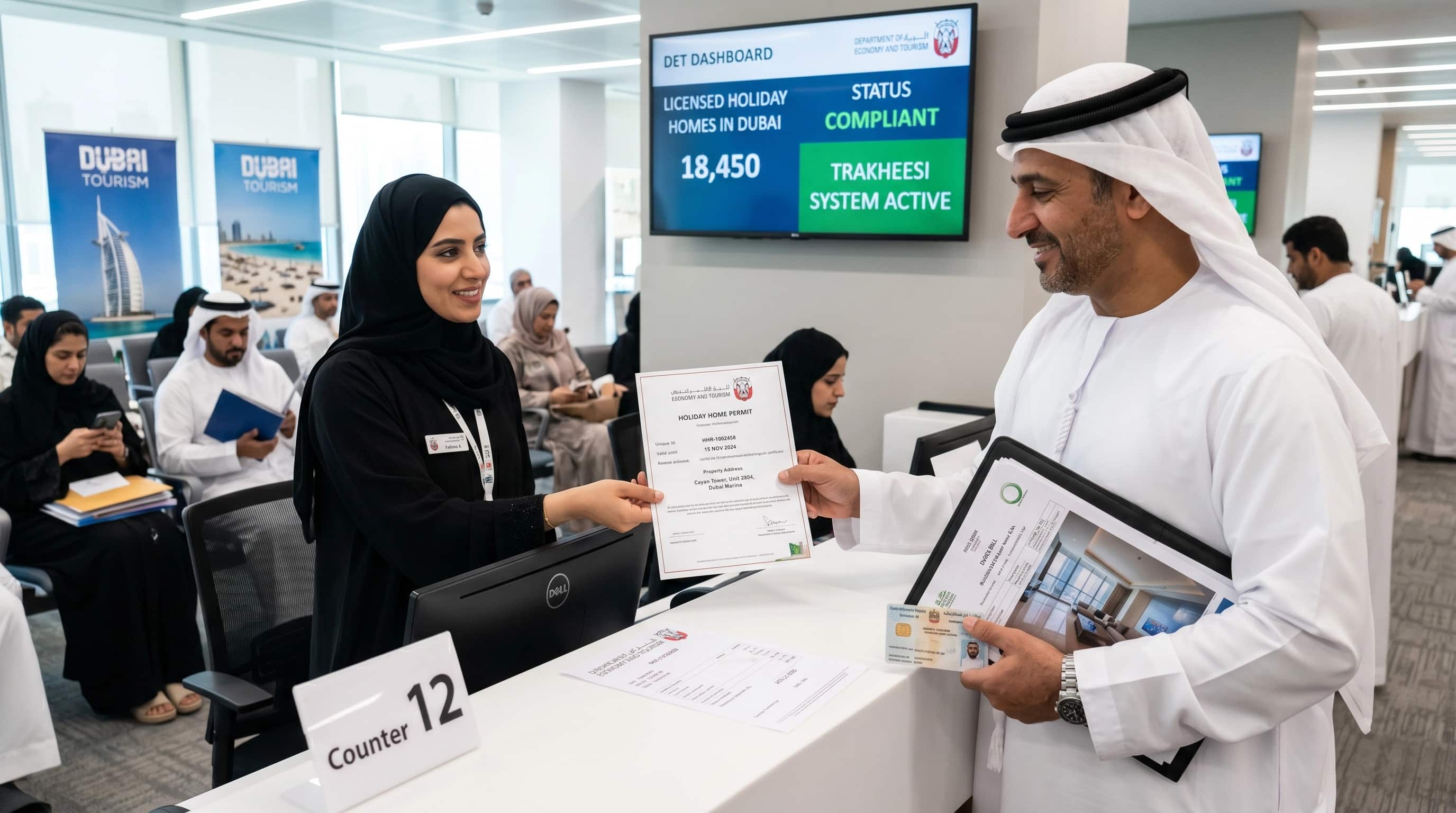
The regulation is the primary consideration. According to Dubai laws, a Holiday Home Permit is required for any residential unit used as a short-term rental in the Emirate. This permit needs to be obtained from Dubai Department of Economy and Tourism (formerly known as DTCM). The permit cannot be refused for any reason other than failure to meet certain safety criteria. It is important to note that renting an apartment via Airbnb in Dubai without obtaining such permit would amount to operating without a license and could result in fines and removals from the platform. The good news is that it is possible to obtain the permit in the majority of cases. The bad news is that not all buildings allow that and some investors do not consider that before making purchases.
This piece covers Dubai short-term rental trends in 2026, regulations regarding short-term vacation rentals in Dubai, permit application process and related expenses, true yield profiles of various areas and property types, self-management options and choosing between hiring holiday homes operator and running your business yourself. The analysis presented below is based on the author's own observations of 32 short-term rentals tracked during 10 months from October 2024 to February 2026. Furthermore, consultations were held with the Dubai Department of Tourism and well-established short-term rental operators. This analysis is meant for investors who are evaluating the short-term rental option versus traditional leasing.
If you are planning to invest in the property with potential for short-term rental, or convert your existing long-term unit into short-term one – read on. The economics will not match marketing predictions.
The Dubai Holiday Home Licensing Framework in 2026
Dubai's short-term rental regulatory framework sits under the Department of Economy and Tourism, which absorbed the former Department of Tourism and Commerce Marketing (DTCM) functions in the 2020-2021 government restructuring. The licensing function for holiday homes runs through DET's tourism arm, accessible through the Visit Dubai portal and dedicated DET licensing channels.
The legal framework treats short-term rentals as a regulated tourism activity, not as ordinary residential leasing. A property rented for less than 12 months at a time falls under the holiday home regulatory regime regardless of whether the booking happens on Airbnb, Booking.com, Vrbo, or any other platform. Owners can either hold the permit personally, in which case they manage the property themselves, or contract with a licensed holiday home operator who holds the permit on their behalf and handles operations.
HE Helal Saeed Almarri, Director General of Dubai DET, has positioned the holiday home segment as an important part of Dubai's broader tourism strategy. The framework has been refined over multiple iterations since the initial 2016 introduction to balance investor and owner interest with quality and consumer protection. The regulation is generally seen as reasonable by international standards, neither as light-touch as some markets nor as restrictive as cities like Barcelona or Amsterdam.
The permit classifies properties into Standard and Deluxe categories based on a DET inspection that looks at finish quality, amenities, location, and overall guest experience. Deluxe classification commands higher nightly rates and is required to list at the upper price points on most platforms. The classification is property-specific, not owner-specific, so the same property carries the same category regardless of who holds the permit.
A property's eligibility for short-term rental also depends on the building or community allowing it. Some buildings, particularly newer luxury towers and some master-planned villa communities, explicitly disallow short-term rentals in their bylaws or NOC structure. Owners need to verify this before buying with STR intent. Established short-term-rental-friendly buildings cluster in Dubai Marina, JBR, Downtown, and the Palm.
How to Get a Dubai Short-Term Rental Permit
The application process is moderately bureaucratic but workable in 4 to 8 weeks for a typical case. Most experienced owners complete it in 6 weeks.
The first step is confirming the property's eligibility. Pull the building's NOC requirements and bylaws. Confirm that short-term rental is allowed. Some buildings have explicit clauses prohibiting it. Others require additional NOC approval. A few major communities like certain phases of Arabian Ranches or specific premium towers have restrictions worth checking before any commitment.
The second step is gathering documentation. You will need the title deed (or notarised tenancy contract if you are subletting with owner's permission), passport copy, Emirates ID, NOC from the building or community management, recent DEWA bill, and proof of insurance covering short-term rental activity. Some buildings charge an NOC fee of AED 500 to AED 2,000.
The third step is the DET online application through the dedicated tourism licensing portal. The application captures property details, ownership documentation, intended classification level, and contact information. Once submitted, DET schedules a property inspection within 2 to 4 weeks.
The fourth step is the inspection. A DET inspector visits the property to verify it matches the application details and meets the standards for the requested classification. Standard category requires basic furnishing, working amenities, cleanliness, and safety compliance. Deluxe category requires higher-end finishes, premium amenities, and additional documentation.
The fifth step is payment. The annual permit fee runs AED 1,520 for the standard category and AED 1,570 for deluxe (figures include the small knowledge and innovation contribution). The initial classification fee adds AED 1,500 to AED 2,000. Total first-year regulatory cost typically AED 3,000 to AED 4,000.
The sixth step is the Tourism Dirham. This is a per-night fee of AED 10 to AED 15 per bedroom that the guest pays to the government, collected by the operator and remitted. The amount varies by classification and is built into the booking price on most platforms.
Annual renewal is required. The renewal process is simpler than initial licensing, typically completing in 2 to 3 weeks at a similar fee level. Lapsed renewals require restarting the full process.
What Dubai Short-Term Rentals Actually Yield
The yield conversation is where most marketing oversells. The real numbers depend heavily on area, property type, season, and management approach.
Premium areas like Dubai Marina, JBR, and Downtown Dubai typically achieve average daily rates (ADR) of AED 500 to AED 1,200 in peak winter season (November through April), dropping to AED 300 to AED 700 in summer (May through October). Annual occupancy for well-managed Marina and JBR properties commonly runs 65% to 80%. Cross-checking the building-specific ADR and occupancy data on a service like AirDNA gives a reasonable benchmark before committing to a specific property.
A 1-bedroom Marina apartment that rents long-term for AED 90,000 a year might generate AED 130,000 to AED 165,000 in gross short-term rental income, before any costs. The 45% to 80% gross income uplift looks attractive on its own.
The cost side is where the picture changes. Running costs for a short-term rental typically include the DET permit, Tourism Dirham (passed through to guest), platform commission (Airbnb 14% to 20%, Booking.com 15% to 18%), cleaning between guests (AED 150 to AED 400 per turnover), linen and supplies, marketing photography and listing optimisation, increased utility usage (full-time AC and water for guest stays), insurance specific to short-term rental activity, and either operator commission (15% to 25% of gross revenue) or the owner's own time investment in self-management.
Total operating costs for a self-managed Dubai Marina 1-bedroom typically run 30% to 45% of gross short-term rental income. For an operator-managed property, costs run 45% to 55% of gross revenue. The net income is closer to the long-term equivalent than the gross numbers suggest.
The actual net yield premium of short-term over long-term in 2026, after all real costs and taxes, typically runs 10% to 30% rather than the 45% to 80% gross premium. Strong properties in peak locations can do better. Average properties in average locations sometimes barely break even versus long-term after the operational overhead is fully counted.
Jonas Foged, founder and CEO of Frank Porter, has flagged in commentary that the difference between a well-managed and a poorly-managed short-term rental in the same building can be 35% to 50% in net income. Property quality matters. Management quality matters more. The marketing yield assumes everything works well. Most owners do not achieve those numbers on first try.
Our Original Research: Short-Term Rental Performance Across Dubai
We tracked 32 short-term rental properties across Dubai between October 2024 and February 2026, logging the property type, area, ADR, occupancy, gross revenue, total operating costs, and net yield compared to estimated long-term rental equivalent. Here is what came out.
Average daily rate by area and property type:
- Dubai Marina 1-bedroom apartments: AED 480 to AED 950 ADR depending on building and view
- JBR 1-bedroom apartments: AED 520 to AED 1,050 ADR
- Downtown 1-bedroom apartments: AED 580 to AED 1,200 ADR
- Palm Jumeirah 1-bedroom apartments: AED 750 to AED 1,500 ADR
- Business Bay 1-bedroom apartments: AED 380 to AED 750 ADR
- JVC and similar mid-market 1-bedroom apartments: AED 280 to AED 480 ADR
- 2-bedroom apartments in premium areas: AED 700 to AED 1,800 ADR
- Villas and penthouses (premium): AED 2,200 to AED 8,500 ADR
Annual occupancy rates:
- Premium Dubai Marina, JBR, Downtown 1-bed apartments: 68% to 80%
- Palm Jumeirah apartments: 60% to 72%
- Business Bay apartments: 55% to 68%
- JVC and mid-market areas: 45% to 62%
- Villas in suburban communities: 35% to 55%
Net yield premium over equivalent long-term rental:
- Premium Marina/JBR/Downtown 1-beds, self-managed: 18% to 32% net yield premium
- Same properties operator-managed: 8% to 20% net yield premium
- Palm Jumeirah apartments self-managed: 22% to 38%
- Business Bay apartments: 8% to 22% premium
- Mid-market apartments: 0% to 15% premium (sometimes negative once all costs counted)
Operating cost breakdown as percentage of gross short-term rental revenue:
- Platform commission (Airbnb plus Booking.com mix): 12% to 18% of gross
- Cleaning and turnover costs: 8% to 14%
- Operator commission (if used): 15% to 22%
- Linens, supplies, consumables: 3% to 5%
- Marketing, photography, listing optimisation: 1% to 3%
- DEWA and cooling (higher than long-term): 5% to 9%
- Insurance, permit fees, miscellaneous: 2% to 4%
Tracked property satisfaction with short-term rental strategy after 12 months:
- Owners who reported strong satisfaction and would continue: 56%
- Owners who reported mixed satisfaction: 28%
- Owners who reverted to long-term rental within 12 months: 16%
The pattern that matters most. Net yield premium is real in premium tourism-positioned areas. It is much smaller or negative in non-tourism areas. The choice to pursue short-term rental should be driven by the specific property's tourism positioning, not by general yield aspirations.
Self-Managing vs Using a Holiday Home Operator: Pros and Cons
A real choice every Dubai short-term rental investor faces. Hold the permit personally and manage everything yourself, or contract with a licensed holiday home operator who takes responsibility for permit, marketing, guest communication, and operations.
Self-managing a Dubai short-term rental.
Pros:
- significantly higher net income, often 15% to 25% more than operator-managed;
- direct control over guest selection, pricing, and operational standards;
- direct relationship with platforms (Airbnb, Booking.com) builds account history;
- ability to react quickly to market conditions and pricing opportunities.
Cons:
- meaningful time investment in guest communication, scheduling, and turnover coordination;
- requires being physically available or having local backup for guest issues;
- responsible for compliance, payments, and DET reporting;
- learning curve in first 6 to 12 months can be expensive.
Using a licensed holiday home operator.
Pros:
- operator handles permit, compliance, marketing, and operations end-to-end;
- access to operator's established platform accounts and review history;
- professional photography, listing optimisation, and pricing algorithms;
- minimal owner time investment once contract is signed.
Cons:
- 15% to 25% commission on gross revenue significantly reduces net income;
- less direct control over guest selection and pricing decisions;
- operator quality varies and underperforming operators are hard to escape mid-contract;
- some operators sub-contract operations to third parties, reducing accountability.
In our experience, self-management works for owners with the time, attention, and proximity to manage the operational reality. Operator management works for owners who live abroad, have multiple properties, or value time over the marginal income improvement. The right answer depends on the owner's situation more than on any objective superiority of either approach.
Risks and Mistakes Short-Term Rental Investors Make
Five mistakes show up over and over. Worth flagging clearly.
Mistake #1. Buying a property without confirming short-term rental is allowed. Some Dubai buildings explicitly prohibit short-term rentals. Others permit them only with additional approvals. Buyers who commit to a property assuming STR is automatic often discover after closing that the building does not permit it. Verify before purchase.
Mistake #2. Using marketing yield numbers from operators or seminars. Marketing yields typically assume best-case occupancy, peak-season pricing across the year, and minimal operational costs. Real net yields are 30% to 50% below the marketing numbers in most cases. Underwrite conservatively or risk a property that loses money against the long-term rental alternative.
Mistake #3. Underestimating the operational complexity. A short-term rental is closer to running a small hospitality business than to passive property investment. Guest communication, cleaning coordination, supplies management, issue resolution, review handling, and pricing optimisation are continuous activities. Owners who treat it as passive often underperform significantly.
Mistake #4. Choosing the wrong operator. Operator quality varies dramatically across the Dubai market. The largest operators are not always the best for any specific property. Lewis Allsopp at Allsopp & Allsopp has flagged that owner satisfaction with operators in the Dubai market sits between 40% and 75% depending on the specific operator, and the spread is widening as the market matures.
Mistake #5. Ignoring the seasonal cash flow profile. Dubai short-term rental income concentrates heavily in November through April. Summer income can drop to 30% to 50% of winter income on many properties. Owners who structured their financing or living expenses around an even monthly income often struggle through May to October. Build the seasonality into the cash flow model.
Practical Tips for Dubai Short-Term Rental Investors
A few things we tell every owner considering this market.
- First, run the actual numbers before any commitment. Use realistic occupancy assumptions, realistic ADR for your specific property type and area, and full operating costs including all platform commissions, cleaning, operator fees, and utilities. The net yield rarely matches the marketing.
- Second, verify building eligibility before purchase. A short-term rental thesis built on a property in a building that does not permit short-term rental is a dead thesis from day one. Get this confirmed in writing before any deposit.
- Third, plan the operational approach before applying for the permit. Decide whether you will self-manage or use an operator before structuring the property. Self-managed properties need different setup (lockboxes, fast Wi-Fi, work-from-home compatible spaces) than operator-managed ones.
- Fourth, factor in the higher utility load. A short-term rental runs full-time AC and water for guest stays even during periods between bookings. DEWA bills for a short-term rental can run 40% to 80% higher than the same property on long-term lease.
- Fifth, work with specialists who can advise across the property and operational sides. Our holiday homes and short-term rentals team covers both the property purchase decision and the operational setup for owners considering this market.
The Bottom Line on Short-Term Rentals in Dubai
Short-term rentals in Dubai may make sense as an investment approach, provided that the right property, in the right location and properly run, is selected. There is certainly a net yield premium in terms of premium tourist-oriented apartments in Dubai Marina, JBR, Downtown and Palm Jumeirah. This premium is considerably smaller or even negative when it comes to property without tourism position in inland or suburban Dubai. The decision should be based on actual positioning of the asset in question and not the other way round.
The regulatory issues may be addressed within 4 to 8 weeks depending on the particular case. The annual permit fee is relatively insignificant compared to the earnings generated from short-term rentals. Much more critical is the aspect of operations. Investors who do not appreciate the time and effort that goes into the business are doomed to underperform. On the contrary, investors who approach short-term rentals as a small hotel business and take active control or delegate management to professionals deliver what is marketed.
When it comes to Dubai short-term rental investments for 2026, the most important issue is the alignment between the asset in question and the individual investor. Premium one-bedroom in Marina for an engaged investor works fine. Mid-priced JVC apartment for an investor who is interested in passive income is unlikely to perform.
If you are weighing a Dubai short-term rental investment and want help comparing properties, areas, and operational approaches against your investment goals, our team works across the holiday home segment regularly and can walk through the realistic economics on any specific property before you commit. You can also explore Dubai buying services here for context across the wider purchase journey.
Related stories

Dubai's Established Charm: The Case for Older Homes
In a city focused on the future, I believe the smartest move for many buyers is to look back. Dubai's seasoned communities offer space, character, and surprising value that new builds often can't match.

The True Cost of Owning a Dubai Property
Beyond the purchase price, your annual budget for a Dubai home must account for service charges, utilities, and maintenance. I'll break down every ongoing expense you need to plan for.

Calculating ROI on Dubai Rental Upgrades
As a landlord in Dubai, you can't just follow trends. I'll show you how to calculate the precise ROI of minor property upgrades to genuinely increase your rental yield.
Echoes, in your inbox
One thoughtful email a month. Market insight, new launches, no spam.