

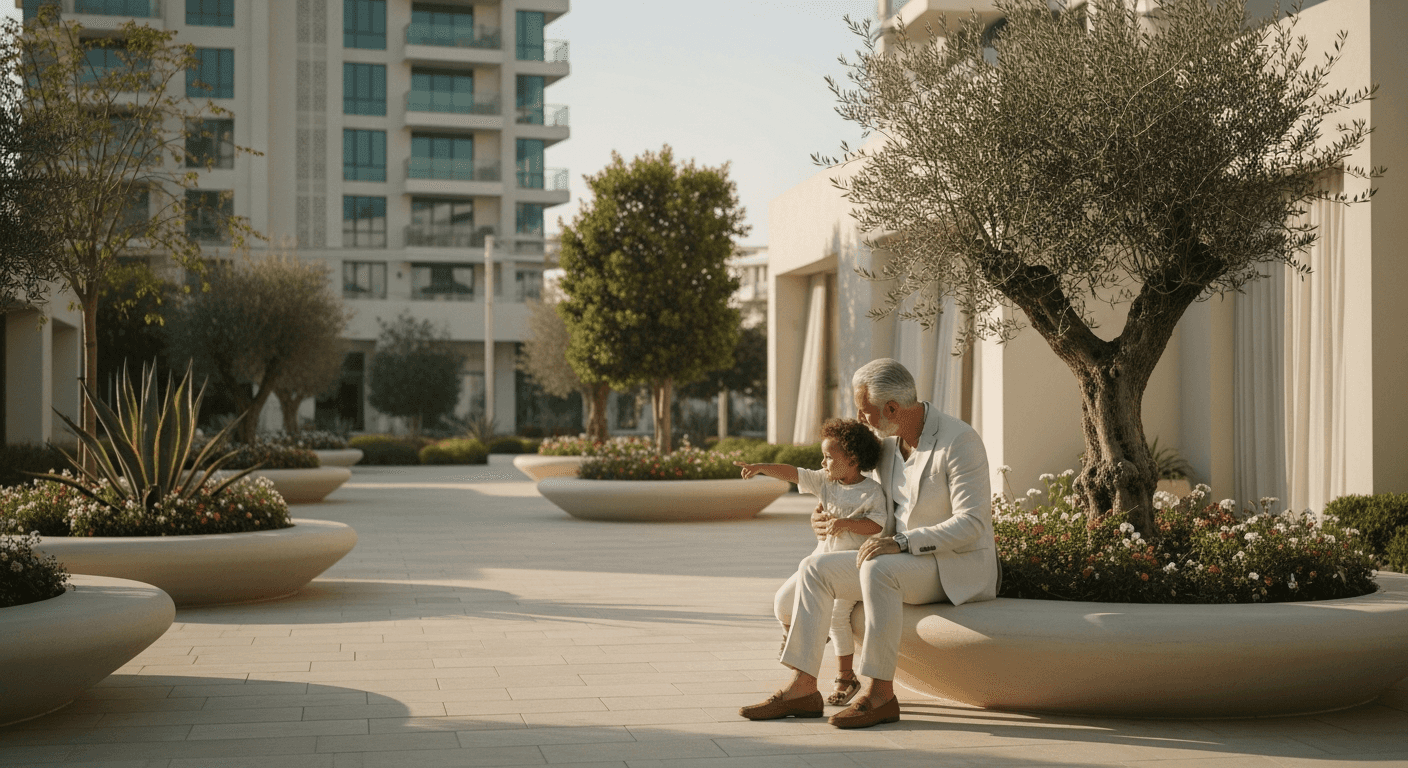
Dubai's Ultimate Indoor-Outdoor Villas
As Gaia Living's communities correspondent, I'll guide you through the Dubai villa communities that masterfully blend interior luxury with stunning outdoor spaces for family living and entertaining.

In my years exploring Dubai’s residential communities, I’ve seen family priorities evolve. One shift stands out above all others: the profound, post-2020 re-evaluation of the home, where the garden has been elevated from a simple patch of green to the true heart of family life. The demand for smooth indoor-outdoor living Dubai villas isn't just a trend; it's a fundamental change in how we want to live, entertain, and raise our children in this city.
Here's what we'll explore:
- The new definition of the garden as an essential living space.
- Key architectural features that enable a smooth indoor-outdoor flow.
- A deep dive into Arabian Ranches, the community that started it all.
- Why Dubai Hills Estate has become the modern benchmark for this lifestyle.
- The world of bespoke, ultra-luxury outdoor design in communities like Emirates Hills.
- A detailed breakdown of the true costs — from purchase to landscaping and long-term maintenance.
- The vital role of the wider community's green spaces and amenities.
- My final verdict on which community offers the best fit for your family's oasis.
The New Heart of the Home: Redefining the Dubai Garden
For a long time, the garden in many Dubai villas felt like an accessory. It was the space left over after the house was built, often sandy, under-utilised, and disconnected from the main living areas. The real action was inside, in the air-conditioned comfort of the majlis or family room. Today, that hierarchy has been completely inverted. For the families we work with at Gaia Living, the quality and integration of the outdoor space is now one of the top three purchasing criteria, sitting right alongside location and the number of bedrooms. This isn't just about having a bigger plot; it's about having a more functional, beautiful, and integrated one.
The search for family entertaining homes has become a search for properties where the line between inside and out is beautifully blurred. Buyers envision weekends spent with the glass doors slid wide open, children running between the lawn and the playroom, and evenings hosting friends for an al fresco dinner under a pergola. The garden is no longer just for looking at; it’s for living in. This shift has forced developers to completely rethink their approach. Where once a token patio was sufficient, the standard is now a deep, covered terrace, pre-provisioned for an outdoor kitchen, and layouts that ensure the garden is a constant, calming visual presence from almost every room in the house.
I believe this change is permanent. It reflects a deeper desire for a more grounded, nature-connected lifestyle, even within a bustling metropolis. The garden has become a private sanctuary — a place to decompress, connect with family, and create memories. It’s a wellness space, a social hub, and a children’s playground all in one. Developers who understand this are thriving. They are no longer just selling square footage of living space; they are selling a lifestyle centered around a private oasis. The villas that command the highest premiums and sell the fastest are those that deliver this vision not as an afterthought, but as the core design principle.
Architectural Signatures of Smooth Flow
 Featured project
Creating that effortless connection between a villa's interior and its garden isn't an accident of design; it's a deliberate and sophisticated architectural strategy. When I walk clients through a property, there are specific features I point to that signal a home has been truly designed for indoor-outdoor living. The most significant, without question, is the use of expansive, floor-to-ceiling glass walls. These aren't your standard patio doors. We're talking about vast panels of sliding or bi-folding glass, often spanning the entire width of the main living area. When fully retracted, they effectively remove a wall of the house, merging the family room or dining area directly with the outdoor terrace. This single feature does more to unite the two zones than any other.
Beyond the glass, the floor plan itself is critical. The most successful layouts are oriented towards the garden. The kitchen, dining room, and main family living space are typically arranged in an open-plan configuration along the rear of the villa, all sharing a direct physical and visual link to the outdoors. This means that whether you are cooking, eating dinner, or relaxing on the sofa, the garden is part of your immediate environment. Older villa designs often failed here, placing formal, unused living rooms at the front of the house and tucking the family spaces away, disconnected from the garden. Developers like Emaar Properties and Meraas have been pioneers in correcting this, creating C-shaped or L-shaped layouts that wrap around a central courtyard or garden, maximizing views and access from multiple points.
Finally, the transition zones are key. A great indoor-outdoor villa doesn't just abruptly end at the door. It features a deep, shaded terrace or loggia that acts as an intermediary space. This covered area is crucial in Dubai's climate. It provides shade from the high sun, allowing you to comfortably sit outside even during warmer parts of the day. It’s the perfect spot for an outdoor sofa set or an al fresco dining villas setup, protected from the elements. Often, these spaces are designed with pre-installed ceiling fans and lighting, and are constructed with the same high-quality flooring as the interior, further blurring the line between what is considered 'inside' and 'outside'. When these elements — expansive glass, an oriented floor plan, and thoughtful transition zones, come together, the effect is transformative.
Spotlight: Arabian Ranches — The Original Oasis
When we talk about family-centric villa communities in Dubai, it’s impossible not to start with Arabian Ranches. For me, the Ranches represents the blueprint for this entire category of living. Launched by Emaar in the early 2000s, it was one of the first master-planned communities to truly sell a suburban, family-oriented dream built around green spaces. What makes it so enduringly popular, especially for families seeking that indoor-outdoor connection, is its maturity. Driving through the original Ranches (now often called Ranches 1), you are struck by the lushness of it all. The trees are tall, the bougainvillea is thick and vibrant, and the gardens feel established and private.
This sense of established greenery is a huge part of its appeal. The plots in communities like Saheel, Mirador, and Alvorada are generally more generous than in many newer developments, giving homeowners a substantial canvas for creating their own private garden design villas. Over the years, I've seen some of the most beautiful and personal garden transformations here. Because these homes are older, many have been fully upgraded, with owners investing heavily in pools, outdoor kitchens, and sophisticated landscaping. For a buyer today, this means you can often find a property where all the hard work has already been done, acquiring a turnkey home with a 15-year-old garden that provides a level of shade and privacy a new villa simply cannot offer for years.
Of course, the Ranches lifestyle extends beyond the villa walls. The community was designed with an interconnected network of parks, walking trails, lakes, and community pools. This means your private outdoor space is complemented by a vast public one. It’s a place where children can safely ride their bikes to a friend's house or to the community centre. With top-tier schools like Jumeirah English Speaking School (JESS) and Ranches Primary School located directly within the community, it creates a self-contained ecosystem that is incredibly compelling for families. While the architecture in Ranches 1 might be more traditional (Tuscan and Arabian styles are common) compared to newer areas, their functional layouts and generous plots continue to make them some of the most sought-after family entertaining homes in the city. The community has since expanded with Arabian Ranches II and III, each offering a slightly more modern take on the original's successful formula.
Spotlight: Dubai Hills Estate — The Modern Standard-Bearer
If Arabian Ranches wrote the book on Dubai’s green suburban living, then Dubai Hills is the thoroughly modern second edition. This is where Emaar took all the lessons learned from its earlier successes and refined them into a master-planned community that has, in my opinion, become the current benchmark for premium family life in Dubai. The entire development is conceived around a magnificent 18-hole championship golf course and the sprawling Dubai Hills Park. This 'green lung' philosophy means that even before you consider your private garden, you are immersed in a verdant, open landscape, which has a profound effect on the overall feeling of the community.
The villas themselves represent a significant evolution in design. While the Ranches leans traditional, Dubai Hills is unapologetically contemporary. Here, the architectural signatures of indoor-outdoor flow are standard, not exceptions. In villa types like Sidra and Maple, you’ll find huge glass panes and open-plan living areas designed specifically to merge with the garden. As you move up the scale to the more luxurious collections like Golf Place, Parkway Vistas, and the exclusive Hills Grove Villas, this concept is taken to another level. We see double-height ceilings in living rooms with towering glass walls that frame the garden and golf course views like a piece of art. The developers understood that modern luxury is about space, light, and a connection to nature.
What sets Dubai Hills apart is its combination of this modern design with an unbeatable central location. Situated along Al Khail Road, it offers quick access to Downtown Dubai, Dubai Marina, and both international airports. This solves the classic suburban trade-off of space versus commute time. You get the large villa with a beautiful garden, but you're not sacrificing convenience. The community is also home to Dubai Hills Mall, multiple outstanding schools (like GEMS Wellington Academy and King's College Hospital London), providing a complete, self-sufficient infrastructure. While some of the newer areas are still seeing their landscaping mature, the core vision is clear and brilliantly executed. For families seeking a brand-new home that perfectly embodies the modern ideal of indoor-outdoor living Dubai villas, Dubai Hills Estate is, for me, the most complete and compelling proposition on the market today.
>The most successful homes no longer see the garden as an addition; they see the living room as a prelude to the garden. The flow between the two is everything.
The Ultra-Luxury Interpretation: Emirates Hills & Jumeirah Bay
When we ascend to the very pinnacle of the Dubai property market, the concept of indoor-outdoor living transforms from a design feature into a form of art. In communities like Emirates Hills and Jumeirah Bay, we are no longer talking about developer-standard villas; we are in custom-built mansions where the garden is as much a statement of status and taste as the home itself. Here, the term bespoke outdoor spaces Dubai takes on its truest meaning. These properties are often sold as plots, allowing owners to engage world-renowned architects and landscape designers to create a private resort tailored to their exact specifications.
Emirates Hills, often dubbed the 'Beverly Hills of Dubai', is the original enclave of the super-rich. The sheer scale of the plots, which wrap around the Address Montgomerie golf course, allows for an almost limitless scope of outdoor design. I have seen gardens here that are simply breathtaking. We’re talking about multi-level infinity pools that cascade down towards the golf course, sunken lounges with fire pits that appear to float on water, professional-grade outdoor kitchens that rival their indoor counterparts, private tennis courts, and even outdoor cinemas with integrated sound systems. The landscaping is a multi-million dirham investment, featuring mature, imported olive trees, intricate water features, and sculptures. The home is designed in tandem with the garden, ensuring that every principal room and terrace capitalizes on a meticulously curated view.
More recently, Jumeirah Bay Island has emerged as a new frontier for this level of luxury, adding a spectacular waterfront dimension. Here, magnificent villas sit on a seahorse-shaped island with views of the open Arabian Gulf or the iconic Dubai skyline. The design ethos, influenced by the neighbouring Bvlgari Resort, is one of contemporary, understated elegance. The challenge and opportunity for designers here is to balance the creation of a lush, private garden oasis with the desire to maximize the stunning sea views. The result is often a smooth blend of soft, green landscaping with hardscaped terraces, infinity pools that seem to merge with the sea, and direct private beach access. In this rarefied segment of the market, the garden isn't just an extension of the living space — it is the main event, a sign of what is possible when imagination and budget have no limits.
The Budget: What Does an Outdoor Oasis Truly Cost?
It’s wonderful to dream about these incredible spaces, but for most families, the practical question is: what does it actually cost? Understanding the full financial picture is critical. The sticker price of the villa is just the beginning. I always advise our clients at Gaia Living to budget comprehensively for both the acquisition and the creation of their ideal outdoor space. Let's break it down for a hypothetical 4-bedroom family villa in a premium community like Dubai Hills or Arabian Ranches.
First, the purchase costs. A quality 4-bedroom villa in these areas can range from AED 6,000,000 to AED 10,000,000. On top of this, you must account for the upfront government and professional fees. These are non-negotiable and add up quickly.
Example Purchase Cost Breakdown (for an AED 8,000,000 Villa): - Purchase Price: AED 8,000,000 - Dubai Land Department (DLD) Fee: 4% of price = AED 320,000. As per DLD regulations. - DLD Registration Fees: Approx. AED 4,200 - Agency Fee: 2% of price + 5% VAT = AED 168,000 - Mortgage Arrangement Fee (if applicable): Typically 1% of loan amount + 5% VAT - Mortgage Valuation Fee: Approx. AED 3,150 - Total Upfront Costs: Approx. AED 495,350 (or ~6.2% of purchase price)
Next, and crucially for this topic, is the budget for transforming the garden. A developer typically hands over a villa with levelled sand and perhaps a boundary wall. Creating a lush oasis is a separate project.
Example Landscaping & Upgrade Costs: - Basic Landscaping (Grass, Plants, Irrigation): AED 70,000 — AED 150,000 - Swimming Pool (Medium Size, Quality Finish): AED 120,000 — AED 250,000 - Pergola & Decking Area: AED 50,000 — AED 120,000 - Outdoor Kitchen (with built-in BBQ, sink, fridge): AED 60,000 — AED 150,000+ - Total Potential Upgrade Cost: AED 300,000 — AED 670,000+
Finally, you must factor in the ongoing running costs. These are recurring expenses that are part of owning a villa with extensive outdoor features. Annual service charges in villa communities typically range from AED 2.50 to AED 5.50 per square foot of your plot area, not your built-up area. A larger garden means higher fees. A pool will noticeably increase your DEWA bill, and professional maintenance contracts for a pool and garden can easily cost AED 1,500-3,000 per month. Being realistic about these total costs from the outset is the key to enjoying your outdoor oasis without financial stress.
Beyond the Villa: The Community Ecosystem
While a beautiful private garden is the cornerstone of the indoor-outdoor lifestyle, its value is magnified exponentially by the quality of the green spaces within the wider community. A truly great family community understands that life happens both inside and outside the villa walls. This is something I always emphasize to clients: look beyond the plot boundary and evaluate the entire neighbourhood ecosystem. The ability to step out of your home and have immediate access to well-maintained parks, shaded jogging tracks, and safe children's play areas is what elevates a collection of houses into a genuine community.
This is where master developers like Nakheel, Emaar, and others have excelled. They don't just sell real estate; they curate environments. Consider a community like Jumeirah Golf Estates. It’s not just for golfers. The entire development is a stunning landscape of rolling hills, lakes, and lush greenery woven between the Fire and Earth courses. Living there means your daily walk or run takes place in an environment that feels more like a country resort than a residential suburb. Similarly, communities like Damac Hills and Damac Hills II have made amenities a central part of their offering, with not just parks and pools, but stables, fishing lakes, and sports fields. This creates a rich and varied outdoor life for residents.
These shared spaces are critical for fostering social connections. It’s in the community park where your children meet their friends after school. It’s on the walking trails where you bump into neighbours and build relationships. These amenities act as a natural extension of your own home, providing spaces for larger gatherings or different types of recreation that your private garden might not accommodate. For families, this is invaluable. Having a choice between a quiet afternoon by your own pool or joining the buzz at the community pool gives you the best of both worlds. When evaluating family entertaining homes, consider how the community itself supports your lifestyle. The best ones offer a smooth transition from your private oasis to a vibrant, green, and engaging public realm.
For families in Dubai, the ultimate luxury is no longer just about the size of the villa, but the quality of the life it enables. The perfect home is one that erases the boundaries between inside and out, supported by a green, amenity-rich community that provides a complete ecosystem for living, playing, and connecting.
My Verdict: Finding Your Perfect Balance
After walking through countless villas across every major community in Dubai, my conclusion is that there is no single 'best' place for indoor-outdoor living. Instead, there is a 'best fit' for your family's specific priorities, budget, and lifestyle. The key is to understand the distinct character and trade-offs of each community.
For those who value a sense of establishment, mature greenery, and a deeply ingrained community spirit, my heart often leads back to the original Arabian Ranches. There is a warmth and authenticity to its tree-lined streets and well-loved gardens that is hard to replicate. You are buying into a neighbourhood with a soul, and for many families, that is priceless. The trade-off may be a more traditional architectural style, but the generous plots and turnkey, renovated gardens offer immediate gratification.
For families seeking modernity, sleek design, and the ultimate in convenience, Dubai Hills Estate is, without a doubt, the top contender. The homes are designed from the ground up for the way modern families live, with an emphasis on light, flow, and technology. The community's central location and world-class amenities — from the park to the mall and hospital, create an ecosystem of unparalleled quality and convenience. It is the new gold standard, and while its gardens are still growing, its potential is immense.
For those on a tighter budget or who enjoy being part of a growing community, newer developments in areas like Al Furjan, Tilal Al Ghaf, or the residential clusters in Dubai South offer fantastic value. You can acquire a brand-new villa with modern indoor-outdoor features at a more accessible price point. The compromise here is patience. It will take time for the landscaping to mature and for the community's full suite of amenities and retail to be delivered. Finally, for the select few where budget is not a constraint, Emirates Hills and Jumeirah Bay offer the ultimate prize: the chance to build a completely bespoke private resort. It's a different world of property ownership, focused on creating a unique legacy.
My advice is always to spend time in these communities at different times of the day. Walk the parks, visit the community centres, and feel the rhythm of each place. Whether you're looking to browse properties for sale or explore the city's diverse neighbourhoods, we at Gaia Living are here to help you find that perfect balance — the home where your family's life can flow effortlessly from the living room to the garden and beyond.
Sources
- Dubai Land Department (DLD): dubailand.gov.ae
- Central Bank of the UAE (CBUAE): centralbank.ae
- UAE Government Portal: u.ae
Questions, answered
- What are the key architectural features of an indoor-outdoor villa in Dubai?
- The most important features are large, floor-to-ceiling sliding or bi-folding glass doors that create a smooth opening to the garden. Other hallmarks include open-plan layouts oriented towards the outdoors, shaded terraces or loggias, and often a direct view of a private pool or landscaped garden from the main living areas.
- Which Dubai communities are best known for villas with great gardens?
- For established greenery and a classic feel, Arabian Ranches is a top choice. For modern design and premium amenities, Dubai Hills Estate is the standard-bearer. For ultimate luxury and bespoke designs, Emirates Hills and Jumeirah Bay offer unparalleled opportunities.
- What is a realistic budget to buy and landscape a 4-bedroom family villa in Dubai?
- For a 4-bedroom villa in a premium community like Dubai Hills or Arabian Ranches, expect a purchase price between AED 6 million to AED 10 million. You should budget an additional 7-8% for upfront transaction costs (DLD fees, agency fees), and a further AED 250,000 to AED 600,000+ for high-quality landscaping, a pool, and an outdoor kitchen.
- How much does it cost to maintain a villa garden and pool in Dubai?
- Ongoing maintenance is a key consideration. A professional combined garden and pool maintenance contract typically costs between AED 1,000 and AED 3,000 per month, depending on the size of your plot and pool. This is in addition to increased DEWA (water and electricity) consumption for irrigation and pool pumps.
- Is it better to buy a villa with a finished garden or landscape it myself?
- Buying a home with a mature, well-designed garden can save you time and the hassle of construction. However, landscaping it yourself allows for complete customisation to your family's needs, whether you prioritise a play area for children, a pool, or an extensive outdoor kitchen for entertaining.
- What are typical annual service charges for a villa community in Dubai?
- Villa community service charges are usually calculated on the plot area, not the built-up area. You can expect to pay between AED 2.50 to AED 5.50 per square foot of your plot annually. This covers the maintenance of community parks, security, roads, and shared amenities.

Sophia profiles Dubai's villa communities — schools, commute times, green space, and the intangible feel of a neighbourhood. She writes for families putting down roots.
Related stories
Beyond the Gates: Dubai's Boutique Villa Sanctuaries
I'm exploring the small, exclusive villa communities that offer a real sense of place, moving beyond the well-trodden path of Dubai's famous megaprojects to find homes with genuine character.
Off-Plan vs Ready: The Dubai Investor's Guide
A detailed comparison for apartment investors in Dubai, weighing the capital appreciation potential of off-plan against the immediate returns of ready properties.

Clearing Disputes for a Smooth Dubai Sale
Unseen property disputes or financial encumbrances can derail your Dubai property sale. I'll share my strategic playbook for identifying and resolving these issues before they cost you time and money.
Echoes, in your inbox
One thoughtful email a month. Market insight, new launches, no spam.