

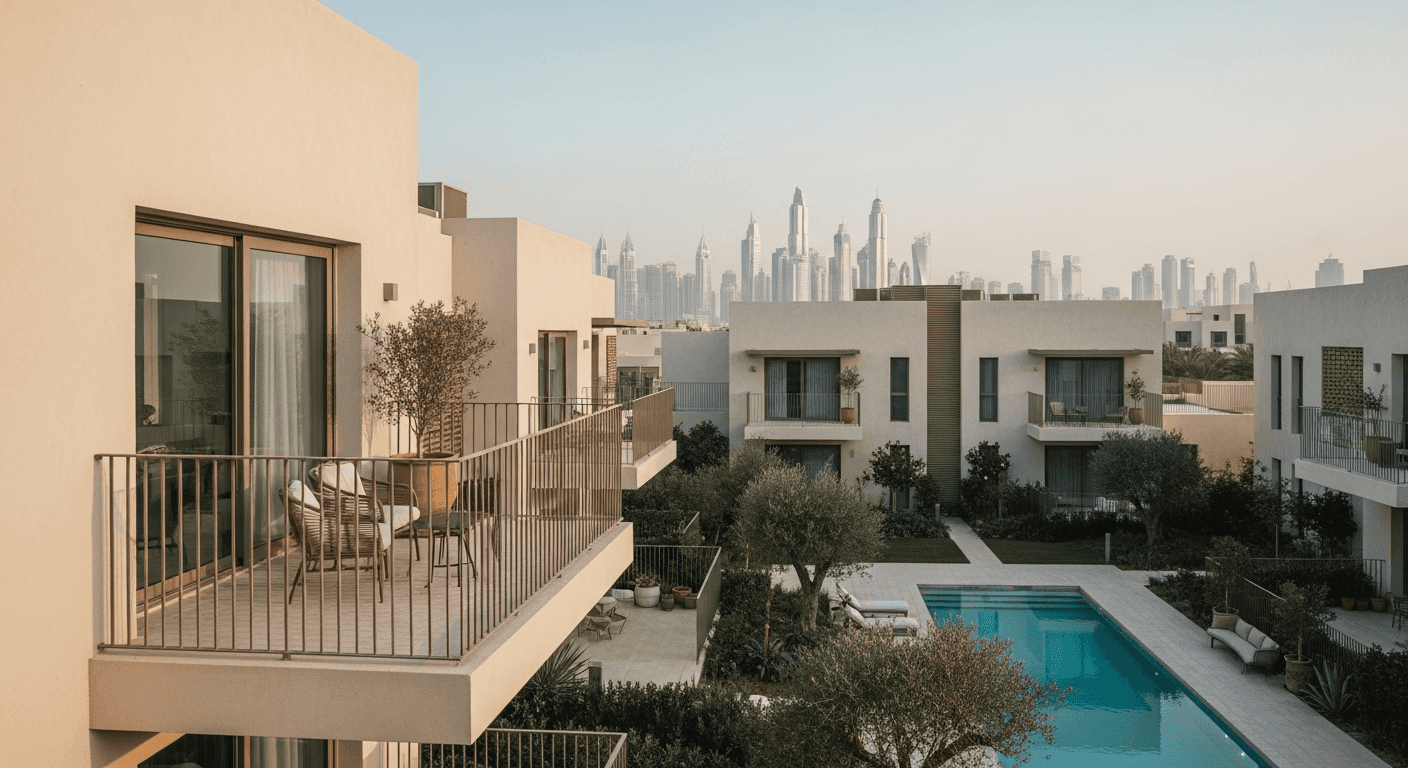
Dubai's Small Apartment Paradox
Dubai has a vast supply of studios and 1-beds, but demographic shifts mean much of it is in the wrong place and of the wrong quality. I analyse the growing mismatch between small unit supply and the demands of new urban households.

The Dubai property market is awash with studios and one-bedroom apartments, yet finding the *right* one is harder than ever. This isn't a supply issue in terms of pure numbers; it is a profound misalignment with how a growing and influential segment of Dubai's population now chooses to live.
Here is what I will explore in my analysis:
- Deconstructing the 'average' Dubai household today
- Mapping the existing supply of studios and 1-beds
- Analysing the qualitative gap: location, amenities, and community
- The impact of remote work and visa reforms on small unit demand
- How developers are responding (or failing to)
- A deep dive into the investment case for 'premium small' units
- The specific communities that exemplify this trend
- A practical checklist for prospective buyers
- My final verdict on where the market is heading
The New Dubai Household: Beyond the 2.4 Children Model
For decades, the narrative of Dubai's residential market was written for the nuclear family. Master-planned communities of sprawling villas in places like Arabian Ranches or three-bedroom apartments with maids' rooms were the aspirational standard, reflecting a city built for traditional family structures. In my analysis of the market, I see this assumption being challenged at a fundamental level. The 'average' household, if such a thing ever truly existed in this diverse city, is becoming smaller, more transient, and more professionally focused. This is the single most important demographic shift shaping the future of Dubai real estate, and its impact on the studio apartment market analysis cannot be overstated.
The drivers of this change are clear. Firstly, there is the global trend of delayed marriage and childbirth, which is pronounced in cosmopolitan hubs. Dubai is increasingly a magnet for ambitious single professionals and dual-income-no-kids (DINK) couples from across the world. These individuals, often in their late twenties to early forties, are at the peak of their earning potential and prioritise career growth, lifestyle, and experiences over accumulating space they do not need. They form a powerful cohort of renters and first-time buyers whose needs are fundamentally different from the families that developers traditionally targeted.
This trend has been put into overdrive by the UAE's visionary visa reforms. The introduction and expansion of the Golden Visa, along with new categories for freelancers and remote workers, have been exceptionally successful in attracting global talent. These individuals are not arriving as part of a corporate relocation package with a housing allowance for a family of four. They are often entrepreneurs, creatives, and tech specialists arriving solo, seeking a dynamic urban base. They are, by definition, smaller household units, and their expectations of city living have been forged in London, Singapore, New York, and Berlin. They demand convenience, quality, and community — not necessarily a garden and a spare bedroom.
While precise, publicly available data from the Dubai Statistics Center (dsc.gov.ae) on single-person households is often aggregated, the directional evidence is overwhelming. We see it in the types of enquiries we receive at Gaia Living, in the tenant profiles for new prime buildings, and in the social fabric of neighbourhoods like DIFC and Business Bay. The classic suburban family model is no longer the only, or even the primary, driver of housing demand in the city's core. The urban household size impact is real, and it demands a radical rethink of our assumptions about property supply.
Mapping the Legacy: Where are Dubai's Small Units?
 Featured project
To understand the current paradox, we must first look at the history of Dubai small unit supply demand. The city does not have a shortage of studios and one-bedroom apartments in absolute terms. In fact, it has a vast inventory. The problem is one of geography and time. Much of this stock was built during a different era of Dubai's growth, between the early 2000s and the mid-2010s, with a very different resident and investor in mind. These legacy communities represent a huge proportion of the city's affordable housing stock, but they are increasingly disconnected from the demands of the new urban professional.
Geographically, this supply is heavily concentrated in a few key areas. Think of the sprawling, high-density developments of Jumeirah Village Circle (JVC), the functional blocks of Dubai International City, the vast scale of Discovery Gardens, and the more industrial-adjacent communities like Dubai Production City and parts of Al Furjan. The development rationale at the time was sound and straightforward: provide a high volume of affordable, no-frills housing to serve the city's rapidly growing workforce and offer accessible entry-level investment properties to a mass market of overseas buyers.
These projects were engineered for efficiency. Developers maximised the number of units per plot, providing basic amenities — typically a simple pool and a small gym, to keep service charges low and investor yields high on paper. The locations were often dictated by the availability of large, affordable land parcels on the city's periphery, with the assumption that residents would be entirely car-dependent. This model was a phenomenal success in its own right, enabling hundreds of thousands of people to live and work in Dubai and creating a new class of property investor. However, in my view, this legacy supply now represents a significant market risk, as its core value proposition is being eroded by changing tastes and expectations.
Contrast this with the smaller, more integrated supply of studios and one-bedroom units in prime, established locations. In Dubai Marina, for example, smaller apartments were built from the outset as part of a premium, walkable waterfront masterplan. In DIFC, they serve the financial centre's professional community. The key difference is that in these locations, the small apartment is not a down-scaled, cheap alternative to a 'proper' home; it is a deliberately designed product for a specific, affluent demographic that values location and lifestyle above all else. This distinction between a 'small unit in a cheap area' and a 'small unit in a great area' is the central fissure running through the Dubai property market today.
The Qualitative Chasm: Why Not All Square Feet Are Equal
The core of my argument is this: the conversation about supply and demand for smaller units is no longer about quantity but about quality. The market has reached a point of saturation in the lower-grade segment, while a significant and growing deficit exists for high-quality, well-located, and thoughtfully designed small homes. For the new Dubai household I described earlier, a generic 400-square-foot studio in a poorly maintained building, located a 30-minute drive from the nearest social hub, is simply not a viable option, no matter how low the rent.
What does 'quality' mean in this context? It is a multidimensional concept that extends far beyond the four walls of the apartment itself. The new urban professional is not just buying or renting square footage; they are investing in a lifestyle ecosystem. Based on my observations of market trends and tenant preferences, the key attributes they are willing to pay a premium for can be broken down into three categories.
First, and most importantly, is location. But 'location' is no longer just about proximity to Sheikh Zayed Road. It is about walkability. It is about being a short stroll away from a third-wave coffee shop, a boutique gym, a park for a morning run, and a variety of casual and fine-dining options. It is about having a Metro station within a 10-minute walk. Neighbourhoods like Creek Harbour or Bluewaters Island are masterclasses in this, where the public realm is as important as the private residence. This is a profound shift from the car-centric design of older communities.
Second is the quality of the building and its amenities. The discerning resident today has zero tolerance for peeling paint, faulty elevators, or a pool that is perpetually closed. They expect premium finishes, intelligent layouts (even in small spaces), and robust building management. Critically, the amenities arms race has moved from quantity to quality. A building with a single, state-of-the-art, 24/7 gym with modern equipment is infinitely more attractive than a building with a tired gym, a dusty squash court, and a sad 'business centre'. The rise of co-working spaces integrated into residential buildings is a direct response to this need, offering a crucial amenity for the remote-working resident. Developers like Omniyat have built their entire brand on this principle of delivering uncompromising quality.
Third is the intangible but crucial element of community. High-density areas like JVC can, for some, feel anonymous due to their sheer scale and fragmented ownership. In contrast, a well-managed, single-owner tower or a curated boutique development can foster a genuine sense of community. Residents want to feel safe, and they want to live among peers with similar lifestyles and aspirations. This is why branded residences, even for smaller units, are becoming so popular. The brand acts as a filter, promising a certain standard of living and attracting a like-minded community, which is a powerful and bankable selling point.
“The future of the Dubai property market for small units isn't about building more, it's about building *better*. The flight to quality is no longer a trend; it is the market.”
Remote Work and Visa Reforms: Supercharging the Demand Shift
If the demographic shift towards smaller households was the kindling, then the global pandemic and the UAE's subsequent policy responses were the accelerant. The widespread adoption of remote and hybrid work models has fundamentally altered the relationship between people and their homes. A residence is no longer just a place to rest and entertain; for a significant portion of the professional population, it is now also their primary workplace. This has had a dramatic effect on 1-bedroom property trends Dubai and the entire small-unit segment.
This shift places new and intense demands on smaller living spaces. A 350-square-foot studio apartment that was perfectly adequate for a young professional who spent 12 hours a day at the office suddenly becomes challenging when it must also function as a full-time workspace. This doesn't necessarily mean demand for studios has vanished, but it has changed shape. A studio with a poorly designed, box-like layout is now far less desirable than one with a small nook that can be converted into a dedicated workspace, or a unit in a building that offers excellent co-working facilities. The '1+study' configuration, once a niche product, has become one of the most sought-after layouts in the city.
Simultaneously, the UAE government's incredibly forward-thinking approach to visas has attracted a wave of global talent that is cementing this trend. The Remote Work Visa, for instance, directly targets individuals who can live anywhere in the world. When these high-earning professionals choose Dubai, they are not looking for a compromise. They are bringing with them expectations set in other global hubs. They scrutinise building amenities, internet speeds, and the proximity of lifestyle offerings with a keen eye. They are willing to pay a premium for a one-bedroom apartment in Emaar Beachfront because it offers a lifestyle that cannot be replicated in a more remote, lower-grade community.
The Golden Visa has a similar effect. By offering long-term residency to investors, entrepreneurs, and exceptional talents, it encourages a more profound commitment to living in Dubai. A Golden Visa holder is not a transient worker looking for the cheapest possible housing for a two-year contract. They are putting down roots, and they are more likely to invest in their living environment, either as discerning tenants or as owner-occupiers. This creates a more stable, quality-focused rental market. The collective impact of these policies is the creation of a deep and sustainable demand pool for premium, well-designed smaller homes, a demand pool that, in my professional opinion, current supply struggles to meet.
Developer Response: A Tale of Two Strategies
Faced with this evolving landscape, Dubai's developers are largely bifurcating into two distinct strategic camps. The path they choose will have long-term consequences for their brand, their investors, and the urban fabric of the city. Observing these strategies is key to understanding the future trajectory of the Dubai small unit supply demand dynamic.
First, there is the 'volume and velocity' strategy. This approach is a continuation of the model that defined Dubai's last major growth cycle. Developers pursuing this strategy focus on acquiring large land banks in emerging, lower-cost areas and building a high volume of standardised, affordable units. Major players like Binghatti and, in some of their projects, Nshama, have perfected this model. They deliver thousands of studios and one-bedroom apartments to the market, targeting first-time buyers and entry-level investors with attractive price points and aggressive payment plans. This strategy still has a place; it provides a crucial entry point to the property ladder and serves a significant segment of the population. However, it does not address the qualitative gap I have identified. It is, in essence, adding more supply to the most saturated part of the market.
The second, and in my view more forward-looking, strategy is the 'premium and curated' approach. This is being adopted by developers who recognise that a growing segment of the market is willing to pay for quality, location, and lifestyle. These developers are focusing on smaller, often infill, sites in prime or rapidly maturing locations like Business Bay, along the Dubai Water Canal, or in established neighbourhoods like Jumeirah. They are not competing on price; they are competing on product. Their projects emphasise superior architecture, high-end interior finishes, and a curated suite of truly useful amenities. Developers like Emaar Properties in their prime master communities, or boutique firms such as Omniyat and Muraba, are exemplars of this strategy.
These premium projects are redefining what a small apartment can be. They might feature collaborations with famous designers, offer hotel-style services, or integrate smart-home technology as standard. Their common areas are designed to be social hubs — think resident lounges that feel like private clubs, cinema rooms, and wellness centres that rival commercial spas. They are selling not just a home but an elevated living experience. While the number of units delivered through this strategy is far lower, their impact on market perceptions and price benchmarks is enormous. This is where the most significant potential for capital appreciation lies, and it is a clear indicator of the market's maturation.
The Investment Thesis: Why 'Premium Small' is the New Safe Haven
For years, the investment case for small apartments in Dubai was simple and compelling: buy a relatively inexpensive studio in an area like International City or Discovery Gardens, accept a minimal chance of capital appreciation, and enjoy a strong gross rental yield, often cited at 7-9%. This was the quintessential model for entry-level investment properties. My analysis shows this model is now under significant pressure. The sheer volume of homogenous, aging stock in these areas creates intense competition among landlords, leading to higher vacancy rates, downward pressure on rents, and rising maintenance costs. The high theoretical yield often evaporates in the face of real-world operational challenges.
I believe a new, more robust investment thesis has emerged: the 'Premium Small'. This strategy involves focusing on studios and, more often, one-bedroom apartments located in prime communities, developed by reputable builders, and featuring the high-quality amenities I've discussed. The on-paper gross yield might look slightly less spectacular — perhaps in the 5-6.5% range, but the total return proposition is, in my opinion, vastly superior. This is because the 'Premium Small' asset attracts a higher quality, more stable tenant, experiences lower vacancy, and, most importantly, possesses genuine potential for strong capital appreciation.
Let's quantify the entry point for such an investment. A high-quality, off-plan one-bedroom apartment in a desirable, centrally located project from a top-tier developer will carry a different cost structure than a ready, secondary market unit. Here is a realistic, line-by-line breakdown for a hypothetical premium one-bedroom unit:
- Purchase Price: AED 1,800,000
- Dubai Land Department (DLD) Fee (4% of Price): AED 72,000
- DLD Registration Fee (Oqood for off-plan): AED 5,250 (incl. VAT)
- Real Estate Agency Fee (2% of Price + 5% VAT): AED 37,800
- Total Upfront Cost on Purchase Date (approx.): AED 1,915,050
This initial outlay is higher, but the asset you acquire is fundamentally different. It is an asset that appeals directly to the new demographic of high-earning professionals. These tenants are less likely to default on rent and more likely to treat the property with care. When it comes time to sell, you are not competing in a sea of identical listings; you are selling a desirable asset in a sought-after location, which is the very definition of a resilient investment. The 1-bedroom property trends Dubai are clearly moving away from a pure yield focus towards a more balanced, total-return approach that weighs capital growth just as heavily.
A Deeper Look: The Communities Getting it Right
Theory is one thing, but property investment is a tangible business. To make this analysis concrete, it is essential to name the specific communities where this flight to quality is most evident. These are the places that serve as living case studies for the 'Premium Small' thesis, offering a blueprint for what the new Dubai household desires and where savvy investors should be looking.
Dubai Creek Harbour is perhaps the most ambitious and well-executed example. Master-planned by Emaar, it was designed from its inception as a pedestrian-first community. The public realm — the waterfront promenade, the vast park, the cycling tracks, is the central amenity. A one-bedroom apartment here is not just a box in a tower; it is a node in a connected, vibrant, and highly curated ecosystem. The quality of the builds, the stunning views, and the planned retail and cultural offerings create a powerful value proposition that commands premium rents and prices, even when compared to more established areas.
In a more mature context, the evolution of the Dubai International Financial Centre (DIFC) from a 9-to-5 business hub into a 24/7 'live-work-play' destination is a sign of this trend. The addition of high-end residential towers and the world-class retail and dining at Gate Avenue have transformed the area. A professional working in DIFC can now live in a premium apartment just an elevator ride away from their office, their favourite restaurant, and their gym. This level of integrated convenience is the ultimate luxury for a time-poor professional, and the smaller units in DIFC's newer towers are among the most sought-after rental properties in the city.
For an example of exclusivity, look no further than Bluewaters Island by Meraas. It is a destination in itself — a contained, meticulously planned island offering a resort-like lifestyle with a direct connection to the bustling JBR and Dubai Marina districts. The number of units is limited by design, creating an inherent scarcity. Owning a smaller apartment here grants access to an exclusive club, and the asset's value is protected by the island's unique and irreplicable nature. These communities stand in stark contrast to areas that, while popular, are struggling to create a cohesive lifestyle narrative. They demonstrate that successful urban development is no longer about just building towers; it's about curating experiences.
Navigating the Nuances: A Checklist for Buyers
Identifying this market shift is the first step. Capitalising on it requires careful due diligence. The term 'premium' is often overused in marketing brochures, so it is crucial for buyers and investors to look past the glossy renders and scrutinise the fundamentals. When we at Gaia Living advise clients on acquiring a studio or one-bedroom apartment, we guide them through a rigorous checklist. These are not just talking points; they are critical factors that will determine the long-term performance of the asset.
Here are the key questions I urge every prospective buyer to ask:
- What is the developer's proven track record? Go beyond their latest launch. Look at projects they delivered five or ten years ago. Are they well-maintained? Are the service charges reasonable? Have they held their value? A history of quality delivery from developers like Emaar Properties or Nakheel is a strong positive signal.
- What are the projected service charges? This is a critical, and often overlooked, number that directly impacts your net yield and the property's attractiveness to tenants. According to the Dubai Land Department (DLD) and RERA regulations, these must be disclosed. A rate of AED 15-19 per square foot per year is typical for a new building with good amenities. Be wary of rates below AED 12 (which may indicate under-maintenance) or above AED 25 (which can cripple returns) without exceptional justification, like in a branded residence.
- Examine the floor plan with a critical eye. Is the layout efficient? Is there 'dead' or unusable space? For a one-bedroom, is the bathroom accessible to guests without passing through the bedroom? Is there a balcony, and is it large enough to be functional? In a post-pandemic world, a small, defined space for a desk can add immense value.
- Investigate the community master plan and management. Are you buying an isolated tower or part of a larger, managed community? For existing communities, you can use the DLD's Dubai REST app to check the official Service Charge and Maintenance Index for the building. This provides transparent data on the costs and health of the owners' association.
- Assess the quality and utility of the amenities. Do not be swayed by a long list of features. A single, exceptionally well-equipped gym that is open 24/7 is more valuable than five mediocre facilities. Is the pool large enough for laps and shaded for use during the day? Are the common areas genuinely inviting?
- Consider the 'third spaces'. The appeal of a small apartment is magnified when the surrounding neighbourhood functions as an extension of the living room. How easy is it to walk to a great coffee shop, a small park, or a local supermarket? This walkability factor is a powerful driver of tenant demand and rental premiums.
My Verdict: The Great Unbundling of the Dubai Home
My analysis leads me to a clear conclusion: the Dubai market for smaller residential units is undergoing a great bifurcation. The gap between the top and bottom of the market is widening, and the undifferentiated middle ground is becoming an increasingly precarious place for investment. We are witnessing the unbundling of the concept of a 'home', where the physical apartment is just one component of a much larger lifestyle package that includes amenities, community, and convenience.
On one side of this divide lies the vast inventory of older, commoditised studios and one-bedroom units in high-density, car-dependent neighbourhoods. While they will always serve a purpose as a source of basic, affordable shelter, I believe these assets face a future of rental stagnation, higher tenant turnover, and limited, if any, capital appreciation. They are utility assets in a market that is rapidly moving towards being an experience market. They represent the past.
The future, in my view, belongs to the 'Premium Small' asset class. This is the growing but still undersupplied category of high-quality, thoughtfully designed, and exceptionally well-located smaller homes. These properties, found in curated communities and amenity-rich buildings, appeal directly to the new, powerful demographic of single professionals and modern couples. These are the assets that will command premium rents from the best tenants and are positioned to deliver superior total returns through a combination of stable yield and strong capital growth.
My advice to investors navigating this market is therefore pointed: avoid the middle. The strategy of buying a mediocre property in a mediocre location is the fastest path to underperformance. Instead, make a conscious choice. Either operate at the affordable, high-yield end of the market with a clear understanding of the operational intensity and risks involved, or elevate your strategy to focus on the premium segment, where long-term value is being forged. The flight to quality is not a fleeting trend; it is the fundamental organising principle of the modern Dubai property market.
The narrative for entry-level investment properties in Dubai has shifted. Success is no longer found in simply buying the cheapest studio available, but in identifying smaller units within high-quality, amenity-rich communities that cater to the sophisticated demands of Dubai's new single and dual-income professional households.
Sources
- Dubai Land Department (DLD): dubailand.gov.ae
- Real Estate Regulatory Agency (RERA): Part of DLD
- Dubai Statistics Center (DSC): dsc.gov.ae
- UAE Government Portal (U.ae) on Visas: u.ae
Questions, answered
- Is buying a studio apartment in Dubai a good investment now?
- It can be, but the strategy has changed. The best returns are now found in premium studios in high-quality, amenity-rich communities, rather than the cheapest available unit. Location, developer reputation, and building quality are more important than ever for securing good tenants and capital appreciation.
- What is the average rent for a 1-bedroom apartment in Dubai?
- Rent for a 1-bedroom apartment in Dubai varies dramatically by location and quality. You could find units for AED 50,000-70,000 annually in areas like International City or Al Furjan, while premium 1-beds in Dubai Marina or Downtown Dubai can command AED 120,000 to over AED 200,000 per year.
- How is the changing household size affecting Dubai's property market?
- Smaller household sizes, driven by an influx of single professionals and young couples, are increasing demand for high-quality, well-located studios and one-bedroom apartments. This demographic values lifestyle amenities, walkability, and community, creating a 'flight to quality' and shifting developer and investor focus.
- Which areas have the largest supply of small apartments in Dubai?
- Historically, the largest concentrations of studios and one-bedroom apartments are found in high-density, more affordable communities built in the 2000s and 2010s. These include Jumeirah Village Circle (JVC), International City, Discovery Gardens, and Dubai Production City.
- What are the typical upfront costs for buying a small apartment in Dubai?
- Besides the property price, budget for approximately 7-8% of the purchase price in upfront costs. This includes the 4% Dubai Land Department (DLD) transfer fee, trustee registration fees (around AED 4,200), and real estate agency fees (typically 2% plus VAT).

Amara translates DLD transaction data, supply pipelines, and macro signals into clear calls on where Dubai's market is heading. She writes the numbers most brokers only feel.
Related stories
Calculating ROI on Dubai Rental Upgrades
As a landlord in Dubai, you can't just follow trends. I'll show you how to calculate the precise ROI of minor property upgrades to genuinely increase your rental yield.

Off-Plan vs Ready: The Real Cost of Capital
I analyse the fundamental trade-off every Dubai investor faces: the lure of off-plan capital growth versus the security of immediate rental income from a ready property.
Beyond the Gates: Dubai's Boutique Villa Sanctuaries
I'm exploring the small, exclusive villa communities that offer a real sense of place, moving beyond the well-trodden path of Dubai's famous megaprojects to find homes with genuine character.
Echoes, in your inbox
One thoughtful email a month. Market insight, new launches, no spam.