

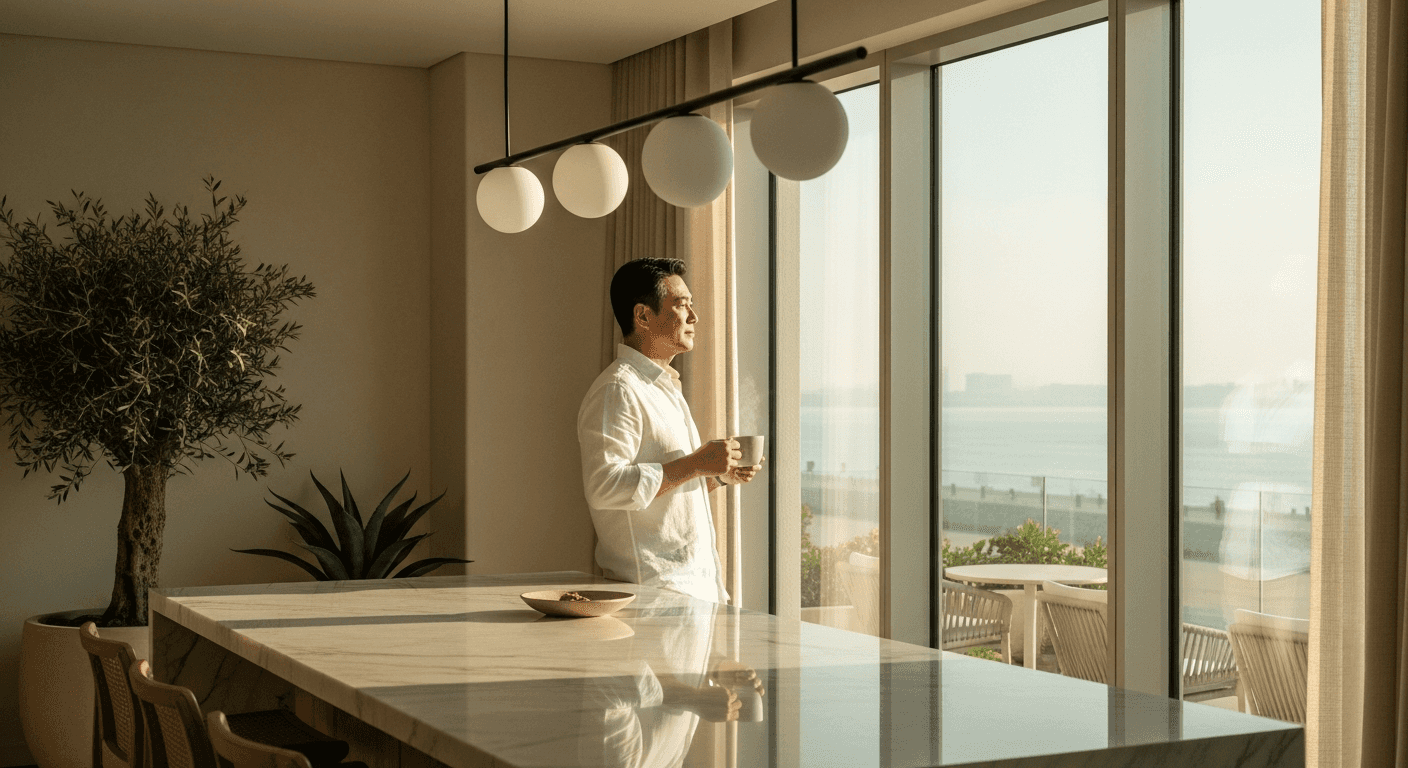
Dubai's Pulse: Homes in the Heart of the Action
For those who want to live where the city's heart beats loudest, choosing a home is about more than square footage. It's a decision to buy into a lifestyle of unparalleled social and entertainment access.

For those who want to live where the city's heart beats loudest, choosing a home is about more than square footage. It's a decision to buy into a lifestyle of unparalleled social and entertainment access, a life measured in steps, not kilometres, from the best experiences Dubai has to offer.
I've spent years exploring every corner of this city, and the question I get most often from clients with a certain energy is simple: "Where is the action?" They're not just looking for a place to sleep. They want a home that's an extension of their social life, a launchpad for adventure, and a front-row seat to the spectacle that is modern Dubai. This is our focus today.
Here is what we will explore:
- Downtown Dubai: The glittering epicentre of everything.
- Dubai Marina & JBR: The original, ever-popular waterfront vibe.
- DIFC & City Walk: The sophisticated and curated urban core.
- Bluewaters Island: The exclusive, resort-style entertainment hub.
- The True Cost of the Vibe: A line-by-line breakdown of what it really costs to buy in.
- My Verdict: Weighing the lifestyle premium against the investment realities.
Introduction: Beyond the Postcard Image
When people think of Dubai, they picture the icons: the soaring Burj Khalifa, the dancing fountains, the palm-shaped island. What they often miss is the lived experience behind the postcard. They see a tourist destination. We who live here see a collection of distinct villages, each with its own rhythm, its own pulse. Choosing where to live is about finding the neighbourhood whose rhythm matches your own. For a certain type of person, that rhythm is the thrum of a city that never truly sleeps, the murmur of a busy restaurant, the shared energy of a crowd watching a show. This is the search for `social living Dubai` in its purest form.
In my work with clients at Gaia Living, I’ve found this desire is about more than just proximity to nightlife. It's about a fundamental lifestyle choice. It’s for the person who values spontaneity, who wants to decide on a world-class dinner at 8 PM and be seated by 8:15. It’s for the professional whose networking happens as much over coffee in a bustling plaza as it does in a boardroom. It’s for the couple who wants their weekend to feel like a vacation without ever packing a bag. These `vibrant Dubai communities` are ecosystems designed for connection and experience.
But buying into these `high-energy residential areas` is not a decision to be taken lightly. It comes with a significant price tag, not just in the purchase price but in the ongoing costs. The premium is real. The challenge, and where we can provide real guidance, is in understanding what you are truly paying for. You are buying convenience. You are buying time saved from traffic. You are buying access and opportunity. The key is to approach this decision with both a passion for the lifestyle and a cold, hard look at the numbers. In this article, I'll walk you through my top picks for these neighbourhoods, sharing not just the vibe but the financial truths of living there.
Downtown Dubai: Living at the Epicentre
 Featured project
There is no place in Dubai, perhaps the world, quite like Downtown. To live here is to make the city’s most famous landmarks your local backdrop. I often tell clients that if Dubai were a theatre, Downtown would be the royal circle. Your morning coffee comes with a view of the Burj Khalifa. Your evening walk is set to the score of the Dubai Fountain. The world’s largest mall is, for all intents and purposes, your corner shop. This isn’t just living in a city; it’s living inside the idea of the city itself, a place of constant spectacle and energy.
The lifestyle is one of ultimate convenience and prestige. The area is a masterclass in urban planning by its primary developer, Emaar Properties. It is immensely walkable, a rare and prized quality in Dubai. You can stroll from your apartment in the South Ridge towers to the Dubai Opera for a show, then to a late-night dinner at any of the dozens of fine dining restaurants in the vicinity, and walk home under the glittering city lights. This walkability is a core part of its value proposition. You are connected not just by roads but by landscaped boulevards, promenades, and footbridges that make the entire district feel like one cohesive, luxurious campus.
The properties here are almost exclusively high-rise apartments and penthouses, catering to a clientele that values views and services. Buildings like The Address Residences offer five-star hotel amenities to their homeowners, while towers surrounding the opera house, such as the stunning Opera Grand, provide a cultural epicentre at your doorstep. The architecture is bold, modern, and designed to maximize the iconic views. When you're assessing a property here, the two most important factors are almost always the floor height and the direction of the view. A full, unobstructed fountain and Burj Khalifa view can add a staggering premium to a property compared to an identical unit on a lower floor facing the other way. The demand is driven by high-net-worth individuals, top executives, and those seeking a prestigious global address.
Financially, this prestige comes at a cost. A one-bedroom apartment can range from AED 1.8 million to over AED 3.5 million, depending on the tower, view, and finish. A two-bedroom unit will typically start around AED 3 million and can easily exceed AED 7 million for premium offerings. Rentals follow suit, with one-beds commanding anywhere from AED 120,000 to AED 200,000 per year. Beyond that, service charges are among the highest in the city, a direct reflection of the immaculate maintenance, security, and world-class amenities. You can expect to pay between AED 22 and AED 35 per square foot annually. For a 1,500 sq ft two-bedroom apartment, that’s an annual bill of AED 33,000 to AED 52,500, a significant ongoing cost that must be factored into any budget. But for those who can afford it, they are paying for a life of ultimate urban convenience and status.
Dubai Marina & JBR: The Original Waterfront Buzz
If Downtown is the city's formal, glittering heart, then Dubai Marina and Jumeirah Beach Residence (JBR) are its vibrant, sun-drenched soul. This was the original blueprint for `social living Dubai`, a high-density, high-amenity community built around a man-made canal and a stunning stretch of public beach. I remember when the Marina was just beginning, with Emaar's original six towers setting the standard. Now, it's a sprawling canyon of skyscrapers, home to one of the most diverse and energetic populations in the city. The vibe here is less about black-tie opera and more about beach clubs, al fresco dining, and the casual luxury of waterfront life.
The appeal is multifaceted. For yacht owners and marine enthusiasts, the marina itself is the draw, offering direct access to the Arabian Gulf. For social butterflies, the 7km Marina Walk is an endless promenade of cafes, restaurants, and shops. For beach lovers, JBR provides something almost unique in the world: the ability to live in a high-rise apartment and be on a public beach in a five-minute walk. The Walk at JBR and The Beach opposite it are constantly buzzing with activity, from pop-up markets to street performers, creating a perpetual holiday atmosphere. This is the quintessential `Dubai nightlife property` hub, with hundreds of bars, lounges, and clubs within a small radius, catering to every taste and budget.
Unlike the more homogenous developer landscape of Downtown, the Marina is a mix of buildings from a wide array of developers, including Emaar's foundational towers, projects by Select Group, Damac, and others. This creates a wider variety in terms of age, quality, layout, and price. You can find everything from 20-year-old towers that might require some renovation to brand-new, ultra-luxury buildings with state-of-the-art facilities. JBR, primarily developed by Dubai Properties, has a more uniform, sand-coloured aesthetic, but the real value is in the location and the view. An apartment in one of the first few rows of JBR with a full sea view is a perennially desirable asset. These areas attract a younger demographic — young professionals, couples, and families with older children, who are drawn to the active and social lifestyle.
This variety is reflected in the pricing. You can find an older one-bedroom apartment in the Marina for around AED 1.3 million, but a similar-sized unit in a new, premium tower could be AED 2.5 million or more. In JBR, the proximity to the beach is the key variable; a two-bedroom with a sea view might cost AED 3 million, while one facing the Marina could be 20-30% less. Rentals for one-bedroom apartments typically range from AED 90,000 to AED 150,000 annually. Service charges in the Marina are generally a bit more moderate than in Downtown, hovering between AED 18 and AED 30 per square foot, but this can vary wildly from building to building depending on its age and amenities. It's an area where doing your due diligence on a specific tower is absolutely critical.
DIFC & City Walk: The Sophisticated Urban Core
For a different flavour of urban energy — one that’s more curated, sophisticated, and design-led, my attention always turns to the axis of the Dubai International Financial Centre (DIFC) and City Walk. These two districts, while distinct, share a common DNA of appealing to a discerning resident who appreciates art, design, and gastronomy. This is less about sprawling spectacle and more about concentrated quality. It’s the difference between a blockbuster movie and an independent art film; both are compelling, but they attract different audiences.
DIFC is a fascinating paradox. By day, it's the serious, beating heart of Middle Eastern finance, a pedestrian-friendly zone of sharp suits and high-stakes business. But after 5 PM, it undergoes a complete transformation. The courtyards and terraces of the Gate Village come alive, revealing arguably the city's highest concentration of world-class restaurants, from Zuma and LPM to new-concept imports. It's also a major hub for art, with numerous galleries showcasing international and local talent. Living in DIFC means having this entire ecosystem on your doorstep. The residential towers, like Index Tower and Central Park Towers, are sleek, modern, and cater directly to the professionals who work in the district. The convenience is absolute: your commute is an elevator ride and a short walk. The lifestyle is one of efficiency, power, and refined pleasure.
Just a short drive away is City Walk, a masterstroke of urban design by Meraas. Where most of Dubai went vertical, City Walk went horizontal. It offers a low-rise, European-style streetscape that feels intimate and human-scale. The architecture is clean and contemporary, with a focus on high-quality materials and thoughtful public spaces. This is a true `entertainment district home`, built around boulevards of boutique shops, flagship retail stores, a cinema, and the Coca-Cola Arena, a major venue for international concerts and events. The dining scene is more relaxed than DIFC's but no less impressive, with a focus on innovative concepts and trendy eateries. Living here feels like being in a perpetually stylish, open-air mall. The residences are beautifully designed, often with minimalist aesthetics and integrated green spaces, attracting a creative and fashion-conscious crowd.
Properties in both locations command a premium. In DIFC, a one-bedroom apartment generally starts around AED 1.5 million, with two-bedrooms fetching upwards of AED 2.5 million. The rental market is strong, driven by the captive audience of financial professionals. At City Walk, the design-led approach and newer construction mean prices are robust. A one-bedroom apartment can trade for between AED 2 million and AED 2.8 million, while larger units and penthouses are significantly more. The focus is on quality of life, and buyers here are paying for that curated environment. Service charges are in the premium bracket, comparable to Downtown, as the upkeep of these highly stylised public realms and building amenities is intensive. This is a choice for those who want their home to be a statement of taste as much as an address.
Bluewaters Island: Exclusive, Curated Entertainment
If you are seeking the absolute pinnacle of curated, resort-style social living, there is no address more current or compelling than Bluewaters Island. Another visionary project by Meraas, this man-made island is a masterclass in creating a self-contained world of luxury and entertainment. It takes the energy of JBR and refines it, creating an environment that feels both connected to and blissfully removed from the hustle of the mainland. With the magnificent Ain Dubai as its centrepiece, Bluewaters is less a neighbourhood and more a destination — one that a select few get to call home.
The lifestyle here is defined by exclusivity and ease. The island is entirely walkable, with a central boulevard of carefully selected retail and dining options, leading down to the private residents' beach and the world-famous Cove Beach club. You have five-star hotels like Caesars Palace at your disposal, providing access to even more dining and wellness options. The feeling is one of being on a permanent, luxurious holiday. While it’s physically connected to the JBR and Marina area by a pedestrian bridge, the atmosphere is a world away. It’s calmer, cleaner, and feels significantly more exclusive. It’s a `luxury party neighbourhood`, but the party is a sophisticated cocktail gathering, not a raucous festival.
The residential offering is finite and therefore highly sought-after. It consists of 10 mid-rise apartment buildings, 17 townhouses, and 4 penthouses. That's it. This scarcity is a fundamental part of its appeal and value proposition. The apartments are modern, with high-end finishes, spacious balconies, and spectacular views of the sea, the marina skyline, or Ain Dubai. Living here gives you access to a suite of private amenities, including state-of-the-art gyms, swimming pools, and landscaped gardens, all maintained to an impeccable standard. The community is tight-knit, composed of high-net-worth individuals and families who value privacy and quality above all else.
As you would expect, this exclusivity comes at the highest end of the price spectrum. A one-bedroom apartment on Bluewaters Island will typically trade for no less than AED 3 million, with two-bedrooms starting around AED 4.5 to 5 million and rising sharply depending on the view. Townhouses are rare finds and command prices well in excess of AED 10 million. The rental market is equally strong, with one-bedroom units achieving rents of AED 250,000 per year or more. Service charges are also at the top of the market, often in the AED 25 to AED 40 per square foot range, but residents see this as the price for the flawless maintenance and resort-level service that defines the Bluewaters experience. Buying here is not just acquiring a property; it's buying membership to one of Dubai's most exclusive clubs.
The Financial Reality: Deconstructing the Cost of Social Living
It’s easy to get swept up in the romance of living in these incredible locations. But as your advisor, my most important role is to ground that dream in financial reality. The "lifestyle premium" is not an abstract concept; it's a series of real, quantifiable costs you must be prepared for, both upfront and on an ongoing basis. Understanding these numbers is the difference between a successful investment and a stressful liability. Let’s break it down, line by line.
First, the upfront costs of acquisition are substantial and go far beyond the property's sticker price. The largest of these is the Dubai Land Department (DLD) transfer fee, which stands at 4% of the purchase price. On top of that, you have administrative fees, trustee fees for the transfer process, and your real estate agency's commission. If you're taking a mortgage, you'll also have bank processing fees and a mortgage registration fee paid to the DLD. It all adds up quickly.
Let’s run a scenario for a ready two-bedroom apartment in Dubai Marina with a purchase price of AED 3,000,000. Here’s a realistic breakdown of the upfront cash you would need:
- Purchase Price: AED 3,000,000
- Mortgage Down Payment (20% for a first-time resident buyer): AED 600,000
- Dubai Land Department (DLD) Transfer Fee (4% of price): AED 120,000
- DLD Admin Fees: approx. AED 4,200
- Trustee Agent Fee (for title deed transfer): approx. AED 4,200
- Real Estate Agency Fee (2% of price + 5% VAT): AED 63,000
- Mortgage Arrangement/Processing Fee (up to 1% of loan): approx. AED 24,000
- Mortgage Registration Fee (0.25% of loan value): AED 6,000
- Property Valuation Fee: approx. AED 3,150
- Developer No Objection Certificate (NOC) Fee: AED 525 - AED 5,250 (variable)
- Total Estimated Upfront Cost: ~ AED 825,000
As you can see, to buy a 3 million dirham property, you need close to 825,000 dirhams in cash before you even make your first mortgage payment. This is a crucial calculation that every buyer must make. And remember, the down payment percentage increases for non-residents or for those buying a second property, as per the Central Bank of the UAE regulations.
Beyond the purchase, the ongoing costs are dominated by service charges. These fees cover the maintenance of all common areas — the pools, gyms, lobbies, landscaping, security, and cleaning. In the high-energy, amenity-rich buildings we've discussed, these are significant. A 1,500 sq ft apartment in Downtown with service charges at AED 28/sqft means an annual bill of AED 42,000. This is a non-negotiable cost tied to your property ownership, so it must be factored into your annual budget alongside your mortgage, utilities (DEWA), and any chiller fees if cooling is billed separately. Understanding this complete financial picture is the first step to making a smart and sustainable lifestyle investment.
Off-Plan vs. Ready: Two Paths to the Pulse
Once you’ve identified your target neighbourhood and understood the costs, the next question is *how* to buy. In Dubai’s dynamic market, you have two primary routes: purchasing a completed (ready) property on the secondary market or investing in a new project directly from a developer, known as buying off-plan. Each path offers distinct advantages and disadvantages, especially when targeting these prime, high-energy locations. At Gaia Living, we guide our clients through this choice based on their specific financial situation, risk tolerance, and timeline.
A ready property offers the significant advantage of certainty. What you see is what you get. You can walk through the apartment, inspect the quality of the finishes, stand on the balcony to check the view, and experience the building's amenities firsthand. You know the service charges, you can talk to existing residents, and you understand the building's current state of maintenance. If you plan to live in the property, you can move in immediately after the transfer is complete. If you're an investor, you can rent it out and start generating income from day one. The primary downside is the financial structure: as we detailed, you need a substantial amount of capital upfront for the down payment and associated fees.
Buying off-plan presents a different proposition. Its main attraction is the financial flexibility offered by developer payment plans. Instead of needing 20-25% of the price in cash upfront, you might only need a 5-10% booking fee, with the rest of the cost spread out in instalments over the construction period, and often for a few years post-handover. This can make entering a prime area more accessible from a cash-flow perspective. You also get a brand-new property, built to the latest standards, with no wear and tear. The potential for capital appreciation during the construction phase is another major draw; if the market rises, your property could be worth more on the day you receive the keys than what you've paid so far. However, this path carries inherent risks. You are buying a promise, a floor plan, and a render. Construction delays can happen. The final finish might not be exactly as you envisioned. And your capital is tied up for several years with no rental income.
In vibrant districts like Downtown or the Marina, both markets are active. Established developers like Emaar or Select Group frequently launch new towers within these master communities, offering attractive off-plan opportunities. These are often seen as less risky due to the developer's track record and the proven desirability of the location. The process is highly regulated in Dubai to protect buyers. Your payments are made into a secure, RERA-regulated escrow account, and your purchase is registered with the DLD through a system called Oqood, which serves as a preliminary title deed. The choice between ready and off-plan is deeply personal. It's a trade-off between the immediate certainty of a ready home and the potential upside and payment flexibility of an off-plan investment.
“The premium you pay for a home in Dubai's high-energy hubs isn't a tax on fun; it's an investment in time, convenience, and connection.”
My Verdict: Is the Premium Worth It?
After walking through the vibrant streets of City Walk, watching the yachts glide through the Marina, and feeling the palpable energy of Downtown at night, we arrive at the ultimate question: is the significant financial premium required to live in these places actually worth it? It's a question I ponder constantly with my clients, and my answer is a confident, albeit qualified, yes. In my view, the premium is justified, provided you understand what you are buying and it aligns with your personal or financial goals.
The key is to reframe the cost. You are not merely paying for a more desirable postal code. You are making a strategic investment in a specific kind of lifestyle. For the ambitious young professional in DIFC, the monthly cost difference might be offset by a single valuable connection made at a local gallery opening. For the busy family in the Marina, the time saved by having the beach, restaurants, and activities within walking distance is time they can spend together — a priceless commodity. The value is in the reduction of friction from your daily life. It’s the spontaneous dinners, the car-free weekends, the 10-minute commute, the built-in social infrastructure. When you quantify the cost of time, transport, and convenience, the premium often begins to look less like an expense and more like a smart allocation of resources.
From a pure investment perspective, these prime, high-energy residential areas demonstrate remarkable resilience. They are the first to recover in market upswings and tend to hold their value better during downturns. The rental demand is perpetual, attracting both long-term tenants and the lucrative short-term rental market (where regulations permit). This creates high liquidity; when it comes time to sell, you will always find a pool of eager buyers for a well-maintained property in a prime location. The enduring global appeal of addresses like Downtown Dubai or Bluewaters Island acts as a protective moat around your investment. People from all over the world want to own a piece of the action, and that fundamental demand underpins their long-term value.
Ultimately, the decision rests on a personal calculation of value. If you are someone who thrives on energy, who values experiences over pure space, and who sees your home as a launchpad for life rather than just a retreat from it, then these neighbourhoods offer a return on investment that can't be measured solely in rental yields or appreciation. It's measured in the quality of your days, the richness of your social life, and the feeling of being at the very centre of one of the most dynamic cities on Earth. You are not just buying an apartment; you are buying your ticket to a front-row seat.
Buying property in Dubai's most vibrant social hubs is a significant financial commitment, with premiums attached to both purchase price and running costs. However, for the right buyer, this premium is a worthwhile investment in a lifestyle of unmatched convenience, networking opportunities, and social vibrancy, supported by strong long-term rental demand and asset liquidity.
## Sources - Dubai Land Department (DLD): https://dubailand.gov.ae - Central Bank of the UAE (CBUAE): https://www.centralbank.ae - UAE Government Portal (Property Purchase Regulations): https://u.ae
Questions, answered
- Are service charges much higher in Dubai's entertainment districts?
- Yes, service charges are typically higher in prime, amenity-rich areas like Downtown Dubai or Dubai Marina, ranging from AED 18 to over AED 35 per square foot annually. This premium covers the extensive maintenance of high-end facilities like pools, gyms, concierge services, and pristine common areas that define these communities.
- What is the typical down payment for a luxury apartment in Downtown Dubai?
- For a resident expatriate, the minimum down payment for a property under AED 5 million is 20% of the purchase price, as mandated by the UAE Central Bank. For a property over AED 5 million, or for a second property, this increases to 35-40%. Non-residents typically face a higher requirement, often around 50%.
- Which area is best for a young professional focused on networking?
- In my opinion, DIFC is unparalleled for career-focused networking, placing you in the heart of the financial district with countless opportunities for professional events and high-end dining. Dubai Marina is a close second, offering a more relaxed social scene that is popular with a diverse mix of young professionals from media, tech, and other creative industries.
- Can I get a mortgage for an off-plan property in Dubai?
- Yes, several UAE banks offer mortgages for off-plan properties, but the terms can be stricter than for ready homes. Often, financing is only available once a certain percentage of the property price (e.g., 50%) has been paid to the developer through their payment plan. It's crucial to consult with a mortgage advisor early in the process.
- Is buying in a high-energy area a good investment?
- Properties in vibrant, central locations like Downtown or the Marina tend to have strong rental demand and higher liquidity, meaning they are easier to sell or rent out. While the purchase price and running costs are higher, they often hold their value well and can generate consistent rental yields, making them a solid long-term investment.
- What is the 'DLD fee' when buying property in Dubai?
- The DLD fee is a mandatory property transfer fee paid to the Dubai Land Department. It is calculated as 4% of the property's purchase price, plus some small administrative charges. This is one of the largest upfront costs you'll face when buying a property in Dubai.

Yusuf writes about how Dubai actually lives — waterfront mornings, community dining, walkability, and the lifestyle premium built into an address.
Related stories
Calculating ROI on Dubai Rental Upgrades
As a landlord in Dubai, you can't just follow trends. I'll show you how to calculate the precise ROI of minor property upgrades to genuinely increase your rental yield.
Off-Plan vs Ready: The Real Cost of Capital
I analyse the fundamental trade-off every Dubai investor faces: the lure of off-plan capital growth versus the security of immediate rental income from a ready property.
Beyond the Gates: Dubai's Boutique Villa Sanctuaries
I'm exploring the small, exclusive villa communities that offer a real sense of place, moving beyond the well-trodden path of Dubai's famous megaprojects to find homes with genuine character.
Echoes, in your inbox
One thoughtful email a month. Market insight, new launches, no spam.