

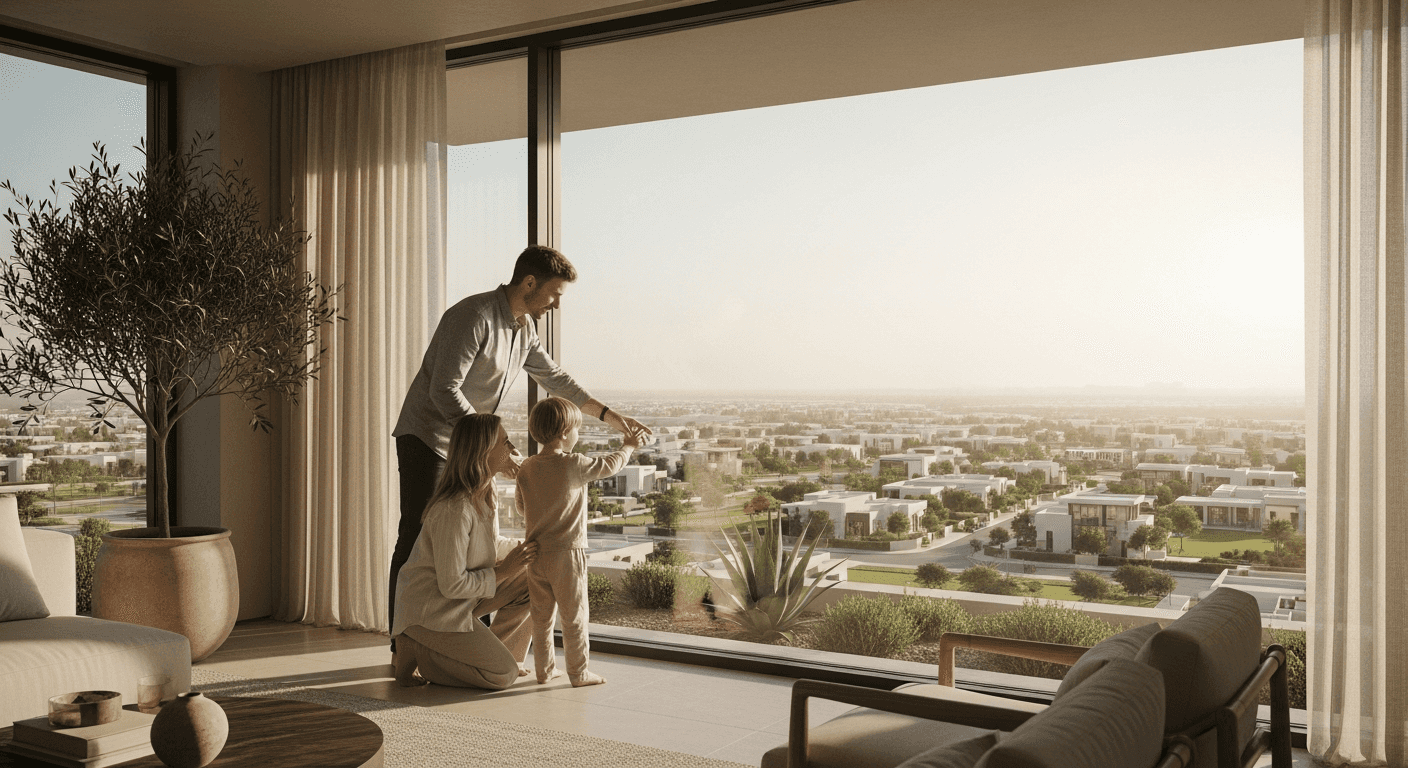
Dubai's Next Growth Corridors for Villa Investors
Discover the Dubai villa communities poised for significant growth, driven by massive infrastructure upgrades and new master developments. This is your guide to a future-proof property investment.

When clients ask me where to find long-term value, my answer often surprises them. I don't always point to the most famous, established postcodes. Instead, I suggest they look at a map, not just of today's Dubai, but of tomorrow's. A future-proof villa investment in Dubai isn't about buying in the current hotspot; it's about identifying the next one by understanding where the city itself is growing.
Here's what we'll explore:
- The core principle of investing ahead of major infrastructure.
- A deep dive into Dubai's southern growth engine: Dubai South.
- Which villa communities stand to benefit most from this expansion.
- How highway upgrades create new pockets of value.
- The game-changing impact of mega-projects like Palm Jebel Ali.
- The often-overlooked value of ongoing community upgrades.
- A line-by-line cost breakdown for buying a villa in one of these zones.
The Master Plan Principle: Investing Ahead of the Curve
One of the most compelling aspects of Dubai's real estate market is its intentionality. The city's growth isn't a chaotic sprawl; it's a meticulously planned journey guided by visionary frameworks like the Dubai 2040 Urban Master Plan. For a savvy investor or a family looking to secure a home that grows in value, understanding this blueprint is the closest thing we have to a crystal ball. The plan clearly outlines the government's intention to develop new urban centres, enhance public beaches, dedicate vast new areas to nature reserves, and streamline mobility. When you see a new highway interchange being built in what seems like the middle of nowhere, or a vast tract of land being prepared, it's rarely speculative. It's a deliberate piece of a much larger puzzle.
At Gaia Living, we encourage our clients to adopt what I call the 'Master Plan Principle'. This means aligning your investment with the city's declared trajectory. The strategy is simple: buy where the infrastructure is *going*, not just where it has already arrived. The greatest capital appreciation often occurs in the phase when an area transforms from 'up-and-coming' to 'established'. This is the period when new schools open their doors, metro stations become operational, and community centres start buzzing with activity. Those who invested before these amenities were a reality are the ones who reap the most significant rewards. This approach requires patience and a degree of foresight, but it’s a proven path to securing long-term family value villas.
This is fundamentally different from speculating or 'flipping'. It's a strategic, long-term hold based on confirmed, large-scale public and private sector investment. Think back to the early days of Dubai Marina or even Dubai Hills Estate. There was a time when these were just sand and concepts, accessible by rudimentary roads. Early investors who understood the vision of developers like Emaar Properties and the government's commitment to creating these integrated communities have seen phenomenal returns over the decades. We are seeing the next generation of these opportunities take shape right now, primarily in the southern corridor of the emirate. The key is to identify which specific villa communities are best positioned to capture the value created by this new wave of infrastructure development homes.
Epicentre of Growth: Dubai South and the Al Maktoum Effect
 Featured project
If there is one area that embodies the future of Dubai, it is Dubai South. This 145-square-kilometre master-planned city is, in my view, the single most important economic and logistical project in the UAE for the coming decades. It's not just a suburb; it's designed to be a self-sustaining ecosystem anchored by what will become the world's largest airport, Al Maktoum International (DWC). The recent confirmation of an AED 128 billion expansion plan to create a facility with five parallel runways capable of handling 260 million passengers annually is the starting gun for a new era of growth in this corridor. This isn't just an airport; it's an 'aerotropolis', a city built around aviation that will support one million residents.
The implications for the surrounding real estate market are immense. An airport of this scale creates a colossal gravitational pull for jobs, not just in aviation but in logistics, hospitality, commerce, and technology. The various districts within Dubai South — from the Logistics District to the Business Park, are designed to attract global companies, creating a huge, localized employment base. For families, this means the potential to live, work, and play within a single, cohesive area. The legacy of Expo City Dubai, now a permanent fixture within the Dubai South map, adds another layer of appeal, offering a ready-made hub for culture, business, and leisure with its own dedicated metro station.
Investing near this epicentre is a direct play on Dubai's economic future. As DWC gradually takes over as the city's primary international hub, the centre of gravity will inevitably shift south. We can expect to see a surge in demand for quality family housing from the thousands of professionals who will be based there. This is a long-term trend that will unfold over the next decade. For investors and homeowners today, this presents a window of opportunity to acquire appreciating villa areas Dubai before the full impact of the Al Maktoum effect is priced in. The infrastructure is not just planned; it's happening. The roads are expanding, the metro is there, and the vision is being realized block by block.
Villa Communities Near Dubai South: A Deep Dive
With the strategic importance of Dubai South established, the practical question becomes: where exactly should one look for a villa? Several existing and emerging communities are perfectly positioned to benefit from this southern shift. The key is to balance current livability with future potential. Right now, Emaar South stands out as one of the most directly linked communities. Developed by Emaar, it offers a range of townhouses and villas in a green, golf-course setting. Its proximity is its greatest asset; residents are minutes away from the Expo City site and the expanding airport, making it a prime candidate for employees of the new aerotropolis.
Slightly further afield but still well within the catchment area, you have established communities that offer excellent value. Al Furjan, a master community by Nakheel, is a fantastic example. It has matured beautifully over the last decade, with its own metro station, two retail pavilions, and a strong sense of community. While it's not brand new, its location offers a perfect blend of established comfort and proximity to the future growth zone of Jebel Ali and Dubai South. Villas here tend to be spacious with good plot sizes, representing solid value compared to more central locations. Similarly, parts of Jumeirah Golf Estates and the newer phases of communities developed by Damac, like DAMAC Hills 2, are also benefiting from the improved connectivity and growing focus on this part of the city.
When evaluating these options, I encourage clients to look at a few key factors:
- Developer Reputation: Is the master developer known for quality and for continuing to invest in the community after handover?
- Existing Amenities: Are there schools, clinics, and supermarkets already in place or firmly planned? A community needs more than just houses.
- Connectivity: How easy is it to get to Sheikh Zayed Road (E11) and Emirates Road (E611)? Travel time to the main business hubs of today still matters.
- Service Charges: What are the annual community fees? These should be reasonable for the level of amenities provided. A typical range for many villa communities is between AED 2.5 and AED 5.5 per square foot of built-up area annually.
Prices in these areas are still significantly more accessible than in prime central villa communities like Dubai Hills or Arabian Ranches. A four-bedroom villa in an area like Emaar South or Al Furjan might trade in the AED 3.5 million to AED 5 million range, whereas a comparable property in a more central, established community could easily be 50-100% higher. This price differential is where the opportunity for capital appreciation lies.
The E611 Corridor: Connecting the Dots for Future Value
Dubai's story is written in its highways. The development along Sheikh Zayed Road defined the city for decades. Now, the corridors of growth are pushing inland, and the expansion of Emirates Road (E611) and Sheikh Mohammed Bin Zayed Road (E311) is critical to unlocking the next wave of residential communities. These highways are the arteries that feed the new heart of Dubai, making once-distant locations feel accessible and integrated. For families, commute times are a major factor in choosing a home, and infrastructure upgrades that shave 15-20 minutes off a daily drive can have a dramatic impact on a community's desirability.
Look at the communities that have sprung up along the E611 corridor. Arabian Ranches III, The Valley, and Villanova are all large-scale Emaar projects that depend on this highway for their connectivity. While Arabian Ranches I and II are more established, the newer phases offer a more attractive entry price and are directly benefiting from ongoing road improvements. The government's investment in new interchanges and road expansions is a clear signal of its commitment to making these areas thriving residential hubs. This focus on connectivity is a core tenet of making them successful long-term family value villas.
I find that many buyers initially underestimate the importance of these road networks. They might look at a community on a map and perceive it as being 'far out'. But a 30-minute drive on a free-flowing, multi-lane highway is often faster and less stressful than a 20-minute crawl through dense urban traffic. As Dubai's population grows, these well-connected, spacious suburban communities become increasingly appealing. They offer a lifestyle that's difficult to replicate in the city's denser core — larger homes, private gardens, and a wealth of green, open space, all made viable by world-class road infrastructure. Investing in a villa in a community along the E611 corridor is a bet on the enduring appeal of the suburban Dubai dream, a dream that is being enabled and amplified by strategic government investment in transport.
“In Dubai, you don't wait to buy real estate, you buy real estate and wait. But the smartest waiting is done in the path of confirmed, large-scale infrastructure development.”
The Coastal Catalyst: Palm Jebel Ali and its Ripple Effect
The relaunch and active development of Palm Jebel Ali by Nakheel is perhaps the most exciting mega-project in Dubai right now. It is a monumental undertaking that will, in my opinion, completely reshape the entire western coastline of the emirate. Planned to be twice the size of the original Palm Jumeirah, it will add around 110 kilometres of new coastline and feature an array of luxury hotels, residences, and world-class leisure attractions. This isn't just another project; it's the creation of a new 'destination' within Dubai, a new centre of gravity for luxury tourism and waterfront living.
The immediate impact will be on the Palm Jebel Ali itself, where the initial villa launches have already set new benchmarks for price and luxury. However, the secondary or 'ripple' effect on the surrounding mainland communities is what long-term investors should be watching closely. The development of the Palm will necessitate a massive upgrade of all supporting infrastructure in the Jebel Ali area — roads, utilities, public transport, and social facilities. This rising tide of quality and investment will lift all boats. Existing villa communities in proximity, and even those a short drive away, will suddenly find themselves next to one of the world's premier destinations.
This creates a classic appreciation scenario. The presence of ultra-luxury properties on the Palm will recalibrate perceptions of value for the entire area. A well-maintained villa in a nearby community, which may have seemed expensive before, will look like remarkable value in comparison. We've seen this exact pattern play out around Palm Jumeirah, where adjacent areas like Dubai Marina and JBR saw their values soar as the Palm matured. The same dynamic is poised to happen around Palm Jebel Ali. Communities in what was once considered the industrial heartland of Dubai will be rebranded as prime coastal-adjacent residential zones. For anyone considering a villa investment in this part of the city, the development of Palm Jebel Ali provides a powerful, long-term tailwind for capital growth.
Beyond the Megaprojects: The Power of Community-Level Upgrades
While the headlines are dominated by giga-projects, it's crucial not to overlook the powerful, value-driving force of ongoing, community-level improvements. A top-tier master developer doesn't just build and leave; they act as a long-term custodian for the community, continuously reinvesting to enhance the lifestyle and protect property values. This is a key differentiator and a vital component of any search for appreciating villa areas Dubai. When you buy into a community from a developer like Emaar, Meraas, or Nakheel, you are also buying into their commitment to future enhancement.
Dubai Hills Estate is the perfect case study. Since its launch, the community has seen a constant stream of upgrades. The opening of Dubai Hills Mall, the development of the business park, the addition of multiple schools like GEMS International School and King's College Hospital have all added immense value for residents. These aren't just amenities; they are pillars of a fully-fledged community that enrich daily life and make the area more desirable each year. This continuous cycle of improvement, from landscaping and park maintenance to the addition of major commercial and social infrastructure, is what creates sticky, long-term demand and supports robust price growth. This is the essence of what we mean by 'community upgrades Dubai'.
When our team at Gaia Living evaluates villa communities, we look for evidence of this ongoing stewardship. Does the developer have a track record of delivering on promised amenities? Are the service charges being used effectively to maintain and improve the common areas? Is there a clear plan for future phases that will complement, not just congest, the existing community? A 'yes' to these questions is often a stronger indicator of future value than proximity to a single, standalone project. These well-managed, ever-improving master communities provide a lower-risk path to capital appreciation, as their value is built on the solid foundation of resident satisfaction and a superior living experience.
The Financials: A Cost Breakdown for a Future-Proof Investment
Understanding the potential for appreciation is one thing; knowing the upfront costs is another. A transparent view of the financials is essential before making any commitment. Let’s walk through a realistic example of purchasing a ready villa in one of these growth corridors. The process and fees are regulated and clear, which is one of the great strengths of the Dubai market.
Let's assume you've identified a four-bedroom villa in a community like Al Furjan or Emaar South with an agreed purchase price of AED 4,000,000. If you are financing the purchase, you will need a mortgage pre-approval from a bank. Under the Central Bank of the UAE's regulations, for a property over AED 5 million, a non-UAE national resident can typically borrow up to 75% for a first property. Let's stick with the under AED 5M example, where the loan-to-value (LTV) is 80%, meaning you need a 20% down payment. For a resale property, here is what your upfront costs would look like:
Example Purchase: AED 4,000,000 Villa
- Down Payment (20% of Purchase Price): AED 800,000
- Dubai Land Department (DLD) Fee (4% of Purchase Price): AED 160,000
- DLD Admin Fee: Approximately AED 4,200 (this is a fixed fee)
- Real Estate Agency Fee (2% of Purchase Price + 5% VAT): AED 80,000 + AED 4,000 = AED 84,000
- Mortgage Registration Fee (0.25% of Loan Amount): 0.25% of AED 3,200,000 = AED 8,000
- Bank Mortgage Processing & Valuation Fees: Varies by bank, but budget around AED 5,000 - AED 10,000
Total Upfront Cash Required: Approximately AED 1,066,200
This calculation is crucial. It shows that on a AED 4 million property, you need over AED 1 million in liquid cash to complete the transaction. It's vital to have this full amount ready. The fees are non-negotiable and mandated by government bodies like the Dubai Land Department (DLD). After the purchase, you'll also have annual service charges to maintain the community's pools, parks, and security. For a 4,000 sq. Ft. villa, with fees at AED 3.5 per sq. Ft., you can expect an annual bill of around AED 14,000. These are the real numbers that underpin a sound investment decision.
My Verdict: A Strategy for Patient, Long-Term Investors
After years of observing the Dubai market, my conviction in the 'Master Plan Principle' has only grown stronger. Investing in the path of progress is a sound, logical strategy that has consistently delivered for those with the patience to see it through. The opportunities we see today in the corridors leading towards Dubai South and flanking the new Palm Jebel Ali are, in my professional opinion, the most compelling long-term villa investment prospects in the emirate.
This is not a strategy for those seeking a quick profit. The value unlocked by a new airport or a mega-project like the Palm doesn't appear overnight. It accrues over five, ten, or even fifteen years as the infrastructure matures, jobs are created, and communities take root. This makes it an ideal strategy for an end-user family looking for a home that will not only provide a wonderful lifestyle but will also be a formidable asset in the future. It's equally suited to a buy-to-let investor who can service the mortgage with rental income while waiting for the long-term capital appreciation to materialize.
My advice is to do your own due diligence on the ground. Drive the new highways, visit the communities, and feel the distances for yourself. Look at the quality of the existing phases and speak to residents. Partner with an advisor who understands the nuances of each community and the specifics of the city's urban plan. The areas we've discussed — from Emaar South and Al Furjan to the communities along the E611 and near the new coast, offer a range of price points and lifestyles. The common thread is their strategic position in the path of Dubai's incredible, forward-looking vision.
The most rewarding villa investments in Dubai are often made by looking beyond the current map and buying into the city's meticulously planned future. By focusing on areas with confirmed, large-scale infrastructure and economic catalysts, investors and families can secure homes that are poised for significant long-term value creation.
Sources
- Dubai 2040 Urban Master Plan: UAE Government Portal
- Real Estate Fees and Regulations: Dubai Land Department (DLD)
- Mortgage Regulations: Central Bank of the UAE (CBUAE)
Questions, answered
- Which areas in Dubai are best for long-term villa investment right now?
- Areas along Dubai's southern corridor, such as those near Dubai South, Expo City, and the newly launched Palm Jebel Ali, present strong potential for long-term appreciation due to massive planned infrastructure and economic development.
- How does infrastructure development affect property prices in Dubai?
- Major infrastructure like new metro lines, airport expansions, or large-scale community hubs significantly enhances connectivity, amenities, and desirability. This typically leads to a steady increase in property values and rental demand in the surrounding areas over the medium to long term.
- Is it better to buy an off-plan or a ready villa in an area with future development?
- Buying off-plan allows you to enter the market at a lower price point before the infrastructure is complete, potentially maximizing capital appreciation. However, a ready property provides immediate rental income or use and has less uncertainty. The choice depends on your risk appetite and financial strategy.
- What are the main costs to consider when buying a villa in Dubai?
- Beyond the property price, budget for a 4% Dubai Land Department transfer fee, a 2% real estate agency fee, a trustee fee of around AED 4,200, and your mortgage down payment, which is typically 20-25% of the purchase price. Annual service charges are also an ongoing cost.
- How does the Dubai 2040 Urban Master Plan influence real estate investment?
- The Dubai 2040 Plan is the government's official roadmap for urban growth, focusing on sustainability, doubling green spaces, and developing new economic hubs. Investing in areas prioritized by this plan is a strategic way to align your property investment with the city's long-term vision.
- Will the Palm Jebel Ali project increase villa prices in nearby areas?
- Yes, in my professional opinion, the development of Palm Jebel Ali is expected to create a significant ripple effect. It will introduce a new ultra-luxury benchmark and a wealth of high-end amenities, which will likely elevate property values in adjacent mainland communities like those in the Jebel Ali area and along the E11 corridor.

Sophia profiles Dubai's villa communities — schools, commute times, green space, and the intangible feel of a neighbourhood. She writes for families putting down roots.
Related stories

Off-Plan vs Ready: The Dubai Investor's Guide
A detailed comparison for apartment investors in Dubai, weighing the capital appreciation potential of off-plan against the immediate returns of ready properties.

Clearing Disputes for a Smooth Dubai Sale
Unseen property disputes or financial encumbrances can derail your Dubai property sale. I'll share my strategic playbook for identifying and resolving these issues before they cost you time and money.
Selling Inherited Property in Dubai: The Complete Guide
Navigating the sale of an inherited property in Dubai requires a clear understanding of the specific legal and financial steps. This guide covers the entire process, from obtaining a succession certificate to the final transfer.
Echoes, in your inbox
One thoughtful email a month. Market insight, new launches, no spam.