

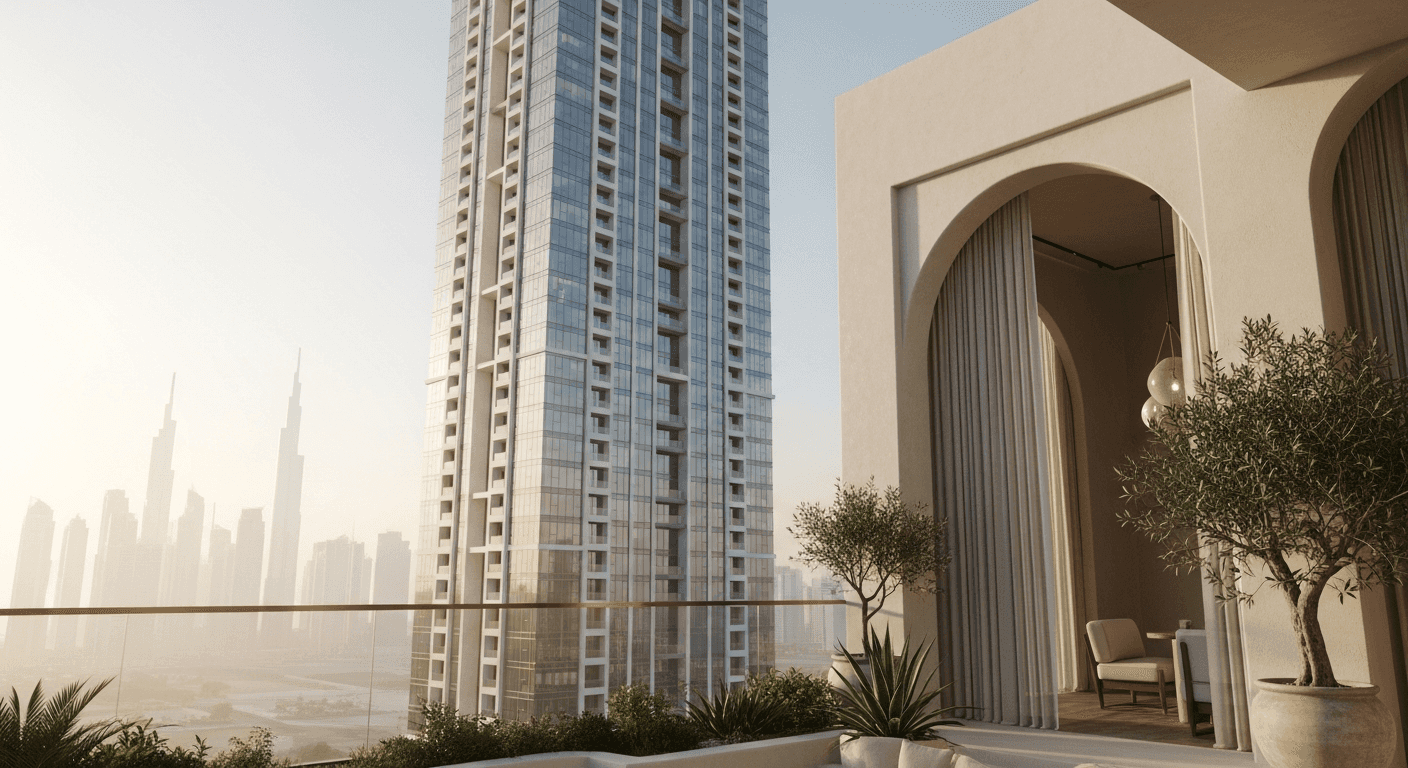
Dubai's New Price Floor: Why Construction Costs Are Reshaping the Market
Rising construction costs are setting a new, higher baseline for property prices in Dubai. As Head of Market Research, I'll explain what this structural shift means for developer strategy, future supply, and your next property purchase.

The conversations we have with clients at Gaia Living have shifted. For years, the focus was on cyclical demand, rental yields, and the timing of market entry. Now, a more fundamental, structural force is at play: the cost of creation. The sharp rise in construction costs is not just a line item on a developer's spreadsheet; it is actively reshaping the future of Dubai's property market, establishing a new price floor for all forthcoming supply and fundamentally altering the financial equation for developers and buyers alike.
This isn't a temporary spike. In my analysis, this is a structural reset. The factors driving up the costs to build in Dubai are deep-seated and regional, meaning they are unlikely to reverse course. For anyone looking to buy properties for sale or invest in this market, understanding these supply-side pressures is no longer optional — it is critical to making informed decisions for the years ahead.
Here’s what we will explore in this report:
- The primary drivers of the current Dubai construction cost trends.
- How specific material and labor costs are impacting project viability.
- The effect on developer margins and the strategic pivot towards luxury.
- A detailed, line-by-line cost breakdown for a typical new apartment.
- The growing price chasm between new launches and the secondary market.
- The knock-on effects for rental income and investment yields.
- My forecast for the market and what it means for your strategy.
The New Cost Reality: Unpacking Construction Inflation
For any market to be properly understood, one must look at both demand and supply. While global demand for Dubai real estate remains exceptionally strong, the supply side of the equation is now governed by a new, unyielding reality: it costs significantly more to build anything today than it did just a few years ago. This isn't unique to Dubai, but the effects here are amplified by the sheer scale and ambition of the region's development pipeline. The factors are a mix of global headwinds and intense local competition.
Globally, the post-pandemic era has left a legacy of fractured supply chains and persistent inflation. The cost of shipping raw materials remains elevated, and geopolitical instability adds a layer of risk and volatility to pricing. Key commodities like steel, copper, and cement have seen substantial price hikes on international markets. Developers can no longer count on the predictable, low-cost material sourcing that underpinned previous construction booms. This global price inflation forms the base layer of the cost challenge. It affects everything from the rebar in a building's foundation to the wiring within its walls.
Layered on top of this is an intense, regional-specific pressure. The UAE, led by mega-projects in both Dubai and Abu Dhabi, is undergoing a massive development cycle. Concurrently, Saudi Arabia's giga-projects, with their almost unimaginable scale, are acting as a giant magnet for construction resources across the entire Middle East. This creates unprecedented competition for a finite pool of assets: skilled labour, high-capacity contractors, and specialized consultants. The top-tier construction firms that developers like Emaar Properties or Damac rely on are now in a position to name their price, as their order books are full for years to come. This directly impacts the material cost impact real estate pricing.
This isn't just about general contractors. The scarcity extends to specialized trades. Finding enough qualified façade engineers, MEP (Mechanical, Electrical, and Plumbing) technicians, and high-end finishing carpenters has become a major operational hurdle for developers. This labour scarcity inevitably leads to wage inflation, which is passed directly into the project budget. A developer launching a project today must budget for significantly higher labour costs than they would have for an identical project launched three or four years ago. This combination of global material inflation and regional resource competition is the engine driving the new cost structure of Dubai real estate.
From Steel Beams to Skilled Hands: A Closer Look at Cost Components
 Featured project
A building's final cost is an accumulation of dozens of variables, broadly categorized into 'hard costs' and 'soft costs'. Understanding how inflation is affecting both categories is key to grasping the full picture of Dubai construction cost trends. It’s a perfect storm where nearly every single line item in a development pro forma is trending upwards, leaving developers with very little room to manoeuvre.
Hard costs are the tangible, physical expenses of construction. This is where the most visible inflation has occurred. Steel rebar and structural steel prices are a benchmark for the industry, and their volatility has a direct impact on the cost of a building's skeleton. Concrete, the other foundational material, has also seen steady price increases driven by both its core components and the energy required for its production. For the sleek, glass-heavy towers that define Dubai's skyline, the cost of high-performance façade glass and aluminium mullions has surged. But the impact goes beyond the core and shell. The cost of MEP systems — the building's circulatory and nervous systems, has also risen, driven by the price of copper for wiring and pipes, and the complex technology now standard in smart, energy-efficient buildings.
Finishing materials represent another area of significant cost pressure, particularly in the luxury segment. The price of high-quality European marble, custom joinery, and branded kitchen appliances and sanitary ware from manufacturers in Germany or Italy has climbed due to their own raw material and energy costs. When a developer like AHS Properties promises a certain standard of luxury, they are locked into sourcing these premium materials, and they must bear the price increases. These are not costs that can be easily 'value-engineered' out of a project without compromising the brand promise and the final sale price.
Soft costs, while less tangible, are equally impactful. The single largest soft cost is often the land itself. In prime areas like Jumeirah Bay, Bluewaters Island, or plots with direct views in Downtown, land prices have reached astronomical levels. A developer paying a premium for a plot has to build something spectacular to generate a return, which immediately pushes the project up the luxury ladder. Other soft costs are also rising. Higher global interest rates mean the cost of financing a multi-year construction project is more expensive. Fees for design, engineering consultants, and project management have also increased as top-tier talent is in high demand. Even marketing and sales budgets have to expand to compete in a crowded off-plan market. While regulatory fees paid to entities like the Dubai Land Department (DLD) are stable, they are part of an overall cost stack where every other element is inflating.
The Developer's Dilemma: Squeezed Margins and Strategic Pivots
Faced with this sustained cost inflation, developers in Dubai are at a strategic crossroads. Their traditional business model, particularly in the mid-market segment, is being fundamentally challenged. When your total project cost increases by 20-30%, as many are now experiencing, you have a limited set of options: you can absorb the increase and accept a drastically lower profit margin, you can attempt to pass the entire cost increase on to the buyer, or you can change the product you are building. We are seeing all three responses in the market today, and it’s leading to a significant strategic pivot.
For developers focused on affordable and mid-range properties in communities like JVC, Al Furjan, or Arjan, the situation is acute. These developers, such as Binghatti or AZIZI, built their brands on delivering value and competing on price. Their profit margins were already leaner than those of luxury players. A sudden surge in construction costs can wipe out a project's entire projected profit if the units were priced based on outdated cost assumptions. This severely impacts new project viability Dubai. Many smaller developers are now finding that launching a new mid-market project is simply not financially feasible unless they can command significantly higher sale prices than the area's current secondary market average — a risky proposition.
This pressure is the primary reason for the most significant trend we're witnessing: a market-wide pivot towards the luxury and ultra-luxury segments. The financial logic is straightforward. For a developer like Meraas building high-end villas in a prime location, construction cost is only one part of the value proposition. The final sale price is determined more by the location, the brand, the lifestyle, and the exclusivity. If the construction cost for a AED 30 million villa increases by AED 1 million, that 3.3% increase can be more easily absorbed or passed on to a buyer in the ultra-high-net-worth category. In contrast, for a developer of an AED 1 million apartment, a AED 200,000 cost increase represents a 20% jump that the target buyer demographic may not be able to afford. This is why we see a constant stream of new off-plan launches for branded residences and super-prime penthouses, while the pipeline for genuinely affordable new-builds has thinned considerably.
This strategic shift has profound implications for the overall shape of Dubai's future supply. It means that the new properties being added to the market are disproportionately skewed towards the expensive end. This isn't necessarily a reflection of demand alone; it's a direct consequence of the supply-side cost structure. Developers are building what is profitable and viable to build. Right now, that is luxury. This creates opportunities for firms with deep land banks acquired years ago at lower costs, like Nakheel with its vast holdings in places like Palm Jebel Ali, but it presents a major barrier to entry for new developers wanting to serve the middle of the market.
A Worked Example: Deconstructing the Cost of a New Dubai Apartment
To make this tangible, let's move from theory to practice. It’s one thing to talk about rising costs, but it’s another to see how they stack up. I want to walk through an illustrative, line-by-line cost breakdown for a hypothetical new mid-to-upper-range two-bedroom apartment in a good, but not super-prime, Dubai location. The purpose here is to show how costs accumulate before a developer can even think about profit. Please note, these are simplified, representative figures for educational purposes — actual costs vary enormously by project, location, and specification.
Let's assume a developer is building a G+12 residential tower. The total sellable area is 120,000 sq. Ft., and our target unit is a two-bedroom apartment of 1,200 sq. Ft. Here is a plausible developer cost structure for that single apartment:
- Land Acquisition Cost (Pro-rata): Land is the first major expense. If the developer paid AED 30 million for the plot, and our 1,200 sq. Ft. apartment represents 1% of the total sellable area, the pro-rata land cost is AED 300,000. In many new projects in areas like Creek Harbour, this is a conservative estimate.
- Hard Construction Costs: This is the core build expense. A reasonable all-in construction cost for a good quality build today might be AED 750 per sq. Ft. For our 1,200 sq. Ft. unit, this comes to AED 900,000. This covers everything from the concrete structure to the final paint and tiles.
- Soft Costs (Consultancy & Permitting): This bucket includes fees for architects, engineers, project managers, and various municipal permits from DLD, RERA, DEWA, etc. This typically runs at 15-20% of hard costs. Let's use 18%, which adds AED 162,000.
- Financing Costs: Developers rarely fund projects entirely with cash. They take construction loans, and with higher interest rates, this cost has risen. Over a 3-year development cycle, the financing cost allocated to our unit could easily be AED 90,000.
- Marketing, Sales & Admin: This includes sales centre costs, agent commissions, advertising, and the developer's own administrative overhead. A 5% allocation of the target sale price is a standard industry metric. If we assume a target price around AED 2M, this would be AED 100,000.
- Contingency: No project runs perfectly. Prudent developers build in a contingency fund for unexpected issues or cost overruns. A 5% contingency on hard costs is common, adding another AED 45,000.
If we sum these figures, we arrive at a total baseline cost for the developer to produce this single two-bedroom apartment:
“300,000 (Land) + 900,000 (Build) + 162,000 (Soft Costs) + 90,000 (Finance) + 100,000 (Sales) + 45,000 (Contingency) = AED 1,597,000”
This is the developer's break-even point. To achieve a fairly standard 20% profit margin, they would need to sell this apartment for approximately AED 1,996,250, or roughly AED 1,660 per square foot. This simple exercise demonstrates starkly why new two-bedroom apartments in many parts of Dubai are now launching at prices approaching or exceeding AED 2 million. The costs simply do not support a lower price point if the project is to be viable.
The Widening Gulf: New Supply vs. The Secondary Market
The direct consequence of this new cost floor is a growing and, in my view, structural, price divergence between the primary (off-plan) market and the secondary (resale) market. The future property prices Dubai supply conversation is now a tale of two distinct markets. A brand-new apartment is becoming a fundamentally different product, with a different price tag, than a nearly identical one in an adjacent, older building. Understanding this gap is crucial for any buyer or investor weighing their options today.
Consider a community like Dubai Hills. A new two-bedroom apartment being launched by Emaar today might be priced at AED 2,200 per square foot. This price is a direct function of the cost structure we just analyzed: today's land value, today's construction costs, and today's required profit margins. Meanwhile, in a building that was completed just five years ago within the same community, a similar two-bedroom unit might be available on the secondary market for AED 1,700 per square foot. This creates a price premium of nearly 30% for the new-build property.
So, what justifies this premium? Buyers of off-plan property are paying for a package of benefits. They get a brand-new asset with zero wear and tear, covered by a developer warranty and a mandatory 10-year structural guarantee. They benefit from the latest design trends, building technologies, and amenity concepts. Crucially, they also get the developer's payment plan, which allows them to secure the property with a relatively small down payment and spread the cost over the construction period and often for several years post-handover. This financial flexibility is a major draw, especially for investors seeking to use use.
However, the size of this premium is now so significant that it forces a serious value calculation. Is the 'newness' and payment plan worth a 30% higher price? For some, the answer is yes. But for an increasing number of buyers, particularly end-users, the value proposition of the secondary market is becoming undeniable. That five-year-old apartment at AED 1,700 per sq. Ft. is in a mature community with established infrastructure. You can see and touch the exact unit you are buying. Provided the building is well-maintained — and this is a critical due diligence point, it may represent far better intrinsic value. This dynamic is playing out across all of Dubai's major communities, from waterfront districts like Dubai Marina to sprawling villa communities like Arabian Ranches.
The Domino Effect: How Construction Costs Reshape Rents and Yields
The impact of higher construction costs doesn't stop at the point of sale. It ripples through the entire market, influencing rental rates, reshaping investment yields, and altering the financial calculus for landlords. An investor who buys a property at a higher price point must, logically, seek a higher rent to make their investment worthwhile. This is putting upward pressure on rents in new buildings and creating a more stratified rental market across the city.
Let's return to our example of the two-bedroom apartment. An investor who purchased an equivalent unit five years ago for AED 1.2 million might be satisfied with an annual rent of AED 100,000, which delivers a healthy gross yield of 8.3%. However, the investor who buys the new-build apartment for AED 2 million today needs to achieve a rent of approximately AED 140,000 just to get a 7% gross yield. This immediately creates a two-tiered rental market in the same neighborhood. New, premium buildings will command higher rents, justified by their modern facilities and pristine condition, while older buildings will offer more affordable rental options.
This dynamic has several important implications for investors. First, it means that achieving the high single-digit gross yields that Dubai was famous for is becoming more challenging in the off-plan space. The entry price is simply too high. Investors in new properties are making a bigger bet on capital appreciation. They are banking on the idea that the entire market will rise, and their AED 2 million property will be worth AED 2.5 million in a few years, rather than focusing solely on immediate rental income. This shifts the risk profile of the investment.
Second, it elevates the importance of net yield. Gross yield is simply annual rent divided by purchase price. Net yield, however, subtracts all ownership costs, the most significant of which are service charges. New, amenity-rich buildings often come with higher service charges to maintain their pools, gyms, and elaborate common areas. An investor must carefully analyze the projected service charges (quoted by the developer in AED per square foot) to calculate their true net return. A high service charge can quickly erode the profitability of a rental property, even if the gross rent seems attractive. This detailed analysis is a core part of the advisory we provide to our investor clients at Gaia Living.
“The era of building mid-market Dubai communities on the cheap is over. The new cost floor for construction is permanent, and it will redefine value in our market for the next decade.”
My Forecast: A Structural Shift, Not a Temporary Blip
Having analyzed these cost pressures from every angle, I am convinced that what we are witnessing is not a cyclical peak but a long-term structural realignment of the market. The forces driving up construction costs are not fleeting. My professional view is that the notion of construction costs reverting to pre-2021 levels is wishful thinking. This means the new, higher price floor for property in Dubai is here to stay, and this will have lasting consequences.
Why am I so confident this is a structural shift? The primary reason is the unprecedented scale of development across the GCC, spearheaded by Saudi Arabia. The Kingdom's Vision 2030 projects are a multi-trillion-dollar undertaking that will absorb a colossal amount of construction materials, machinery, and, most importantly, human talent for at least the next decade. This creates a powerful, sustained demand pull on the entire regional supply chain. A contractor or skilled engineer in Dubai now has lucrative opportunities in Riyadh or Neom. This regional competition for resources will keep prices for both labor and materials elevated for the foreseeable future.
Beyond that, global supply chains are being reconfigured. After the shocks of the pandemic and geopolitical events, companies and countries are prioritizing resilience over pure cost efficiency. This 'deglobalization' trend means more expensive, more secure supply lines, which translates to permanently higher costs for imported goods, including many of the high-spec components used in modern buildings. These are macro trends that a single city's property market cannot override.
This leads me to a clear forecast: the price gap between new and old properties will not only persist but will likely continue to widen. The new supply coming online will systematically reset the price benchmarks in every community it enters. This will have a gradual but powerful effect of pulling up the entire market's average price over time. For developers, this means the flight to quality and brand will intensify. Those with strong balance sheets, premium land banks, and trusted brands — firms like Aldar in Abu Dhabi or master developers in Dubai, are best positioned to navigate this high-cost environment. In my opinion, we may see a consolidation in the market, as smaller developers without these advantages struggle to bring viable projects to launch.
Investor and Homebuyer Strategy in a High-Cost Market
So, what is the practical takeaway from all this analysis? How should you, as a homebuyer or an investor, adapt your strategy to this new reality? The right approach depends on your goals, but the underlying principle is to be more discerning and analytical than ever before.
For end-users looking for a home, the key is to consciously evaluate the 'new-build premium'. You are no longer just choosing between two properties; you are choosing between two different value propositions. If the allure of a brand-new home with the latest amenities and a warranty is your top priority, then you must be prepared to pay the premium. However, I would strongly urge homebuyers to give the secondary market serious consideration. A well-maintained property in an established community like The Meadows or Jumeirah Golf Estates can offer significantly more space and a better location for the same budget. Your due diligence here is critical. Before buying an older property, you must perform a thorough check:
- Service Charge History: Request at least 3 years of service charge statements from the seller. Are they stable or rising rapidly?
- Building Maintenance: Scrutinize the condition of the common areas. A well-run Owners Association will keep the building in top shape.
- Reserve Fund: Ask for the status of the building's reserve or sinking fund. A healthy fund means no surprise special assessments for major repairs down the line.
- Professional Inspection: Always commission a snagging or property inspection report from a reputable firm.
For investors, the calculus has become more nuanced. The simple strategy of buying any off-plan property and waiting for high yields and appreciation is over. You must be more selective. The higher entry prices for new builds mean that your potential for capital appreciation is a much larger part of your total return equation. You need to have strong conviction in the future growth of a specific community or sub-market. Alternatively, the savviest investors I see are now hunting for value in the secondary market. They are looking for older, well-located assets that may be underthe-rented or require a minor cosmetic upgrade, where they can force appreciation and generate a stronger net yield from day one. This requires more effort and on-the-ground knowledge but can deliver superior returns in the current environment.
The rising cost of construction has created a new price floor for Dubai's off-plan market, permanently widening the value gap between new and secondary properties. Buyers and investors must now be more strategic, weighing the premium for 'new' against the tangible value available in well-maintained, established communities. Success in this market is no longer about timing the cycle, but about making rigorous, asset-level choices.
Ultimately, the Dubai property market is maturing. The supply-side constraints are introducing a new discipline and forcing a focus on quality and long-term value. For those who understand these new rules of the game, the opportunities remain as compelling as ever. Our role at Gaia Living is to help you navigate this complexity with clarity and confidence. Whether you are drawn to the promise of a new launch or the value of an established home, we are here to provide the data and insight you need.
Sources
- Dubai Land Department (DLD): https://dubailand.gov.ae/
- Central Bank of the UAE: https://www.centralbank.ae/
- UAE Government Portal (u.ae): https://u.ae/en
Questions, answered
- How much have construction costs in Dubai actually increased?
- While precise figures vary, industry reports and our observations suggest significant double-digit percentage increases in overall project costs since 2021. The main drivers are global inflation in materials like steel and concrete, coupled with high regional demand for skilled labor and contractors, which has pushed up wages and service fees.
- Are developers still profitable with these higher costs?
- Yes, but margins are under pressure, especially in the mid-market segment. This is why many developers are strategically pivoting towards high-end and luxury projects where higher sale prices can more easily absorb increased costs. Profitability now depends heavily on brand, land acquisition strategy, and operational efficiency.
- Is it cheaper to buy an old or new property in Dubai now?
- Generally, an older property in the secondary market will be cheaper on a per-square-foot basis than a brand new off-plan property in the same area. Buyers of new properties are paying a premium for modern amenities, warranties, and often flexible payment plans, but the price gap has widened significantly due to rising construction costs.
- How do rising construction costs affect rental yields for investors?
- Higher acquisition prices for new properties mean investors must charge higher rents to achieve the same gross rental yield. This can compress initial yields if the rental market doesn't keep pace. Investors now need to weigh the potential for higher long-term capital appreciation against a potentially lower immediate rental return.
- Will these high costs make Dubai property unaffordable?
- It's creating a challenge for affordability in the new-build market. However, the secondary market provides a crucial release valve with more varied price points. We're seeing a growing price divergence between new launches and existing homes, which makes exploring established communities more attractive for budget-conscious buyers.
- What is the biggest factor driving up construction costs in Dubai?
- It's a combination of factors, but the concurrent boom in large-scale development across the UAE and Saudi Arabia is a primary driver. This creates intense regional competition for a finite pool of skilled labor, contractors, and raw materials, leading to significant price inflation that impacts all new projects in Dubai.

Amara translates DLD transaction data, supply pipelines, and macro signals into clear calls on where Dubai's market is heading. She writes the numbers most brokers only feel.
Related stories
Calculating ROI on Dubai Rental Upgrades
As a landlord in Dubai, you can't just follow trends. I'll show you how to calculate the precise ROI of minor property upgrades to genuinely increase your rental yield.

Off-Plan vs Ready: The Real Cost of Capital
I analyse the fundamental trade-off every Dubai investor faces: the lure of off-plan capital growth versus the security of immediate rental income from a ready property.

Beyond the Gates: Dubai's Boutique Villa Sanctuaries
I'm exploring the small, exclusive villa communities that offer a real sense of place, moving beyond the well-trodden path of Dubai's famous megaprojects to find homes with genuine character.
Echoes, in your inbox
One thoughtful email a month. Market insight, new launches, no spam.