

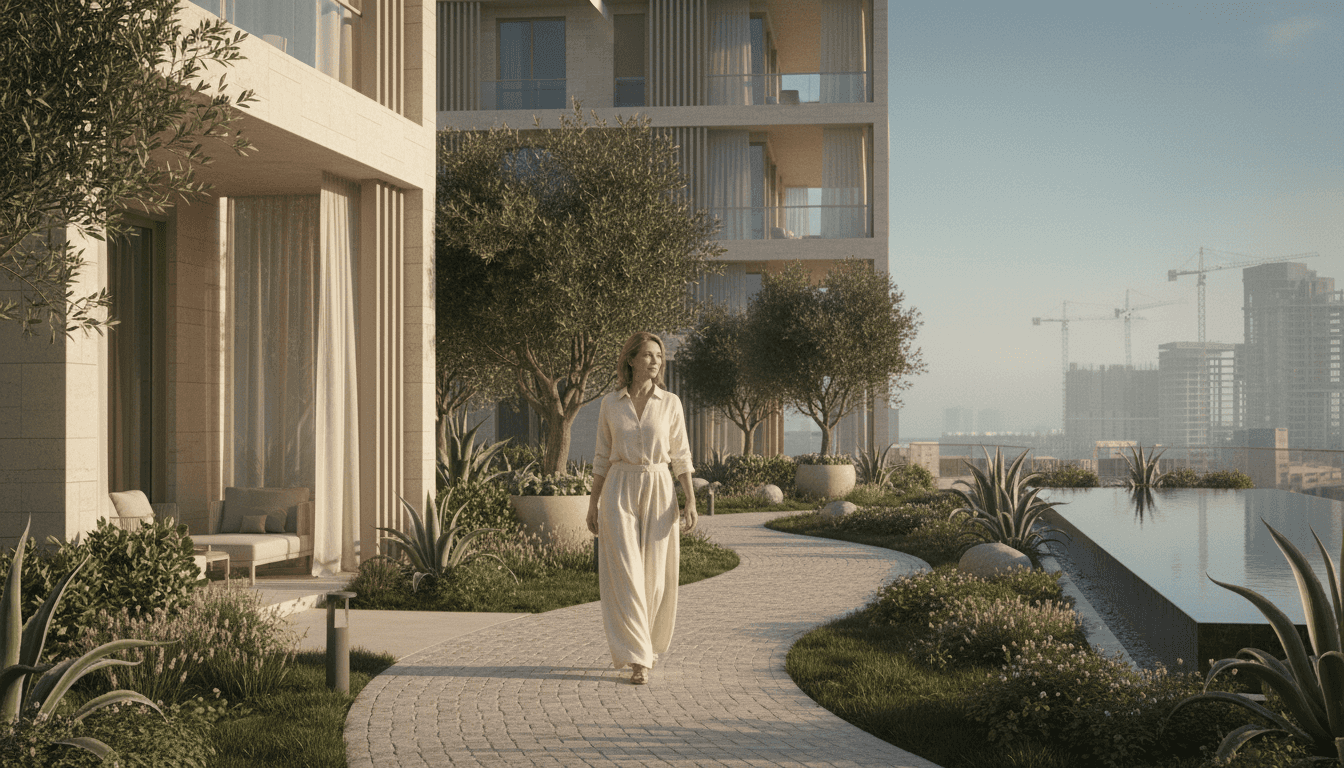
Dubai's New Demographics: Reshaping Property Demand
Dubai's population is not just growing, it's changing profoundly. I'll break down how new resident profiles are shifting demand from studios to larger family homes, and what this means for investors and homebuyers.

For years, the story of Dubai real estate was written in studios and one-bedroom apartments, a reflection of a transient, young, and largely single professional population. That story is being rapidly rewritten. The fundamental demographic trends in Dubai real estate are undergoing their most significant shift in a generation, and the market is scrambling to keep pace.
Here's what I'll explore in this analysis:
- The fundamental shift from a transient to a settled population.
- The rise of the 'Golden Visa' generation and their housing needs.
- Why developers are pivoting from studios to larger apartments.
- The changing face of family communities beyond traditional villas.
- The new demand for flexible layouts: home offices and multi-gen spaces.
- How these demographic trends impact rental yields and capital appreciation.
- A cost analysis: the premium for space in key Dubai communities.
The End of the Transit Lounge Mentality
Dubai's success was built on being a dynamic hub for global talent. For decades, the implicit contract for many expatriates was simple: come for a few years, work hard, save money, and move on. The property market reflected this perfectly. The dominant demand was for smaller, easily rentable units in prime locations like Dubai Marina or Downtown. A studio or a one-bedroom apartment was the default choice for a young professional on a two-year contract. Investors, both local and international, catered to this reality, leading to a skyline dense with towers where smaller units vastly outnumbered larger family homes. This was the engine of the rental market — a constant churn of tenants and a focus on maximising yield per square foot.
That era is decisively over. The shift began before the pandemic but has accelerated dramatically since 2020. The change is driven by a powerful combination of government policy and a global reassessment of what 'home' means. Proactive visa reforms, most notably the expansion of the Golden Visa program and other long-term residency options, have fundamentally altered the calculus for expatriates. The UAE government's message is clear: we want you to stay, put down roots, and build a life here. This isn't just a place to work; it's a place to live, raise a family, and even retire. For the first time, a large and growing cohort of residents can realistically plan a future in Dubai that spans decades, not just years.
This psychological shift from 'temporary resident' to 'long-term stakeholder' is the single most important demographic trend shaping Dubai real estate today. People who plan to stay for ten, twenty, or more years have entirely different housing requirements. Their focus shifts from short-term convenience to long-term livability. A 600-square-foot studio is fine for a 28-year-old on a rotation, but it's completely unsuitable for a 35-year-old entrepreneur with a spouse, a child on the way, and plans to build a business over the next decade. The changing property needs in Dubai are no longer a niche concern; they represent the new mainstream demand.
The Golden Visa Generation: Planting Roots, Buying Space
 Featured project
The Golden Visa is more than just a residency permit; it's a market catalyst. By offering 10-year renewable visas to investors, entrepreneurs, and specialised talents, the UAE has attracted a new demographic of resident — one that is typically more established, affluent, and family-oriented. These are not junior executives on their first international assignment. They are business owners, senior partners, tech founders, and seasoned professionals who are moving their families and, in many cases, their entire enterprises to Dubai.
At Gaia Living, we see this every day. The conversations we have with clients have changed. Five years ago, a common question was, "What's the net rental yield on a studio in Business Bay?" Today, it's, "Where can I find a three-bedroom apartment with a good school nearby and enough space for a home office?" The expat housing preferences in Dubai have matured. This new cohort is driving the demand for properties that offer stability, space, and a sense of permanence. They are looking at real estate not just as a short-term rental solution or a speculative asset, but as a primary family home.
This has a profound effect on the types of properties in demand. The Golden Visa holder who invests the required AED 2 million in property is not typically buying four small studios to rent out. They are far more likely to consolidate that investment into a single, high-quality asset for their own use. This means they are immediately in the market for larger two-bedroom-plus-maid's-room units, three and four-bedroom apartments, townhouses, or villas. They are end-users first and investors second. This recalibrates market dynamics away from pure yield-chasing and towards quality of life, which is a much more stable foundation for long-term value. The market is now serving residents who are literally invested in their communities.
The Developer's Pivot: From Studios to Family-Sized Apartments
Dubai's leading developers are shrewd observers of market trends. The shift in demand has not gone unnoticed. If you look at the master plans for new communities and the floor plans of towers launching today, the change is striking. While studios and one-beds still exist, their proportion within new projects has decreased significantly. The new heroes of the off-plan market are spacious two-bedroom, three-bedroom, and even four-bedroom apartments.
Look at projects in master communities like Dubai Hills Estate by Emaar Properties or Sobha Hartland II by Sobha Realty. The emphasis is squarely on family living. These are not just collections of towers; they are integrated neighbourhoods with parks, schools, and retail, all designed to support a resident population that stays. The apartment layouts themselves reflect this. It's now common to see three-bedroom units of 2,000 sq. Ft. or more, often with dedicated maid's rooms and generous balcony spaces — features that were once the preserve of luxury penthouses or villas. Developers like Nakheel at Palm Jebel Ali and Aldar Properties in projects like Haven are designing entire cities-within-a-city around the concept of wellness and family life.
This pivot is a direct response to the demographic shift. Developers understand that the highest absorption rates and premium pricing are now found in projects that cater to the family apartment demand in Dubai. A project that launches with a majority of studios in today's market will struggle to capture the imagination of the most active buyer segment. The profit margin on a 2,500 sq. Ft. three-bedroom apartment sold to an end-user family is often more secure than that on three separate 800 sq. Ft. one-bedroom units sold to disparate, yield-focused investors. The risk profile is lower, and the sales velocity for well-designed family stock is higher. This is a commercial decision, not an altruistic one, and it confirms the depth of this market transformation.
“The Dubai property market has matured from a high-yield rental machine into a homeownership-driven ecosystem. The 'forever home' is no longer a concept reserved for villas; it's now being sought in spacious, well-appointed apartments.”
Reimagining the Family Community
For a long time in Dubai, 'family living' was synonymous with 'villa'. If you had children, the default assumption was that you would move to a suburban community like Arabian Ranches or The Springs. While these areas remain incredibly popular, the concept of a family community is expanding vertically. The rising cost of villas and a preference for the convenience of urban living have created a huge market for family-friendly apartment complexes.
What defines a 'family-friendly' apartment building in the current market? It's a combination of factors that go far beyond the four walls of the unit itself. Residents are looking for a holistic lifestyle package. Here are the key features buyers now prioritise:
- Proximity to Quality Schools: This is non-negotiable for most families. The travel time to the school run can dictate the entire property search. Communities that have reputable schools within their boundaries or a short drive away command a significant premium.
- Abundant Green Space: After years of living in concrete jungles, residents crave nature. Developments that integrate large parks, landscaped gardens, and walking/cycling tracks are in high demand. Emaar's Creek Harbour is a prime example, where the central park and waterfront promenade are as much a part of the value proposition as the apartments themselves.
- Comprehensive Amenities: The standard gym and pool are no longer enough. Families want kids' play areas (both indoor and outdoor), dedicated children's pools, community event spaces, barbecue pits, and even skate parks or sports courts. These amenities foster a sense of community and provide a safe environment for children.
- Walkable Retail and F&B: The ability to walk to a supermarket, a coffee shop, or a casual restaurant is a major lifestyle upgrade. Master-planned communities like JVC are retrofitting their retail offerings to cater to the growing resident population, turning previously sleepy districts into vibrant neighbourhoods.
This shift means that standalone towers in areas with poor community infrastructure are becoming less attractive to this key buyer demographic. The value is now in the master plan. A developer isn't just selling an apartment; they are selling access to a complete, self-contained lifestyle. This is a major factor behind the success of large-scale projects that can control the entire environment, ensuring a high-quality, cohesive living experience from day one.
The '+1' Revolution: The Demand for Flexible Layouts
The global pandemic was an accelerant for a trend that was already emerging: the need for flexible space within the home. The mass adoption of remote and hybrid work models made the home office an essential, not a luxury. This has had a direct and lasting impact on expat housing preferences in Dubai. The open-plan living area that was once desirable is now seen as impractical for a household where one or more people need a quiet space to take video calls and focus on work.
This has given rise to what I call the '+1' revolution. Developers are increasingly designing and marketing units as '2+1' (two bedrooms plus a study) or '3+1' (three bedrooms plus a maid's room that can be repurposed). This small, extra room — often no more than 6-8 square metres, adds immense value and functionality. It can be a dedicated office, a nursery for a growing family, a gaming room for a teenager, a Peloton room, or traditional staff accommodation. Its flexibility is its key selling point.
This demand for a 'plus one' space is a direct reflection of the changing property needs of Dubai's new residents. A family planning to live in a property for a decade needs it to adapt to their evolving lifestyle. The apartment must accommodate the arrival of a new baby, the shift to a work-from-home career, or the need for a live-in nanny. Properties that lack this flexibility are now at a distinct disadvantage. In my experience, when comparing two otherwise identical apartments, the one with a small, enclosed study or maid's room will sell or rent faster, and for a higher price, almost every time. It's a tangible feature that solves a real-world problem for the modern family.
Impact on Yields, Rents, and Capital Growth
How do these demographic shifts translate into financial returns for investors and homeowners? The impact is multifaceted. The Dubai population property demand is bifurcating the market. On one hand, the traditional studio and one-bedroom segment continues to serve the short-term rental market and a segment of single professionals. Rental yields here can still be high on paper, often in the 7-9% gross range in areas like Dubai International City or Discovery Gardens. However, this segment is also more susceptible to supply fluctuations and tenant turnover, which can impact net returns.
On the other hand, the family-sized segment (2-beds and larger) is where the most significant capital appreciation has been concentrated in recent years. As demand from long-term, end-user families outstrips the available supply of quality, spacious apartments, prices have been driven upwards. A family buying a home is less sensitive to marginal yield calculations and more focused on securing the right property for their needs, which supports stronger price points. The rental growth in this segment has also been explosive. Landlords with well-located three-bedroom apartments have seen rents increase by 30-50% or more over the last three years, as the pool of families seeking such properties has expanded dramatically.
For an investor, this requires a strategic choice. Do you chase the higher gross yield of a small unit, with its associated higher churn and management intensity? Or do you opt for a larger unit, which may have a slightly lower gross yield (perhaps 5-7%) but offers a stronger potential for capital growth and a more stable, long-term tenant profile? In my view, the smart money is increasingly flowing towards the latter. Investing in a three-bedroom apartment in a prime family community today is a bet on the fundamental, long-term demographic trajectory of Dubai. It's an investment in the city's future as a permanent home for global talent, not just a temporary stopover.
The Cost of Space: A Price Analysis
The premium for space and family-friendly features is not just theoretical; it's clearly visible in the market data. Let's compare the costs in a popular, mature community and a newer, developing one to illustrate the point. We'll look at typical sales prices for different unit types to understand the financial commitment involved.
Scenario 1: Established Family Community - Dubai Hills Estate This is a prime example of a master community built for families. The prices reflect its popularity and comprehensive infrastructure. - 1-Bedroom Apartment (approx. 700 sq. Ft.): AED 1.3 million - 1.6 million - 2-Bedroom Apartment (approx. 1,100 sq. Ft.): AED 2.0 million - 2.8 million - 3-Bedroom Apartment (approx. 1,800 sq. Ft.): AED 3.5 million - 5.0 million - 3-Bedroom Townhouse (approx. 2,200 sq. Ft.): AED 4.5 million - 6.0 million
Scenario 2: Developing Family Community - [Arjan](/areas/arjan) Arjan is an area in transition, attracting families with more competitive pricing and new, modern buildings. - 1-Bedroom Apartment (approx. 750 sq. Ft.): AED 900,000 - 1.2 million - 2-Bedroom Apartment (approx. 1,200 sq. Ft.): AED 1.4 million - 1.9 million - 3-Bedroom Apartment (approx. 1,900 sq. Ft.): AED 2.0 million - 2.6 million
The price jump from a one-bed to a three-bed is not linear; it's exponential. In Dubai Hills, the entry price for a three-bed is nearly triple that of a one-bed. This reflects the intense competition for these larger units. But let's look at the full cost of acquiring that three-bedroom apartment in Arjan, a common scenario for a family looking for value.
Sample Purchase Cost Breakdown (3-Bed in Arjan at AED 2,200,000): - Purchase Price: AED 2,200,000 - Dubai Land Department (DLD) Transfer Fee: 4% of price = AED 88,000 - DLD Admin Fees: Approx. AED 4,200 - Real Estate Agency Fee: 2% of price + 5% VAT = AED 46,200 - Trustee Office Fee: Approx. AED 4,200 - Mortgage Registration Fee (if applicable): 0.25% of loan amount (on a typical 75% LTV, this is ~AED 4,125) - Bank Processing & Valuation Fees: Approx. AED 5,000 - 7,000
Total Upfront Cost: ~AED 2,350,000 (or ~AED 150,000 in fees on top of the price).
This doesn't even include the required mortgage down payment, which for an expatriate resident is typically 20-25% of the purchase price (AED 440,000 to AED 550,000). The path to owning a family home requires significant capital, but for the growing number of residents committed to Dubai long-term, it's an investment they are increasingly willing and able to make.
The Dubai real estate market is undergoing a structural evolution driven by a demographic shift towards long-term residency. Demand is consolidating around larger, family-oriented properties with flexible layouts in well-amenitised communities. For investors and homebuyers, this means success is no longer about chasing the highest theoretical yield on the smallest unit. It's about understanding the needs of the new Dubai resident and investing in the space, quality, and lifestyle that will define the market for the next decade.
## Sources - Dubai Land Department (DLD): dubailand.gov.ae - UAE Government Portal (Golden Visa Information): u.ae - Dubai Statistics Center (Population Data): dsc.gov.ae
Questions, answered
- How are Dubai's demographics changing the property market?
- Dubai is shifting from a transient, short-term expat population to one dominated by long-term residents and families, thanks to visa reforms like the Golden Visa. This is driving a significant increase in demand for larger properties, such as three and four-bedroom apartments and townhouses, over the traditionally popular studios and one-bedroom units.
- Are studios still a good investment in Dubai?
- While studios can still offer high rental yields, the strongest demand and potential for capital appreciation is shifting towards larger family-oriented units. The changing property needs in Dubai mean investors should now consider the growing preference for space and flexible layouts when making decisions.
- What type of properties are families in Dubai looking for?
- Families are increasingly seeking larger apartments (2, 3, and 4-beds) and townhouses that offer flexible spaces like a home office, a maid's room, or multi-generational living areas. Proximity to quality schools, parks, and community amenities is also a critical factor in their property search.
- How has the Golden Visa affected Dubai's real estate market?
- The Golden Visa has been a catalyst, encouraging affluent professionals and entrepreneurs to view Dubai as a permanent home rather than a temporary work destination. This has directly fuelled the Dubai population property demand for larger, higher-quality homes suitable for long-term family life, underpinning the market's premium segment.
- Which areas are popular for family apartments in Dubai?
- Communities like Dubai Hills Estate, Creek Harbour, and JVC are seeing high family apartment demand. These areas offer a blend of spacious units, green spaces, schools, and community retail, catering directly to the new wave of long-term residents.
- What does 'flexible layout' mean in the context of Dubai property?
- A 'flexible layout' refers to a property design that can adapt to changing needs. This often includes a small room that can serve as a home office, a nursery, or staff accommodation, sometimes marketed as a '+1' or '+study' unit. This feature has become a key selling point for new projects catering to post-pandemic lifestyle changes.
Omar tracks the announcements that move the market — new launches, regulation, mega-projects, and developer moves — and tells you what they actually mean for buyers.
Related stories
A First-Timer's Guide to Vetting Dubai's Developers
Buying off-plan in Dubai requires more than just loving the renders. This guide walks you through the essential steps for vetting a developer's track record to protect your first property investment.
Living in the Limelight: Dubai's Cultural Neighbourhoods
Discover the premium you'll pay and the lifestyle you'll gain when you buy a home near Dubai's top arts and culture hubs. From Al Quoz to Downtown, we explore what it truly costs to live a creative life.
The True Cost of an Empty Dubai Flat
A detailed breakdown of how vacancy periods silently destroy rental yields and a practical guide for Dubai landlords to minimize this often-underestimated expense.
Echoes, in your inbox
One thoughtful email a month. Market insight, new launches, no spam.