

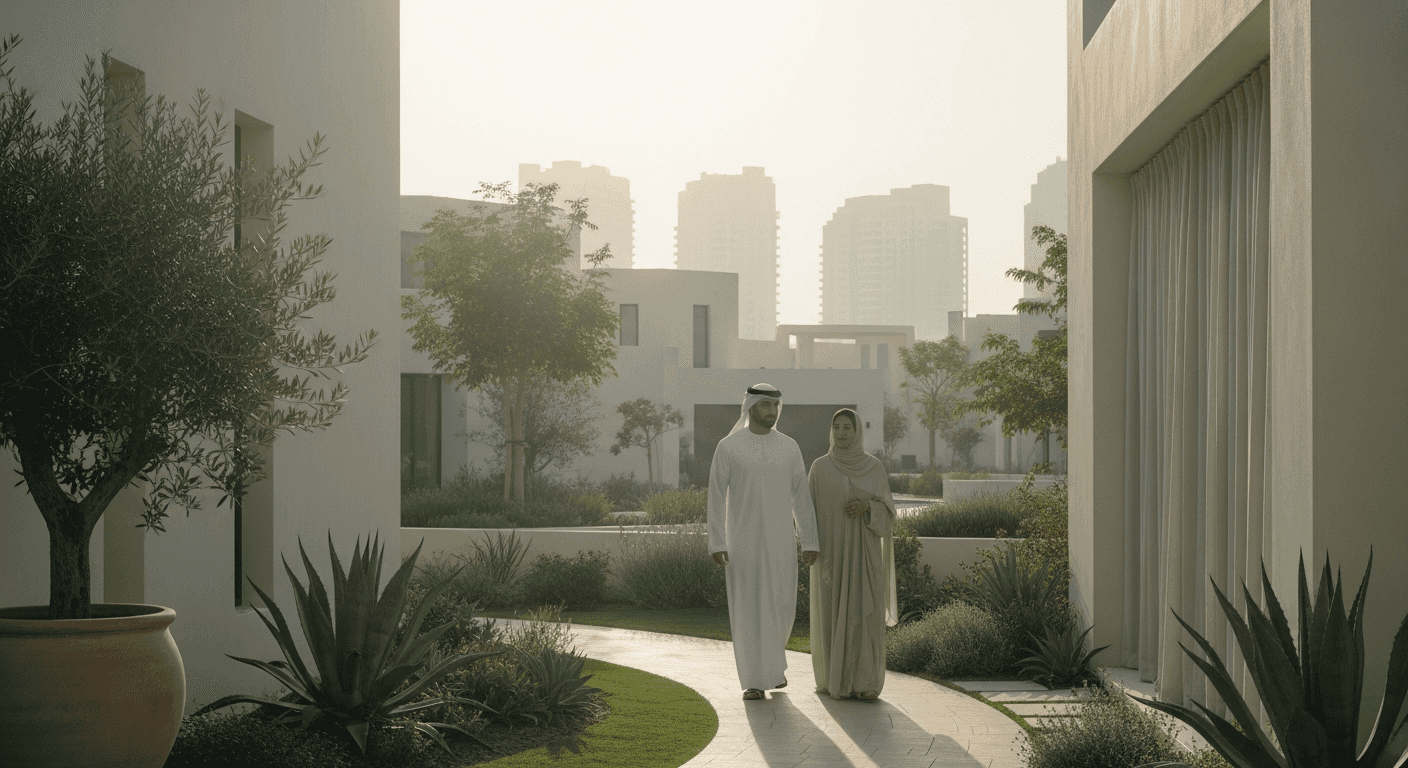
Dubai's Most Social Villa Communities
Looking for a villa community with more than just great homes? I explore the Dubai neighbourhoods that truly foster connection through vibrant social calendars and organised family events.

For many families I meet, the search for a home in Dubai begins with a list of practicalities: bedrooms, square footage, proximity to a school. But I’ve found the search that ends with true, long-term happiness is the one that looks past the front door and asks, “What is life like *beyond* the gates?” A beautiful villa is one thing; a community is something else entirely.
Here's what we'll explore in my guide to finding that sense of community:
- What truly makes a community 'social' beyond just amenities.
- The original blueprint: Arabian Ranches and its enduring appeal.
- The modern masterplan: Dubai Hills Estate's high-energy community life.
- The challengers: Communities like Damac Hills and Al Furjan that are building their own social identity.
- The crucial role of community management in creating a social calendar.
- A real-world cost breakdown for buying into a socially active community.
- My verdict on finding the right social fit for your family.
Introduction: Beyond the Landscaped Gardens
I was at a Spring Fair in one of Dubai’s well-known villa communities a few months ago. Children were having their faces painted, parents were browsing stalls run by their neighbours, and the air was filled with the smell of barbecue and the sound of a local band. It struck me then that this — this lively, interactive, slightly chaotic scene, is the real, often unspoken, goal for so many families moving to or within the city. It represents a stark contrast to the quiet, sometimes sterile, atmosphere of a 'dormitory' community, a place where garage doors open and close with little interaction in between.
The pandemic was a powerful catalyst in shifting priorities. At Gaia Living, we saw a marked change in client conversations. The focus expanded from the private realm of the home to the public realm of the neighbourhood. Questions about garden size were joined by questions about park life. Proximity to the office became balanced with the need for walkable cafes and friendly faces. The search was, and still is, for a `vibrant community living Dubai` experience. This isn't about nonstop parties; it's about the comfort of connection, the ease of a quick chat while walking the dog, and the shared joy of watching your children grow up alongside their friends from down the street.
This article is for those who believe, as I do, that the true value of a family home is measured not just in square feet, but in the richness of the life lived around it. It’s a deep dive into the `Dubai family events villa communities` that have successfully cultivated this elusive social magic. We'll examine the pioneers that wrote the playbook, the modern innovators rewriting it, and the practical steps you can take to find a neighbourhood that feels like home before you even unpack the boxes. Because, ultimately, a great community doesn't just give you an address; it gives you a sense of belonging.
The Original Blueprint: Why Arabian Ranches Still Sets the Bar
 Featured project
When you talk about purpose-built family communities in Dubai, the conversation almost always starts with Arabian Ranches. Developed by Emaar Properties in the early 2000s, it was a masterclass in creating not just houses, but a lifestyle. In my view, its enduring success provides the foundational text for what makes a suburban community thrive in this city. Ranches wasn't just a collection of villas; it was a holistic concept built around green spaces, shared amenities, and social hubs. It was designed, from its very first phase, to encourage residents to leave their homes and interact.
What does this look like in practice? It’s in the DNA of the place. The network of winding paths that are always busy with cyclists, joggers, and parents pushing strollers. It's the strategically placed sub-community pools and parks, which become mini-social centres for each cluster of homes. These aren't just amenities to be ticked off a list; they are the stages upon which daily `neighbourhood gatherings Dubai` take place. The Arabian Ranches Golf Club and the Ranches Restaurant are more than just facilities for members; they are central meeting points for the entire community, hosting Friday brunches and evening get-togethers that have been institutions for over a decade.
The `organised family activities` are legendary. Halloween in Arabian Ranches is an event of such scale that it draws visitors from across the city, with residents going to incredible lengths to decorate their homes. The community management team, Emaar Community Management (ECM), has honed a calendar of events that feels both professional and heartfelt. This includes everything from Festival of Lights celebrations to outdoor movie nights on the golf course lawn and weekly markets where local artisans and residents can sell their wares. It’s this consistent, reliable rhythm of social opportunities that helps new residents quickly integrate and feel part of the fabric of the community.
This social infrastructure has a tangible effect. I’ve spoken with countless families who moved to Ranches as newcomers to Dubai and, years later, count their neighbours among their closest friends. The community has a maturity and an established social network that is hard to replicate. While newer developments may offer shinier facilities, Ranches has an authenticity that comes from years of shared experiences. Here’s a snapshot of what a family there can expect from the social calendar:
- Seasonal Festivals: Major events for Halloween, Diwali, Christmas, and UAE National Day with decorations, food stalls, and entertainment.
- Outdoor Movie Nights: Regular 'Cinema under the Stars' events, typically on the lawns of the golf club or in larger community parks.
- Community Markets: Weekend markets featuring fresh produce, crafts from local artisans, and food trucks.
- Fitness and Wellness Events: Community fun runs, outdoor yoga sessions, and sports tournaments for children and adults.
- Sub-Community Gatherings: Smaller, more intimate barbecues, street parties, and playdates organised within specific enclaves like Saheel, Mirador, or Alvorada.
This is the blueprint that so many others have tried to follow. The combination of thoughtful master-planning, central social anchors, and a proactive management team creates a powerful formula for a thriving `community social life villas` environment. It remains, in my opinion, the benchmark against which all others are measured.
The modern masterplan: Dubai Hills Estate and Programmed Sociability
If Arabian Ranches is the venerable, established classic, then Dubai Hills Estate is its ambitious, modern successor. Also an Emaar Properties flagship, it feels like the developer took every lesson learned from Ranches and applied it on a grander, more integrated scale. From my first drive through the community years ago to my most recent visits, the energy has been palpable. It’s a place designed for a new generation of Dubai families, combining the tranquility of suburban living with an almost urban level of accessibility and activity.
The masterstroke of Dubai Hills, in my opinion, is the Dubai Hills Park. This vast, 180,000-square-metre green lung is the undeniable heart of the community. Unlike the more distributed, smaller parks of Ranches, this central hub acts as a massive social magnet. On any given weekend, it’s a vibrant mix of life: families picnicking, kids at the splash park or skate park, residents playing on the basketball and volleyball courts, and dozens of people simply walking the perimeter. This centralisation of activity creates a powerful sense of a shared public square. Emaar leverages this space brilliantly for large-scale `Dubai family events villa communities`, including massive National Day celebrations, farmers' markets, and wellness festivals that draw residents from every corner of the estate.
Beyond the park, the planning is incredibly smart. The integration of Dubai Hills Mall at the edge of the community provides a weather-proof social and commercial hub that Ranches, in its original form, lacked. The presence of top-tier schools within the gates, like GEMS International School, and a King's College Hospital clinic means that daily life — school runs, appointments, grocery shopping, all happens within the community bubble. These aren't just conveniences; they are crucial touchpoints that foster familiarity and connection among residents. You bump into the same parents at the school gate, the supermarket, and the park, which is how casual acquaintanceships organically deepen into friendships.
What’s also different here is the demographic breadth. While Ranches is predominantly villas, Dubai Hills offers a wide spectrum of properties, from apartments overlooking the park to sprawling mansions on the golf course. This creates a more diverse community in terms of age, nationality, and family size, which adds to the dynamic social fabric. The events calendar reflects this, with activities catering to young professionals and couples alongside the kid-centric programming. It's a highly 'programmed' sociability, managed with slick efficiency via the Emaar One app, where residents can book amenities, see event schedules, and receive community announcements. While some might miss the more 'organic' feel of an older community, for busy families, this level of organisation is a huge asset.
The Up-and-Comers: DAMAC Hills and Al Furjan's Community Spirit
While Emaar may have written the original playbook, other developers have created compelling alternatives, each with a distinct flavour of community life. Two that I often recommend to clients looking for that vibrant social element are Damac Hills and Damac Hills II and Al Furjan. They represent two different but equally valid approaches to fostering connection.
Damac has always been a developer that leans into bold, headline-grabbing amenities, and they've used this to great effect in Damac Hills. The Trump International Golf Club Dubai provides a traditional anchor, similar to the clubs in Ranches or Dubai Hills. But it's the more unique features that truly define its social character. Malibu Bay, the man-made wave pool, is a stroke of genius. It’s a destination within the community, a place where families spend entire afternoons, creating a relaxed, holiday-like atmosphere. Similarly, the stables and the petting zoo are not just novelties; they are focal points for `organised family activities` and weekend routines. DAMAC leverages these high-concept spaces to host events, from food truck festivals around the park to movie nights with the golf course as a backdrop. The community life here feels energetic, youthful, and amenity-driven. It's a place where the social calendar is built around 'doing things' and using the impressive facilities on offer.
In contrast, the community spirit in Al Furjan, a Nakheel development, feels more grounded and organic. It lacks a single, grand centerpiece like a golf course or a wave pool. Instead, its strength lies in its thoughtful, human-scale design. The masterplan is cleverly bisected by metro access and features two community pavilions — Al Furjan Pavilion and Al Furjan West Pavilion. These aren't mega-malls; they are true community centres with a Spinneys, a gym, a pool, cafes, and restaurants. They are the hubs for daily errands and casual meetups. The extensive network of landscaped walkways and dedicated cycle paths physically knits the community together, encouraging residents to get out and explore on foot or by bike. You see more impromptu `neighbourhood gatherings Dubai` here, kids playing football in the shared green spaces between villas, neighbours chatting over their garden walls.
What I appreciate about Al Furjan is its unpretentious, neighbourly feel. The social life is less about large, developer-led extravaganzas and more about the connections forged in the shared spaces. The presence of The Arbor School, with its focus on environmentalism, also attracts a like-minded community of families. While it may not have the 'wow factor' of Damac Hills, for many of our clients, the quiet, connected, and convenient lifestyle that Al Furjan offers is precisely what they're looking for. It proves that a vibrant community isn't always about the biggest events, but about creating the right environment for small, everyday connections to flourish.
The Unseen Engine: Community Management's Crucial Role
The vibrant posters advertising a community fun run, the perfectly manicured lawn for an outdoor movie night, the timely clean-up after a thousand-strong Halloween party — these things don't just happen by magic. Behind every successful social community is a diligent, proactive, and well-funded community management team. This is the unseen engine that drives the social calendar, and its quality can make or break the resident experience. For buyers, understanding the role of community management is just as important as inspecting the quality of the villa itself.
In Dubai, these services are handled by companies, often subsidiaries of the master developer, like Emaar Community Management (ECM) or Nakheel Community Management. Their responsibilities are vast, covering everything from security and landscaping to waste management and, crucially, resident engagement. The annual service charges that homeowners pay are what fund these operations. When you see a charge of, say, AED 3.50 per square foot on your 4,000 sq. Ft. villa, that's AED 14,000 per year. A significant portion of that budget is — or should be, earmarked for maintaining and activating the communal spaces that foster social life.
“The best communities don't just happen; they are actively managed, funded by residents, and sustained by a shared desire for connection.”
A great community management team is proactive, not just reactive. They don't just fix broken lights; they actively seek to enhance community life. They run surveys to ask residents what events they want. They have dedicated community managers and event planners on staff. They communicate effectively through newsletters, portals, and dedicated apps (the Emaar One app is a prime example), keeping everyone informed about upcoming activities. They also play a vital role as facilitators, empowering residents who want to organise their own street parties or book a park for a child's birthday. The best ones create a framework of support, making it easy for residents to take initiative, which is often where the most authentic community bonding happens.
Conversely, a weak or underfunded management team can quickly lead to a decline in a community's social vibrancy. Common areas become poorly maintained, events become rare or poorly attended, and a sense of apathy can set in. When we at Gaia Living help clients evaluate a property, we always advise them to look into the community management. Ask to see the latest service charge breakdown. Is there a line item for 'community events'? Visit the management office. Check the community notice boards. A community with empty notice boards is often a community with an empty social calendar.
The Cost of Community: A Real-World Financial Breakdown
This vibrant, socially connected lifestyle is incredibly appealing, but it’s essential to approach it with a clear understanding of the financial commitments. The sticker price of the villa is only the beginning. The real cost includes a series of upfront fees and ongoing charges that are crucial for budgeting accurately. Let's walk through a realistic, line-by-line breakdown for purchasing a home in one of these premier communities.
For this example, let's assume you're an expatriate resident buying a four-bedroom villa in a community like Dubai Hills Estate with a purchase price of AED 6,500,000 and you're taking out a mortgage.
First, the upfront costs. These are the one-time payments you'll need to make at the time of the transaction. According to regulations from the Dubai Land Department (DLD), the fees are quite standardized, which brings a welcome level of transparency to the process.
Example Upfront Costs for an AED 6,500,000 Villa:
- Down Payment (for mortgage): As per Central Bank of the UAE rules, as a non-UAE national buying a property over AED 5 million, you need a minimum of 35% down for a second property or 20% for a first. Assuming it's your first, the minimum is 20%.
- `20% of AED 6,500,000 = AED 1,300,000`
- Dubai Land Department (DLD) Transfer Fee: This is the largest single fee, set at 4% of the property's purchase price.
- `4% of AED 6,500,000 = AED 260,000`
- DLD Registration Fees: Fixed fees for issuing the new title deed.
- `Approx. AED 4,200`
- Real Estate Agency Fee: This is typically 2% of the purchase price, plus 5% Value Added Tax (VAT) on the fee itself.
- `2% of AED 6,500,000 = AED 130,000`
- `5% VAT on fee = AED 6,500`
- `Total Agency Fee = AED 136,500`
- Mortgage Registration Fee: The DLD charges a fee to register the mortgage against the property's title deed. This is 0.25% of the total loan amount. The loan amount here is AED 5,200,000 (80% of price).
- `0.25% of AED 5,200,000 = AED 13,000`
- Bank & Valuation Fees: Your mortgage provider will charge processing and/or arrangement fees, plus a fee for an independent valuation of the property.
- `Approx. AED 5,000 - AED 8,000`
- NOC Fee: The developer requires a No Objection Certificate (NOC) to transfer ownership. This fee varies.
- `Approx. AED 1,000 - AED 5,000 (we'll use AED 5,000 for this estimate)`
- Trustee Office Fee: The fee for the registration trustee who facilitates the transfer at the DLD.
- `Approx. AED 4,200`
Adding these up, the total cash you need ready, *in addition to your down payment*, is approximately AED 427,900. Your total initial cash outlay would be this amount plus the down payment, totaling roughly AED 1,727,900. This is a critical calculation for any serious buyer.
Beyond these initial costs are the ongoing ones. The most important is the annual service charge, which, as we've discussed, funds the maintenance and `organised family activities`. For a villa community, this can range from AED 3 to AED 6 per square foot of the property's built-up area. For a 4,000 sq. Ft. villa at AED 4/sq. Ft., that’s AED 16,000 per year. This fee is the lifeblood of the community's vibrancy. It's not just a cost; it's your investment in the lifestyle you're buying into.
How to Spot a Socially Vibrant Community: A Buyer's Checklist
So, you’ve shortlisted a few communities, and you're ready to see them in person. How can you look beyond the polished marketing brochures and get a real feel for the `community social life villas` experience? As a communities correspondent, this is my favourite part of the job — playing detective to uncover the true personality of a neighbourhood. Over the years, I've developed a checklist of things to do and look for that provides a much clearer picture than a brief, daytime viewing ever could.
It’s about observing the unscripted moments. A formal tour will always show you the pristine, empty tennis courts. I want to know if those courts are booked solid every evening. The sales pitch will mention the community pool; I want to see if it’s a social hub on a Friday afternoon or a ghost town. This requires a bit more effort, but the insight you gain is invaluable when making a decision that will shape your family's life for years to come.
Here is the checklist I share with my clients at Gaia Living. I encourage you to use it on your own house-hunting journeys:
- Do the 'Weekend Evening' Test: This is my number one rule. Visit your target community between 5 pm and 7 pm on a Friday or Saturday. Park your car and walk around. Are people out? Are the parks being used? Are you hearing the sounds of children playing and neighbours chatting? This is the single most effective way to gauge the ambient social energy of a place.
- Become a Digital Eavesdropper: Before you even visit, search on social media for the community's unofficial residents' groups. These forums are a treasure trove of unfiltered information. You'll see residents organising playdates, asking for recommendations, and yes, complaining about issues. It's the most authentic insight you can get into the day-to-day reality of living there.
- Check the Notice Boards: Go to the community centre, the gym, or the lobby of the local supermarket. Look at the physical and digital notice boards. Are they covered in flyers for yoga classes, kids' soccer leagues, and upcoming events? Or are they empty and dusty? A busy notice board is a sign of a busy, engaged community.
- Talk to a Local: If you see a resident walking their dog or watching their kids in the park, be brave and strike up a conversation. Ask them directly: "We're thinking of moving here. What do you love about the community life? What are the events like?" In my experience, people are incredibly happy to share their honest opinions.
- Scrutinise the Service Charges: Ask your agent for the detailed service charge breakdown for the property. Look for a specific line item for community events. A management company that budgets for social activities is one that values them.
- Assess the 'Third Spaces': Look for the places between home and work where community life happens. Is there a local coffee shop with outdoor seating? Is it busy? Are the park benches positioned to encourage conversation? The design of these 'third spaces' has a huge impact on a community's sociability.
Following these steps will give you a multi-dimensional view of the community, allowing you to make a decision based not just on the house, but on the home and lifestyle it offers.
My Verdict: Finding Your Family's Perfect Social Scene
After years of walking the landscaped paths and attending the community fairs of Dubai's best-loved neighbourhoods, my core belief remains unchanged: the right community can be as important as the right house. The search for `vibrant community living Dubai` is a search for a support network, a social life, and a place for your children to build their first friendships. But as we've seen, 'vibrant' can mean different things to different people.
There is no single 'best' social community, only the one that is the best fit for your family's personality and lifestyle. For the family that loves the gravitas of an established community and the comforting rhythm of long-standing traditions, the mature, leafy streets of Arabian Ranches will always feel like home. For the energetic family that thrives on large-scale events, modern amenities, and the buzz of a crowd, the high-octane environment of Dubai Hills Estate is a perfect match. And for those seeking something different, the amenity-rich world of Damac Hills or the grounded, neighbourly feel of Al Furjan offer compelling and distinct social ecosystems.
My advice is to be honest about what you truly want. Do you want events to be organised for you, or do you prefer a blank canvas to create your own social gatherings? Do you value a central, high-energy hub, or do you prefer smaller, more intimate sub-community spaces? Answering these questions honestly will guide you more effectively than any sales brochure. Use the tools I've shared — the financial breakdown to ensure you're prepared, and the buyer's checklist to assess the reality on the ground. At Gaia Living, we believe our role is not just to transact property but to help families find their place in the story of Dubai. That place is about more than bricks and mortar; it’s about connection, belonging, and the simple joy of knowing your neighbours.
The most vibrant Dubai villa communities blend top-down event programming from proactive management with the organic, ground-up social life that flourishes in well-designed parks, pools, and local hubs. Scrutinize both before you buy, because you are choosing not just a home, but a lifestyle.
Sources
- Dubai Land Department (DLD): https://dubailand.gov.ae/
- Central Bank of the UAE: https://www.centralbank.ae/
- The official UAE Government portal: https://u.ae/
Questions, answered
- Which Dubai villa community is best for family events?
- Communities like Arabian Ranches and Dubai Hills Estate, both by Emaar, are renowned for their extensive, well-organised family events, including seasonal festivals, outdoor cinemas, and markets. The choice depends on whether you prefer the established feel of Ranches or the modern energy of Dubai Hills.
- How are community events in Dubai funded?
- Community events are primarily funded through the annual service charges paid by property owners. A portion of these fees, which typically range from AED 3 to AED 6 per square foot for villas, is allocated by the community management company to a budget for events and activities.
- Are there social communities beyond those made by Emaar?
- Yes. Nakheel's Al Furjan is known for its tight-knit, neighbourly feel fostered by local pavilions and parks. DAMAC Hills uses its high-concept amenities like the wave pool and stables to host unique social gatherings and events.
- What should I look for to gauge a community's social life before buying?
- Visit on a weekend evening to see if people are outdoors, check community notice boards or apps for event schedules, and talk to residents. Also, review the service charge statement to see if funds are allocated for community activities, which is a strong indicator of a planned social calendar.
- What are the main upfront costs of buying a villa in Dubai?
- Besides the property price, you must budget for a 4% Dubai Land Department (DLD) transfer fee, a 2% real estate agency fee (+VAT), and various registration and NOC fees. For a mortgaged property, a down payment of at least 20% of the purchase price is also required by the UAE Central Bank.
- What is the difference in social life between Arabian Ranches and Dubai Hills Estate?
- Arabian Ranches offers a classic, established community feel with events centered around sub-community parks and the golf club. Dubai Hills Estate has a more modern, high-energy vibe with large-scale events focused on its central park and mall, attracting a diverse demographic.

Sophia profiles Dubai's villa communities — schools, commute times, green space, and the intangible feel of a neighbourhood. She writes for families putting down roots.
Related stories
Calculating ROI on Dubai Rental Upgrades
As a landlord in Dubai, you can't just follow trends. I'll show you how to calculate the precise ROI of minor property upgrades to genuinely increase your rental yield.
Off-Plan vs Ready: The Real Cost of Capital
I analyse the fundamental trade-off every Dubai investor faces: the lure of off-plan capital growth versus the security of immediate rental income from a ready property.
Beyond the Gates: Dubai's Boutique Villa Sanctuaries
I'm exploring the small, exclusive villa communities that offer a real sense of place, moving beyond the well-trodden path of Dubai's famous megaprojects to find homes with genuine character.
Echoes, in your inbox
One thoughtful email a month. Market insight, new launches, no spam.