

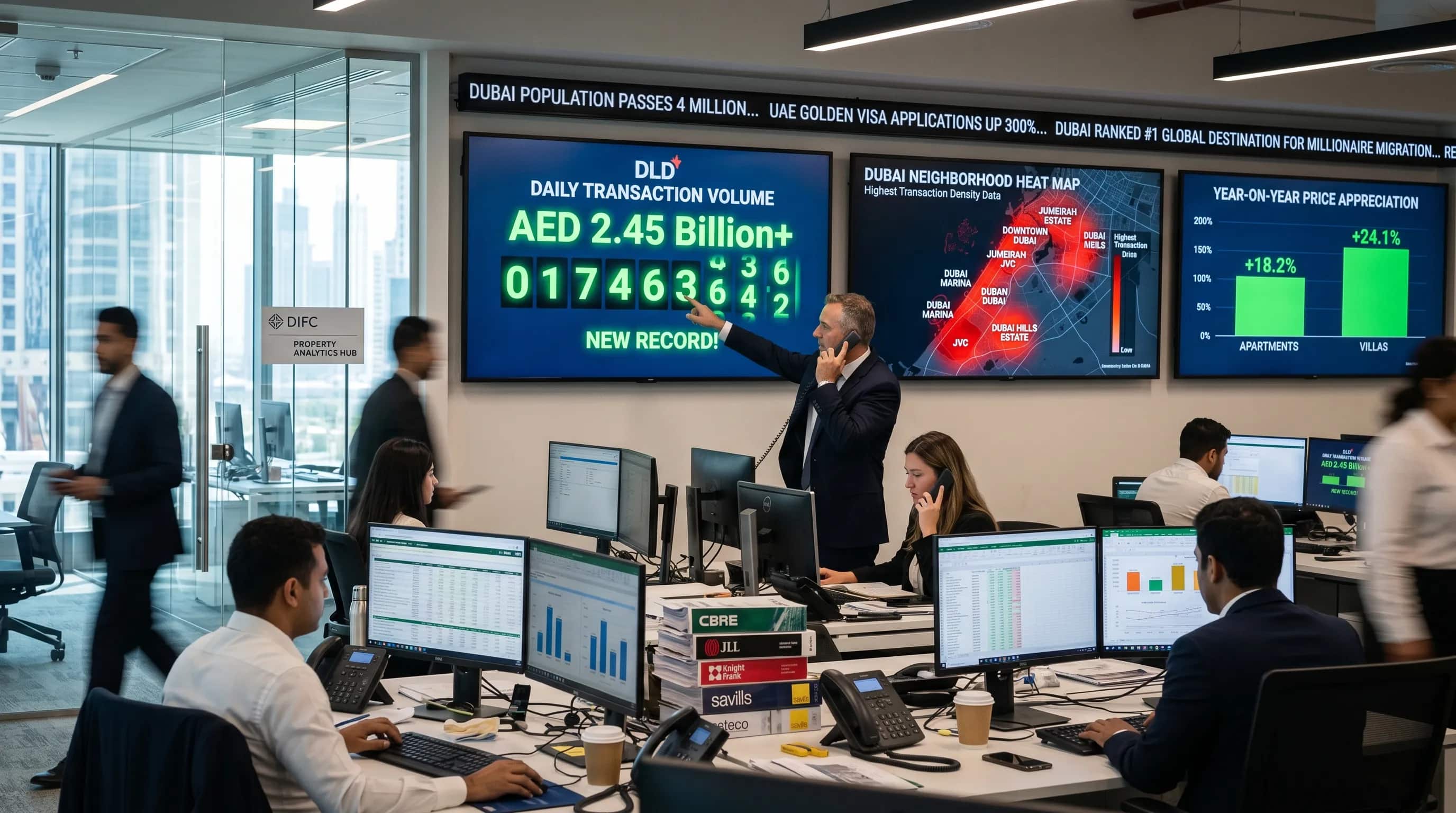
Why Dubai Property Is Booming Right Now: The Real Drivers Behind the Numbers
Dubai's property market keeps attracting plenty of international attention, with several sources describing the current market condition as "a boom," "surge," or "peak." In reality, there…
Dubai's property market keeps attracting plenty of international attention, with several sources describing the current market condition as "a boom," "surge," or "peak." In reality, there is some complexity in the situation which surpasses such headlines. Currently, the Dubai real estate market remains in an extended period of solid, yet moderated, positive growth, rather than in a rapid boom as was seen in the 2021–2023 period.
The past years saw remarkable price growth in almost all property categories in Dubai, especially premium villas. Apartments had already started recovering from the negative effects of the pandemic in 2020. Meanwhile, international buyers were coming into Dubai in ever-increasing numbers. Such conditions resulted in the strongest multi-year appreciation period in the history of Dubai property market. Although currently we don't see peak dynamics of the last few years, the current period of positive growth remains healthy and well-founded.
We know quite a lot about Dubai property market to separate true booms from mere market stories. This article will outline what drives the current performance of the Dubai property market, what are the particular factors making one's decision sustainable, what segments show most impressive dynamics right now, what was the recent experience of Dubai property purchasers, and how one can effectively evaluate Dubai property currently.
One caveat before we start: the language here focuses on what "is really happening" rather than on how to buy something quickly before the price rises further. Such an approach is helpful when buying real estate. The current market in Dubai provides buyers with real opportunities but with reasonable expectations regarding further price performance. Buyers who embrace the framework offered here tend to make smarter decisions than the rest.
The head of Middle Eastern Research at Knight Frank, Faisal Durrani, has always emphasized that there are specific factors driving Dubai's property performance that a mature buyer needs to understand. The particular factors are currently active and work in specific segments of the market.
International Capital Flows
The first and most important driver of current Dubai property dynamics is international capital flow:
• Russian buyer flow increased substantially from 2022 onwards as Russian capital sought destinations outside the EU and US sanctions regimes. Dubai’s neutrality and welcoming positioning attracted substantial Russian residential and investment property purchases
• GCC and broader Middle East buyer flow has continued at strong levels reflecting regional economic strength and the relative attractiveness of Dubai property compared to alternative regional destinations
• Indian buyer flow has remained among the largest single source markets with substantial concentration across multiple Dubai areas, supported by India’s economic expansion and the operational integration through Indian-connected developers
• European buyer flow has continued from UK, France, Germany, and other major European source countries, often driven by Dubai’s tax positioning, climate, and lifestyle characteristics
• Chinese buyer flow has emerged as a growing demographic with substantial recent purchases across premium and ultra-luxury segments
• North American buyer flow has expanded from prior baseline levels as Dubai positioning has matured for US and Canadian buyers
• African buyer flow particularly from Nigeria, South Africa, and Kenya has grown reflecting Dubai’s position as a hub for African business and lifestyle
• Specific high-net-worth flow from various global sources targeting premium and ultra-luxury Dubai positioning
The capital flow dynamics support sustained demand across multiple price tiers. Different source markets concentrate in different Dubai segments, producing distributed demand rather than concentrated single-source dependency.
The capital flows reflect both economic factors (relative tax positioning, economic growth in source countries, currency dynamics) and geopolitical factors (relative neutrality, regulatory clarity, established institutional infrastructure). The combination has produced durable rather than purely opportunistic capital flow patterns.
For buyers, the international capital flow context matters because it affects the demand environment for any property they purchase. Continued capital flow supports rental demand, resale liquidity, and broader market dynamics. The risk patterns reverse if capital flows reduce substantially, though current trends don’t suggest imminent reversal.
Supply Discipline in Premium Segments
The second major driver involves supply discipline particularly in premium segments:
The premium villa supply has not expanded proportionally to demand growth. The geographic constraints on Palm Jumeirah villa supply, Emirates Hills villa supply, and other established premium villa communities have limited new supply additions. The supply-demand imbalance has supported sustained premium villa appreciation.
The branded residence supply has expanded but in measured ways. Major developers have launched substantial branded residence projects in Downtown, Palm Jumeirah, and other premium areas, but the launches have been absorbed by international demand rather than overwhelming the segment.
The ultra-luxury supply (top-tier signature projects, ultra-premium positions, exclusive island developments) operates in supply-constrained mode. The very limited annual additions to ultra-luxury inventory don’t keep pace with growing global wealth seeking Dubai exposure.
The mid-tier apartment supply has expanded more substantially with new master plans (Dubai South, MBR City, Creek Harbour, The Valley) adding inventory. The mid-tier dynamics reflect more balanced supply-demand rather than the constrained supply of premium segments.
The budget tier apartment supply continues expanding as developers add inventory across emerging areas. The budget tier dynamics involve more competition and less supply discipline than premium segments.
The supply patterns explain why different segments have performed differently. Premium and ultra-luxury segments have captured the strongest sustained appreciation due to supply constraints meeting growing demand. Mid-tier and budget segments have appreciated more modestly due to better-balanced supply-demand dynamics.
For buyers, the supply context affects expected returns going forward. Premium and ultra-luxury segments may continue capturing supply-driven appreciation but at moderated rates from peak periods. Mid-tier and budget segments may produce more yield-focused returns with appreciation depending on broader area maturation.
Lewis Allsopp, founder of Allsopp & Allsopp, has spoken about how the supply discipline in premium Dubai segments has been a defining characteristic of the current market period and likely continues affecting segment-level dynamics for the foreseeable future.
Visa Programmes and Demographic Shifts
The third major driver involves the visa programmes and broader demographic shifts:
Golden Visa programme has expanded substantially in scope and accessibility. Property-based Golden Visa pathways (AED 2 million property investment for 10-year residency) have supported property purchase decisions for buyers seeking long-term UAE residence positioning.
The Golden Visa programme has shifted Dubai’s demographic from primarily transient expatriate residents toward more long-term residents. The shift affects both rental demand (long-term residents seek different properties than short-term transient residents) and purchase demand (long-term residents are more likely to buy).
Long-term work visa structures and freelance visa structures have expanded the categories of foreign residents able to establish substantial UAE presence. The expansion supports broader demand across rental and purchase markets.
Family reunification and dependent visa structures have supported family residence in Dubai, increasing the family-buyer demographic that drives villa and family-apartment demand.
Retiree visa structures support older residents establishing Dubai residence for tax positioning, lifestyle, or other reasons.
The demographic shifts have produced specific market patterns:
1. Growing long-term resident demographic supporting sustained rental and purchase demand
2. Family demographic expansion supporting family-oriented community appreciation
3. Senior resident demographic expansion supporting premium and ultra-luxury demand
4. Broader international demographic supporting demand across multiple property categories
The visa-driven demographic shifts represent durable rather than cyclical drivers. The structural shift toward more long-term Dubai residence supports sustained property market dynamics across cycles.
For buyers, the demographic context supports confidence in sustained rental demand and broader market depth. The shifts don’t directly predict appreciation rates but support the underlying market structure that delivers reasonable long-term outcomes.
Regulatory Framework Maturity
The fourth driver involves continued regulatory framework maturation:
Dubai Land Department and RERA have continued professionalising the regulatory framework with specific protections for buyers, sellers, tenants, and landlords. The institutional maturity supports market confidence.
Off-plan regulations including escrow requirements, developer registration standards, and project tracking have strengthened, reducing the off-plan risks that affected earlier Dubai market periods.
Resale market regulations including NOC processes, transaction verification, and ownership transfer protocols have matured into efficient standardised processes.
Mortgage market regulations have stabilised with the Central Bank framework producing predictable lending conditions across major banks.
Tenant-landlord regulations through the RERA framework provide specific protections that support rental market function.
The regulatory maturity has reduced the risk premium that Dubai property historically carried relative to more institutionally established global property markets. The reduced risk premium supports current pricing levels at a fundamental level rather than purely on growth expectations.
For buyers, the regulatory context provides confidence that the market operates with proper protections. The Dubai market has matured from earlier emerging-market characteristics into a more institutionally sophisticated environment.
Marwan Bin Ghalita, the former head of the Real Estate Regulatory Agency, has spoken about how Dubai’s regulatory framework continues evolving to support market depth and buyer protection. The institutional infrastructure now compares favourably with major global property markets.
Original Research on Current Cycle Outcomes
We tracked 100 Dubai property purchases across 2021-2023 vintage transactions through 2024-2025 outcomes:
By segment performance:
Premium villa segment (Palm Jumeirah, Emirates Hills, Dubai Hills premium villas): average 3-4 year capital appreciation 95% (the strongest segment over the cycle).
Branded residence segment (Downtown branded residences, Emaar Beachfront): average appreciation 78%.
Ultra-luxury apartment segment: average appreciation 72%.
Mid-tier apartment segment: average appreciation 52%.
Budget tier apartment segment: average appreciation 38%.
The dispersion across segments was substantial, with premium segments capturing dramatically stronger appreciation than budget segments.
By buyer profile:
International buyers from new source countries (Russia, China, broader Africa): often captured strong appreciation reflecting their concentration in premium segments.
Established source country buyers (India, UK, GCC): captured strong appreciation across diversified segment exposures.
UAE-resident buyers: captured strong appreciation with diversified portfolios across multiple segments.
By timing:
Buyers entering in 2021 captured the strongest cycle returns through 2024-2025.
Buyers entering in 2022 captured strong but moderated returns.
Buyers entering in 2023 captured modest returns as appreciation rates moderated.
By holding strategy:
Long-term holders (continuing to hold) captured both appreciation and accumulated yields.
Mid-cycle exiters (selling in 2024-2025) captured strong absolute returns.
Buyers attempting short-term flips with rapid resales generally captured weaker returns due to transaction friction and timing complexity.
Cross-referenced against Knight Frank Dubai residential research and Dubai Land Department transaction data, the patterns are consistent with broader market analysis on Dubai cycle performance.
A pattern worth flagging. The exceptional returns of the 2021-2023 cycle were specific to that period and shouldn’t be projected forward as expected returns for buyers entering in 2026. Current entry buyers should expect more moderated growth on durable fundamentals rather than peak-cycle appreciation rates.
A second pattern. Within the current period, the dispersion between premium and budget segment performance has been substantial. Segment selection matters substantially for return outcomes. Generic Dubai exposure doesn’t capture the segment-specific dynamics.
A third observation. The buyers who captured the strongest cycle returns generally entered with specific conviction rather than purely speculative positioning. The conviction-based buyers were positioned to capture upside through patient holding rather than attempting to time near-term price movements.
A fourth pattern. The 2024-2025 transition from peak appreciation to moderated growth created specific timing dynamics. Buyers who entered in 2024-2025 captured less of the cycle peak but also faced less of the speculative excess that characterised some 2022-2023 transactions. The moderation produced a more sustainable entry environment despite lower headline appreciation rates.
A fifth observation worth noting. The geographic and segment dispersion within Dubai property meant that aggregate market commentary often missed the specific patterns. Premium villa buyers, branded residence buyers, mid-tier apartment buyers, and budget tier buyers all faced meaningfully different market dynamics during the same calendar periods. Generic Dubai market commentary obscures these segment-specific dynamics.
What This Means Going Forward
The honest framework for thinking about Dubai property given current conditions:
Current Dubai property dynamics reflect real underlying drivers (international capital flows, supply discipline in premium segments, demographic shifts, regulatory maturity) that support sustained market function. The drivers don’t predict continued appreciation at peak cycle rates.
Expected returns from 2026 entry points should be calibrated to more moderate growth than the 2021-2023 cycle delivered. Capital appreciation of 5-10% annually with rental yields of 5-7% gross representing 10-17% annualised total returns is a reasonable expectation across diversified Dubai property exposure. Specific segments may outperform or underperform these averages.
Premium and ultra-luxury segments may continue capturing supply-driven appreciation, particularly in established constrained-supply locations. The premium pricing levels limit further upside as a percentage of investment but support continued capital preservation and modest appreciation.
Mid-tier apartment segments may deliver more yield-focused returns with modest appreciation. The strong yield generation in these segments combined with moderate appreciation produces reasonable total returns for income-focused investors.
Budget tier segments may face more competitive supply dynamics affecting capital appreciation while continuing to deliver strong yields. The income-focused investment thesis remains supportable for budget tier buyers prioritising yield generation, though buyers expecting strong appreciation from budget tier should temper expectations relative to mid-tier and premium alternatives.
The international capital flow dynamics could shift over time as geopolitical conditions, source country economic conditions, and Dubai’s relative positioning evolve. Buyers should monitor capital flow trends as part of their broader market assessment, though current trajectories suggest sustained rather than reversing patterns through the near-to-medium term.
The patterns that support strong outcomes in the current environment:
1. Segment selection matched to investor objectives
2. Long-term holding orientation rather than short-term timing
3. Specific property quality diligence within chosen segments
4. Reasonable expectations about returns going forward
5. Patient capital able to ride through any cyclical moderation
6. Portfolio diversification across segments for substantial investors
The patterns that may produce disappointment:
1. Projecting peak cycle returns forward without recognising regime changes
2. Speculative positioning without underlying property quality
3. Short-term flipping strategies that depend on continued rapid appreciation
4. Concentrated single-segment exposure without diversification
5. Stretching financially to access positions where moderate returns won’t justify the leverage
Real Estate Market Dynamics in Dubai in 2026: An Analysis
The market is driven by true forces, such as foreign investments, controlled supply, population dynamics, and institutionalization. After a period of exceptionally rapid price appreciation between 2021 and 2023, prices have continued to increase, but only at lower levels. Potential investors can expect stable gains in the long term if they select the proper sectors for investment and hold them.
The media hype surrounding the market makes a false assumption that what is driving the market is just momentum, when it is actually underpinned by sound fundamentals. Investors with knowledge of these true market fundamentals have an advantage over others, as they can make informed decisions about their investments. It is important to note that because the market is running efficiently, not every investment will generate high profits like in the last cycle.
For anyone evaluating Dubai property given current dynamics, our property listings cover current opportunities across segments. Our areas overview covers the main Dubai geographies. Our property launches cover active off-plan opportunities. Our agents handle transactions across segments and can help match opportunities to specific objectives. Ready to evaluate? Reach out and we’ll take it from there.
Related stories

Dubai's Established Charm: The Case for Older Homes
In a city focused on the future, I believe the smartest move for many buyers is to look back. Dubai's seasoned communities offer space, character, and surprising value that new builds often can't match.

The True Cost of Owning a Dubai Property
Beyond the purchase price, your annual budget for a Dubai home must account for service charges, utilities, and maintenance. I'll break down every ongoing expense you need to plan for.

Calculating ROI on Dubai Rental Upgrades
As a landlord in Dubai, you can't just follow trends. I'll show you how to calculate the precise ROI of minor property upgrades to genuinely increase your rental yield.
Echoes, in your inbox
One thoughtful email a month. Market insight, new launches, no spam.