

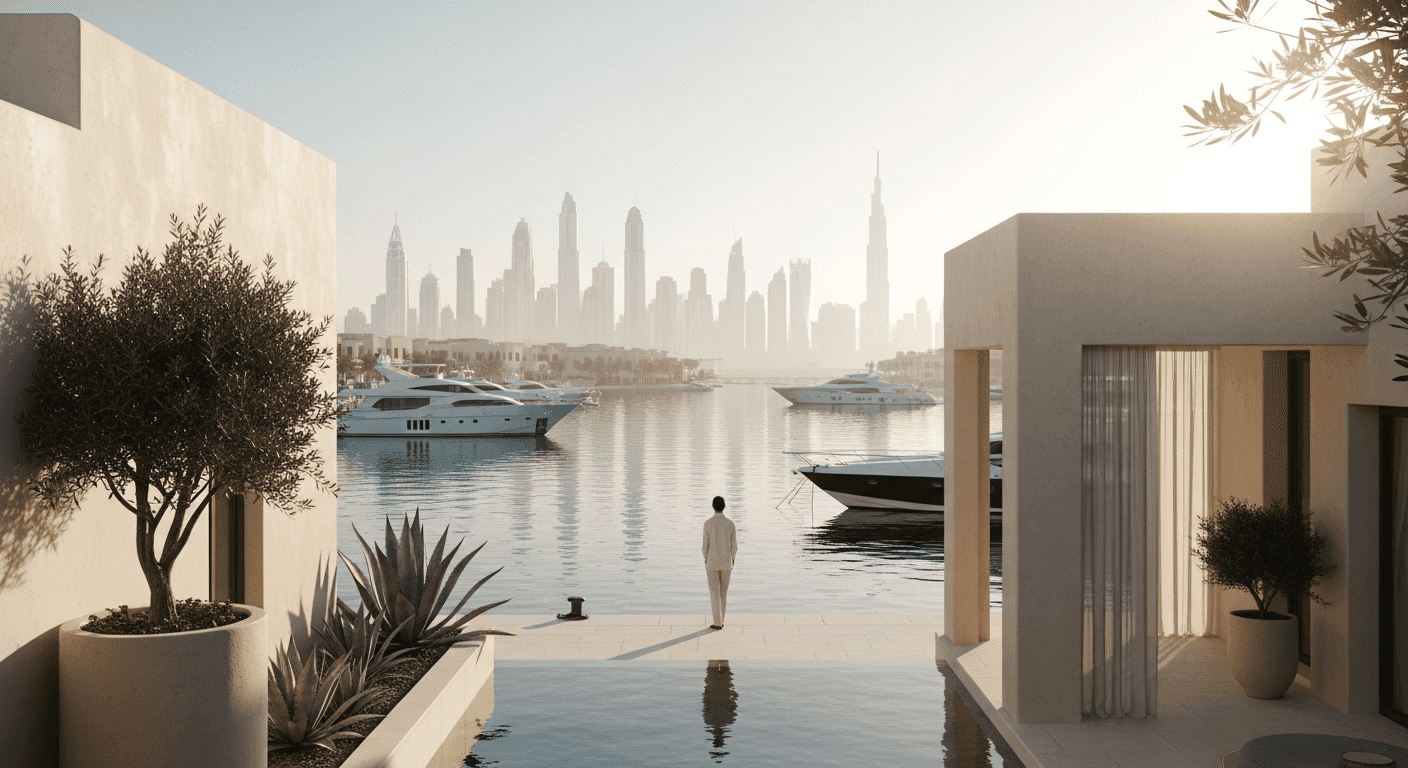
Dubai Property Market 2026: My Forecast & Analysis
My analysis suggests the Dubai property market in 2026 will transition from broad-based growth to a more discerning, mature phase. I believe success for investors will hinge on a granular understanding of micro-markets and the structural forces reshaping demand.

As the Head of Market Research at Gaia Living, the question I am asked more than any other is: what’s next for the Dubai property market? After a period of unprecedented growth, it’s only natural for investors and end-users to be contemplating the future. My analysis suggests the market in 2026 will be defined by a fundamental shift in character — a transition from broad-based, rapid momentum to a more discerning, mature, and bifurcated phase. Success will no longer be about riding a rising tide; it will be about surgical precision, granular knowledge, and a deep understanding of the structural economic and demographic forces now reshaping our city.
Here’s the framework for my Dubai property market forecast for 2026:
- My central thesis for the 2026 market: Maturity over momentum.
- The macroeconomic drivers: Beyond the Golden Visa.
- Supply and demand dynamics: Where new inventory will have the greatest impact.
- Price & Rental Yield Predictions Dubai 2026: A tale of two markets.
- Prime Dubai Communities Property Trends: The enduring power of master planning.
- Best Dubai Areas to Buy Property 2026: My picks for end-users and investors.
- A worked example: The true, all-in cost of buying a Dubai property.
- Navigating the risks: A candid look at the challenges ahead.
The Thesis: Maturity Replaces Momentum
My core argument for the state of the market in 2026 is that the post-pandemic boom, characterized by rapid, double-digit price and rent increases across almost all segments, is concluding. It is being replaced by a phase of market maturity. This is not a prediction of a downturn, but rather an evolution into a more stable, predictable, and fundamentally-driven ecosystem. In my view, this is an unequivocally positive development for the long-term health of Dubai real estate. Market maturity means that price movements become less volatile and are more closely tied to tangible economic indicators like GDP growth, job creation, and population expansion, rather than the speculative fervour or sentiment-driven waves that defined previous cycles.
What does this maturity look like in practice? First, it involves a significant divergence in performance between different asset classes and locations. The era of buying any property and expecting a 20% annual appreciation is firmly behind us. In its place, a 'flight to quality' will become the dominant theme. We will see prime, well-managed, and community-focused developments in scarce locations hold their value and appreciate modestly, while secondary or tertiary assets in areas with significant new supply pipelines may face price stagnation or even minor corrections. This bifurcation is a hallmark of a developed property market, where buyers and tenants become more discerning about what they are willing to pay a premium for.
This cycle is fundamentally different from the one that peaked in 2014. The previous boom was heavily fueled by short-term speculative capital and high levels of investor leverage. The current market, by contrast, is anchored by a substantive demographic shift. Proactive government policies, a soaring reputation for safety and quality of life, and new residency schemes have attracted a massive influx of end-users: families, entrepreneurs, and high-net-worth individuals who are moving to Dubai to live and work, not just to park capital. This creates a much stickier, more resilient base of demand. The regulatory environment, overseen by institutions like the Dubai Land Department (DLD) and the Central Bank of the UAE, is also far more robust, with measures like mortgage loan-to-value caps preventing the kind of excessive leverage that can destabilize a market. In 2026, the market's performance will be a story of micro-economics, not just macro-tides.
Macroeconomic Tailwinds: The New Economic Blueprint
The enduring strength I foresee for the Dubai property market is not an accident; it's the direct result of a meticulously planned national economic strategy. While many commentators focus on the success of the Golden Visa programme, that is merely one tool in a much larger toolbox. The real driver for long-term, sustainable demand is the ambitious Dubai Economic Agenda, known as 'D33'. This is not just a slogan; it's a comprehensive roadmap with the stated goal of doubling the size of Dubai's economy by 2033 and establishing it as one of the top three global cities. This agenda is the bedrock of my positive long-term Dubai real estate investment outlook for 2026.
This plan is already creating substantive, high-income employment that directly fuels housing demand. The focus is on future-facing industries like artificial intelligence, Web3, FinTech, and advanced manufacturing. We're seeing major global tech firms and AI companies establishing significant operational headquarters here, not just sales offices. These are not transient jobs; they are roles that attract skilled professionals and their families who require long-term housing solutions, from apartments in vibrant urban centres to villas in family-oriented communities. The establishment of a federal corporate tax regime has further cemented this trend. Far from deterring business, it has signaled the UAE's transition into a mature global economic hub, compelling companies to build genuine substance and headcount here. This creates a virtuous cycle: more substantive companies lead to more high-quality jobs, which in turn leads to sustained demand for quality housing.
Furthermore, the stability of the financial system, stewarded by the Central Bank of the UAE, provides a crucial guardrail against speculative excess. The mortgage regulations currently in place are a key pillar of this stability. For most expatriate residents, a minimum down payment of 20% is required for a first property valued under AED 5 million, rising to 35% for properties over that value, and even higher for second properties. These are sensible caps that ensure buyers have significant equity in their properties from day one, reducing the likelihood of distressed selling during a market correction. This regulatory prudence distinguishes the current market from previous cycles and provides a strong foundation for the price stability I anticipate for 2026. The demand is real, it's driven by jobs and people, and it's financed responsibly.
Supply vs. Demand: A Delicate Balancing Act
No serious Dubai property market analysis is complete without addressing the perennial question of supply. For years, the narrative has been one of potential oversupply. However, my view is that this is a dangerously simplistic take on a highly nuanced situation. In 2026, it will be more critical than ever to understand that Dubai is not a single, monolithic market; it is a city of distinct micro-markets, each with its own unique supply-and-demand dynamics. The blanket term 'oversupply' is misleading and unhelpful for serious investors.
The key is to analyze where the new supply is actually being delivered. A significant portion of the upcoming pipeline is concentrated in emerging areas on the city's periphery, such as Dubai South, which is being developed around the future hub of Al Maktoum International Airport, and new phases of villa communities in the Dubailand district. These projects cater to a specific, more budget-conscious segment of the market and are designed to accommodate the city's long-term population growth. While the absorption of this new stock will need to be monitored, it doesn't directly compete with or impact the value of prime, established locations.
By 2026, the era of buying anywhere and watching it appreciate will be a memory. The market will reward granular, research-backed decisions and punish speculative bets.
Contrast this with the supply situation in prime, mature communities. In areas like Palm Jumeirah, Jumeirah Beach Residence, or Downtown Dubai, there are virtually no large, undeveloped land plots remaining. New supply is limited to a handful of ultra-luxury, boutique projects or the occasional redevelopment. This inherent scarcity acts as a powerful support for property values. The same dynamic is at play in highly desirable, land-constrained villa communities like Jumeirah Golf Estates or the original phases of Arabian Ranches. Understanding Dubai real estate demand in 2026 means recognizing that buyers are increasingly specific. An executive looking for a sea-view apartment in Dubai Marina is not cross-shopping a townhouse in a developing suburban community. This segmentation is a crucial feature of the market's maturity. The key for an investor is to align their purchase with a segment where demand is deep and supply is finite.
Price & Rental Yield Predictions Dubai 2026
Forecasting specific numbers years in advance is a speculative exercise, but based on the structural trends I've outlined, I can confidently predict the direction and character of the market. For 2026, I anticipate a significant bifurcation in price performance, creating a tale of two markets. The frantic, across-the-board appreciation of the post-pandemic recovery is over. In its place, we will see much more nuanced and selective growth.
For prime and ultra-prime properties, my forecast is one of modest, sustainable appreciation, likely in the 3-5% annual range. This segment includes waterfront villas on the Palm, high-floor apartments with iconic views in Downtown Dubai, and exclusive mansions in communities like Emirates Hills. This growth will be underpinned by persistent demand from global high-net-worth individuals for whom Dubai is a primary home and safe haven, combined with the extreme scarcity of such assets. The mid-market segment, encompassing standard apartments and townhouses in popular but well-supplied communities, is likely to see prices stabilize. I expect price movements here to be much flatter, perhaps with minor growth that tracks just below or at the level of inflation. This stability is healthy, improving affordability for end-users. In some specific peripheral areas where multiple large-scale projects are handed over simultaneously, we could see minor, localized price corrections as supply temporarily outstrips immediate demand. These areas will likely offer attractive entry points for long-term investors willing to wait for infrastructure and communities to mature.
Regarding rental yield predictions for Dubai in 2026, the story is one of normalization. The staggering 20-30% year-on-year rent hikes seen in 2022 and 2023 were unsustainable and a symptom of a market catching up after a long period of decline. By 2026, I expect rental inflation to have cooled considerably, settling into a much more sustainable rhythm of 2-4% annually, more closely aligned with wage growth and the broader economy. This will bring relief to tenants and create a more predictable environment for landlords. Consequently, gross rental yields will likely experience a slight compression from their current highs. However, they will remain exceptionally attractive by global standards. I project that a well-chosen apartment in a high-demand rental hub like JVC or Business Bay could still generate a gross yield of 6-8%. Villas in sought-after family communities like Dubai Hills or Arabian Ranches will likely offer gross yields in the 4-6% range. The crucial metric for investors, however, will be the *net* yield, making a thorough analysis of service charges more important than ever.
Prime Dubai Communities Property Trends
As the market matures, the definition of a 'prime' community is evolving. It's no longer just about a high price tag or a prestigious name. By 2026, the property trends in Prime Dubai communities will demonstrate that true value lies in the holistic living experience. The most resilient and sought-after locations will be those that have successfully executed the '15-minute city' concept, offering a seamless blend of high-quality residences, world-class amenities, green spaces, retail, dining, and educational facilities within a single, cohesive master plan.
The established prime communities will continue to command a premium due to their irreplaceable locations and brand equity. Palm Jumeirah, the global icon of waterfront living developed by Nakheel, will remain a top choice for trophy homes and luxury apartments. Similarly, Downtown Dubai, the vibrant heart of the city master-planned by Emaar Properties, will continue to attract those seeking an energetic, urban lifestyle with the Burj Khalifa and Dubai Mall at their doorstep. These areas are, in essence, Dubai's 'blue-chip' real estate, benefiting from unparalleled brand recognition and constrained supply.
However, the more interesting trend to watch is the solidification of *new* prime communities – areas that have, over the past decade, matured from developing suburbs into top-tier destinations in their own right. The standout example is Dubai Hills. It is the quintessential modern master community, offering a spectrum of property types from apartments to lavish mansions, all centered around a championship golf course and the expansive Dubai Hills Park. Its success lies in its execution: top-tier schools, a major shopping mall, and a genuine sense of community have made it the benchmark for family living in Dubai. Another example is Bluewaters Island by Meraas. Its finite supply, unique island setting, and curated lifestyle offering have allowed it to command prices on par with the most established prime locations. The lesson here is that visionary master planning creates lasting value. Developers who invest in green space, infrastructure, and community life are creating the prime locations of tomorrow.
Best Dubai Areas to Buy Property 2026: An Analyst's View
Given my forecast of a bifurcated and selective market, the question of the 'best' area to buy depends entirely on the buyer's objectives. The optimal choice for a yield-seeking investor is vastly different from that of a family looking for their forever home. Here is my breakdown of the best Dubai areas to buy property in 2026, segmented by profile.
- For the Luxury End-User: The focus here is on trophy assets, lifestyle, and exclusivity. Branded residences will continue to be a major draw, offering the service and prestige of a luxury hotel brand. Look towards projects in Business Bay and Downtown Dubai managed by five-star hospitality groups. For waterfront connoisseurs, high-floor apartments in Emaar Beachfront will offer unparalleled sea and marina views, while villas on the newly developed 'fronds' of Palm Jebel Ali will represent the next frontier of ultra-luxury living. For this profile, appreciation is a secondary bonus; the primary driver is acquiring a unique and world-class home.
- For the Investor Seeking Yield: To maximize rental returns, the strategy is to target smaller units (studios and one-bedroom apartments) in high-density areas with excellent connectivity and strong, consistent tenant demand. Perennial favourites like JVC and Arjan will remain strong contenders due to their relative affordability and proximity to key business hubs. I also see continued strength in Business Bay, which attracts young professionals who want to be close to the city's commercial heart. The key to success in this segment is building selection. Investors must perform due diligence on the developer's quality, the building's amenities, and, crucially, the history of its service charges, as these can significantly impact net yield.
- For the Family End-User: For families, the criteria are schools, parks, space, and community. Dubai Hills remains the gold standard, offering a complete ecosystem. However, more accessible options provide excellent value and lifestyle. The various phases of Arabian Ranches continue to be immensely popular for their established greenery and community feel. For those seeking value, communities like Town Square and the newer phases of DAMAC Hills offer larger homes and impressive amenities at a more competitive price point. The focus for this buyer is long-term liveability.
- For Long-Term Property Appreciation Dubai 2026: This is for the investor with a patient, strategic outlook. The goal is to identify areas poised for significant transformation due to major infrastructure projects. My top pick here remains Dubai South. The phased expansion of Al Maktoum International Airport into the world's largest aviation hub will be a monumental catalyst, driving employment and residential demand for decades. Investing here today is a bet on the city's long-term vision. Similarly, I see value in well-planned communities along the E311 and E611 transport corridors, which will form the backbone of Dubai's future urban expansion. The key is to choose projects by reputable master developers like Emaar Properties or Nakheel to ensure the vision is executed to a high standard.
A Worked Example: The Real Upfront Cost of a Dubai Property
To effectively invest in Dubai real estate, it is essential to have a precise understanding of the transaction costs beyond the headline property price. These costs are significant and must be factored into any budget. To illustrate this, let's walk through a realistic, line-by-line cost breakdown for purchasing a ready two-bedroom apartment in a popular area like Dubai Marina with a purchase price of AED 2,500,000.
This example assumes the buyer is an expatriate resident obtaining a mortgage with a 75% Loan-to-Value (LTV) ratio, meaning a 25% down payment. The fees are governed by entities like the Dubai Land Department (DLD) and are largely non-negotiable.
Line-by-Line Upfront Cost Breakdown:
- Purchase Price: AED 2,500,000
- Down Payment (25%): AED 625,000
- Dubai Land Department (DLD) Transfer Fee (4% of Price): AED 100,000
- DLD Admin Fee: Approximately AED 4,200 (This is a fixed fee for title deed issuance)
- Real Estate Agency Fee (2% of Price + 5% VAT): (AED 50,000 + AED 2,500) = AED 52,500
- Trustee Office Fee (For property transfer): Approximately AED 4,200
- Developer's No Objection Certificate (NOC) Fee: This varies by developer but typically ranges from AED 500 to AED 5,000. We will use a conservative estimate of AED 1,500.
- Mortgage Registration Fee (Payable to DLD): 0.25% of the loan amount + AED 290 admin fee. (Loan amount = AED 1,875,000). So, (0.0025 * 1,875,000) + 290 = AED 4,977.50
- Bank Mortgage Arrangement Fee: Typically 0.5% to 1% of the loan amount, plus VAT. Using 0.5%, this would be (0.005 * 1,875,000) * 1.05 = AED 9,843.75
- Bank Property Valuation Fee: A fixed fee charged by the bank to assess the property's value. This ranges from AED 2,500 to AED 3,500. We will use AED 3,000.
Total Estimated Upfront Cash Required (Mortgage Buyer): Summing the down payment and all associated fees: AED 625,000 + 100,000 + 4,200 + 52,500 + 4,200 + 1,500 + 4,977.50 + 9,843.75 + 3,000 = AED 805,221.25.
As you can see, the total cash required is over AED 180,000 more than the 25% down payment alone. This represents an additional 7.2% of the property's value in upfront costs. For a cash buyer, the mortgage-related fees would not apply, but the DLD, agency, and other administrative fees would still amount to over AED 160,000. Understanding this real cost structure is the first step to making a sound investment.
Navigating the Risks: A Candid Look at the Challenges for 2026
A credible forecast must be balanced, and my optimistic outlook for the Dubai property market is tempered by a realistic assessment of the potential risks. A prepared investor is one who understands the challenges as well as the opportunities. As we look towards 2026, several factors warrant careful monitoring.
First, geopolitical volatility remains an omnipresent risk. While Dubai has masterfully positioned itself as a safe haven in a turbulent region, a significant escalation of global or regional conflicts could impact investor sentiment and the flow of international capital. Second, the health of the global economy is paramount. A deep and prolonged recession in key source markets—such as Europe, the UK, India, or China—could dampen demand, particularly at the higher end of the market. Dubai's economy is increasingly diversified, but it is not entirely insulated from major global economic shifts.
On a more local level, the absorption of new supply remains a key variable. While I believe the market is segmented, a pace of new off-plan launches that drastically outpaces the rate of population and job growth could put downward pressure on prices and rents in specific sub-markets. Investors should use official resources like the Dubai Pulse data portal to track handover volumes in their target areas. Another internal risk that is often overlooked is the rising cost of service charges. These annual fees, which cover the maintenance and operation of a building or community, can significantly erode an investor's net rental yield. In some older buildings, these charges have been increasing, impacting the property's overall investment appeal. My advice to every buyer we work with at Gaia Living is to conduct thorough due diligence on a property's service charge history and the financial health of the owners' association.
Finally, while the off-plan market is now well-regulated by RERA and the use of escrow accounts protects buyers' funds, the risk of project delays still exists. Delays can impact an investor's expected returns and timeline. The best mitigation against this is to partner with proven, top-tier developers with a long and consistent track record of delivering high-quality projects on schedule. Developers like Emaar Properties, Meraas, and Aldar have built their reputations on reliability, which is why their projects often command a premium.
Key takeaway: My Dubai property market forecast for 2026 is one of 'selective maturity'. Overall market stability will mask significant divergence between prime, well-managed communities and oversupplied secondary areas. For those who invest in dubai real estate with a focus on quality, infrastructure, and strong fundamentals, the outlook remains compelling for both rental yield and long-term appreciation.
Sources
- Dubai Land Department (DLD): https://dubailand.gov.ae/
- Central Bank of the UAE: https://www.centralbank.ae/
- Dubai Pulse (Open Data): https://www.dubaipulse.gov.ae/
- UAE Government Portal: https://u.ae/
Questions, answered
- What is the property price forecast for Dubai in 2026?
- I forecast a divergence in 2026. Prime properties will likely see modest, sustainable appreciation of 3-5% annually due to scarcity, while the mid-market may stabilize as new supply comes online. The era of rapid, market-wide price hikes is likely over, replaced by more nuanced growth.
- Will rents in Dubai continue to increase until 2026?
- I expect rental growth to cool significantly by 2026. The extreme hikes of recent years will likely slow to a more sustainable pace, aligning with wage inflation, perhaps in the 2-4% annual range. This moderation is a healthy sign of market maturity.
- What will rental yields be like in Dubai in 2026?
- My rental yield predictions for Dubai in 2026 suggest a slight compression but they will remain globally competitive. Expect gross yields of 6-8% for apartments in high-demand areas like JVC or Dubai Marina, and 4-6% for villas in family communities, though net yields after service charges are the crucial metric.
- Which are the best areas to buy property in Dubai in 2026?
- For luxury, I'd look at branded residences in Downtown Dubai or Business Bay. For yield-focused investors, apartments in JVC or Arjan remain strong. For families, established communities like Dubai Hills and Arabian Ranches offer the best lifestyle, while areas like Dubai South show potential for long-term appreciation due to infrastructure development.
- Is Dubai real estate still a good investment for 2026?
- Yes, but selectivity is key. The market is maturing, so success will depend on choosing quality assets in well-managed communities with strong infrastructure. The 'buy anywhere' strategy is gone; a research-led approach focused on specific micro-markets is essential to invest in Dubai real estate wisely for 2026 and beyond.
- What are the main risks for the Dubai property market in 2026?
- The primary risks include potential global economic slowdowns impacting buyer demand, regional geopolitical shifts, and the risk of oversupply in specific, isolated sub-markets. Rising service charges can also impact net returns, making due diligence on individual buildings more important than ever.

Amara translates DLD transaction data, supply pipelines, and macro signals into clear calls on where Dubai's market is heading. She writes the numbers most brokers only feel.
Related stories

Dubai's Blue Line: A New Property Corridor Emerges
The Dubai Metro Blue Line is more than just a transport link; it's a strategic infrastructure project set to redefine property values and investment potential across Dubai's western corridor. I'll break down which communities stand to gain the most.

Future-Proofing Your Dubai Villa with Smart Tech
A practical guide to integrating smart home technology into your Dubai villa. We explore the costs, benefits, and essential systems for creating a secure, efficient, and truly future-ready family home.
Parking: The Unsung Hero of Dubai Apartment Value
I explore how apartment parking allocation, from basement quality to visitor access, is a critical and often overlooked driver of property value and livability in Dubai.
Echoes, in your inbox
One thoughtful email a month. Market insight, new launches, no spam.