

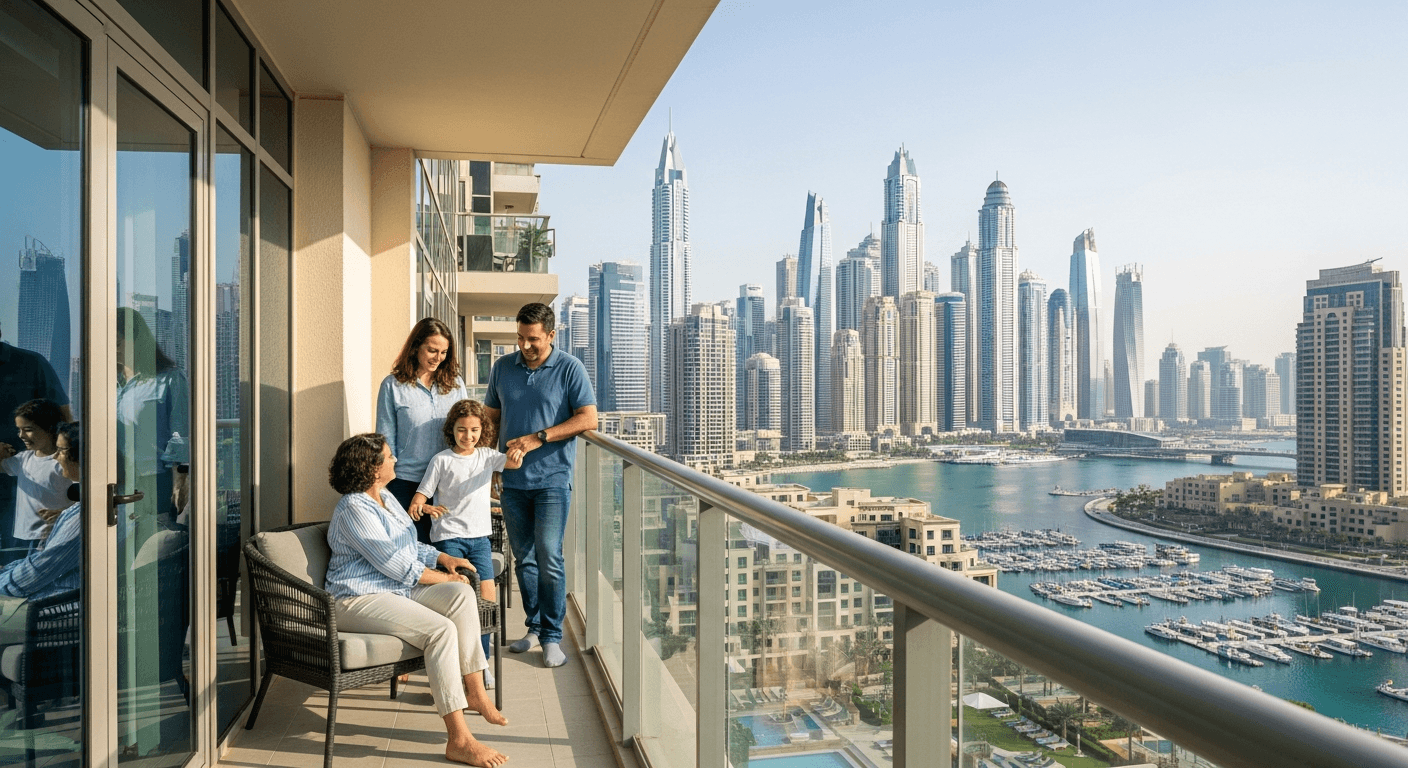
Dubai Apartments: Older Charm vs. New Build Value
A deep analysis of whether to invest in Dubai's established older apartments or brand-new towers, weighing location, size, build quality, and the true long-term costs.

As an apartment specialist in Dubai, I find the most perennial question from clients isn't about a specific neighbourhood or developer. It's a fundamental query about time itself: should I buy into a building that has stood for fifteen years, or one whose glass is still being polished? The debate between older versus newer apartments in Dubai is not just about aesthetics; it’s a complex value proposition analysis that pits location against layout, and established character against modern efficiency. It's a choice between two very different philosophies of living.
Here's what we'll explore in this detailed analysis:
- Defining 'Older' vs. 'Newer' in Dubai's unique timeline
- The prime real estate advantage of established communities
- How apartment layouts and sizes have evolved over two decades
- A realistic look at build quality, maintenance, and longevity
- A deep dive into service charges and long-term running costs
- A line-by-line financial breakdown of buying old vs. New
- The investor's angle on rental yields and capital appreciation
- My final verdict on which property type suits which buyer
What Do We Mean by 'Older' vs. 'Newer' in Dubai?
First, we need to calibrate our terms. In a city as young as modern Dubai, 'old' is a relative concept. For the purpose of this discussion, when I refer to 'older' apartment buildings, I'm generally talking about the first wave of freehold towers constructed between roughly 2002 and 2010. These are the pioneers that defined the city's skyline. Think of the original six Emaar Properties towers in Dubai Marina, the first phases of Jumeirah Beach Residence (JBR), or some of the earliest buildings in Downtown Dubai like The Residences complex. These buildings came up during a period of explosive growth and have had time to settle, mature, and develop distinct characters.
In contrast, 'newer' buildings are those handed over from approximately 2018 onwards. This category includes the sleek, glass-clad towers in contemporary master plans like Emaar Beachfront and Creek Harbour, recent additions to Business Bay, and the latest phases in family-centric communities like Dubai Hills Estate. This category also encompasses the vast world of off-plan vs ready apartments Dubai, where buyers commit to a property before it's even built. These buildings are designed with current market tastes in mind — think open-plan living, extensive 'resort-style' amenities, and a strong emphasis on smart home technology and sustainability.
The time gap between these two eras is more significant than the mere decade that separates them. It represents a monumental shift in construction technology, design philosophy, resident expectations, and the regulatory environment governed by entities like the Dubai Land Department (DLD) and the Real Estate Regulatory Agency (RERA). The older buildings were foundational, setting the very standards that the newer ones now seek to innovate upon. Understanding this context is the first step in making a sound decision. The choice isn't between good and bad, but between different eras with distinct trade-offs.
Location, Location, Maturity: The Prime Real Estate of Established Communities
 Featured project
The most compelling argument for buying in an older building is almost always its location. The simple truth of urban development is that the best plots of land are developed first. Those early towers in Dubai Marina don't just have marina views; they *are* the marina. They are woven into the fabric of the community, with direct access to the Marina Walk, established retail, and a short stroll to the beach or tram. You are buying into a known quantity, a fully-formed ecosystem that has had over a decade to mature. The surrounding infrastructure is complete, the traffic patterns are understood (for better or worse), and the community has a palpable, lived-in feel.
These established communities Dubai apartments offer a level of convenience and walkability that newer developments, often located on the expanding fringes of the city, can take years to replicate. Consider Downtown Dubai. An apartment in a building from 2008 puts you steps away from the Dubai Mall, the Souk Al Bahar, and the Burj Khalifa. The parks are green, the trees are tall, and the neighbourhood feels complete. A brand-new tower in a developing area might promise a future retail promenade or park, but you are buying the promise, not the reality. For end-users, particularly those moving to Dubai for the first time, this immediate access to amenities is a powerful draw. You can see and feel the lifestyle you are buying into on day one.
This maturity also translates into a more stable and predictable environment. There's less risk of a new construction project suddenly appearing next door and obstructing your prized view — a common concern in developing areas like the outer edges of Business Bay or parts of Jumeirah Village Circle (JVC). The master plan is complete. While this stability might mean less explosive capital growth compared to a nascent area hitting its stride, it also provides a defensive moat for your investment. The desirability of these prime locations is proven and enduring. For many buyers I work with, this certainty is worth more than the potential upside of an unproven location. It's the difference between buying a finished painting and commissioning a new one.
“The debate is a classic head-versus-heart dilemma: the rational appeal of a brand-new unit with warranties versus the emotional pull of a larger home in a neighbourhood that already feels like home.”
Space vs. Style: The Great Floor Plan Debate
Walk into an apartment in one of the original Marina towers and then into a brand-new one in Emaar Beachfront, and the difference in philosophy is immediately apparent. This is where the 'older apartments Dubai vs new' debate becomes tangible. Older apartments, almost without exception, offer more generous square footage. Bedrooms are larger, living and dining areas are often distinct, and you're far more likely to find a proper closed kitchen, a separate laundry room, and ample storage space.
For families or anyone who values space and privacy, these layouts from a bygone era are incredibly appealing. A 1,600 sq. Ft. two-bedroom unit from 2006 often feels significantly more spacious than a 1,400 sq. Ft. two-bedroom from 2024. The older design ethos prioritized segregated spaces. The closed kitchen, now often seen as dated, was designed to contain cooking smells and noise. This is a feature many of my clients from certain cultural backgrounds actively seek out. These larger footprints provide a canvas for renovation; you have the 'good bones' to create a modern interior within a more spacious shell, a project many end-users find rewarding.
Newer apartments, by contrast, are designed for a different lifestyle and a different set of economic realities. They champion open-plan living, with kitchens flowing smoothly into the living area to create a more social, inclusive space. What they may lack in raw square footage, they often make up for in efficiency and light. Floor-to-ceiling glass is now standard, flooding apartments with natural light and focusing attention on the view — be it the sea, the skyline, or a golf course. Developers like Meraas at City Walk or Bluewaters Island have perfected this, creating apartments that feel bright and airy. While bedrooms might be more compact and storage less generous, the overall feel is contemporary and aligned with modern, less formal living. The trade-off is clear: you are exchanging sheer size for superior views, more light, and a layout that promotes social interaction.
Ultimately, neither approach is inherently superior; they just serve different needs. A buyer who loves to entertain and values a stunning view might feel constrained by a closed-off kitchen, regardless of its size. Conversely, a family with young children might find the sprawling layout and separate rooms of an older apartment far more practical for daily life. When we at Gaia Living show clients both options, it often clarifies their own priorities in a way no brochure ever could. It’s a question of whether you want to live in a large, private sanctuary or a bright, open, view-oriented hub.
The Elephant in the Room: Apartment Build Quality and Longevity
This is perhaps the most misunderstood aspect of the old versus new debate. There is a common misconception that 'new' automatically means 'better quality' and 'old' means 'crumbling'. The reality in Dubai is far more nuanced. The critical factor in apartment build quality comparison Dubai is not the age of the building, but the reputation and diligence of the developer who built it.
Some of the best-built residential towers in this city are the ones that went up in the first wave. Emaar's early projects in the Marina and Downtown are legendary for their solid construction. They were often 'over-engineered' by today's standards, with robust concrete structures, generous MEP (Mechanical, Electrical, Plumbing) provisions, and high-quality core systems. These buildings have had 15-20 years to reveal any latent defects, and the well-managed ones have a proven track record of durability. When you buy into a well-maintained older tower, you are buying a known and tested product.
However, this is not a universal truth. The boom years also saw a rush to completion by less scrupulous developers, and some older buildings suffer from persistent issues with plumbing, HVAC systems, and facade integrity. A thorough inspection is non-negotiable. Here's a checklist I always recommend for an older property:
- Check the A/C: Look for signs of leaks or mold around vents. Ask about the age of the central chiller plant and individual fan coil units (FCUs). Replacing FCUs can be a significant expense.
- Inspect for Water Damage: Look at the base of walls, under sinks, and on ceilings for any staining or peeling paint, which can indicate past or present leaks.
- Facade and Windows: Check the condition of window seals. In a climate like Dubai's, worn seals can lead to dust and sand ingress and poor thermal insulation, driving up DEWA bills.
- Review the Building's Records: A good owners' association will have records of major works. Ask to see minutes from recent meetings to understand what capital projects (like elevator modernization or roof waterproofing) are planned or underway.
Newer buildings, on the other hand, offer the significant advantage of being built to the latest codes, which include stricter requirements for fire safety (like the updated UAE Fire and Life Safety Code) and sustainability (Al Sa'fat green building regulations). They also come with a one-year defects liability period where the contractor is responsible for fixing issues, and often a longer structural warranty. Yet, 'new' is not a guarantee of perfection. Fast-tracked construction can sometimes lead to snagging issues with finishes, joinery, and fittings. Again, the developer's identity is key. A project by a top-tier name like Select Group or Aldar is a very different proposition from one by a newer, unproven entity. The risk shifts from the building's age to the developer's delivery capability.
Service Charges: Unpacking the Hidden Costs of Ownership
For any apartment owner in Dubai, the annual service charges are a significant and unavoidable cost. This is a key battleground in the old vs. New comparison. These fees, calculated in AED per square foot of your unit's area, are approved by RERA and cover everything from security and concierge services to the maintenance of pools, gyms, landscaping, and the building's core systems. The narrative you often hear is that newer buildings have much higher fees, and while there's truth to that, the full story is more complex.
Newer, high-end buildings do indeed command some of the highest service charges in the market, often ranging from AED 22 to over AED 30 per square foot. This is because they are competing on amenities. We're no longer just talking about a pool and a gym. New towers by developers like Damac or Binghatti might offer indoor cinemas, residents' lounges, co-working spaces, yoga studios, and elaborate, resort-style pool decks. These all cost money to staff, maintain, and insure. You are paying for a lifestyle package, and the service charge reflects that. The upside is that all the equipment is new, under warranty, and you are unlikely to face major capital expenditure in the first decade.
In contrast, service charges older buildings Dubai often appear more attractive at first glance, typically falling in the AED 15 to AED 22 per square foot range. The amenities are usually more basic — a simple gym, a standard pool, and the building systems are less complex. This lower running cost can make an older property seem like a bargain. However, this is where buyers must be cautious. The hidden risk in an older building is the 'Special Assessment' or 'Sinking Fund Levy'. After 15-20 years, major components reach the end of their operational life. This can include:
- Chiller plant replacement (a multi-million dirham expense for a large tower)
- Elevator modernization
- Facade remediation or replacement
- Roof and water tank re-waterproofing
If the building's sinking fund (the portion of your service charge set aside for future capital works) has been insufficiently managed, the Owners Association will have to raise a large, one-off levy from all owners to cover the cost. I have seen these levies run into tens of thousands of dirhams per apartment, completely negating years of savings from lower annual fees. A savvy buyer of an older apartment will scrutinize the building's financial health, the state of its sinking fund, and any engineering reports on major systems before committing.
A Tale of Two Budgets: The Upfront and Ongoing Financials
Let's put some real numbers to this. Understanding the total cost of acquisition and ownership is crucial. Let's compare two hypothetical two-bedroom apartments, both around 1,500 sq. Ft., one in an older tower in JBR and one in a new building in Dubai Hills Estate. This illustrates the financial trade-offs clearly.
Scenario 1: Buying a 15-Year-Old Apartment in JBR
This property attracts buyers with its beachside location and large layout.
- Purchase Price: AED 2,800,000
- Upfront Costs (paid by buyer):
- Dubai Land Department (DLD) Fee (4% of price): AED 112,000
- DLD Registration Trustee Fee: AED 4,200 (including VAT)
- Real Estate Agency Fee (2% of price + 5% VAT): AED 58,800
- No Objection Certificate (NOC) Fee from developer: ~AED 1,000 - 5,000
- If mortgaged, Mortgage Registration Fee (0.25% of loan amount): ~AED 5,250 (on an 80% loan)
- Total Upfront Cash Outlay: Approximately AED 181,250
- Ongoing Annual Costs:
- Service Charges (estimated at AED 18/sq. Ft.): 1,500 sq. Ft. x 18 = AED 27,000 per year
Scenario 2: Buying a Brand-New Apartment in Dubai Hills Estate
This property appeals with its modern design, golf course views, and family community.
- Purchase Price: AED 3,500,000
- Upfront Costs (paid by buyer):
- Dubai Land Department (DLD) Fee (4% of price): AED 140,000
- DLD Registration Trustee Fee: AED 4,200 (including VAT)
- Real Estate Agency Fee (2% of price + 5% VAT): AED 73,500
- NOC Fee is not applicable for a primary sale from the developer.
- If mortgaged, Mortgage Registration Fee (0.25% of loan amount): ~AED 6,562 (on an 80% loan)
- Total Upfront Cash Outlay: Approximately AED 224,262
While the newer apartment has a higher ticket price and thus higher upfront government and agency fees, the equation can change for off-plan properties. A developer might offer a post-handover payment plan or even waive the DLD fees, significantly altering the initial cash requirement. For the older ready property, the full amount is due upfront, and financing is subject to bank valuation and the property's condition. According to Central Bank of the UAE rules, residents typically need a minimum 20% down payment for a first property under AED 5 million. For an older unit, a bank may sometimes require a larger down payment if their valuation comes in lower than the sale price. These are critical details we help our clients navigate at Gaia Living.
Yield, Appreciation, and Exit: An Investor's Perspective
For a pure investor, the decision between old and new hinges on three things: rental yield, capital appreciation potential, and ease of exit. The calculus here is different from that of an end-user.
Older apartments often win on gross rental yield. Because their purchase price per square foot is lower, the rental income generated represents a higher percentage of the initial investment. A well-maintained two-bedroom in an older part of Dubai Marina might be acquired for AED 2.5 million and rent for AED 160,000 per year, giving a gross yield of 6.4%. A comparable new unit might cost AED 3.5 million and rent for AED 190,000, yielding 5.4%. For an investor focused on immediate cash flow, the older asset can be more compelling. These established areas also have a deep and consistent rental pool, reducing vacancy risk. Tenants are attracted to the location, space, and often lower rent compared to brand-new stock.
However, capital appreciation is a different story. While well-located older properties hold their value exceptionally well, the potential for explosive growth often lies with newer properties in developing areas. Buying off-plan in a master community like Dubai South or Rashid Yachts & Marina before the surrounding infrastructure is complete allows an investor to ride the wave of the area's maturation. As new metro lines, malls, and community facilities come online, the value of the properties can see a significant uplift. The risk is higher, but so is the potential reward. Newer buildings also tend to appreciate faster in a rising market as they represent the most desirable, modern product.
Finally, consider the exit strategy. When it's time to sell, who is your target buyer? A newer apartment with modern finishes and stunning views will appeal to a broad international audience and command a premium. It's an easier, more aspirational product to market. An older apartment, especially one that hasn't been upgraded, might appeal to a more niche buyer — someone specifically looking for that layout, location, or a renovation project. The buyer pool might be smaller, but it is often highly motivated. At Gaia Living, we find that a tastefully renovated older apartment in a prime location can be one of the most sought-after properties on the market, blending the best of both worlds: location, space, and modern style.
My Verdict: Matching the Building to the Buyer
After years of walking clients through countless apartments, from the original towers of JBR to the gleaming new launches at Al Marjan Island, my conclusion is this: there is no single 'better' option. The right choice is entirely dependent on your personal priorities, financial situation, and risk appetite. The key is to make the decision with a clear understanding of the trade-offs.
An older apartment is often the right choice for the value-conscious end-user or family. This buyer prioritizes space, a mature community, and immediate access to amenities. They are willing to undertake some renovation to modernize the interior and are prepared to do their due diligence on the building's maintenance history and financial health. They value the certainty of a known location over the promise of a future one. For them, a home is about generous proportions and a lived-in neighbourhood feel.
A newer apartment (or off-plan purchase) is typically best for the lifestyle-focused buyer or the growth-oriented investor. This individual is drawn to cutting-edge design, extensive amenities, and the latest technology. They want a turnkey solution with minimal hassle and the peace of mind that comes with developer warranties. As an investor, they are willing to accept a lower initial rental yield in exchange for stronger potential capital appreciation and a product that will be in high demand from a global audience upon exit. They are buying into the future of Dubai, not its past.
My advice is always to experience both. Spend a weekend exploring the established, walkable communities like the Marina and Downtown. Then visit the sales centres for the new master plans. Understand the feeling of a large, closed-kitchen layout versus a bright, open-plan one. At Gaia Living, our role is not to push one over the other, but to provide the detailed, factual context — from service charge histories to developer track records, that empowers you to make the most informed decision for your unique circumstances. The perfect Dubai apartment is out there; it might just be from a different decade than you initially expected.
## Sources - Dubai Land Department (DLD): https://dubailand.gov.ae - Real Estate Regulatory Agency (RERA): Part of the DLD, regulations accessible on their site. - Central Bank of the UAE (CBUAE), for mortgage regulations: https://www.centralbank.ae - UAE Government Portal, for building codes and residency information: https://u.ae/en
Questions, answered
- Are older apartments in Dubai a good investment?
- Yes, they can be. Older apartments often offer larger layouts in prime, mature locations like Dubai Marina or Downtown Dubai at a lower price per square foot. However, buyers should budget for potential maintenance and higher-than-expected service charge increases for major retrofits.
- Are service charges higher in new or old buildings in Dubai?
- New buildings typically have higher service charges from day one due to more extensive amenities and advanced systems. Older buildings may have lower baseline charges, but they carry the risk of significant special assessments for major capital replacements, which can suddenly increase costs for owners.
- What is the build quality like in older Dubai apartments?
- Build quality varies by developer, not just age. Many of the original towers from top-tier developers like Emaar are known for their robust construction and generous proportions. It is crucial to assess the specific building and developer's track record rather than making a blanket assumption based on age.
- Do new apartments in Dubai have better layouts?
- Not necessarily 'better', but different. Newer apartments usually feature open-plan kitchens and living areas, which suits a modern lifestyle. Older apartments tend to have larger, more segregated rooms and closed kitchens, which some buyers prefer for privacy and space.
- Is it cheaper to buy an old or new apartment in Dubai?
- The initial purchase price of an older apartment is generally lower on a per-square-foot basis. However, the total cost of ownership involves service charges, potential renovation costs, and financing. New properties, particularly off-plan, can offer attractive payment plans that ease the initial financial burden.
- What are the main advantages of buying a new apartment in Dubai?
- New apartments offer modern amenities, contemporary finishes, designs that maximize views, and often come with a developer warranty against defects. They also typically comply with the latest building codes and sustainability standards, potentially leading to greater efficiency.

Ravi lives and breathes apartment living — from studio yields in JVC to branded residences on the Palm. Floor plans, service charges, and view lines are his love language.
Related stories
Dubai's AC Dilemma: The Real Cost of Cooling
Your apartment's air conditioning is more than just a utility—it's a major factor in your monthly budget and comfort. I'll break down the real costs and benefits of Dubai's two main cooling systems, helping you choose your next home wisely.
Managing Multiple Offers: A Dubai Seller's Playbook
Receiving multiple offers on your Dubai property is an excellent problem to have, but handling it incorrectly can cost you time and money. Here’s my strategic playbook for managing competitive bids to secure the best possible outcome.

Gifting Property to Family in Dubai
Thinking of transferring a Dubai property to a family member? Learn how to navigate the DLD's rules for gifting to first-degree relatives and significantly reduce your transfer costs.
Echoes, in your inbox
One thoughtful email a month. Market insight, new launches, no spam.