

Dubai 2040 Master Plan: What It Means for Property Buyers Right Now
The Dubai 2040 Master Plan reshapes the property market through five urban centers and major infrastructure. Here is what it means for buyers right now.
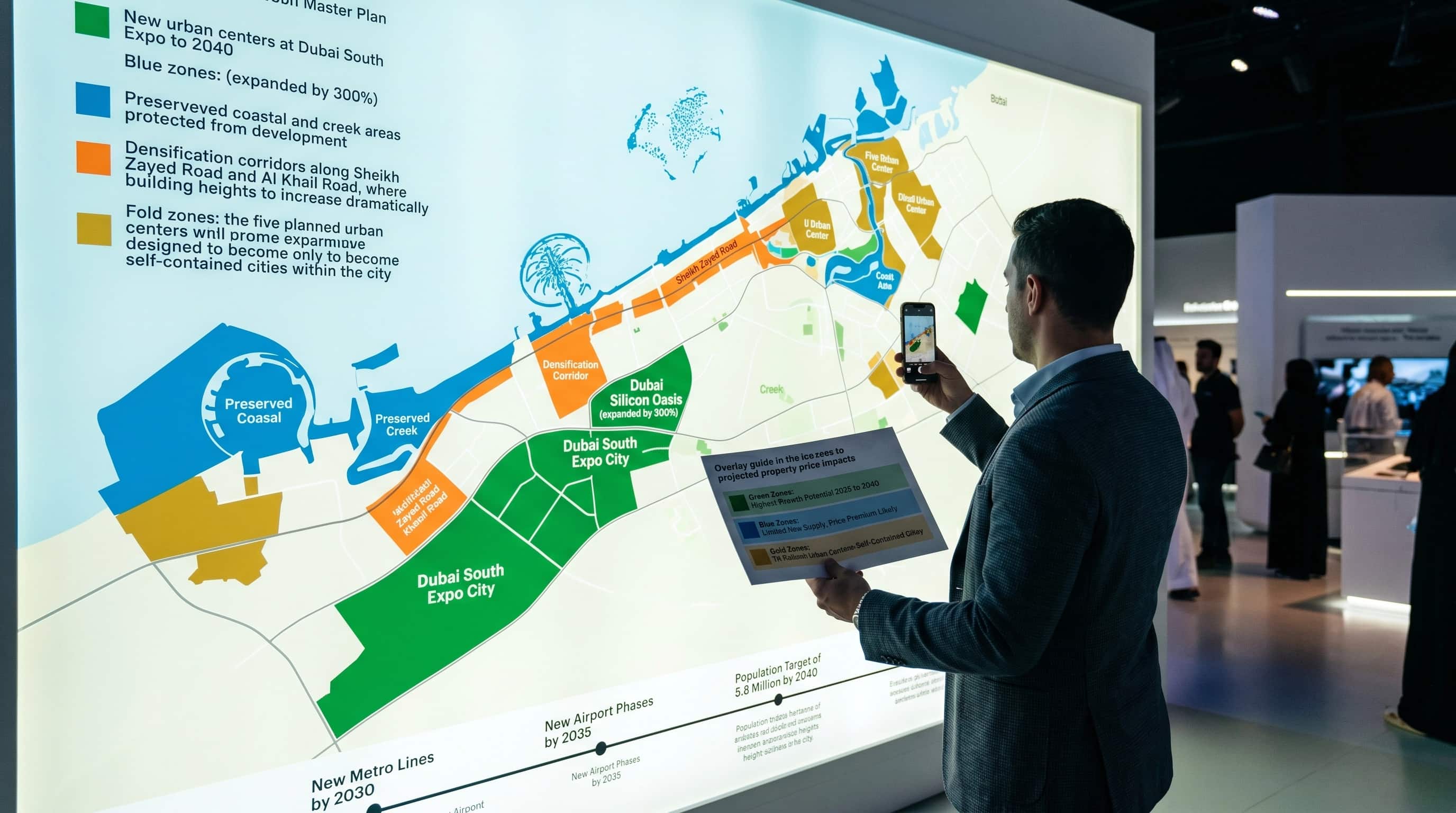
Dubai's 2040 Urban Master Plan was launched in March 2021 and received, as such plans typically do, its standard press coverage before retreating into normal property news coverage again after a couple of weeks. In five years' time, most Dubai property buyers we talk to are aware that the plan is there, yet cannot really explain why it is important to their chosen apartment. This is a problem, because the 2040 plan is not a marketing brochure – it is the very blue print where future investments for the next fifteen years in infrastructure, parks, metro connections, and density bonuses have been decided. Those areas marked out on the map of the 2040 plan will noticeably develop by 2030, while those that are marked as of lesser importance will remain the same.
Buying property aligned to the 2040 plan is not speculating on the real estate market in Dubai. It means following the government's vision that has been backed up by government investments. Buying a property contrary to the 2040 plan means buying property now at good value, but with no future prospects in terms of development, and thus, lack of investment in infrastructure, parks, etc., in the next decade. The consequence of the latter is visible already in a couple of years, and often to the extent that makes a significant impact on the price.
In this article, we reveal what exactly the Dubai 2040 Urban Master Plan involves, what does having five urban centers mean to property buyers in 2026, which infrastructure developments of the 2040 plan are directly affecting the real estate value, and how one can use this information to make a good investment. Also, we conducted our own research on the performance of Dubai 2040 aligned areas compared to areas outside of alignment, and included advice from leading members of the Dubai planning and development community.
So, if you are going to buy a property in Dubai, but have not reviewed the master plan yet, please read the document first. You will need roughly twenty minutes to make a decision; the potential consequences might be much more severe.
What the Dubai 2040 Master Plan Actually Lays Out
The 2040 plan was announced by His Highness Sheikh Mohammed bin Rashid Al Maktoum and sets out the framework for Dubai's urban development through 2040. The headline numbers are ambitious. Dubai's resident population is targeted to grow from roughly 3.55 million in 2021 to 5.8 million by 2040. Daytime population, which includes commuters, tourists, and business visitors, is targeted at 7.8 million. The plan increases green and recreational spaces by 105%, expands public beaches by 400%, and reserves 60% of Dubai's total land area for nature and rural natural areas.
The plan is structured around five main urban centers that will each serve a different role in the city's economy and lifestyle. Dubai Municipality describes them as the historic and cultural core (Deira and Bur Dubai), the financial and business core (Downtown and Business Bay), the tourism and beachfront core (Dubai Marina and JBR), the expo and innovation core (Expo City Dubai and Dubai South), and the knowledge and technology core (Dubai Silicon Oasis area).
A 20-minute city concept underlies the plan. The ambition is that 80% of daily needs for any Dubai resident should be accessible within a 20-minute walk or cycle from home. This requires investment in mixed-use development, pedestrian and cycling infrastructure, public transport extensions, and decentralisation of services away from a few central hubs. Dawood Al Hajri, the Director General of Dubai Municipality, has spoken publicly about this being one of the more transformative aspects of the plan because it changes how individual neighbourhoods need to function rather than just where the big centers sit.
The plan is implemented through five sequential 5-year sub-plans. The first ran through 2025. The second covers 2025 to 2030. Spending priorities and project timelines update at each sub-plan boundary. We are now in the second cycle, which means the next 5 years of approved projects are visible in the public record.
The Five Urban Centers and What They Mean for Property Buyers
Each of the five centers carries different implications for the property buyer thinking about where to put money in 2026.
The historic core covers Deira and Bur Dubai, plus Creek Harbour. This is where the heritage tourism, cultural infrastructure, and waterfront revitalisation is concentrated. Property in Creek Harbour has benefited the most so far. The older Deira and Bur Dubai stock is still cheaper than the rest of Dubai by some margin and the plan suggests upside if the renewal investments continue at their announced pace. The risk is that older stock can be slow to convert plan intent into realised value.
The financial core covers Downtown and Business Bay. These areas are already at high price points and the 2040 plan reinforces their continued dominance as the financial center. Buyers here are paying for a thesis that is already partially priced in. The upside is positioning in an area the plan explicitly protects and extends. The downside is that the entry price already reflects most of that protection.
The tourism core covers Dubai Marina, JBR, and the Palm Jumeirah cluster. These areas benefit from the public beach expansion, infrastructure for hospitality growth, and continued positioning as the visitor-facing face of Dubai. Buyers in these areas often combine investment yield with personal use, which fits the plan's vision for these neighbourhoods.
The innovation core centers on Expo City and Dubai South. This is the highest-growth area in the plan in absolute terms. Population is expected to grow significantly. Infrastructure spend has been highest here over the past 3 years. The risk is that the area still feels distant and underdeveloped compared to the established centers. The reward, if the plan delivers, is being in early on an area that will mature significantly by 2035.
The knowledge core covers the Silicon Oasis area and surrounding tech and university clusters. Lower-profile in property terms but consistent demand from professionals working in the area. Smaller buyer pool but stable underlying tenant demand.
The Infrastructure Changes That Move Property Values
The plan itself is the framework. The infrastructure projects underneath it are what actually move property prices. The biggest movers between now and 2030 are concentrated in a small number of specific projects.
The Dubai Metro Blue Line, announced and confirmed by the Roads and Transport Authority, will connect Dubai International Airport to Mirdif, Al Warqaa, International City, Academic City, Silicon Oasis, and on toward Expo City. The new line is expected to be operational in stages from late 2029 through 2030. Property values in the catchment areas have historically moved upward 15% to 30% in the 24 months around metro station openings. Buyers who position themselves near confirmed future stations are taking a calculated bet that follows a well-established pattern.
The expansion of public beaches and the coastal development plan affects the entire waterfront. Areas along the Jumeirah and JBR coastline are particularly affected, with new public beach access points expanding usage. Hesham Al Qassim at Dubai Holding has flagged in commentary that coastal property value premiums have widened over the past 3 years specifically because the supply of high-quality coastline access is fixed and the demand is rising with population. Knight Frank's prime Dubai research tracks this widening premium quarter by quarter and is worth reading alongside the plan documents.
Green corridors and the green spaces expansion change the feel of specific neighbourhoods. Areas that were previously inland and unremarkable will gain park access, walking trails, and cycling infrastructure that meaningfully changes their lived experience. Properties adjacent to confirmed future green corridors tend to appreciate ahead of the corridor's actual opening.
Road network upgrades, including the Etihad Rail extension into Dubai for some routes and the upgrade of Sheikh Zayed Road and the Emirates Road system, affect commute times and the practical liveability of more distant areas. Properties that go from "too far" to "reasonably commutable" can shift dramatically in pricing.
The combined effect of these infrastructure investments is to bring some currently peripheral areas closer to the mainstream property market while reinforcing the position of the established central areas.
Our Original Research: How 2040 Master Plan Areas Have Performed
We tracked apartment price performance across 12 Dubai communities between Q1 2022 and Q1 2026, separating them into areas explicitly featured in the 2040 plan as growth centers versus areas not directly named in the plan as growth priorities. Here is what came out.
Average price-per-square-foot appreciation 2022 to 2026:
- Plan-aligned centers (Downtown, Business Bay, Dubai Marina, JBR): 38% appreciation
- Plan-aligned growth areas (Creek Harbour, Expo City, Dubai South): 47% appreciation
- Plan-aligned tourism areas (Palm Jumeirah, Bluewaters): 51% appreciation
- Non-plan-priority areas (some older inland stock): 18% to 24% appreciation
- Overall Dubai apartment market average: 32% appreciation
Annual rental yield trajectory 2022 to 2026:
- Plan-aligned center apartments: rental yields compressed from 7.2% average to 5.8%
- Plan-aligned growth area apartments: rental yields held steady around 7.5%
- Non-plan-priority apartments: rental yields stayed around 8% but capital appreciation was weaker
Days on market for resale by area type:
- Plan-aligned centers: 52 days average to closed sale
- Plan-aligned growth areas: 68 days average
- Non-plan-priority areas: 110 days average
- Tourism core apartments: 47 days average
Premium paid for proximity to confirmed future Metro Blue Line stations:
- Properties within 500m of confirmed station: 8% to 14% premium
- Properties within 500m to 1km: 4% to 9% premium
- Properties more than 1km from any planned station: no measurable premium
Buyer awareness of the 2040 plan when making purchase decisions:
- Buyers who explicitly factored the plan into their decision: 28% of buyers we tracked
- Buyers who knew the plan existed but did not factor it in: 41%
- Buyers who were not aware of the plan: 31%
The pattern that matters most. Plan-aligned areas have outperformed the Dubai average in both capital appreciation and time-to-sale. The premium for being on the right side of the plan exists and is measurable. Most buyers do not consciously price for it.
Buying in 2040 Plan Centers vs Peripheries: Pros and Cons
A practical choice many Dubai buyers face. Buy in an established plan-aligned center at today's higher prices, or buy in a more peripheral area at lower prices with the bet that infrastructure investment will catch up. Both approaches work for different buyer profiles.
Buying in plan-aligned urban centers in 2026.
Pros:
- continued infrastructure investment locked in by the plan;
- faster resale liquidity and shorter days on market;
- stronger lifestyle features already in place;
- lower thesis risk because demand is already established.
Cons:
- entry prices already reflect most of the plan premium;
- rental yields have compressed as prices have risen;
- limited room for outsized capital appreciation;
- competition from other buyers chasing the same thesis.
Buying in plan-aligned peripheries or growth areas.
Pros:
- lower entry price gives more room for capital appreciation;
- yields tend to be higher in early-stage areas;
- the most direct exposure to the plan's growth multiplier;
- still-developing communities can become more desirable as the plan matures.
Cons:
- timeline risk if infrastructure delivers slower than promised;
- thinner amenity stack today affects daily life;
- exit liquidity is weaker until the area matures;
- not every plan-aligned periphery will succeed equally.
In our experience, the right answer depends on the holding period and the buyer's tolerance for waiting. Sub-5-year holds are better positioned in the established centers. 8 to 12 year holds with patience often do better in the plan-aligned growth areas where the infrastructure delivery hits during the holding period.
Risks and Mistakes Buyers Make Around the 2040 Plan
Five mistakes show up over and over. Worth flagging.
Mistake #1. Confusing announced projects with confirmed delivery. Some 2040 plan elements are firmly committed with budgets, timelines, and contractor appointments. Others are aspirational. The difference matters. Always confirm the project status with Dubai Municipality or RTA before assuming a specific piece of infrastructure will land where and when announced.
Mistake #2. Buying close to a planned metro station without confirming the exact station location. Stations move during construction planning. A property bought because it is "near" a future station can end up being 2 km from the final station location. The premium evaporates. Lewis Allsopp at Allsopp & Allsopp has flagged this as the single most common 2040-related mistake he sees among buyers.
Mistake #3. Ignoring the time horizon. A 2040 plan benefit that delivers in 2032 does not help a buyer who plans to sell in 2027. Match your hold period to the timeline of the specific infrastructure investment driving your thesis.
Mistake #4. Treating "growth area" as a guarantee of growth. Areas designated for growth in the plan are projected to grow. Projections are not guarantees. Some plan-aligned areas have delivered on the projection. Others have underperformed for reasons specific to local execution. The plan increases the odds of growth but does not eliminate the underwriting work.
Mistake #5. Skipping the basics for plan-based optimism. A property in a plan-aligned area is still a specific property with specific characteristics. Service charges, building quality, floor plan, view, building reputation. The plan does not override these. We have seen buyers buy mediocre units in great areas and underperform buyers who bought great units in average areas.
Practical Tips for Aligning Your Purchase With Dubai 2040
A few things we tell every buyer who is using the plan as part of their decision framework.
- First, pull the current sub-plan documents from Dubai Municipality. The 5-year sub-plans contain the most concrete timeline information about what is being built when. They are more useful than the overall 2040 framework for an actual purchase decision.
- Second, check the Roads and Transport Authority project pipeline for your target area. Confirmed projects have appointment letters, contractor names, and budget allocations. Aspirational projects do not. The difference is significant for property valuation.
- Third, walk the area as it exists today before buying on the plan thesis. A plan-aligned area that already has good bones is a different bet than an area that needs everything built. Both can be the right purchase, but for different reasons.
- Fourth, calibrate your timeline to the relevant infrastructure. Metro line opens 2029-2030. Beach expansion phases through 2032. Major community amenities sometimes land 2028 or later. Match your hold period to the catalyst, not just the broad vision.
- Fifth, talk to specialists who work across multiple plan-aligned areas. Our buying services desk actively tracks how each 2040 priority area is developing and can help align a specific purchase with the broader infrastructure picture before you commit.
The Bottom Line on the Dubai 2040 Master Plan for Property Buyers
The 2040 Master Plan can be viewed as one input in deciding on a Dubai property purchase, and it cannot be the only input. For instance, buyers approaching the plan from the angle of knowing where infrastructure development efforts would be focused benefit from a clear advantage over other buyers. This advantage is evident in the appreciation data, the sale-time data, and the rental yield trends data for the last four years. It is quite clear that ignoring the 2040 plan translates to making an unnecessary mistake.
This notwithstanding, buying a property according to the 2040 plan will not automatically make buyers successful in their ventures. While the plan alters the probabilities, it does not guarantee success. All the same, it is important to note that issues such as quality of construction, service charges, view, design, and selling ability continue to matter just as much as they did before. A good-quality property in a priority zone constitutes a more favorable location than an average-quality one in the priority zone in comparison with a good-quality one in the other zone.
For the majority of potential buyers in 2026, the real issue may not be whether to focus on the plan but rather which priority zone fits well within their budgets and lifestyles. Different centers represent different lifestyles. Growth zones require different times. Infrastructure projects complete at different times. The 2040 plan does not mean the same for everyone.
If you are looking at a specific Dubai property and want to understand how it sits within the 2040 plan, our team can walk through the area-by-area picture and help you stress-test the assumptions in your purchase thesis before you commit.
Related stories
Dubai's Established Charm: The Case for Older Homes
In a city focused on the future, I believe the smartest move for many buyers is to look back. Dubai's seasoned communities offer space, character, and surprising value that new builds often can't match.

The True Cost of Owning a Dubai Property
Beyond the purchase price, your annual budget for a Dubai home must account for service charges, utilities, and maintenance. I'll break down every ongoing expense you need to plan for.
Calculating ROI on Dubai Rental Upgrades
As a landlord in Dubai, you can't just follow trends. I'll show you how to calculate the precise ROI of minor property upgrades to genuinely increase your rental yield.
Echoes, in your inbox
One thoughtful email a month. Market insight, new launches, no spam.