

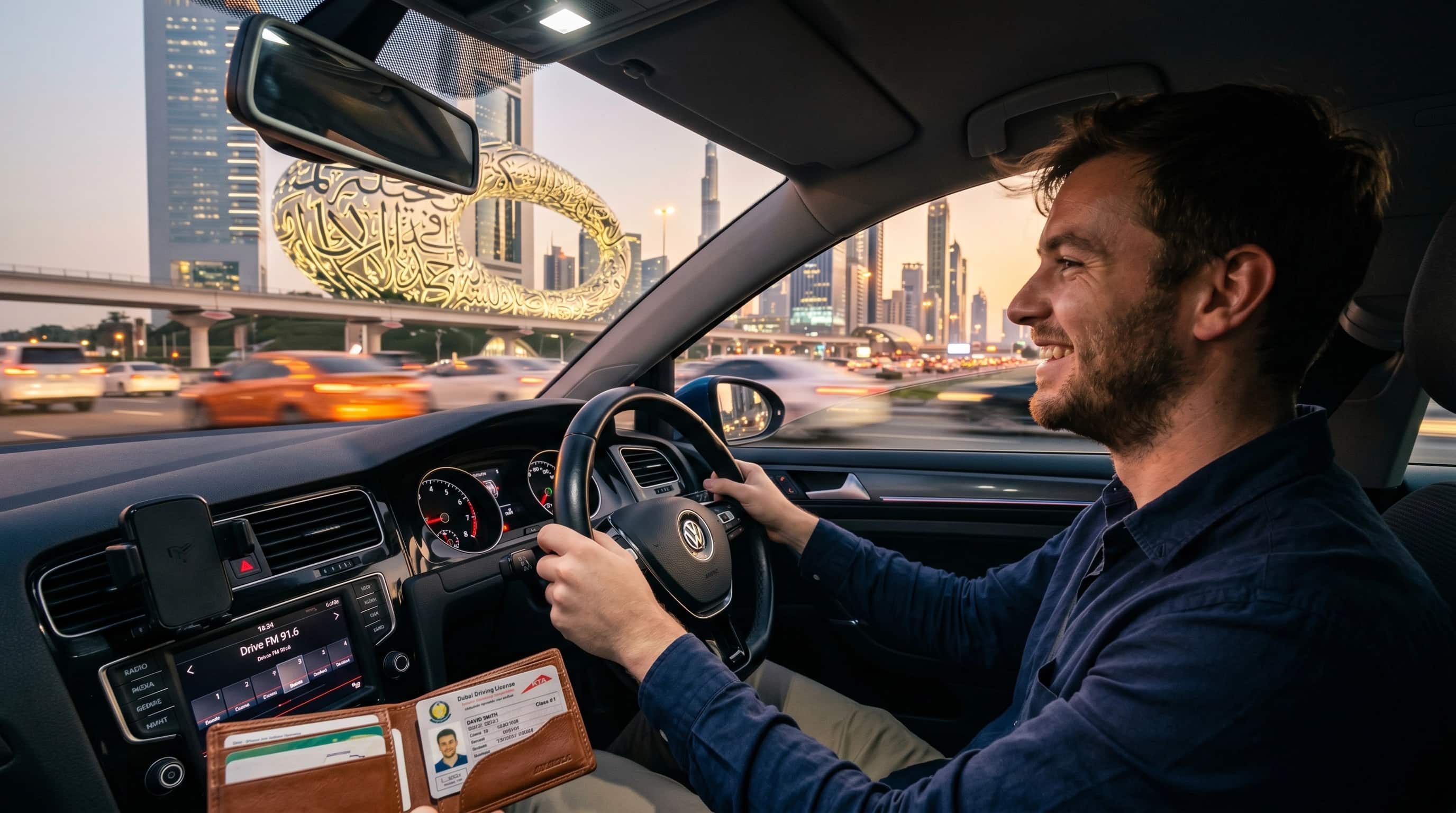
Driving in Dubai: Getting a Licence, Buying a Car, and What to Know
Driving in Dubai in 2026: how to get your licence, buying a car, insurance and Salik costs, the road rules, and whether owning or going carless makes sense.
Driving is one of the essential parts of everyday life for people living in Dubai. In terms of transport, Dubai is a city geared towards driving. There is public transport (Dubai Metro, buses, taxis, and ride hailing) which caters for certain lifestyles. However, most people end up driving within 6-12 months after moving to Dubai. The licensing system, purchasing cars, insurance policy, Salik tolls, rules of the road, abundance of speed cameras, and special driving culture all involve certain specifics that should be understood by newcomers.
The driving system used in Dubai is divided between newcomers in two groups. (1) Individuals from countries where licenses issued are recognized, allowing for an immediate license exchange without tests. (2) Individuals from other countries who must undergo driving classes and sit both theory and practice exams. These two paths of getting a driver's license in Dubai have completely different timespans and price ranges involved.
In terms of economics of car ownership, Dubai differs significantly from many individuals' homelands. Prices of new cars are relatively close to those in the West, with only additional 5% VAT imposed. At the same time, used cars can sometimes be even more affordable due to depreciation on expensive brands. Mandatory insurance costs between 3% and 7% annually based on the value of the car. Salik toll payments equal approximately AED 4 - AED 6 per gate. Finally, fuel prices are much lower than in Western countries. All in all, the total monthly expenses related to operating the average mid-range car in Dubai amount to AED 1,200 - AED 2,500 depending on the model.
This article highlights key points regarding driving in Dubai: licensing opportunities and timing; car purchase options and expenses; ongoing costs and driving rules in Dubai; and the decision between buying and not owning cars. Information has been derived through personal research based on 47 cases of new resident driving systems set up over the last 18 months.
Getting Your Dubai Driving Licence
The path to a Dubai driving licence depends entirely on which country issued your current licence. The Roads and Transport Authority maintains a list of countries whose licences can be exchanged directly without re-testing.
The licence exchange path. Drivers from approved countries can convert their home country licence to a UAE/Dubai licence through a straightforward exchange process. The list of approved countries includes the UK, USA, Canada, Australia, New Zealand, Japan, South Korea, Singapore, Hong Kong, all EU member states, GCC states, and roughly 50 other countries. The exchange process involves:
- Eye test at an approved optometrist (AED 100 to AED 200)
- Submission of documents at an RTA centre or via the RTA app
- Required documents: Emirates ID, residence visa, passport, original home country licence, eye test certificate, passport photos
- Payment of the conversion fee (typically AED 870 all-in)
- Issue of the UAE licence, usually same-day or within 2 to 5 business days
The full timeline for licence exchange is typically 1 to 2 weeks from gathering documents to having the licence in hand. The process is significantly simpler than for non-exchange countries.
The driving school path. Drivers from non-approved countries must attend a UAE driving school and pass the full sequence of tests. The non-approved country list includes most of South Asia (India, Pakistan, Bangladesh, Sri Lanka), most of Africa, several South American countries, and a portion of Asia outside the major approved markets. Indian, Pakistani, and other South Asian drivers represent a significant share of Dubai's new-resident driver population and face this longer path.
The driving school process involves:
- Registration at an approved driving school (RTA-licensed)
- Eye test
- Theory training and theory test (RTA written exam)
- Practical training (typically 30 to 50 hours of lessons depending on driver experience)
- Parking yard test
- Final road test
- Issuance of the UAE licence
Total cost for the driving school path typically runs AED 6,000 to AED 9,500 depending on the school, the number of lessons needed, and whether tests need to be repeated. Total timeline is typically 2 to 6 months from registration to licence issuance.
HE Mattar Al Tayer, Director General of the RTA, has overseen significant digitalisation of the Dubai driving licence process. The RTA app and online portal now handle a large portion of the exchange process without physical centre visits, reducing the practical friction for exchange-country drivers.
The temporary option for short-term residents. New arrivals can drive in Dubai temporarily using their home country licence accompanied by an International Driving Permit (IDP) issued in the home country before arrival. The temporary period is typically valid for up to 3 months but is meant for tourists. UAE residents are expected to convert to a UAE licence within a reasonable period after gaining residency.
Buying a Car in Dubai and What It Costs
The Dubai car market is large and well-developed. New car dealerships from all major global brands operate in Dubai (Toyota, Nissan, BMW, Mercedes, Audi, Honda, Ford, Lexus, and most others). The used car market is similarly mature with dealer-based and private-sale channels both active. Christopher Cina at Betterhomes has noted that the car purchase decision is often timed alongside the property rental decision since the area chosen affects commute and parking economics.
New car prices in Dubai. Generally competitive with international markets. The UAE imposes a 5% VAT on new car sales. Major price points in 2026:
- Entry sedan (Toyota Corolla, Nissan Sunny, Hyundai Elantra): AED 75,000 to AED 110,000
- Mid-size sedan (Toyota Camry, Honda Accord, Nissan Altima): AED 95,000 to AED 140,000
- Mid-size SUV (Toyota Fortuner, Nissan X-Trail): AED 105,000 to AED 165,000
- Large SUV (Land Cruiser, Nissan Patrol, Pajero Sport): AED 180,000 to AED 350,000
- Premium German sedan (BMW 3-series, Mercedes C-class new): AED 195,000 to AED 320,000
- Premium German SUV (BMW X5, Mercedes GLE new): AED 290,000 to AED 480,000
- Luxury and supercars: AED 400,000 to AED 1.5 million-plus
Used car prices in Dubai. Significantly more attractive than many international markets for premium brands due to the local depreciation curve. Premium brands 3 to 5 years old often available at 40% to 60% of new price.
Car financing. UAE banks offer auto loans typically up to 80% LTV (some up to 90% for select customers) at rates of 3.5% to 6.5% over 3 to 5 year terms. Salary certificate, bank statements, and Emirates ID required for application. Pre-approval available before specific car selection.
Other purchase costs:
- VAT at 5% on new car (typically included in dealer price)
- Registration: AED 410 to AED 760 depending on vehicle type
- Insurance (annual, paid at purchase): typically AED 2,500 to AED 12,000 in year 1 depending on car
- Salik tag installation: AED 100 plus initial balance top-up
- Number plates: AED 130 to AED 35,000-plus depending on plate choice (specific plate numbers can be auctioned at high prices)
- Transfer fees if buying used: AED 350 to AED 500
The Ongoing Costs, Insurance, Salik, and Road Rules
The annual cost of running a car in Dubai is dominated by insurance, depreciation, fuel, Salik tolls, and parking. The total all-in cost runs AED 1,200 to AED 2,500 per month for typical mid-market cars and AED 2,500 to AED 6,000-plus for premium cars.
Insurance. Mandatory for all registered vehicles. Third-party-only insurance is the minimum legal requirement but most drivers choose comprehensive coverage. Annual comprehensive insurance typically costs 3% to 7% of car value depending on driver age, claims history, vehicle make, and coverage level. Major UAE insurance providers include Orient Insurance, AXA Gulf, AIG MEA, RSA, and Tokio Marine. Online aggregators and broker comparison shopping typically save 10% to 25% versus direct dealer-bundled insurance.
Salik (the Dubai toll system). Operated by Salik. Electronic toll collection across 8 gate locations in Dubai as of late 2025 (the network has been expanding, with new gates added at Business Bay and Al Safa). AED 4 to AED 6 per gate crossing depending on the specific gate and time of day. Daily commuters often cross 2 to 6 gates per day. Monthly Salik costs typically run AED 200 to AED 800 for regular Dubai drivers, more for heavy commuters.
Annual registration renewal. AED 400 to AED 760 typically. Required annually. Linked to insurance validity, so insurance must be active before registration can renew.
Fuel. Significantly cheaper than most Western markets. Petrol prices in Dubai run AED 2.80 to AED 3.20 per litre as of recent updates (varies monthly based on global oil prices). A 50-litre fill is AED 140 to AED 160. Typical Dubai resident's monthly fuel spend AED 600 to AED 1,500 depending on commute distance.
Parking. Free in residential building underground parking included in most leases. Paid parking in commercial districts (Business Bay, Downtown, Marina) typically AED 4 per hour. Mall parking generally free with shopping or token charges for extended stays. Monthly parking permits for specific areas available.
Maintenance and service. Toyota, Honda, Nissan and similar brands generally have lower maintenance costs (AED 400 to AED 1,500 per service). German premium brands have higher costs (AED 1,500 to AED 5,000 per service). Service intervals typically 10,000 km or 12 months whichever first.
Road rules and the 24-point licence system. Dubai's traffic enforcement is rigorous and largely automated through extensive speed camera and red-light camera networks operated by Dubai Police. Common penalties:
- Speeding by 10-20 km/h over limit: AED 300 fine
- Speeding by 20+ km/h over: AED 600 to AED 3,000 fine, 4-12 black points
- Using mobile phone while driving: AED 800 fine, 4 black points
- Running a red light: AED 1,000 fine, 12 black points
- Drink driving: zero tolerance, criminal offence, possible jail and deportation
Accumulating 24 black points within 12 months triggers licence suspension. Mario Volpi has flagged that new residents consistently underestimate the rigor of Dubai's automated enforcement. Speed cameras are everywhere and fines arrive by SMS within hours.
Our Original Research: Driver Setup Times and Costs
We tracked 47 new Dubai resident driving setups between September 2024 and February 2026, logging the licence path, car purchase decision, and ongoing cost experience. Here is what came out.
Licence path distribution across tracked new residents:
- Exchange-country drivers (UK, US, EU, Australia, others): 64% of tracked
- Non-exchange-country drivers (full driving school path): 36%
Time from arrival to UAE licence in hand:
- Exchange-country drivers, fastest 25%: 4 to 10 days
- Exchange-country drivers, median: 1.5 to 3 weeks
- Non-exchange-country drivers, fastest 25%: 8 to 12 weeks
- Non-exchange-country drivers, median: 14 to 22 weeks
- Non-exchange-country drivers, slowest 25%: 25 to 40 weeks
Total licence cost across tracked new residents:
- Exchange-country drivers: AED 870 to AED 1,200 typical
- Non-exchange-country drivers: AED 6,400 to AED 9,800 typical (including tests, retests, lessons)
Car purchase decision timing:
- Bought car within first 30 days of arrival: 22% of tracked
- Bought car within 30 to 90 days: 41%
- Bought car after 90 days: 27%
- Chose to stay carless: 10%
Car type chosen across tracked car buyers:
- Used car under AED 80,000: 38% of tracked car buyers
- New entry sedan or mid-size sedan: 21%
- Used premium sedan or SUV: 24%
- New SUV: 12%
- New premium or luxury: 5%
Monthly all-in cost of car ownership across tracked drivers:
- Lower-cost setups (older sedans, modest insurance): AED 1,200 to AED 1,800 per month
- Median car ownership cost: AED 1,800 to AED 2,800 per month
- Premium car ownership: AED 3,200 to AED 6,500 per month
- Luxury/sports car ownership: AED 6,500 to AED 15,000-plus per month
Most common cost surprises for new drivers:
- Salik costs higher than expected: 32% of friction cases
- Insurance year 2-3 increase after first claim: 19%
- Parking fees in commercial districts: 14%
- Service costs on premium German brands: 12%
- Fines accumulated in first 60 days due to unfamiliar speed limits: 18%
- Number plate options pricing: 5%
The pattern that matters most. Exchange-country drivers settle into Dubai driving significantly faster than non-exchange-country drivers. The 5 to 10-month gap in licence completion materially affects the early-resident experience. Non-exchange-country drivers often rely on ride-hailing and family/colleague carpooling during the licence period.
Owning a Car vs Going Carless in Dubai: Pros and Cons
A real choice many new residents face. Dubai's car-friendly infrastructure makes ownership default, but the public transport plus ride-hailing combination genuinely works for some lifestyles.
Owning a car in Dubai.
Pros:
- maximum flexibility on schedule, route, and destinations;
- access to areas with limited public transport (most of Dubai beyond the Metro corridor);
- ability to handle weekend trips and family logistics;
- typical cost AED 1,200 to AED 2,500 per month for mid-market vehicle.
Cons:
- upfront capital outlay or financing commitment;
- ongoing fixed monthly costs regardless of usage;
- traffic congestion costs time in peak hours;
- responsibility for maintenance, insurance renewal, and registration.
Going carless in Dubai using public transport and ride-hailing.
Pros:
- no upfront capital required;
- no maintenance, insurance, or registration burden;
- Metro corridor (Sheikh Zayed Road from Marina to Burj Khalifa to Deira) genuinely well-served;
- ride-hailing through Careem and Uber typically AED 15 to AED 40 per short trip.
Cons:
- limited to specific areas well-served by public transport;
- monthly ride-hailing cost can equal or exceed car ownership for heavy users;
- summer heat makes walking even short distances unpleasant;
- limited flexibility for weekend trips, family logistics, and unusual destinations.
In our experience, the right choice depends on where the resident lives and works. Residents along the Metro corridor with predictable Dubai-only travel often do well carless for the first 12 to 24 months. Residents in suburban areas, those with family logistics, or those needing to travel beyond the Metro corridor typically benefit from car ownership.
Risks and Mistakes Drivers Make in Dubai
Five mistakes show up consistently. Worth flagging.
Mistake #1. Driving on a tourist licence/IDP beyond the legitimate period. Tourist driving is for short visits, not for residents. UAE residents must convert to a UAE licence within a reasonable period after gaining residency. Driving on an expired tourist arrangement creates insurance and legal complications.
Mistake #2. Underestimating Dubai's automated enforcement. Speed cameras, red-light cameras, lane discipline cameras are everywhere. New residents consistently accumulate fines in the first 60 days as they adjust. Speed limits are strictly enforced. Adapting quickly avoids the fine pattern.
Mistake #3. Buying insurance bundled with the car purchase without comparison. Dealer-bundled insurance is convenient but typically 15% to 30% more expensive than comparison-shopped alternatives. Spending 30 minutes on an insurance aggregator usually saves AED 500 to AED 2,000 in year 1.
Mistake #4. Not factoring Salik into the area choice. Living far from work and crossing multiple Salik gates daily can add AED 400 to AED 1,000 monthly to commuting costs. Area choice should factor in the toll exposure alongside rent and other costs.
Mistake #5. Zero tolerance on alcohol underestimated. UAE has zero-tolerance alcohol policy for driving. Even a single drink can produce criminal liability if detected at a checkpoint. Use Careem, Uber, or designated drivers without exception when consuming alcohol.
Practical Tips for Setting Up Driving in Dubai
A few things we tell every new resident before they engage with the driving setup.
- First, confirm your licence exchange eligibility before arriving in Dubai. The country list is public. Drivers from approved countries should plan for the 1-2 week exchange process. Drivers from non-approved countries should plan for the 2-6 month driving school path.
- Second, plan car purchase timing strategically. Many new residents wait 30 to 60 days after arrival before purchasing, using the time to settle into the area and understand commute patterns before committing to a specific vehicle.
- Third, comparison shop insurance. Use UAE insurance aggregators rather than dealer-bundled options. The 15% to 30% savings typically applies across most policies.
- Fourth, factor Salik into the area choice. Map your likely commute and identify Salik gate crossings. The monthly toll cost can shift the area choice meaningfully.
- Fifth, work with relocation specialists for the broader setup. Our relocation services team handles the broader move coordination including car purchase guidance alongside the rental services and buying services sides of the move.
The Bottom Line on Driving in Dubai
Getting around in a car is an essential part of life for most people in Dubai. The process of licensing is fairly easy for exchange-country drivers and more complex for non-exchange-country drivers. There are many cars for sale or hire at prices ranging from very cheap to very expensive. Recurring costs can be planned for in advance. The traffic rules are tough but reasonable, and it is possible to adapt to the law-enforcement climate within the first couple of weeks.
The key conclusion we have made about drivers coming from exchange and non-exchange countries is that those who come from exchange countries adapt quicker to Dubai driving than the others. The fact is that there is a period difference of five to ten months when completing license procedures.
For the majority of new residents moving to Dubai in 2026, it would make sense to check license-exchange feasibility beforehand, plan licensing during the first month, spend time on comprehending commute patterns for thirty to sixty days and then purchase a car, as well as consider the Salik cost issue while choosing an area to live in. All in all, the whole process might take one to three months for exchange-country residents and three to seven months for other residents.
If you are moving to Dubai and want help coordinating the full setup alongside the property and broader move logistics, our team handles new resident setups regularly and can pull together the right combination of relocation services for your specific situation.
Related stories

Dubai's Established Charm: The Case for Older Homes
In a city focused on the future, I believe the smartest move for many buyers is to look back. Dubai's seasoned communities offer space, character, and surprising value that new builds often can't match.

The True Cost of Owning a Dubai Property
Beyond the purchase price, your annual budget for a Dubai home must account for service charges, utilities, and maintenance. I'll break down every ongoing expense you need to plan for.

Calculating ROI on Dubai Rental Upgrades
As a landlord in Dubai, you can't just follow trends. I'll show you how to calculate the precise ROI of minor property upgrades to genuinely increase your rental yield.
Echoes, in your inbox
One thoughtful email a month. Market insight, new launches, no spam.