

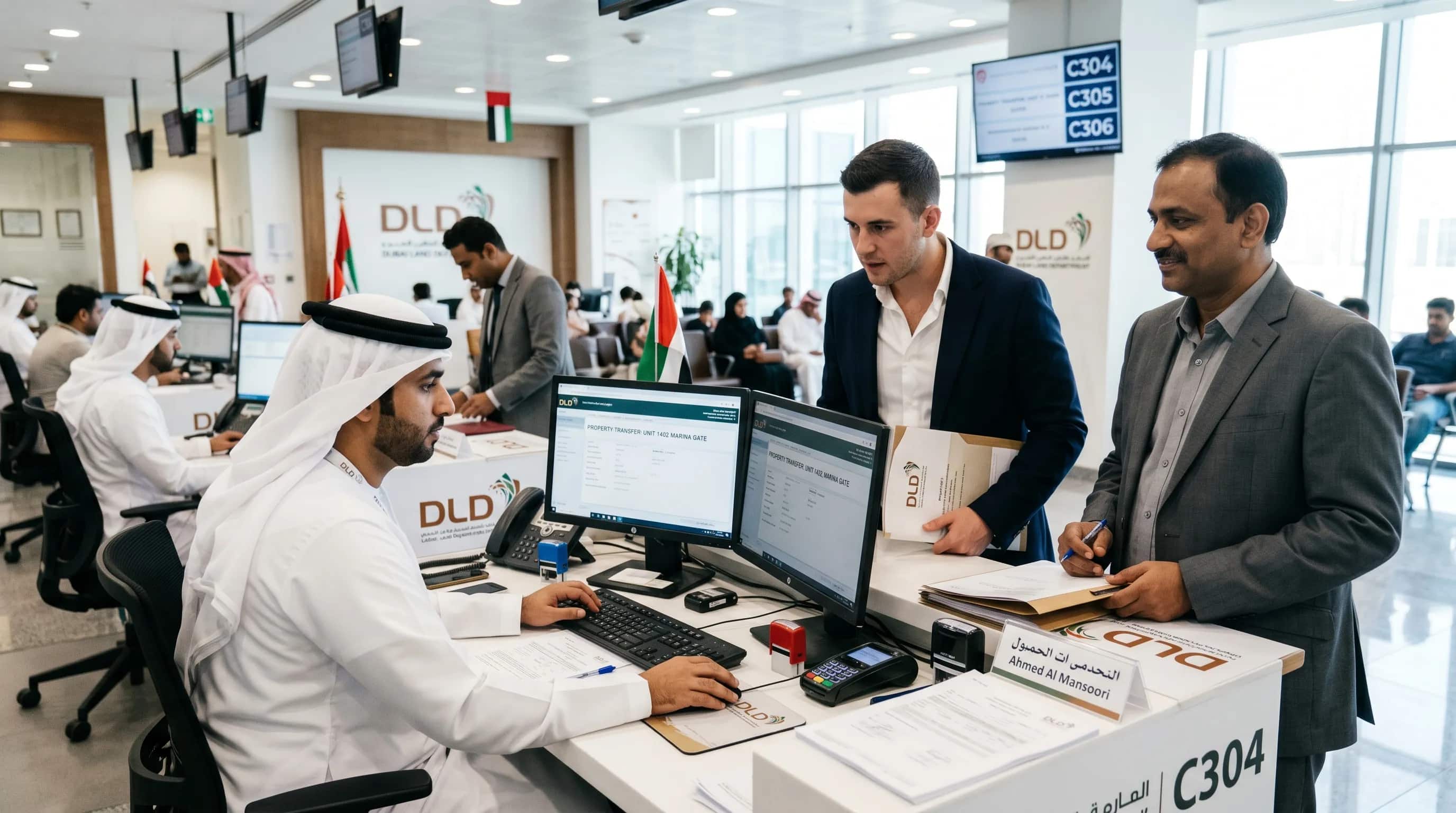
DLD Transfer Day: What Actually Happens When You Sign for Your Property
Transfer day is when a Dubai property legally becomes yours. Here's what actually happens at the DLD, who attends, the fees you pay, and what to bring.
You've found the premises. The deal has been struck. If needed, you might have obtained a mortgage. But the focus is often on the transfer day – the day of the official transfer of ownership, usually in slightly ominous terms as if a major event awaits you. In reality, there is nothing to fear. Transfer day with the Dubai Land Department is a fairly short and clear-cut appointment, and with the procedure known beforehand, there is no reason to be scared.
Transfer day with the Dubai Land Department is the point in time when the legal ownership of the ready property is officially transferred from the vendor to you, confirmed by the Dubai Land Department, and the deed is registered in your name. It is the equivalent of the handover received by the purchaser of an off-plan property. It means that all previous procedures – making an offer, paying deposit, completing paperwork and obtaining approvals – culminate into one single appointment during which the payment is made and the ownership rights become official.
This article describes the whole process: What really happens during transfer day; how to arrive there – including the necessary paperwork and approvals; what will happen inside the room during the appointment; how much money will be required on that day; what problems to expect, and how to avoid them.
A word about figures. Various fees, percentages, and cost distribution can fluctuate and change over time, and some fees are up for negotiation between the buyer and the vendor. You should treat all the numbers listed below only as guidance and find out current rates with the Dubai Land Department. Nevertheless, the whole process remains pretty constant.
What Transfer Day Actually Is
Transfer day is the appointment where ownership of a property legally moves from the seller to the buyer. It happens at the Dubai Land Department or, far more commonly, at one of the DLD-approved Registration Trustee offices around the city, which handle transfers on the department's behalf. Both parties, or people acting for them, turn up, the money and documents change hands, and a new title deed is issued. That title deed, in your name, is the whole point of the day.
This is the ready, or secondary, market process, where you buy a completed property from an existing owner. It is different from buying off-plan, where the developer handles registration and you take possession at handover. On the resale side, transfer day is your handover and registration rolled into one appointment, and it is when you stop being a buyer and become an owner.
Here is what transfer day accomplishes:
- Ownership changes hands. The legal title passes from the seller to you, recorded officially by the DLD.
- A new title deed is issued. You receive a title deed in your name, which is your proof of ownership.
- The money is settled. The seller is paid, the fees are paid, and any commissions are settled, all at once.
- A mortgage is registered. If you are financing, your bank's mortgage is recorded against the property that day.
- The seller's loan is cleared. If the seller had a mortgage, it is settled so the property transfers free of it.
- The keys are handed over. With ownership transferred, you take the keys and access to your new property.
The reassuring thing is how contained it all is. For a straightforward, ready purchase with everything prepared, the appointment itself is often quick, sometimes under an hour at the trustee office. The complexity is not in the day, it is in the preparation that leads up to it. The framework of property ownership and registration that sits behind all this is set out through the UAE government portal, and it is genuinely well organised once you see how the pieces fit.
So transfer day is best thought of as the finish line of a process, not a hurdle in itself. Everything you do beforehand is what makes the day smooth. Get the run-up right, and the appointment is almost an anticlimax, which is exactly what you want when this much money is moving.
Getting to Transfer Day
The day itself is quick, but only because of the work that comes before it. The run-up is where the real effort sits, and getting it right is what turns transfer day into a formality rather than a scramble. Here is roughly how you get there.
It starts when your offer is accepted and both sides sign the sale agreement, often called the MOU or Form F, the standard contract that sets out the price and terms. You usually pay a deposit at this point, commonly around ten percent, typically held securely rather than handed straight to the seller. Then the approvals begin. The developer or community managing the building issues a No Objection Certificate, confirming there are no unpaid service charges and they have no objection to the sale. If you are financing, your bank finalises its offer and a valuation is done. If the seller has a mortgage, it has to be arranged for settlement so the property can transfer free of debt. And the manager's cheques, the certified bank cheques used for property payments here, are prepared for the right amounts and payees.
Here is the run-up to transfer day:
- Sign the sale agreement. Both parties sign the MOU or Form F setting out the price and terms.
- Pay the deposit. A deposit, often around ten percent, is paid and usually held securely until transfer.
- Get the NOC. The developer issues a No Objection Certificate confirming no unpaid charges and no objection.
- Finalise any mortgage. If you are borrowing, the bank issues its final offer and values the property.
- Settle the seller's loan. Any existing mortgage on the property is arranged for clearance at transfer.
- Prepare manager's cheques. The certified cheques for the seller, the fees, and commissions are readied.
- Book the appointment. A transfer slot is booked at a Registration Trustee office for all parties.
The single item that trips people up most is the NOC, because it depends on the service charges being fully paid, and a seller behind on those has to clear them first. Sorting that early keeps the timeline on track. This whole run-up is smoother with experienced help, and because it is specifically the ready-property process, our ready property service is built around exactly these steps, from agreement to the trustee office.
Get all of this lined up, and transfer day becomes the simple appointment it is meant to be. Skip or rush a step, and that is where the delays come from.
What Happens on the Day
So you arrive at the Registration Trustee office on the appointed day. Here is what actually happens, step by step, and why it usually goes faster than people expect.
Everyone gathers first. The buyer and seller, or their representatives holding Power of Attorney, the agents, and if there is a mortgage, representatives from the relevant banks. The trustee officer checks the documents, the original passports and Emirates IDs, the existing title deed, the NOC, and the signed sale agreement. Then the money moves. The manager's cheques are handed over, the seller receives the cheque for their proceeds, the DLD fee is paid, any commission is settled, and if the seller had a mortgage, it is cleared. With the money confirmed and the paperwork in order, the transfer is processed and a new title deed is issued in the buyer's name. The keys and any access cards are handed over, and that is it, you are the owner.
Here is the day, step by step:
- Everyone attends. Buyer, seller or their representatives, agents, and bank reps if a mortgage is involved.
- Documents are checked. Original IDs, the existing title deed, the NOC, and the signed agreement are verified.
- Cheques are handed over. The seller's proceeds, the DLD fee, and commissions are all settled by certified cheque.
- The seller's mortgage clears. Any existing loan on the property is settled so it transfers free of debt.
- Your mortgage registers. If you are financing, the bank's mortgage is recorded against the property.
- The title deed issues. A new title deed is produced in your name, making you the legal owner.
- Keys change hands. You receive the keys and access cards, and the property is yours.
The thing that surprises most first-time buyers is the speed. When everything is prepared, the appointment is frequently done in well under an hour, because the trustee office does this all day, every day, and the system is built for it. You can confirm the process, the documents required, and your new title deed through the Dubai Land Department, which is also where the record of your ownership now lives.
The flip side is that the speed depends entirely on readiness. The appointment is quick when the cheques are right, the documents are complete, and the approvals are in place. When something is missing, the day stops, which is why all that run-up preparation matters so much. On the day itself, your job is mostly to show up prepared, sign, and collect your keys.
The Costs You Pay That Day
Transfer day is also payday for several fees, so it helps to know what you are settling and roughly how much. These are separate from the purchase price, and they are why buyers are told to budget a margin on top of the price of the property itself.
The big one is the DLD transfer fee, commonly around four percent of the property value, which is the headline cost of registering the transfer. On top of that sit a handful of smaller charges. The Registration Trustee office charges its own fee, often somewhere around a few thousand dirhams depending on the property value. There is a title deed issuance fee, usually a few hundred dirhams. The agent commission, commonly around two percent plus tax, is settled here too. The developer's NOC carries a fee, which varies a lot by developer, anywhere from a few hundred to several thousand dirhams. And if you are financing, there is a mortgage registration fee, typically a small percentage of the loan plus an admin charge.
Here is the rough shape of the costs:
- DLD transfer fee. Commonly around four percent of the property value, the largest single cost of the day.
- Trustee office fee. The registration office's charge, often around AED 4,000 or so, scaling with value.
- Title deed fee. The cost of issuing the new title deed, usually a few hundred dirhams.
- Agent commission. Commonly around two percent of the price plus tax, settled at transfer.
- NOC fee. The developer's charge for the No Objection Certificate, varying widely by developer.
- Mortgage registration. If financing, a small percentage of the loan plus an admin fee, paid that day.
Add these up and a common rule of thumb is to budget somewhere in the region of six to eight percent of the purchase price for the total costs of buying a ready property, though the exact figure depends on your situation and especially on whether you are financing. Because the mortgage side adds its own fees and steps, getting the financing right early matters, and our mortgage service helps line up the borrowing so the costs hold no surprises on the day.
One honest caution on all these numbers. Fees and percentages change, and some, like who pays the DLD fee or the commission, can be negotiated between buyer and seller. The borrowing rules and caps that sit behind any mortgage are overseen by the Central Bank of the UAE, and the official transfer fees are published by the DLD. So use these figures to budget sensibly, then confirm the current, exact amounts for your specific purchase before you write any cheques.
What Can Go Wrong, and How to Avoid It
Transfer day goes wrong in predictable ways, and almost all of them come down to something not being ready. The good news is that every common problem has a simple fix, and the fix is always the same idea, sort it before the appointment, not on the day.
We lined up the usual problems against their fixes, each on one line:
- NOC not ready: clear any outstanding service charges early so the developer issues the certificate in time.
- Seller's mortgage not settled: arrange the loan settlement and blocking before the appointment, never on the day.
- Wrong cheque amounts or payees: confirm every manager's cheque against the final agreed figures in advance.
- Missing documents or IDs: bring originals of every passport, Emirates ID, the title deed, and the NOC.
- Buyer's mortgage not finalised: get the bank's final offer issued and its representative booked ahead of time.
- A party cannot attend: arrange a proper Power of Attorney well before transfer day, not at the last minute.
Notice the pattern. None of these is dramatic, and none is hard to avoid. They are all just preparation, the documents, the approvals, the cheques, the people, lined up before everyone sits down at the trustee office. When a transfer is delayed or collapses on the day, it is nearly always because one of these was left to the last moment, not because the system failed.
The seller's side matters as much as the buyer's here, because half the things that can stall a transfer, the NOC, the service charges, the existing mortgage, sit with the seller. If you are the one selling, getting your own paperwork and any loan settlement sorted early is just as important, and our property selling service helps vendors arrive at transfer day with everything in order so the sale completes cleanly.
The single best protection against a messy transfer day is simply a good agent or conveyancer coordinating the whole run-up, chasing the NOC, checking the cheques, confirming every party and document. Transfer day is quick and simple when someone has done that work. It is stressful only when no one has. So the real lesson is that a smooth transfer day is made in the weeks before it, not on the day itself.
What We Would Actually Do
To summarize, transferring day turns out to be much easier than one may think. Essentially, it is an appointment at the trustee’s office where you get your money back, a new deed of ownership and keys. The problem lies in the preparations and not in transferring itself. Once you have prepared for it properly, the appointment usually does not take more than an hour.
So, what would be our advice to a friend who needs to transfer his property? The process of transferring itself is not difficult and takes little time and effort. Therefore, it makes sense to concentrate on preparatory work. It is important to organize the NOC beforehand and make sure that all the bills are paid. You should check all the cheques that your manager gives you for accuracy. Take all necessary papers with you, such as passports, Emirates ID, and the deed of ownership. And if you use financing, try to have everything ready for this case: the offer from the bank and its representatives included.
Moreover, it is important to allocate appropriate money to the process. The selling price is just one component of your expenses. You should consider about six to eight percent more for DLD fee, trustee, and title fees, the commission, the NOC, and mortgage. Get accurate prices from the DLD, as they can change sometimes and negotiate on certain conditions. Just be ready to spend this money.
Procrastination can cause most problems on transfer day. Any documents missing, loans unsettled, or incorrect cheques can stop the whole process. Do your best to prepare well before transferring day, and it will turn out quite simply. And if you need professional help in purchasing property from making an offer to obtaining your keys – we are just the right company for you. Our property buying service coordinates the whole run-up so transfer day goes smoothly. And if you have a transfer coming up and want a straight conversation about getting it right, we are glad to help. Get in touch and we will take it from there.
Related stories

Buying in Dubai By Selling Assets Abroad
A detailed guide on how to strategically sell your international property or investments to fund your home purchase in Dubai. I'll walk you through the entire process, from legal and tax considerations to transferring funds and proving their origin.

Exit Strategy: The Key to Total Return in Dubai Property
Many investors focus only on annual rental yield. I'll explain why your exit strategy and understanding total return are far more critical for a successful Dubai property investment.

The Professional's Retreat: Dubai Villas for Work & Family
For professionals balancing careers and family, finding the right Dubai villa is crucial. I explore the communities that masterfully blend dedicated home offices with exceptional family living.
Echoes, in your inbox
One thoughtful email a month. Market insight, new launches, no spam.