

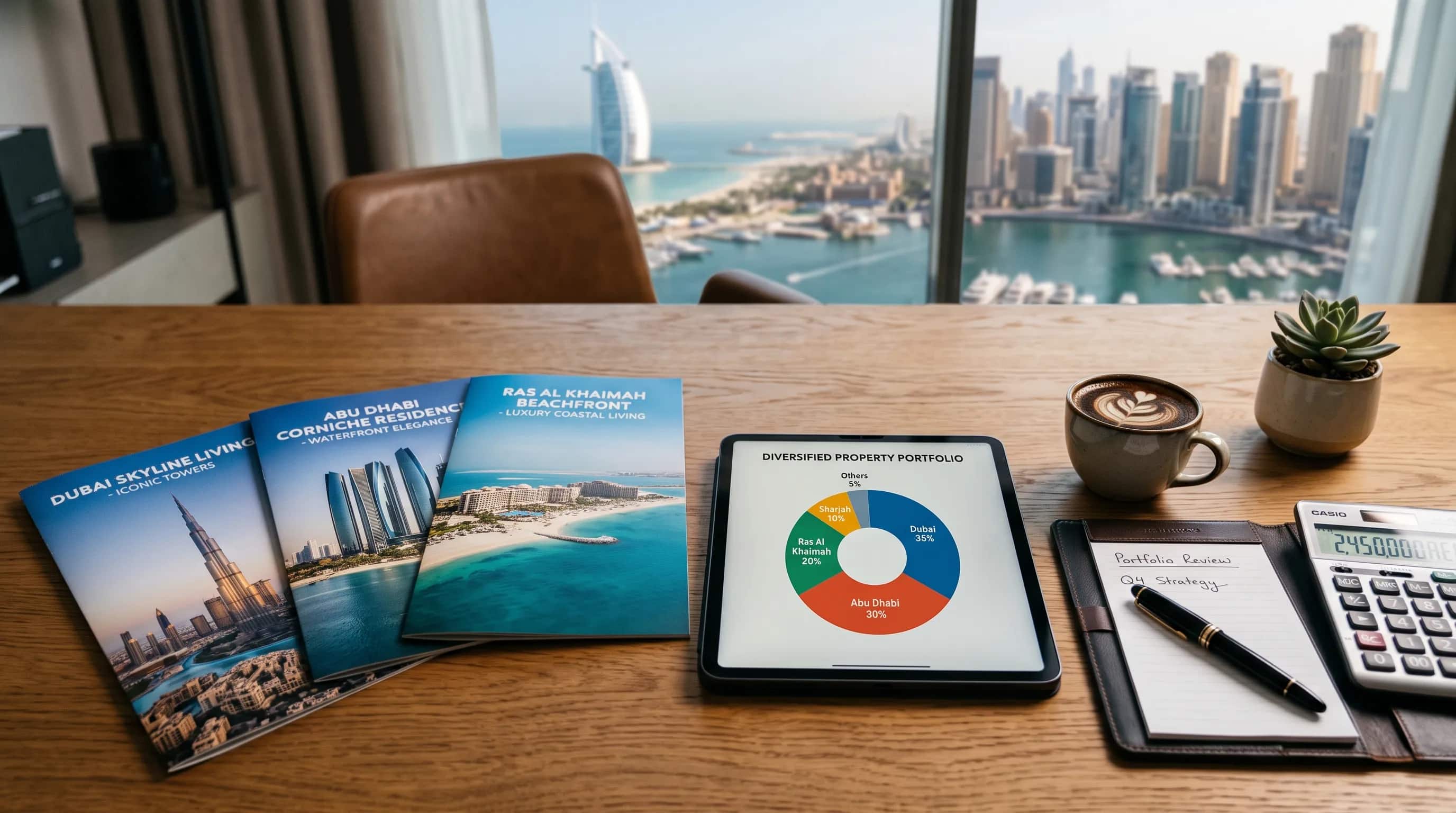
Diversifying Across Dubai, Abu Dhabi, and RAK: A Portfolio Approach
Diversifying across Dubai, Abu Dhabi, and RAK: a property portfolio approach, what it spreads, what it does not, the costs, and who it actually suits.
To spread one’s property holdings between Dubai, Abu Dhabi, and Ras Al Khaimah (RAK) is, in theory, a wise practice. Not to limit one’s investment to just one emirate. And indeed there is some wisdom in it: Each market has its unique function—Dubai as a liquid market, Abu Dhabi as a more steady one, and RAK as the growing story—which gives reason to hold all three, since this way a portfolio would be balanced in a way that cannot be achieved by just one emirate.
But before going about purchasing property in all three, it would be wise to look into the more sobering aspects of diversification among Dubai, Abu Dhabi, and RAK. First of all, diversification in this case is still UAE real estate, which eliminates some risks but leaves others untouched. In addition, diversification in this case means higher expenses, increased administrative work, and more knowledge of three different markets and their regulatory systems. This tactic will usually show results only when applied on a large scale, as often times one well-chosen property will perform better than three scattered ones. Diversification is a sensible strategy but not a panacea, nor always a proper one.
So here we are clear from the start: We are a property company; consequently, the more dispersed our property portfolio gets and covers more emirates, the more business there is for us—this is exactly the reason why it is important to be upfront about it: Sometimes the wisest thing to do is one strong property instead of three.
Here we have a clear-cut guide: What are the functions of the three emirates; what exactly is diversified; where are the limitations which are seldom mentioned; who should diversify; and a true scorecard.
Note: This is investment tactics and should be taken as general information, not a financial advice. The numbers are given as an illustration, and no forecasts are made concerning the return of investments in any of the emirates. True diversification will go beyond the property purchase and it is recommended to consult with a financial advisor. Do your math and get expert advice. With that reservation, here is the portfolio strategy laid out in plain sight.
Dubai, Abu Dhabi, and RAK: Three Roles
The reason this idea has legs is that the three emirates genuinely play different roles. Dubai is the core, the largest, most liquid, most international market, with the widest choice and the easiest resale, but also the priciest and the most cyclical, so it swings more in both directions. It is where you go for liquidity and depth, and the Dubai Land Department reflects just how active and transparent that market is.
Abu Dhabi plays a steadier role. As the capital, it is more government and institutionally anchored, historically less volatile than Dubai, with lower transaction fees, often around 2% versus Dubai's 4%, so on an AED 2 million home the fee gap alone is meaningful, and it has big established projects. It tends to move more slowly and calmly, which is exactly its appeal in a portfolio, and our Abu Dhabi area guide covers what that market looks like.
RAK, Ras Al Khaimah, plays the growth role. It is smaller and cheaper, with an emerging tourism-and-development story, so it offers higher potential yields from a lower entry price, but a thinner, less liquid market and more risk that depends on those growth plans playing out. It is the higher-risk, higher-potential corner.
Here are the three roles:
- Dubai. The liquid core, largest and most tradable.
- But cyclical. It swings more than the others.
- Abu Dhabi. The steady anchor, calmer and government-backed.
- With lower fees. Often around 2% versus Dubai's 4%.
- RAK. The growth corner, cheaper with higher potential.
- But thinner. Less liquid and more dependent on its plans.
The honest summary is that Dubai, Abu Dhabi, and RAK bring liquidity, stability, and growth potential respectively, which is why holding all three can, in principle, balance a portfolio better than concentrating in one. That is the genuine appeal, three different risk-and-return characters under one strategy. But whether combining them actually protects you the way people assume is a separate question, and the answer is only partly yes, which the next section is about.
What Diversifying Actually Spreads
So what does spreading across the three actually protect you from? Real risks, but specific ones. If you own only in one Dubai area and that area oversupplies, or one building underperforms, or one tenant leaves, your whole position suffers. Spread across emirates, areas, and properties, and a problem in one place is cushioned by the others, so you reduce single-emirate, single-area, and single-property concentration risk. That is real, and worth having.
You also get exposure to different demand drivers and cycles. Dubai's global, cyclical demand, Abu Dhabi's steadier institutional base, and RAK's tourism-led growth do not all move in lockstep, so when one is soft another may hold, smoothing your overall ride. Cross-emirate market reports from firms like Knight Frank give useful context on how differently the markets can behave.
If RAK's growth role is the part that appeals, our Ras Al Khaimah area guide is worth a read on what that corner actually involves, and on why its higher potential comes with a thinner market.
Here is what it spreads:
- Single-emirate risk. One emirate softening hurts less.
- Single-area risk. One area's oversupply is cushioned.
- Single-property risk. One bad building or void matters less.
- Different cycles. The three do not move in lockstep.
- Different drivers. Global, institutional, and tourism demand.
- A smoother ride. Overall, if one is soft another may hold.
The honest summary is that diversifying across the three genuinely spreads the specific risks of being concentrated in one emirate, one area, or one property, and gives you exposure to markets that do not all move together. That is a real benefit for an investor with enough holdings to spread. But there is a large and often ignored category of risk it does not touch at all, which is where honesty matters most, and where the next section comes in.
The Limits Nobody Mentions
Here is the part the eggs-in-one-basket pitch skips. It is all still UAE real estate. Dubai, Abu Dhabi, and RAK share the same country, the same dollar-pegged currency, the same broad economy, and heavily overlapping investor and expat demand, so they are correlated. A UAE-wide or regional shock, a global downturn, a shift in capital flows, a regional event, hits all three at once. So this diversifies the specific risks of one emirate or one property, but not the systematic risk of UAE property as a whole. Real diversification, the kind that protects against a whole-market fall, means spreading across asset classes and countries, not three emirates of one nation.
Then there is the cost and complexity, which multiply. Three properties in three emirates means three sets of transaction fees, three lots of service charges, three maintenance headaches, and three different rule-books and authorities to deal with, all needing your attention and local knowledge. Managing a spread-out portfolio well is genuinely harder than looking after one property, and our property management team sees how quickly a scattered portfolio becomes a second job. Spreading a modest budget thin can also leave you with three mediocre properties instead of one good one, which is worse, not safer.
Here are the limits:
- Still all UAE property. The three are correlated.
- Systematic risk remains. A UAE-wide shock hits all three.
- Not real diversification. That means other assets and countries.
- Costs multiply. Fees, charges, and maintenance times three.
- Complexity multiplies. Three rule-books and more admin.
- Needs scale and knowledge. Or you spread a budget too thin.
The honest summary is that diversifying across the three emirates reduces specific risk but not the systematic risk of UAE property, and it comes with real, multiplying costs and complexity that a single property avoids. It is not the safety blanket it is sometimes sold as, and it is easy to end up with more cost, more hassle, and three weaker properties, all in the name of a diversification that does not protect against the biggest risk of all. Knowing that is what separates a smart portfolio from a scattered one. It is also worth being honest that the word diversification borrows its comfort from the stock market, where you really can spread across unrelated assets, and that comfort does not fully carry over to three slices of the same national property market.
Who Should Actually Diversify
So who is this actually for? Larger, experienced investors, mostly. If you have enough capital to buy well in each emirate, not just scrape into three, and enough knowledge of each market, or good local advice, to avoid buying badly in unfamiliar territory, then spreading across Dubai, Abu Dhabi, and RAK can sensibly balance liquidity, stability, and growth in a real portfolio. For that investor, the added cost and complexity are worth the spread.
It is not for everyone, and here is the honest part. If you are a first or small buyer, or you have the budget for one or two properties, concentrating on one good, well-chosen property usually beats scattering thin across three emirates, because a single strong asset in a market you understand tends to serve you better than three weak ones you cannot properly manage. Chasing diversification with too little capital or knowledge is how people end up worse off. The wider framework for investing and residency across the country sits within the UAE government portal if you are weighing a broader move.
Here is who should diversify:
- Larger investors. With capital to buy well in each.
- The experienced. Who know each market or take advice.
- Portfolio builders. Balancing liquidity, stability, and growth.
- Not small buyers. One good property usually beats three thin ones.
- Not first-timers. Concentrate where you understand first.
- Not the under-capitalised. Do not spread a budget too thin.
The honest summary is that diversifying across the emirates suits larger, experienced investors with the capital, knowledge, and appetite to manage a real spread, and does not suit small, first-time, or under-capitalised buyers, for whom one good property is the smarter move. Match the strategy to your scale and experience, not to a slogan about eggs and baskets, and you will avoid the common trap of over-diversifying into weakness. The right number of properties is the number you can buy well and manage well, wherever they are. A good rule of thumb is to only add a second or third market once your first holding is solid and you have money spare that you can genuinely afford to commit, rather than diluting a single decent position into several shaky ones.
The Honest Scorecard
So how does the three-emirate portfolio approach really stack up? We scored it straight, each on one line:
- Dubai: the liquid core, largest and most tradable, but the priciest and most cyclical.
- Abu Dhabi: the steady component, more government-anchored and historically less volatile.
- RAK: the growth component, cheaper and catalyst-driven, but thinner and higher-risk.
- What it spreads: single-emirate, single-area, and single-property concentration risk.
- What it does not spread: UAE-wide or regional shocks, since all three are correlated.
- Cost and complexity: multiply across three emirates, in fees, management, and rules.
- Best for: larger, experienced investors, not small or first-time buyers.
The pattern is that the strategy is real and useful within limits. It genuinely balances three different market characters and cushions concentration risk, but it does not protect against a UAE-wide fall, and it multiplies your costs and workload. It is a portfolio tool for people who already have a portfolio, not a starting move for a first buyer.
Read the list and the honest conclusion is that diversifying across Dubai, Abu Dhabi, and RAK is worth doing when you have the scale and knowledge to do it well, and a distraction when you do not. The single most important line is the fifth, that it does not spread systematic risk, because it stops you overpaying, in money and effort, for a sense of safety that is only partial. Understand exactly what it protects against, and you can use it well.
The honest summary of the scorecard is that a three-emirate property spread is a genuine strategy for larger investors that reduces specific risk and balances market roles, at the cost of complexity and without touching UAE-wide risk, which makes it right for the experienced and wrong for the small or first-time buyer. Judge it by your scale, your knowledge, and what it actually protects, and it becomes a sensible tool rather than a comforting slogan, one you reach for when you have outgrown a single holding, not one you start with.
What We Would Actually Do
A short analysis will show that diversification among Dubai, Abu Dhabi, and Ras Al Khaimah represents a legitimate strategy with real constraints. It attempts to balance liquidity in Dubai, stability in Abu Dhabi, and growth opportunities in Ras Al Khaimah while avoiding risks connected with exposure in a single emirate, region, or property. However, it still does not provide a guarantee against any general downturn in UAE real estate and creates additional expenses and burden in terms of administration and required knowledge. This strategy works well on a large scale but fails completely in case of arbitrary implementation; hence, the first question that should be asked is whether the scale is available.
If asked by a friend, we would ask about scale and experience. In case of having enough money for buying property in all emirates and enough competence in order not to make wrong purchases, we would help in making an appropriate spread among all holdings where every holding would have a clear purpose. If they have money for buying one or two properties or are new in this field, we would advise them to focus on buying one good property in the area they know because it will always pay better than thin spread.
We should also disclose our own motives. More properties in different emirates mean more business for us; hence, in case when we or anybody else recommends such a diversification, it is necessary to take into account that a single property will probably be more beneficial. For protection from any general decline in the market, a financial adviser's help is needed because it means diversification in terms of financial investments, not only among emirates.
The most typical mistake is people who attempt to spread their modest budget between three emirates in order to create a feeling of security and get three worse properties, extra expenses, and no protection from real risks. Do the diversification if you have the right scale for successful implementation, do not diversify otherwise, understand what protection you have with the help of the spread and what protection you do not have, and do not enter unfamiliar markets. That is how the strategy gets its legitimacy. Otherwise, it only brings extra costs.
If you want help deciding whether a spread makes sense for you, or building one properly across the emirates, that is exactly what we do. Our property buying service works across all three markets.
And if you want a straight, honest conversation about your portfolio, including whether to concentrate instead, we are glad to help. Get in touch and we will take it from there.
Related stories

Buying in Dubai By Selling Assets Abroad
A detailed guide on how to strategically sell your international property or investments to fund your home purchase in Dubai. I'll walk you through the entire process, from legal and tax considerations to transferring funds and proving their origin.

Exit Strategy: The Key to Total Return in Dubai Property
Many investors focus only on annual rental yield. I'll explain why your exit strategy and understanding total return are far more critical for a successful Dubai property investment.

The Professional's Retreat: Dubai Villas for Work & Family
For professionals balancing careers and family, finding the right Dubai villa is crucial. I explore the communities that masterfully blend dedicated home offices with exceptional family living.
Echoes, in your inbox
One thoughtful email a month. Market insight, new launches, no spam.